Banks Want to Ban Rewards on Stablecoins: Coinbase CEO

TheCryptoTimesPubblicato 2025-09-30Pubblicato ultima volta 2025-09-30

While stablecoin adoption is growing, big banks are now under fire for trying to stop crypto rewards programs. Coinbase CEO Brian Armstrong warned on X that banks are lobbying to end USDC reward rights under the GENIUS Act. He argued that this move would protect banks’ monopoly while hurting American consumers. 

Armstrong stressed that crypto has clear rules coming, and banks are pushing for another handout by blocking stablecoin rewards. 

John Deaton, Managing Partner at Deaton Law and well-known XRP supporter, echoed Armstrong’s warning. He wrote on X, “Bank’s are the enemy of the people. I’m glad Brian Armstrong is bullish and fighting back against them but we can’t underestimate the hold they have on many Senators.” He also criticized Senator Ed Markey for siding with banks since the 2008 financial crisis.

Senators push back on bank influence

The controversy comes after a letter from the American Senate Blockchain Association surfaced on Monday. The group, led by Senators Tim Scott and Elizabeth Warren, accused big banks of trying to dismantle stablecoin legislation. They argued that banks are recycling an old playbook, claiming stablecoins would drain deposits and shrink lending. 

“Big banks are dusting off a predictable playbook using the ‘loophole’ trope whenever there is competition,” the letter stated. Senators pointed out that the same big banks blamed for the 2008 crash have now piled up trillions in deposits. According to them, these banks have only grown stronger, often leaving smaller banks struggling to keep up. 

Stablecoin market trends

Besides the regulatory fight, fresh data from rwa.xyz shows a shift in stablecoin liquidity. Tether (USDT) led inflows with $6.3 billion in the past 30 days. Ethena’s USDe followed with $2.1 billion, while Circle’s USDC added $1.7 billion. Paxos’ PYUSD also gained ground with $1.2 billion inflows.
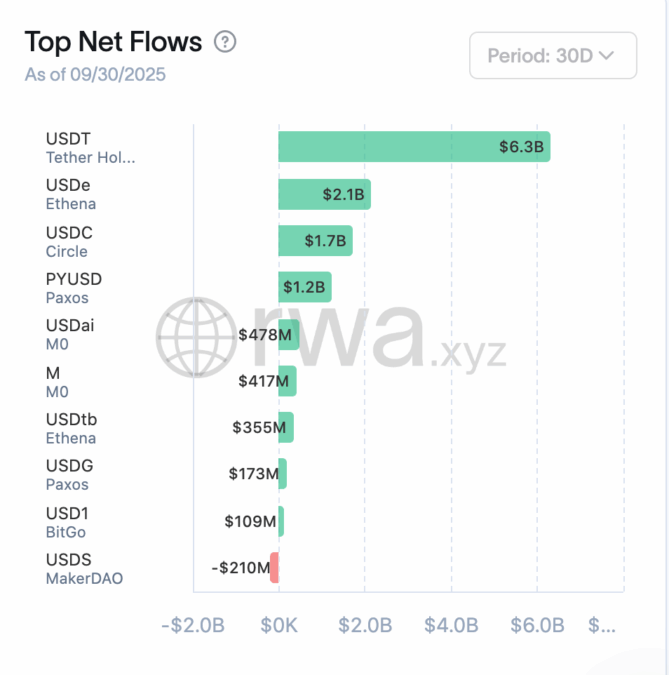
Top Stablecoins Net Flow - Rwa
Source: rwa.xyz

Other tokens saw modest growth. USDai added $478 million, M gained $417 million, and USDtb pulled in $355 million. Paxos’ USDG and BitGo’s USD1 logged smaller inflows of $173 million and $109 million. However, a $210 million decline in MakerDAO’s USDS indicated a shift in capital toward more modern possibilities. 

This fight shows how old banks and new crypto firms are pulling in opposite directions. Banks want to stay in charge, but crypto leaders argue people should have the freedom to earn and use rewards without losing out. 

Also Read: Visa Pilots Real-Time Cross-Border Payments With Stablecoins


Mobile Only Image

Letture associate

Telegram Introduces WEB-Proxy Technology: Masks Traffic as Regular Website Visits

Telegram has introduced a new experimental WEB-Proxy technology designed to circumvent blocking by disguising messenger traffic as regular, secure website visits. Announced on August 21, 2026, the technology routes MTProxy data through an in-app WebView using HTTPS or WebSocket transport, making the data stream indistinguishable from legitimate web surfing. The core innovation is a multiplexed stream sent through a single WebView session. It uses special frame formats to pack multiple logical Telegram connections into one encrypted channel that externally resembles loading a web page. A server-side relay receives this stream, separates it into individual connections for the standard MTProxy, without decrypting content or knowing final destinations, thus preserving privacy. The WEB-Proxy operates on a standard HTTPS domain that also hosts a public website. The proxy bridge page is only activated by a specific URL parameter derived via HMAC-SHA256 from the proxy configuration; all other requests receive the normal site homepage. This provides reliable cover against automated detection systems. Currently a proof-of-concept, the system includes a desktop implementation, an experimental Android client, and plans for iOS support. The technology represents a shift towards more sophisticated integration with legitimate web infrastructure, complicating filtering systems that must choose between blocking HTTPS traffic entirely or allowing service access. Its long-term value will depend on resilience to adaptive traffic analysis and scalability without performance loss.

cryptonews.ru18 min fa

Telegram Introduces WEB-Proxy Technology: Masks Traffic as Regular Website Visits

cryptonews.ru18 min fa

MiCA is coming for DeFi vaults, but regulation will be difficult

The European Commission is exploring whether to extend the Markets in Crypto-Assets (MiCA) regulation to cover decentralized finance (DeFi) lending and borrowing, including lending vaults. These vaults, which channel billions into on-chain credit markets, present significant regulatory challenges because their decentralized structure doesn't map neatly onto existing financial frameworks. Their legal status is currently based on non-binding interpretations that they fall outside MiCA and EU fund rules. The article uses Morpho's decentralized lending protocol as an example, illustrating how responsibilities are divided among various participants (owner, curator, allocator, sentinel), making it difficult to identify a single "provider" to regulate. Experts warn that broadly categorizing "DeFi lending" could inadvertently capture vastly different structures. They argue that any regulatory approach should focus on the specific structure and control mechanisms of a vault, rather than using decentralization as a simple dividing line, and that DeFi lending may require a dedicated, carefully crafted framework distinct from traditional finance. The Commission's consultation closes on September 30, 2026. The core challenge for regulators is not just whether to regulate DeFi lending, but how to design rules that distinguish between different forms of on-chain lending and the entities that control them.

cointelegraph2 h fa

MiCA is coming for DeFi vaults, but regulation will be difficult

cointelegraph2 h fa

Grayscale Report: Financial Privacy in the AI Era, Why Zcash Should Not Be Overlooked?

Title: Grayscale Report: Financial Privacy in the AI Era – Why Zcash Should Not Be Overlooked The article argues that privacy is a fundamental, not niche, attribute of functional money. It highlights that technological shifts, like the rise of AI and stablecoins, are driving a new wave of public focus on financial privacy. Zcash, a decentralized digital currency similar to Bitcoin but with built-in privacy via zero-knowledge proofs, is positioned to address this need. Unlike transparent blockchains, Zcash offers users the option to conduct "shielded" transactions that hide sender, receiver, and amount while remaining verifiable. The report details Zcash's evolution, noting key upgrades that improved usability and security. It points to rising on-chain usage of privacy features as evidence of real demand. Currently, ZEC holds a minimal share (~0.4%) of the total crypto market cap. Grayscale suggests this reflects a market assumption that privacy is a marginal concern. The investment thesis hinges on a potential market re-evaluation: if privacy is recognized as a core monetary feature in an era of enhanced surveillance, Zcash's current valuation represents significant upside potential. Key risks discussed include regulatory challenges, historical trusted setup concerns for older pools (mitigated by newer protocols), quantum computing threats, and execution risks associated with future technical upgrades. The conclusion is that while the future scale of private digital currency is uncertain, the market currently prices in little chance of its value increasing substantially, presenting a potential opportunity for investors.

marsbit4 h fa

Grayscale Report: Financial Privacy in the AI Era, Why Zcash Should Not Be Overlooked?

marsbit4 h fa

Trading

Spot
活动图片