Прогноз цен на сиба-ину: аналитики отслеживают скачок сопротивления в преддверии октябрьской волатильности

cryptonews.ruPublished on 2025-04-29Last updated on 2025-09-30

  • Цена на породу сиба-ину сегодня колеблется на уровне $0,00001182, удерживая поддержку линии тренда на уровне $0,00001180 и будучи ограничена сопротивлением EMA.
  • Валютные потоки демонстрируют умеренный приток в размере 638 тыс. долларов США, однако аналитики говорят, что для устойчивого роста необходим постоянный многомиллионный приток.
  • Октябрьские события вновь всплывают на поверхность, поскольку трейдеры вспоминают параболический рост SHIB в 2021 году, подогревая спекуляции на тему повторного прорыва.

Сегодня цена сиба-ину составляет $0,00001182, немного снизившись после потери поддержки $0,000012. Продавцы остаются активными ниже 20-дневной экспоненциальной скользящей средней (EMA) на уровне $0,00001238, в то время как покупатели удерживают восходящую линию тренда вблизи $0,00001180. Сейчас внимание рынка сосредоточено на том, сможет ли SHIB преодолеть диапазон $0,00001264–$0,00001286, чтобы повторно протестировать потолок более широкого нисходящего канала.

Цена на сиба-ину сохраняет критическую поддержку
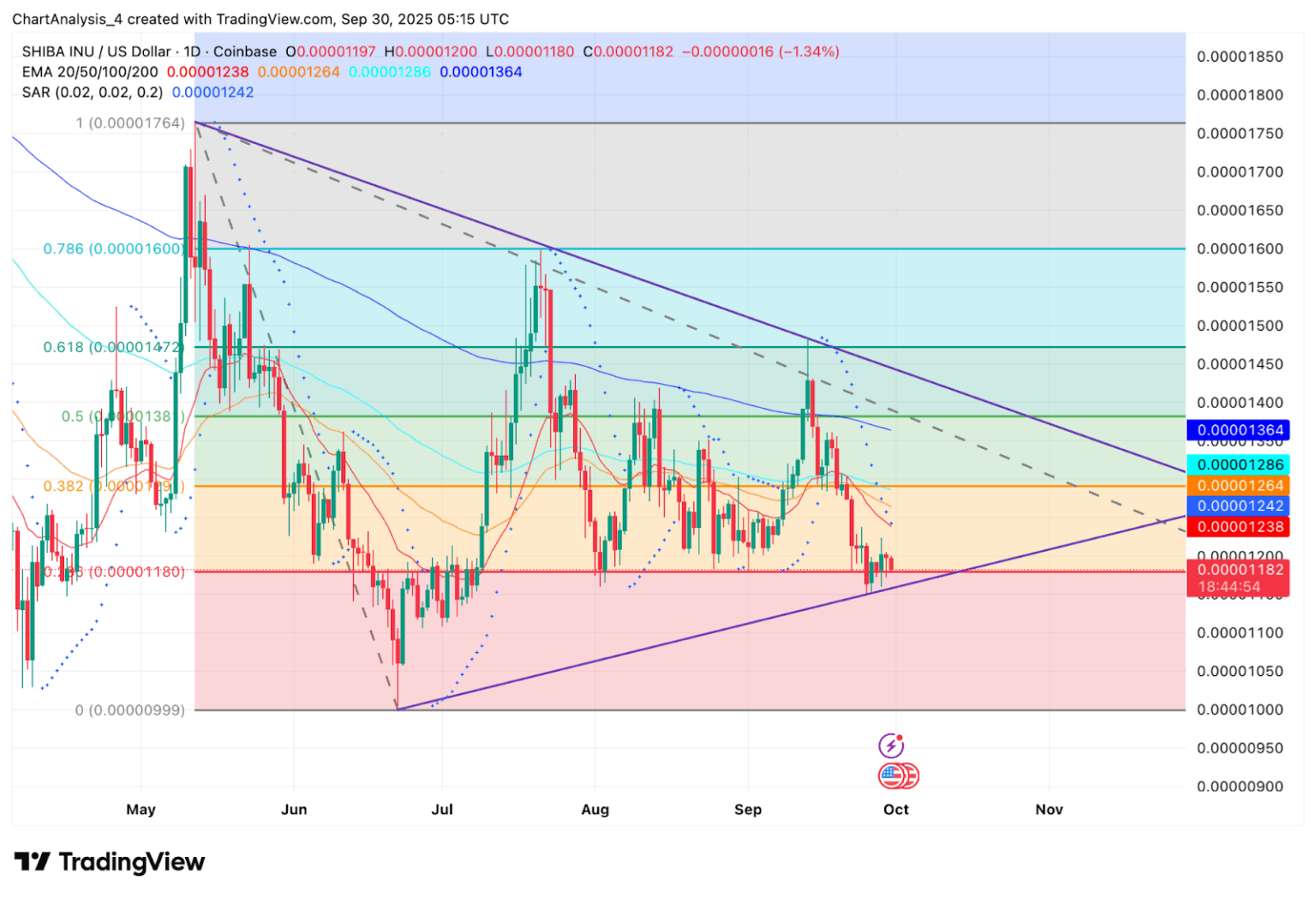
Технический анализ SHIB (Источник: TradingView)

На дневном графике SHIB зажат между сужающимся треугольником с поддержкой на уровне $0,00001180 и нисходящим сопротивлением вблизи $0,00001360. Цена неоднократно отскакивала от этой базы с середины сентября, что указывает на накопление.

Кластеры экспоненциальных скользящих средних (EMA) остаются ключевыми. 20-дневная EMA на уровне $0,00001238 и 50-дневная EMA на уровне $0,00001264 являются непосредственными барьерами. 100-дневная EMA на уровне $0,00001286 обозначает следующее сопротивление, а 200-дневная EMA на уровне $0,00001364 совпадает с нисходящей линией тренда. Прорыв этой зоны подтвердит прорыв к $0,00001472 (уровень Фибоначчи 0,618) и, возможно, к $0,00001600 (уровень Фибоначчи 0,786).

По теме: Прогноз цены Cardano: вероятность одобрения ETF достигает 91%, аналитики оценивают последствия

С другой стороны, потеря $0,00001180 грозит более глубоким тестированием $0,00001100 и $0,00000999, которые остаются ключевыми областями ликвидности.

Parabolic SAR остается выше текущих уровней, что подчеркивает медвежий контроль, но переворот может ускорить импульс, если цена преодолеет кластер EMA.

Потоки в цепочке демонстрируют умеренное накопление
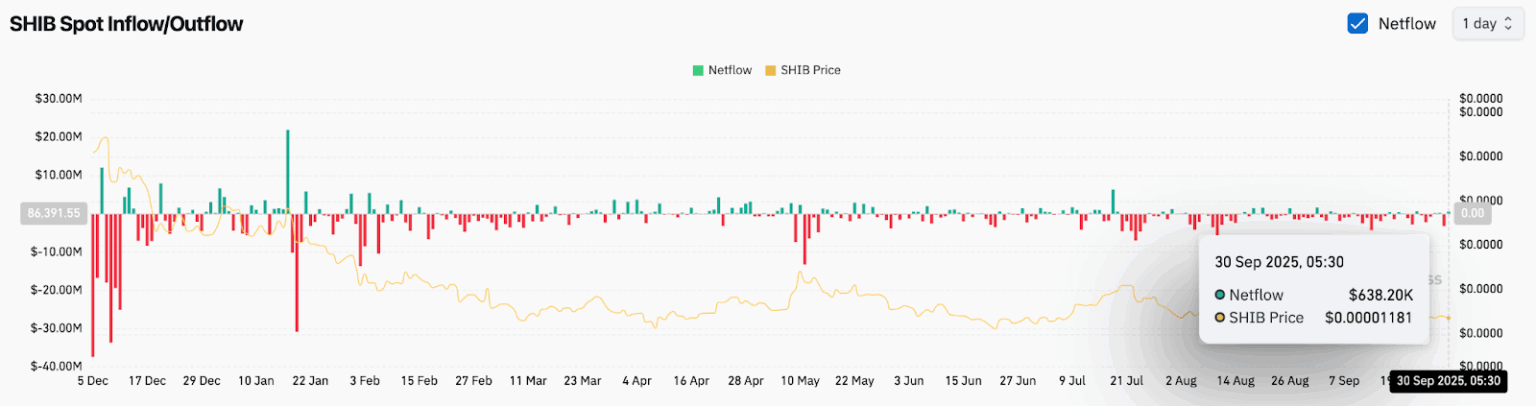
SHIB Netflows (Источник: Coinglass)

Данные о чистом потоке средств на бирже показывают, что 30 сентября SHIB зафиксировал скромный приток в размере 638 000 долларов, что прервало несколько недель устойчивого оттока. Хотя этот показатель недостаточен для того, чтобы свидетельствовать о широкой уверенности, он указывает на то, что некоторые инвесторы готовятся к исторической волатильности в октябре.

В прошлых циклах сильный приток инвестиций предшествовал резкому росту, но текущий приток остаётся осторожным. Аналитики отмечают, что для поддержания роста цен на сиба-ину потребуется стабильный многомиллионный приток инвестиций, аналогичный тому, который наблюдался во время резкого роста в 2021 году.

Октябрьское повествование снова всплывает

SHIB’s October Surge and CAW’s October Scenario

1. SHIB’s Historic October Rally

In October 2021, SHIB (Shiba Inu) experienced one of the most explosive rallies in crypto history.
Several factors converged to create this perfect storm:
•U.S. Q4 inflows
As funds and… pic.twitter.com/SH4mHGlHJC

— CAWdecoded (@cawdecoded) September 29, 2025

Рыночные комментаторы вновь проводят параллели с историческим ралли SHIB в октябре 2021 года, когда токен вырос экспоненциально всего за несколько недель. Тогда приток инвестиций в США в четвёртом квартале, пиковая шумиха в социальных сетях и листинги на новых биржах совпали, способствуя одному из самых запоминающихся параболических движений криптовалюты.

В этом году трейдеры выделяют октябрь как ещё один ключевой месяц, характеризующийся общим улучшением склонности к риску и возвращением спекулятивного внимания к мем-токенам. Несмотря на иные условия, воспоминания об октябрьском прорыве SHIB добавляют психологического веса, поддерживая инвесторов в ожидании повторения подобных тенденций.

Технический обзор цен на породу сиба-ину

Ключевые уровни остаются четко определенными к октябрю:

  • Уровни роста: $0,00001238, $0,00001264 и $0,00001286 в качестве ближайших препятствий. Прорыв может продолжиться до $0,00001472 и $0,00001600.
  • Уровни снижения: поддержка линии тренда $0,00001180, за которой следуют $0,00001100 и $0,00000999.
  • Потолок сопротивления: $0,00001364 (200-дневная EMA) — ключевой уровень для переключения на среднесрочный бычий импульс.

Техническая картина показывает, что SHIB сжимается внутри нисходящего клина, решительный прорыв которого может спровоцировать расширение волатильности в любом направлении.

Перспективы: вырастет ли популярность породы сиба-ину?

Прогноз цен на сиба-ину на октябрь зависит от того, смогут ли покупатели удержать $0,00001180 достаточно долго, чтобы бросить вызов кластеру $0,00001264–$0,00001286. Техническое сжатие и историческая сезонность указывают на повышенную волатильность в будущем.

По теме: Прогноз цены Ethereum: аналитики ожидают $4359 на фоне угрозы «медведей» из-за короткого сжатия

Если бычий импульс усилится благодаря более сильному притоку средств, SHIB может повторно протестировать отметку $0,00001472 и даже $0,00001600. Однако, если не удержать $0,00001180, существует риск прорыва базы накопления и падения SHIB до $0,00001100 и ниже.

Пока что SHIB остаётся в ключевой зоне. Октябрьские события продолжают питать оптимизм, но поток уверенности и техническое подтверждение станут решающими факторами для следующего этапа.


Related Reads

Shanghai's $10 Billion Unicorn Is About to Go Public

Shanghai-based automotive-grade millimeter-wave radar chip unicorn Calterah Microelectronics Technology (Shanghai) Co., Ltd. has filed for an IPO on Shanghai's STAR Market, aiming to raise 3.49 billion yuan. Founded in 2014 by Chen Jiashu, a UC Berkeley PhD graduate, and his professor Ali Niknejad, Calterah pioneered CMOS technology for 77GHz radar chips, breaking the decades-long monopoly of international giants like Texas Instruments. Its low-cost, highly integrated solutions enabled millimeter-wave radar to move from luxury to mass-market vehicles. By 2025, Calterah captured a 31.1% share in China's automotive millimeter-wave radar chip market (second domestically, fourth globally), with cumulative shipments exceeding 30 million units. Its client list includes BYD, Geely, Nio, and Volvo. The company has undergone 11 funding rounds, attracting high-profile investors such as the National Integrated Circuit Industry Investment Fund Phase II, China Capital Management, and GD Capital. Its valuation has reached tens of billions of yuan, with a projected post-IPO valuation of approximately 14 billion yuan. Despite rapid revenue growth—increasing from 206 million yuan in 2023 to 632 million yuan in 2025 with a 75.28% CAGR—Calterah remains unprofitable. It reported net losses of 323 million yuan, 334 million yuan, and 193 million yuan from 2023 to 2025, accumulating over 900 million yuan in losses over three and a half years. These losses are primarily attributed to heavy R&D investment, which totaled over 1.039 billion yuan in the reporting period, often exceeding annual revenue. The company faces significant risks, including high customer concentration (its top five customers accounted for over 99% of revenue from 2023-2025, with BYD alone representing over 50% in 2025) and supply chain concentration. Revenue pressure from key customers and dependencies on overseas suppliers for EDA tools and IP pose challenges to sustainable growth. The IPO is seen as crucial for securing capital to expand production, diversify its customer base, and reduce supply chain dependencies.

marsbit21m ago

Shanghai's $10 Billion Unicorn Is About to Go Public

marsbit21m ago

Ray Dalio's Latest Macro Analysis Full Text: Buy More Gold, Add Some Bitcoin

In his latest macro analysis, Ray Dalio applies his framework from "How Countries Go Broke: The Big Cycle" to the current global debt environment. He highlights recent events like Japan selling U.S. Treasuries and rising U.S. long-term yields as signs of an unsustainable debt dynamic. Dalio explains that excessive government debt leads to either unacceptably high interest rates, severe economic downturns, or significant currency debasement through central bank money printing. He summarizes the U.S. fiscal situation: with $5.5 trillion in revenue, $7.5 trillion in spending, a $2 trillion deficit, and total debt at six times annual revenue, debt servicing costs are immense. Without correction, U.S. debt could reach $55-$60 trillion in a decade. Dalio proposes a "3% Three-Way" solution: reducing the budget deficit to 3% of GDP through balanced spending cuts, tax increases, and interest rate reductions to avoid a traumatic adjustment. In response to FAQs, he argues that the risk of a U.S. debt crisis is high and could materialize within a few years if the current path continues. He dismisses the notion that the dollar's reserve status makes the U.S. immune, citing historical precedents of reserve currency declines. He is also unconvinced by Japan's high-debt stability, noting poor returns for yen-denominated assets. For investors, Dalio recommends diversifying globally, underweighting bonds, and overweighting assets like gold and a small allocation to Bitcoin (around 10-15% to gold) to hedge against currency debasement and poor debt returns.

marsbit1h ago

Ray Dalio's Latest Macro Analysis Full Text: Buy More Gold, Add Some Bitcoin

marsbit1h ago

Stripe’s 16-Year Chronicle: From 7 Lines of Code to a $100 Billion Valuation

Stripe's 16-year journey began with a simple promise: "7 lines of code to accept payments." Founded by Patrick and John Collison, the company started by hiding the complexity of bank integrations and merchant accounts behind a clean API, initially targeting developers at startups. This early focus on user experience and technical simplicity fueled rapid adoption. A key early milestone was establishing vital bank partnerships, a challenge overcome by hiring Billy Alvarado, who brought crucial institutional relationship skills. From this foundation, Stripe systematically expanded its product boundaries. It launched Connect for platform payments, Atlas for company formation, Radar for fraud prevention, and Billing for subscriptions. This transformed Stripe from a payment processor into a broader financial infrastructure suite for internet businesses. The COVID-19 pandemic accelerated growth but also led to over-hiring. A 14% layoff in 2022 marked a period of organizational correction. Subsequently, Stripe shifted its growth strategy towards strategic acquisitions to enter new domains quickly. It acquired Bridge (stablecoin infrastructure), Privy (wallet infrastructure), Metronome (usage-based billing), and agreed to buy OpenRouter (AI model routing). These moves signal Stripe's ambition to build a "programmable money system" for the emerging AI and agent-based economy, managing not just currency flows but also the measurement and pricing of computational resources like AI tokens. Internally, Stripe leverages AI agents (like "Minions") to boost engineering productivity. Despite scaling to nearly 8,000 employees and processing $1.9 trillion in payment volume annually, the company remains private. A recent employee tender offer valued it at $159 billion. The core question for Stripe's future is whether it can successfully integrate its expanding product matrix—spanning payments, crypto, and AI infrastructure—into a cohesive platform, positioning itself as the foundational economic layer for autonomous software agents.

marsbit1h ago

Stripe’s 16-Year Chronicle: From 7 Lines of Code to a $100 Billion Valuation

marsbit1h ago

Treasury Secretary's Move to Suppress Treasury Yields Ignites 'Currency Debasement Trade'! Gold Hits Three-Month High, Bitcoin Surges Over 25% in a Single Week

US Treasury Secretary Besant's efforts to lower long-term Treasury yields by announcing expanded buybacks had only a brief market impact. However, this move fueled a "currency devaluation trade," weakening the US dollar while boosting both gold (to a three-month high) and Bitcoin (up over 25% for the week). Analysts attribute this reaction to deepening market concerns over the massive US fiscal deficit and structural pressures keeping long-term rates elevated, including fierce competition for capital from global government borrowing and massive AI sector financing. Despite the Treasury's actions, fundamental forces like growth, inflation, and capital demand are seen as limiting its ability to sustainably suppress yields. Bitcoin's strong positive correlation with gold has reinforced its narrative as a hedge against devaluation. While equity markets have shown resilience, some strategists warn that Treasury yields nearing 5% increase pressure on the dollar and high-leverage assets. Figures like Ray Dalio have advised reducing bond exposure in favor of gold and some Bitcoin, citing US debt risks. Market opinions are divided on the sustainability of the devaluation trade, with some noting the lack of a near-term catalyst for its next leg higher. The underlying tension between the Treasury's desire for lower borrowing costs and the Federal Reserve's focus on inflation and reducing market intervention remains a key theme. Upcoming events like Nvidia's earnings and the Jackson Hole symposium will test whether AI profits can continue supporting stocks and if the Fed aligns more with Washington's preference for easier financial conditions.

华尔街日报3h ago

Treasury Secretary's Move to Suppress Treasury Yields Ignites 'Currency Debasement Trade'! Gold Hits Three-Month High, Bitcoin Surges Over 25% in a Single Week

华尔街日报3h ago

Trading

Spot
活动图片



