Bitmine Ethereum Position Dips Below Cost Basis: $7.5B Portfolio In The Red

bitcoinistPublished on 2025-09-26Last updated on 2025-09-27

Abstract

Ethereum is under significant pressure as the broader crypto market enters a corrective phase. After reaching a new all-time high...

Trusted Editorial content, reviewed by leading industry experts and seasoned editors. Ad Disclosure

Ethereum is under significant pressure as the broader crypto market enters a corrective phase. After reaching a new all-time high of around $4,950 on August 24, ETH has now shed more than 22% of its value, slipping below the psychological $4,000 level. The steep pullback has left many investors in difficult positions, with some of the largest players in the market also feeling the impact.

According to top analyst Maartunn, even BitMine, one of the largest institutional holders of Ethereum, has seen its ETH position dip below its on-chain cost basis. This marks a critical moment, as whales typically act as stabilizers during corrections, and their unrealized losses reflect the depth of current market stress.

Despite this downturn, some analysts argue that Ethereum’s retracement may represent a healthy reset after weeks of overheated momentum. Corrections of this scale are not unusual following parabolic rallies and often serve to shake out excess leverage before setting up for longer-term stability. Still, with sentiment fragile and selling pressure mounting, the coming days will be pivotal for ETH as it tests key support levels and investors closely monitor whale behavior for signs of renewed confidence.

BitMine’s ETH Play Falls Below Cost Basis

According to top analyst Maartunn, Ethereum’s correction has placed one of the market’s largest institutional holders under heavy pressure. BitMine’s ETH portfolio, valued at roughly $7.5 billion, has just dipped below its on-chain cost basis around the $4,000 level. This development underscores the severity of the recent downturn and highlights that even large-scale players are not immune to the pain of corrections.
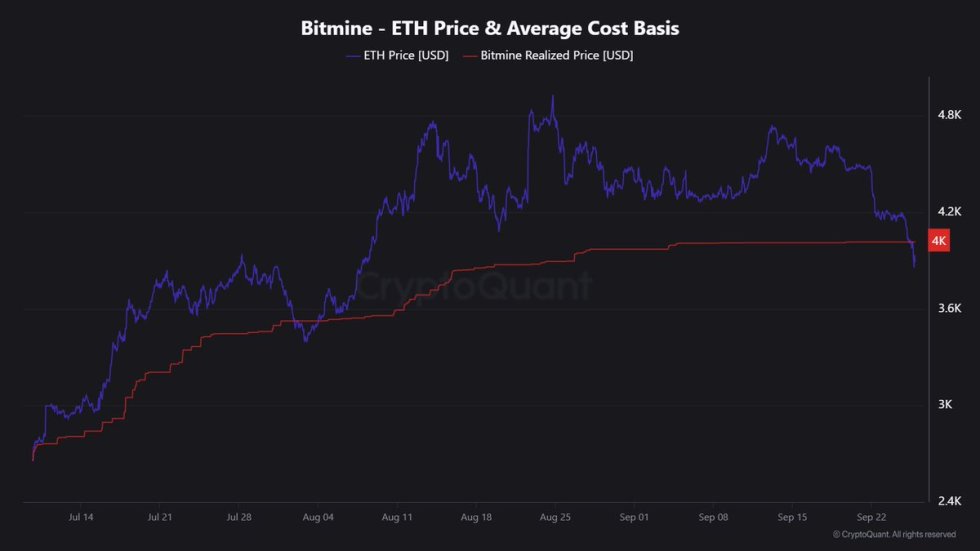
BitMine Ethereum Average Cost Basis | Source: Maartunn

Maartunn emphasizes that this stage of the market is less about timing the perfect entry or exit and more about endurance. As he put it, “It’s about who can hold their breath the longest.” The remark reflects a broader sentiment among analysts who view the current environment as a psychological test for both retail and institutional investors. With volatility high and sentiment deteriorating, the ability to withstand drawdowns may determine who ultimately benefits from the next phase of Ethereum’s cycle.

The outlook remains divided. Optimists argue that this is a necessary pullback before Ethereum gears up for a massive leg higher, supported by growing institutional adoption and strong long-term fundamentals. On the other hand, cautious voices warn of a deeper correction, noting that breaking below critical support levels could trigger further downside.

The coming weeks will likely prove decisive. If ETH can stabilize above the $3,800–$4,000 range, confidence may return quickly. However, if selling pressure intensifies, the market could face an extended period of uncertainty before momentum rebuilds.

Bulls Struggle To Find Support

Ethereum (ETH) has broken below the critical $4,000 level, now trading around $3,891, as shown on the 12-hour chart. This decline marks a continuation of the bearish trend that started after the September peak near $4,950. The breakdown has been accompanied by rising trading volume, confirming strong selling pressure and suggesting that bears currently dominate the market.
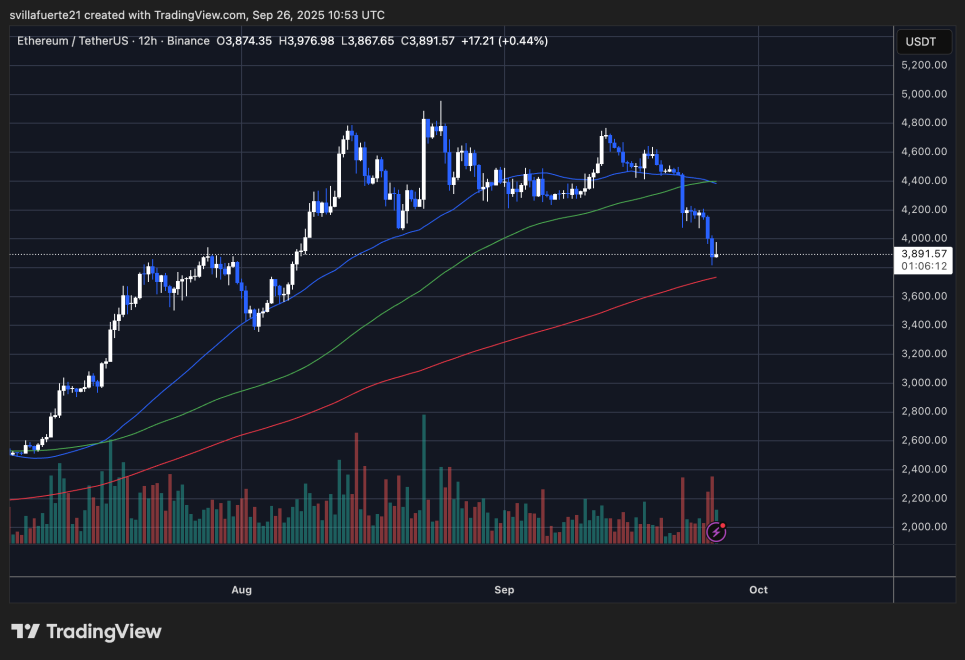
ETH losing ground | Source: ETHUSDT chart on TradingView

The 50-day EMA has crossed below the $4,400 zone, reinforcing near-term weakness, while the 200-day EMA around $3,650 now acts as the next major support level. The price action shows a decisive rejection from the $4,600–$4,800 resistance range earlier this month, followed by a steep selloff that erased more than 20% of ETH’s value.

If ETH holds above the $3,850–$3,900 zone, it could attempt a rebound and retest the $4,200 resistance. However, failure to defend this range risks further downside toward $3,650–$3,700, where the 200-day EMA and previous accumulation levels converge.

Ethereum is in a corrective phase, but the volume spike suggests potential exhaustion of sellers. The coming sessions will determine whether bulls can reclaim $4,000 to stabilize momentum or if further capitulation is ahead.

Featured image from Dall-E, chart from TradingView

Editorial Process for bitcoinist is centered on delivering thoroughly researched, accurate, and unbiased content. We uphold strict sourcing standards, and each page undergoes diligent review by our team of top technology experts and seasoned editors. This process ensures the integrity, relevance, and value of our content for our readers.

Sebastian's journey into the world of crypto began four years ago, driven by a fascination with the potential of blockchain technology to revolutionize financial systems. His initial exploration focused on understanding the intricacies of various crypto projects, particularly those focused on building innovative financial solutions. Through countless hours of research and learning, Sebastian developed a deep understanding of the underlying technologies, market dynamics, and potential applications of cryptocurrencies. As his knowledge grew, Sebastian felt compelled to share his insights with others. He began actively contributing to online discussions on platforms like X and LinkedIn, focusing on fintech and crypto-related content. His goal was to expose valuable trends and insights to a wider audience, fostering a deeper understanding of the rapidly evolving crypto landscape. Sebastian's contributions quickly gained recognition, and he became a trusted voice in the online crypto community. To further enhance his expertise, Sebastian pursued a UC Berkeley Fintech: Frameworks, Applications, and Strategies certification. This rigorous program equipped him with valuable skills and knowledge regarding Financial Technology, bridging the gap between traditional finance (TradFi) and decentralized finance (DeFi). The certification deepened his understanding of the broader financial landscape and its intersection with blockchain technology. Sebastian's passion for finance and writing is evident in his work. He enjoys delving into financial research, analyzing market trends, and exploring the latest developments in the crypto space. In his spare time, Sebastian can often be found immersed in charts, studying 10-K forms, or engaging in thought-provoking discussions about the future of finance. Sebastian's journey as a crypto analyst and investor has been marked by a relentless pursuit of knowledge and a dedication to sharing his insights. His ability to navigate the complex world of crypto, combined with his passion for financial research and communication, makes him a valuable asset to the industry. As the crypto landscape continues to evolve, Sebastian remains at the forefront, providing valuable insights and contributing to the growth of this revolutionary technology.

Trending Cryptos

Related Reads

Foundation Steps Back, Ethlabs Steps Forward: Ethereum Undergoes Its Largest Restructuring in History

On June 23rd, the Ethereum ecosystem witnessed two major shifts, signaling a significant governance realignment. First, former Ethereum Foundation researchers established Ethlabs, a new independent non-profit. Backed by major ETH holders like Bitmine and SharpLink, Ethlabs aims to address practical needs for institutional adoption, including faster settlement, native asset issuance, cross-chain transactions, and mainnet scaling. Secondly, the Ethereum Foundation announced a major restructuring, laying off 54 employees (20% of its staff) to become a leaner entity focused on protocol governance and maintenance rather than being the primary builder. This move represents a pivotal correction. Criticisms had mounted over the Foundation's perceived slowness, lack of clear strategy, and over-reliance on Vitalik Buterin's influence. Ethlabs emerges as a more execution-oriented, "industrialized" layer focused on market adoption—bridging the gap between research and real-world use. Notably, Vitalik Buterin is absent from its list of supporters, interpreted as an intentional step to avoid excessive personal endorsement and allow the organization to build independent credibility. The Ethereum Foundation's downsizing and redefinition mark a retreat from its former central coordinating role. It now aims to share the "privilege of stewarding Ethereum" with other emerging groups like Ethlabs, the Ethereum Applications Guild, and The Ethereum Economic Zone. Analysts frame this dual shift as the Foundation ensuring Ethereum remains "correct" (credibly neutral), while Ethlabs must prove it remains "effective" (competitive and attractive for capital and adoption). This addresses community "shareholder-like anxiety" about ETH's market performance. While risks exist—such as concerns over shifting from Foundation centrality to large-holder influence—the consensus is that the greater risk for Ethereum was inaction, caught between technical idealism and organizational inertia. These steps aim to create a more multi-stakeholder, execution-driven future for the network.

链捕手1h ago

Foundation Steps Back, Ethlabs Steps Forward: Ethereum Undergoes Its Largest Restructuring in History

链捕手1h ago

Second Half of U.S. Crypto Policy: The Clarity Act Aims for 60 Votes, CFTC's "One-Person Commission" Becomes Biggest Variable

In a pivotal year for US crypto policy, the "CLARITY Act" is advancing in the Senate but faces a high hurdle, needing 60 votes to pass. Key challenges include bridging partisan divides on ethics and swaying undecided Republican senators within a tight legislative calendar of only about 40 working days. The policy "second half" involves intense negotiations on a broader framework for Web3 and DeFi, including crypto tax reforms and the Blockchain Regulatory Certainty Act. A significant uncertainty is the understaffed CFTC, operating with four commissioner vacancies, which complicates regulatory clarity. Meanwhile, the departure of key "crypto champions"—SEC Commissioner Hester Peirce and Senator Cynthia Lummis—will impact ongoing policy efforts. Industry experts are cautiously optimistic but realistic. Sara K. Weed notes that while progress is being made, CLARITY is unlikely to pass this Congress, pushing agencies like the SEC and CFTC to provide more guidance. Sulolit Mukherjee suggests meaningful crypto tax legislation is more likely to be attached to larger must-pass bills. Rashan Colbert discusses the jurisdictional debate over prediction markets, emphasizing the need for a regulatory framework that fosters their development as financial tools rather than treating them broadly as gambling. The clock is ticking, but opportunities remain for substantive progress through continued bipartisan dialogue and pragmatic efforts.

marsbit3h ago

Second Half of U.S. Crypto Policy: The Clarity Act Aims for 60 Votes, CFTC's "One-Person Commission" Becomes Biggest Variable

marsbit3h ago

Research Report Analysis: Morgan Stanley Details SanDisk SNDK, The Truth About Cloud Data Center Pricing Power and AI Inference Benefits

Morgan Stanley raised its price target for SanDisk (SNDK) from $1100 to $1750 on June 22, maintaining an Overweight rating. The upgrade is driven by AI inference demand reshaping the NAND market, particularly for KV Cache and context window storage in cloud data centers. These cloud clients exhibit price inelasticity and sign long-term contracts, granting SanDisk significant pricing power. SanDisk's New Business Model (NBM) agreements, covering over one-third of FY27 bit shipments with 3-5 year terms and fixed price/price collar structures, are crucial. They are projected to sustain gross margins around 80% even at floor prices, providing a buffer against cyclical downturns. Morgan Stanley forecasts gross margins to surge from 30.3% in FY25 to 86.7% in FY27e. With NAND supply expected to remain tight into 2026/2027 and cloud/data centers becoming the largest end-market, SanDisk holds supply-side pricing power. The company targets 15-19% bit growth via technology transitions, not capacity expansion. Revenue is projected to grow ~6.6x from FY25 to FY27, with EPS rising from $2.74 to $14.73, driven by high-margin cloud business. Key upside catalysts include faster enterprise SSD adoption and edge AI growth. Downside risks involve slower industry growth, competitor capex increases, market share loss, and competition from Chinese players like YMTC. The investment thesis rests on AI-driven structural demand, NBM's margin protection, and sustained supply tightness. The $1750 target implies ~28x FY27e P/E.

marsbit4h ago

Research Report Analysis: Morgan Stanley Details SanDisk SNDK, The Truth About Cloud Data Center Pricing Power and AI Inference Benefits

marsbit4h ago

Trading

Spot
Futures

Hot Articles

Discussions

Welcome to the HTX Community. Here, you can stay informed about the latest platform developments and gain access to professional market insights. Users' opinions on the price of ETH (ETH) are presented below.

活动图片