Сумма активов под управлением криптофондов достигла $40,4 млрд

cryptonews.ruPublished on 2025-04-21Last updated on 2025-09-22

С 12 по 20 сентября инвестпродукты на основе цифровых активов зафиксировали приток в размере $1,9 млрд. Об этом говорится в отчете CoinShares.
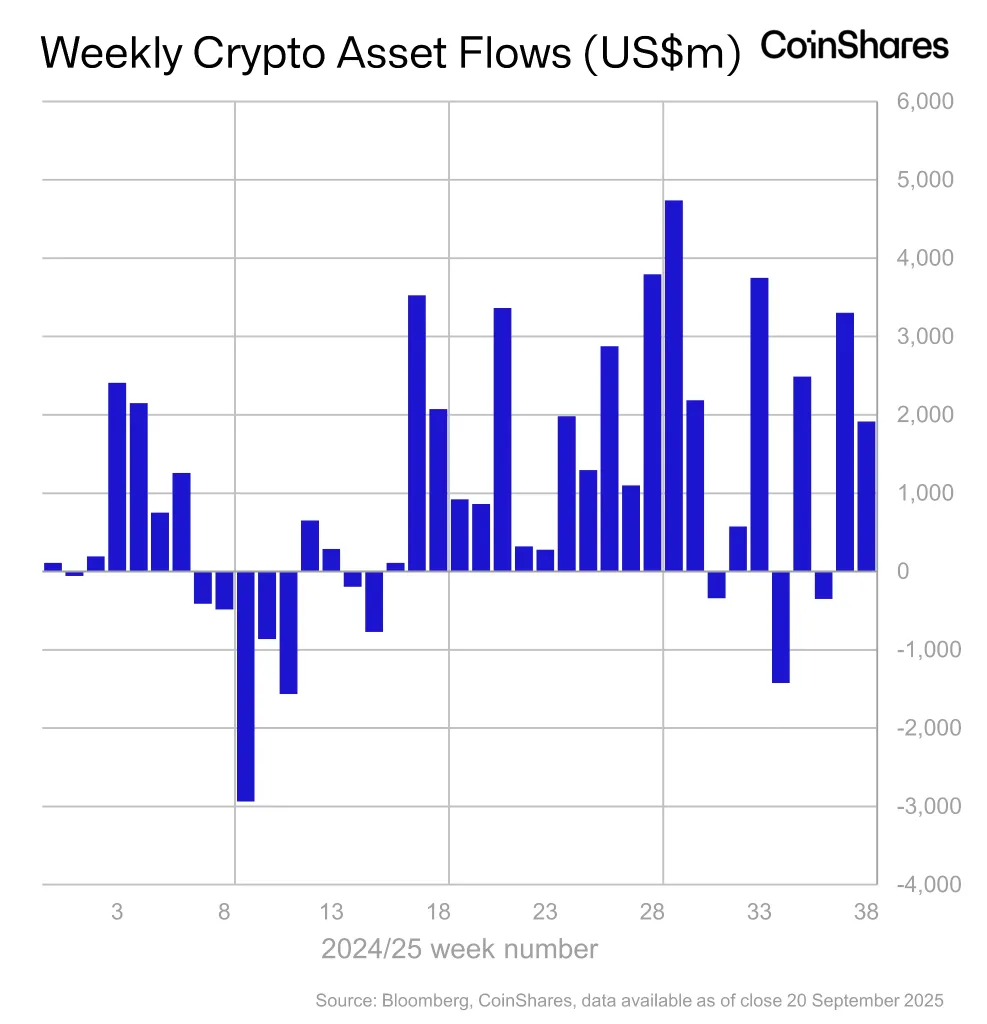
Динамика недельных притоков в криптофонды. Источник: CoinShares.

«После месяцев ожиданий ФРС снизила ключевую ставку. Хотя инвесторы изначально отреагировали на смену „ястребиной“ политики регулятора с осторожностью, приток средств возобновился к концу недели — $746 млн поступили в четверг и пятницу, когда рынки начали осознавать последствия», — отметили аналитики.

AUM биржевых фондов обновил годовой максимум на отметке $40,4 млрд и приблизился к совокупному показателю 2024 года — $48,6 млрд.
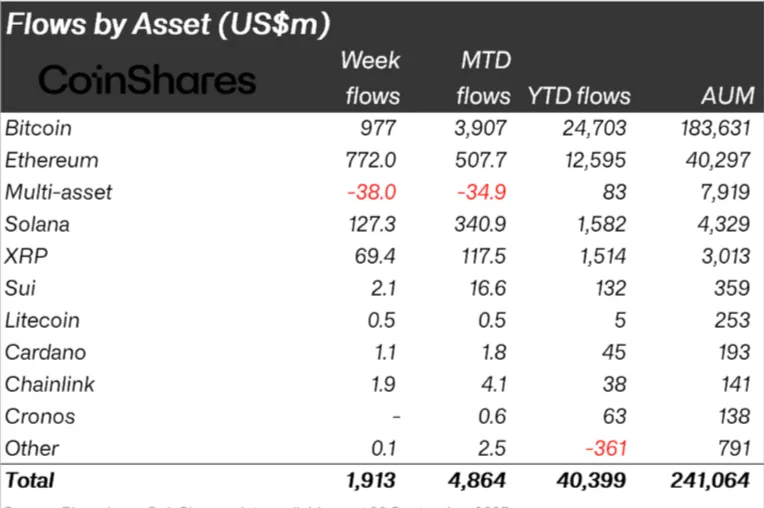
Еженедельное распределение привлеченного капитала по активам. Источник: CoinShares.

Большая часть недельного притока пришлась на биткоин-продукты — $977 млн. Ethereum-фонды получили $772 млн, в результате чего суммарный показатель с начала года достиг рекордных $12,6 млрд.
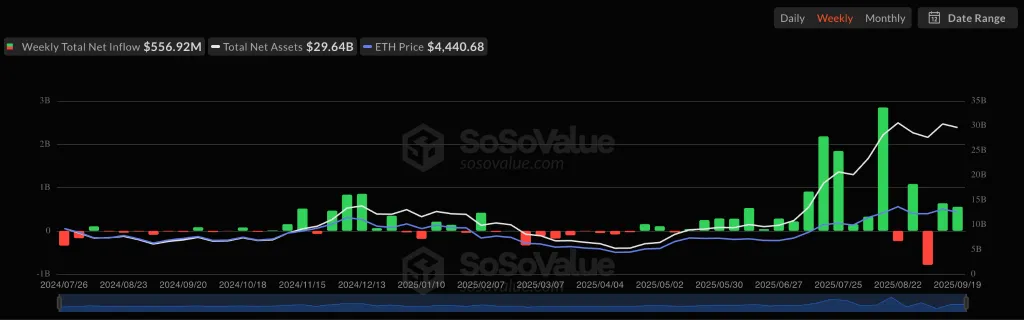
Недельные притоки и оттоки по спотовым Ethereum-ETF. Источник: SoSoValue.

Ориентированные на Solana и XRP структуры привлекли $127,3 млн и $69,4 млн соответственно. 19 сентября в США запустили спотовый ETF на базе криптовалюты Ripple. По итогам дебютной сессии совокупный объем торгов составил $37,7 млн.
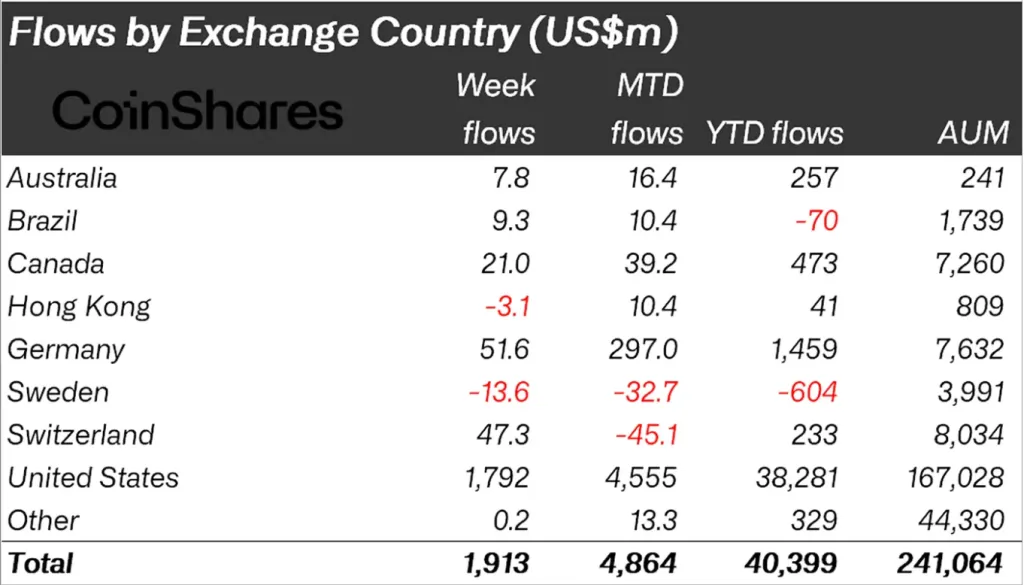
Еженедельное распределение привлеченного капитала по регионам. Источник: CoinShares.

В региональном разрезе лидировали США — $1,8 млрд. В тройку лидеров вошли Германия ($51,6 млн), Швейцария ($47,3 млн) и Бразилия ($9,3 млн).

С 5 по 13 сентября инвестпродукты на основе цифровых активов зафиксировали приток в размере $3,3 млрд.

Коррекция вопреки притокам

Новая неделя началась на крипторынке с падения. 22 сентября цена биткоина снижалась до $112 000, а курс Ethereum — до $4000. Суточные ликвидации достигли $1,7 млрд.
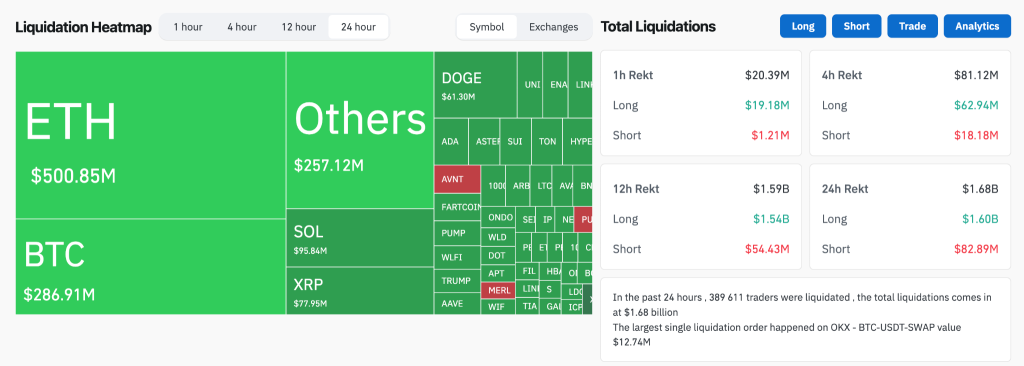
Источник: CoinGlass.

За последние 24 часа все криптовалюты из топ-10 по капитализации продемонстрировали снижение. Наибольшие потери зафиксировали XRP, Solana и Dogecoin, которые подешевели на 5,9%, 7,5% и 10,8% соответственно.
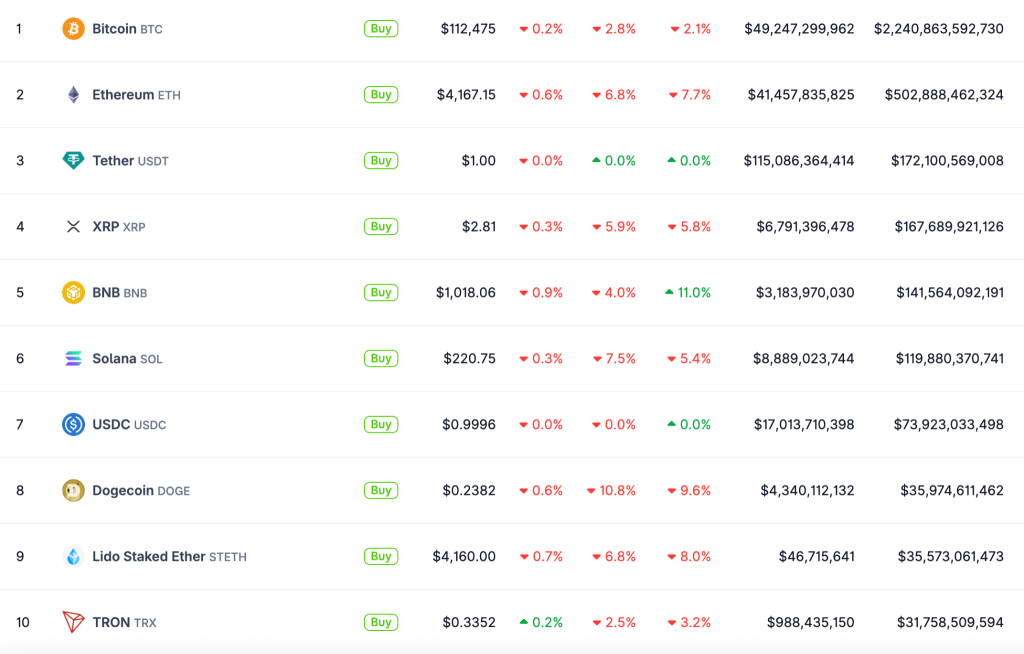
Источник: CoinGecko.

Напомним, на фоне коррекции аналитики разошлись во мнениях касательно сезонного роста цифровых активов в октябре.

Related Reads

Grayscale Report: Financial Privacy in the AI Era, Why Zcash Should Not Be Overlooked?

Title: Grayscale Report: Financial Privacy in the AI Era – Why Zcash Should Not Be Overlooked The article argues that privacy is a fundamental, not niche, attribute of functional money. It highlights that technological shifts, like the rise of AI and stablecoins, are driving a new wave of public focus on financial privacy. Zcash, a decentralized digital currency similar to Bitcoin but with built-in privacy via zero-knowledge proofs, is positioned to address this need. Unlike transparent blockchains, Zcash offers users the option to conduct "shielded" transactions that hide sender, receiver, and amount while remaining verifiable. The report details Zcash's evolution, noting key upgrades that improved usability and security. It points to rising on-chain usage of privacy features as evidence of real demand. Currently, ZEC holds a minimal share (~0.4%) of the total crypto market cap. Grayscale suggests this reflects a market assumption that privacy is a marginal concern. The investment thesis hinges on a potential market re-evaluation: if privacy is recognized as a core monetary feature in an era of enhanced surveillance, Zcash's current valuation represents significant upside potential. Key risks discussed include regulatory challenges, historical trusted setup concerns for older pools (mitigated by newer protocols), quantum computing threats, and execution risks associated with future technical upgrades. The conclusion is that while the future scale of private digital currency is uncertain, the market currently prices in little chance of its value increasing substantially, presenting a potential opportunity for investors.

marsbit36m ago

Grayscale Report: Financial Privacy in the AI Era, Why Zcash Should Not Be Overlooked?

marsbit36m ago

Vitalik Moves to Local Mixing as Obfuscation Series Reaches Third Stage

Ethereum co-founder Vitalik Buterin published the third part of his series on cryptographic obfuscation, focusing on a method called "local mixing." This method abandons lattices and elliptic curves in favor of ideas borrowed from hash function design. Buterin described local mixing as a "completely different way of cryptography," free from elliptic curves, prime factorization, and lattices, making it more akin to symmetric cryptography used in everyday encryption. The process begins with a circuit of logic gates like XOR, AND, and NOT. It undergoes a pipeline that ensures a correct output while obscuring any trace of the internal logic. Key steps include adding reversibility, strengthening, mechanization, mixing, and finally obfuscation. The mixing step scatters extra logic gates and shuffles their arrangement. Reversibility is foundational, allowing gates to be rewritten as other reversible gates with similar behavior. Buterin acknowledged local mixing is a "wild and risky undertaking," lying on the "graveyard of failed attempts at white-box cryptography." However, its proponents argue it needs more research effort and a willingness to accept higher overhead costs. Buterin suggested AI could accelerate its development. He called obfuscation the "final boss of cryptography," with the most complex constructions having runtimes exceeding the universe's age. The article concludes by explaining obfuscation's utility: it can encrypt a program so it still functions with normal inputs and outputs while hiding the code. Combined with blockchain, this moves toward a "trusted third party that requires no trust," enabling applications like private, collusion-resistant voting without relying on a trusted committee.

cryptonews.ru1h ago

Vitalik Moves to Local Mixing as Obfuscation Series Reaches Third Stage

cryptonews.ru1h ago

India Orders Closure of Hundreds of Google Firebase Accounts Used in Banking Frauds

India's cybercrime agency ordered Google to block hundreds of accounts on its Firebase app development platform. The move came after investigators traced numerous fake banking apps and phishing websites to the service. The Indian Cyber Crime Coordination Centre (I4C) sent multiple notices to Google, identifying at least 57 websites and databases on Firebase allegedly used to distribute malware and steal victims' financial data. Among these, seven were phishing pages mimicking login screens of major Indian banks like State Bank of India, ICICI Bank, and Axis Bank. The rest were reportedly data collection points for stolen information like credit card numbers and one-time passwords. The fraud scheme involved Android malware disguised as legitimate banking apps, luring victims with promises of new credit cards, rewards, or credit limit increases. Once installed, the app secretly forwarded device data to a Firebase database controlled by scammers, granting them access to other apps and the victim's funds. One scam specifically targeted beneficiaries of a government farmer aid program. This action marks a shift in India's approach. Previously focused on blocking individual fraudulent websites, authorities are now targeting the broader infrastructure enabling these scams. The move highlights how fraudsters exploit widely accessible platforms like Firebase, attracted by its free tier and database capabilities, to target India's vast digital payment user base.

cryptonews.ru1h ago

India Orders Closure of Hundreds of Google Firebase Accounts Used in Banking Frauds

cryptonews.ru1h ago

Trading

Spot
活动图片