美联储降息落地 比特币冲击13万 XRP瞄准4.2美元狗狗币ETF成最大变量

金色财经Published on 2025-09-19Last updated on 2025-09-19

美联储降息引爆市场警报:XRP、比特币与狗狗币面临关键一周考验
图片

美联储多年来首次下调利率,为加密市场投下了一枚重磅“烟雾弹”。在风险偏好提升和稳定币储备增加的背景下,主流币与 meme 币都将迎来重大考验。XRP 瞄准 4.20 美元关口,比特币或冲击 13 万美元,而“表情包之王”狗狗币则因首只 ETF 上市而成为焦点。

XRP:4.20 美元关口或迎历史性突破

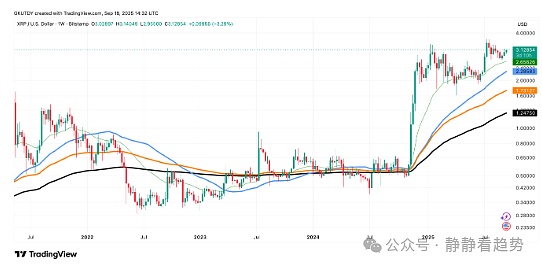
目前,XRP 在周线级别维持在 3.12 美元。值得注意的是,它仍站在所有主要均线上方:26 日 EMA 在 2.65 美元、50 日均线在 2.28 美元、100 日 EMA 在 1.73 美元、200 日 EMA 在 1.24 美元。这一格局显示,尽管今年早些时候 XRP 从 0.50 美元一路飙升至 3.50 美元,涨幅高达 700%,但上升趋势并未明显衰减。
图片

当前的关键价位是 4.20 美元。若能突破该阻力区间,市场结构将从压制转向支撑,随之可能打开上探 5.00 美元甚至 6.90 美元的大门。随着黄金交叉不断累积,技术图表几乎没有显示疲态,若流动性继续流入核心币种,这一路径相当现实。 

比特币:冲击 13 万美元还是陷入整理?

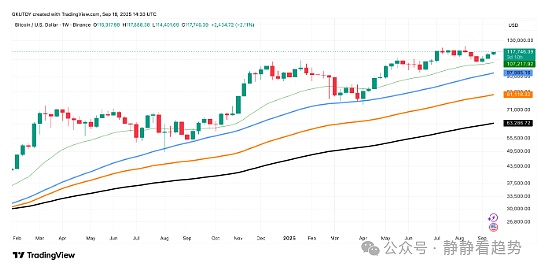
比特币目前在 117,350 美元附近徘徊,市场对它的定位依然分化:是抗通胀的“数字黄金”,还是流动性回归风险资产时的高贝塔选择?

降息消息既强化了黄金的对冲逻辑,也为高风险资产提供了支撑。当前 BTC 仅略低于 11.8 万至 12 万美元的阻力区,一旦突破,该区域或将成为价格迈向新纪录前的最后一道门槛。
图片

看涨路线:若 BTC 成功站稳 118,000 至 120,000 美元,将直指 125,000 美元,随后有望挑战 130,000 美元的新高。下方多层支撑牢固:107,000 美元(26 日均线)、98,000 美元(50 日均线)、81,000 美元(100 日均线)、63,000 美元(200 日均线)。同时,RSI 并未过热,留给上涨空间充足。

风险情景:如果 BTC 长时间停滞在 12 万美元下方,行情可能转向横盘整理;若跌破 114,000 美元,市场注意力将重新回到 107,000 美元的支撑,进一步跌至 98,000 美元也非不可能。这不会破坏长期上升趋势,但可能推迟市场冲击 13 万美元的时间表。

狗狗币:ETF 上市为 Meme 币点燃新叙事

狗狗币目前报 0.282 美元,这是近期少有的行情并非单纯由网络情绪驱动,而是受到基本面重大消息推动。REX-Osprey 狗狗币 ETF(代码 $DOJE)将于本周在美国交易所正式上市,为 DOGE 带来前所未有的机构可见度。

无论 ETF 实际吸引的资金规模如何,市场往往会先对叙事本身作出反应,而这足以激发下一轮波动。

上行空间:DOGE 已站上主要均线:26 日 EMA 为 0.241 美元、50 日 MA 为 0.224 美元、100 日 EMA 为 0.187 美元、200 日 EMA 为 0.152 美元。若成功突破 0.30 美元,将有望冲击 0.35 美元;若 ETF 故事持续发酵,价格甚至可能在投机热潮推动下测试 0.40 美元至 0.60 美元。

潜在风险:若 0.30 美元至 0.35 美元的阻力区迟迟无法突破,DOGE 的上涨动能可能枯竭。跌破 0.24 美元将再次考验 26 EMA,而进一步下探可能带来 0.21 美元甚至 0.18 美元的低位。若 ETF 热度消退,0.15 美元附近的 200 EMA 也可能成为市场底线。

总结

美联储降息为加密市场带来了新的流动性与风险情绪的博弈。XRP 正冲击 4.20 美元的关键点位,比特币蓄势突破 12 万美元大关,而狗狗币则凭借 ETF 上市故事成为新的投机热点。未来一周,市场将迎来关键时刻,或决定这一轮牛市的高度与持续性。


Related Reads

a16z: How Tokenization is Transforming the Nature of Assets in 7 Charts

"Tokenized Assets: How Tokenization Changes the Nature of Assets" by a16z Crypto The market for tokenized assets, excluding stablecoins, has grown from under $3 billion two years ago to over $340 billion today. US Treasury bonds are the primary growth driver, allowing investors to hold yield-bearing assets digitally and enabling more efficient settlement. Other key sectors include private credit (growing fastest), commodities (dominated by gold), and niche financial assets. However, the market remains concentrated in tokenized US Treasuries and gold. A critical insight is that most tokenized assets currently lack "composability." While the total market is large, only a small fraction is actively used within DeFi protocols. For instance, only about 5% of tokenized bonds and a low percentage of tokenized gold are utilized on-chain. In contrast, assets like reinsurance and private credit tokens show much higher on-chain usage rates (84% and 33%, respectively). This highlights a divide: many tokenized assets are merely digital records on a blockchain without enabling new, programmable financial applications. The Pantera Capital Token Native Index indicates over 70% of tokenized assets have minimal on-chain native functionality. Ethereum remains the dominant blockchain for tokenized assets (over $150B), but the ecosystem is diversifying across chains like BNB Chain, Solana, and Stellar, based on factors like cost and compliance. Major institutions forecast massive future growth, with predictions for the tokenized asset market ranging from $2 trillion to over $30 trillion by the early 2030s. However, compared to the global financial system (e.g., ~$140T bonds, multi-trillion dollar gold market), tokenized assets currently represent a tiny fraction (0.01% or less). The conclusion is that while tokenization has begun by digitizing and streamlining settlement for simpler assets, the next phase involves bringing more complex financial instruments on-chain and deeply integrating them into composable, internet-native financial infrastructure.

Odaily星球日报21m ago

a16z: How Tokenization is Transforming the Nature of Assets in 7 Charts

Odaily星球日报21m ago

The Revived Codex, Carrying OpenAI's Hopes for IPO

This article analyzes the intense recent development of OpenAI's Codex, positioning it as a crucial component for OpenAI's impending IPO. Over the past two months, Codex has seen a rapid series of major updates focused on integrating into real enterprise workflows. Key new features include enhanced context capture (Appshots, file previews, built-in browser), long-running task execution ("Goal Mode"), remote operation (phone control, lock-screen access), and enterprise management tools (plugin sharing, access tokens, automated risk review). These updates aim to make Codex a comprehensive AI workbench that can "see the scene, push tasks, and manage risks." The author argues that while ChatGPT proves OpenAI's massive user base and API provides foundational revenue, Codex represents OpenAI's clearest path to demonstrating tangible, high-value commercial viability. It targets developers and engineering teams—a segment already accustomed to paying for efficiency gains in costly software development cycles. This is critical because, despite higher overall revenue, OpenAI's adjusted operating margins remain deeply negative, highlighting the challenge of outrunning immense compute costs. The pressure is amplified by competitor Anthropic's success with Claude Code, which has shown that a focused approach on high-value enterprise and developer workflows can lead to a path toward profitability. Codex's aggressive evolution is thus seen as OpenAI's strategic move to capture a similar enterprise-ready, revenue-generating narrative essential for its market debut. In essence, "ChatGPT proved OpenAI has users. Codex needs to prove OpenAI is a business that can make money."

marsbit1h ago

The Revived Codex, Carrying OpenAI's Hopes for IPO

marsbit1h ago

a16z: 7 Charts to Understand How Tokenization Is Changing the Nature of Assets

a16z: 7 Charts on How Tokenization is Transforming the Nature of Assets Tokenized Assets, often referred to as "real-world assets" (RWA), are altering the form, flow, and structure of the financial system. The market recently surpassed $30 billion (excluding stablecoins), driven largely by tokenized U.S. Treasuries. These offer investors digital, yield-bearing assets with efficient settlement. Growth varies significantly by asset class. Asset-backed credit leads in speed, followed by niche financial assets, while venture capital and active strategies took longer to scale. U.S. Treasuries and commodities dominate, holding about two-thirds of the current market share. Within commodities, gold tokenization dominates entirely due to its standardization and historical appeal in crypto. The ecosystem is spread across multiple blockchains. Ethereum holds over half the market, with others like BNB Chain, Solana, and Stellar holding significant shares. However, a key insight is that most tokenized assets currently lack "composability." While the total market is large, only a small fraction (e.g., 5% of tokenized bonds) is used within DeFi protocols. Many tokens are simply digital records of off-chain assets, not natively programmable financial building blocks. In contrast, smaller categories like reinsurance tokens see very high on-chain usage. Looking ahead, forecasts for the tokenized asset market by 2030 range from $2 trillion to over $30 trillion, representing immense potential growth from today's ~$340 billion base. Yet, relative to global markets (e.g., $140T+ in bonds), tokenization's penetration remains minuscule (<0.02%). The current phase focuses on digitizing straightforward assets for efficiency. The next major challenge is bringing more complex financial instruments on-chain and integrating tokenized assets into truly composable, internet-native financial infrastructure.

marsbit1h ago

a16z: 7 Charts to Understand How Tokenization Is Changing the Nature of Assets

marsbit1h ago

Trading

Spot
Futures

Hot Articles

What is DOGE M

Doge Matrix ($doge m): The New Breed of Community-Driven Cryptocurrency Introduction In the ever-evolving landscape of cryptocurrency, new projects constantly emerge, each aiming to capture the interest of investors and enthusiasts alike. One of the latest entrants to this domain is Doge Matrix, represented by the ticker symbol $doge m. This project has attracted attention thanks to its roots in the popular meme culture surrounding Dogecoin, establishing its place within the web3 space. This article aims to provide a comprehensive analysis of Doge Matrix, covering its overview, creator, investors, functionality, timeline, and notable aspects. What is Doge Matrix ($doge m)? Doge Matrix is a community-driven cryptocurrency project that seemingly builds upon the widespread appeal of Dogecoin, a digital currency known for its Shiba Inu mascot and its meme origins. While the overarching objectives of Doge Matrix are not extensively defined, it is characterized by a commitment to harnessing community involvement and support. Unlike traditional cryptocurrencies that often emphasize utility or intrinsic value through underlying technologies, Doge Matrix positions itself within a space that embraces the cultural phenomenon of cryptocurrencies, particularly appealing to those who resonate with the ethos of meme-based assets. Drawing on the strengths of the Dogecoin community, Doge Matrix operates as part of a broader ecosystem, inviting participation and engagement from users who share an interest in cryptocurrency and the digital landscape. Who is the Creator of Doge Matrix ($doge m)? The identity of the creator of Doge Matrix remains unknown. This lack of transparency is not an uncommon occurrence in the cryptocurrency space, where some projects are launched without revealing the identities of their founders. The absence of information regarding the founding team can raise questions among potential investors about the project’s accountability and direction. Who are the Investors of Doge Matrix ($doge m)? As it stands, there is no publicly available information detailing the investors or investment foundations that back Doge Matrix. The project appears to rely primarily on community support rather than institutional investment. This model aligns with the community-driven nature of the initiative, fostering an environment where the direction of the project is shaped by its participants rather than being dictated by a select few financial backers. How Does Doge Matrix ($doge m) Work? The specifics regarding the operational mechanisms of Doge Matrix are somewhat vague, reflecting a broader trend of projects in the meme coin space where innovative functionalities are not always clearly articulated. Nonetheless, Doge Matrix seems designed to tap into the existing cryptocurrency ecosystem by encouraging user participation while tapping into the familiar cultural references associated with Dogecoin. Its potentially unique characteristics derive from community interactions rather than technological advancements, emphasizing shared experiences and collaboration among token holders. While the exact innovations have not been explicitly outlined, the project appears to create a space where community members can engage, share ideas, and propel the project's potential forward. Timeline of Doge Matrix ($doge m) Reflecting on the project’s timeline reveals notable events that have defined its journey thus far: November 25, 2024: Doge Matrix reached its all-time high value, marking a significant milestone in its early history. January 1, 2025: Conversely, Doge Matrix hit its all-time low value, illustrating the volatility often associated with cryptocurrencies, especially in the early stages of a project's lifecycle. Ongoing: The project continues to be actively traded and supported by its community, although specific future milestones or objectives have yet to be disclosed. Key Points About Doge Matrix ($doge m) Community Focus At the heart of Doge Matrix is a commitment to community engagement. The project thrives on the premise of collaboration and shared objectives among its members, emphasizing the importance of collective effort. Unlike centralized projects that often have a defined leadership structure, Doge Matrix at present showcases a more fluid approach to governance, where every community member's voice matters. Volatility The cryptocurrency market is notorious for its volatility, and Doge Matrix is no exception. Its price history reflects significant fluctuations between high and low values, which is typical of many new cryptocurrencies but underscores the risks associated with investment in emerging tokens. Lack of Detailed Information One of the most striking features about Doge Matrix is the scarcity of detailed information regarding its technological underpinnings and operational mechanisms. This ambiguity necessitates that potential investors conduct thorough due diligence before engaging with the project. Conclusion In summary, Doge Matrix ($doge m) illustrates a new wave of cryptocurrency projects that lean heavily on community engagement and cultural relevance. While lacking in certain specifics—such as clear leadership, defined objectives, and detailed functionality—the project has managed to generate interest within the crypto community, leveraging the established appeal of meme culture. As with any investment in the cryptocurrency space, understanding the inherent risks and conducting comprehensive research is essential for potential participants. Doge Matrix stands as a reminder of the dynamic, sometimes unpredictable nature of the crypto industry, marked by constant evolution and enthusiasm for community-driven initiatives.

3.5k Total ViewsPublished 2025.02.03Updated 2025.02.03

What is DOGE M

Discussions

Welcome to the HTX Community. Here, you can stay informed about the latest platform developments and gain access to professional market insights. Users' opinions on the price of DOGE (DOGE) are presented below.

活动图片