Solana Price Prediction for September: Analysts Target Breakout as Snorter Token Gains Buzz

bitcoinistPublished on 2025-09-15Last updated on 2025-09-15

Abstract

Solana is experiencing a September to remember. In just two weeks, $SOL has surged 23.5%, leaving $BTC (+6.9%) and $ETH...

Trusted Editorial content, reviewed by leading industry experts and seasoned editors. Ad Disclosure

Solana is experiencing a September to remember. In just two weeks, $SOL has surged 23.5%, leaving $BTC (+6.9%) and $ETH (+6.4%) in the dust.

The surge occurs as Galaxy Digital acquires 6.5M $SOL, roughly $1.55B worth, fueling speculation that institutions are front-running the next big breakout. For traders, that’s a signal worth watching: when whales move in before retail, Q4 often follows with fireworks.

Sentiment on Crypto Twitter and CMC community threads remains bullish, but liquidations serve as a reminder that volatility is still present.

At the same time, Solana’s increasing liquidity is spilling over into Solana meme utility plays like Snorter Token ($SNORT), a Telegram trading bot project that leverages the network’s momentum.

Institutional Buying Drives the Solana Rally

Galaxy Digital’s aggressive buying is one of the biggest stories behind Solana’s September surge. The firm purchased $6.5M in $SOL in less than a week.

The size of these purchases is raising eyebrows, with analysts suggesting Galaxy may act on behalf of Forward Industries, which recently raised $1.65B to build a dedicated Solana treasury.
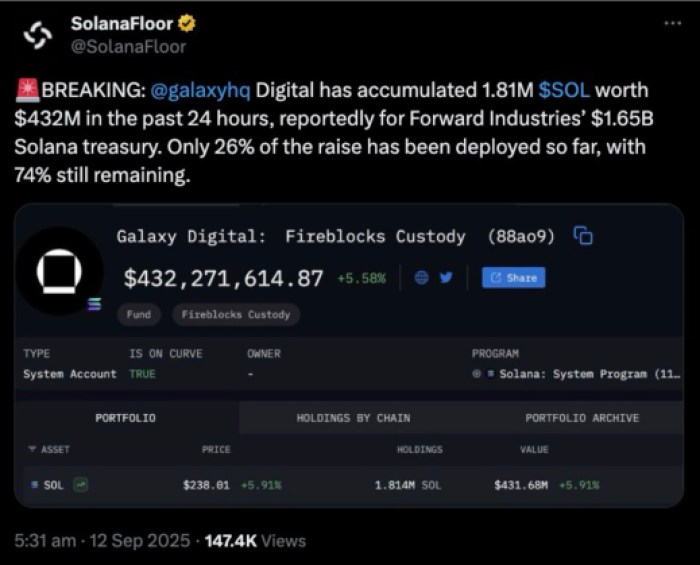
Galaxy Digital accumulations reportedly being tied to Foward Industries’ $1.65B Solana treasury
Source: SolanaFloor via X

Why does this matter? Institutions don’t usually commit that kind of capital without conviction. Solana has faced criticism in the past for network outages and scaling glitches. Yet, billion-dollar inflows show that major players see it as a viable bet heading into the next market cycle phase.

The move reflects what happened with Bitcoin earlier this year, when ETFs directed billions into $BTC. If Solana follows the same strategy, institutional rotation could speed up price discovery well before retail investors fully re-enter the market.

Analyst & Community Price Predictions

Chart watchers are lining up bullish scenarios for $SOL.

TEKT0NIC highlighted a textbook cup-and-handle pattern, indicating a possible breakout toward the $330-$350 range if momentum continues.
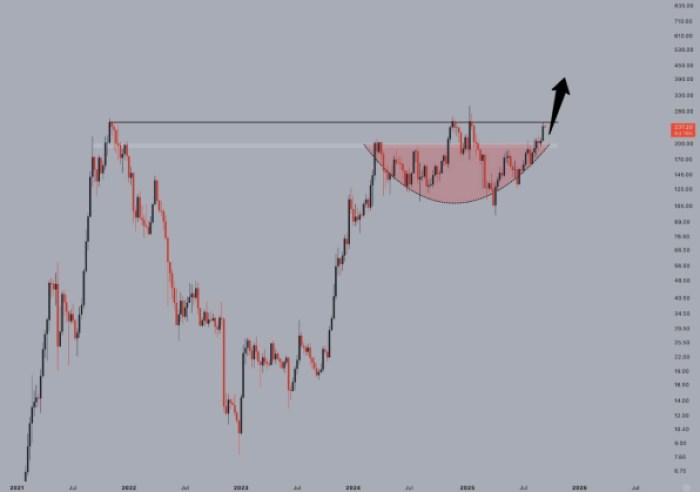
$SOL chart on TradingView with cup and handle pattern
Source: @TEKT0NIC on CoinMarketCap.

Z988Crypto sees the same setup but warns that confirmation only occurs if Solana breaks through resistance between $261 and $296. Until then, a short-term pullback to the $210-$220 range remains possible.

Amin_BTC zoomed in further, noting $235 as the key support to watch: hold it, and $245 is the next stop, lose it, and a deeper correction could follow.

Despite the caution, sentiment skews positive. Solana’s total value locked (TVL) has an all-time high of over $13B, while the month-to-date gains of over 23.5% leave $BTC and $ETH far behind.
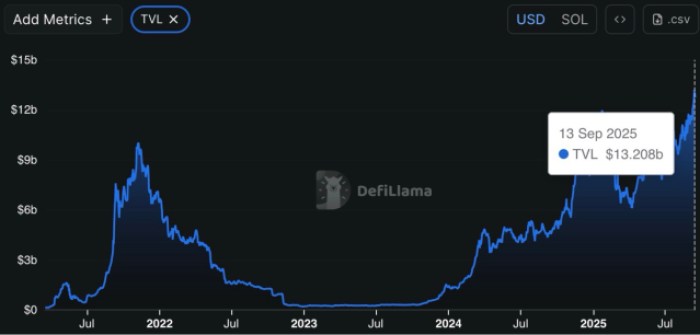
Solana TVL chart
Source: DefiLlama.

Historically, green Septembers have set the stage for strong Q4 rallies, and institutions buying early further reinforce that trend.

Still, the market remains fragile – $445M in liquidations occurred over the last 24 hours, including $32M in $SOL positions.

Solana’s Ecosystem Momentum

Beyond price action, Solana’s fundamentals are getting stronger. On-chain activity, including active addresses and revenue, shows signs of rebounding, which explains why $SOL is doing so well in September.
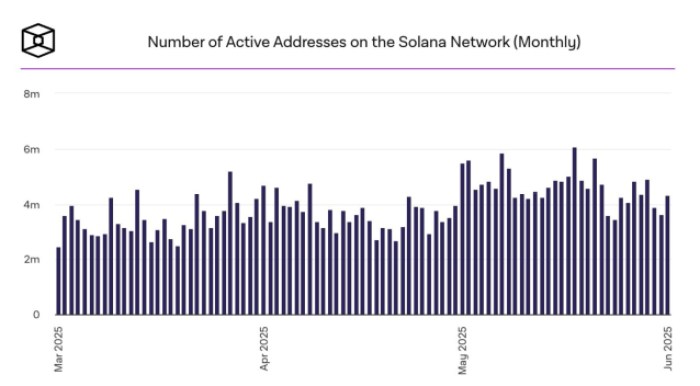
The number of active addresses on the Solana network, monthly bar chart
Source: TheBlock.

Analysts often describe this stage as ‘Altcoin Phase 3,’ where large-cap coins are spotlighted. For investors, it positions Solana as the clear challenger to Bitcoin and Ethereum’s dominance.

And as liquidity increases, demand flows into Solana-native tools like Snorter Token – projects aimed at helping retail traders capture the same alpha institutions seek.

Snorter Token ($SNORT) – Meme Branding Meets Trading Bot Utility

As Solana’s ecosystem heats up, demand for trading tools surges, and Snorter Token ($SNORT) aims to become the preferred choice.

Snorter is a Telegram-native bot designed for Solana and Ethereum. It allows traders to manage their entire playbook from chat: sub-second swaps, instant sniping at token launch, copy-trading top wallets, rugpull detection, and portfolio tracking.

Holding $SNORT lowers execution fees from 1.5% to 0.85%, making it cheaper than competitors like BONKbot and Trojan, while providing faster execution thanks to custom Solana RPC infrastructure. Unlike most meme coins, Snorter supports its branding with real functionality.

Discover how to buy Snorter Token ($SNORTER) in our step-by-step guide.
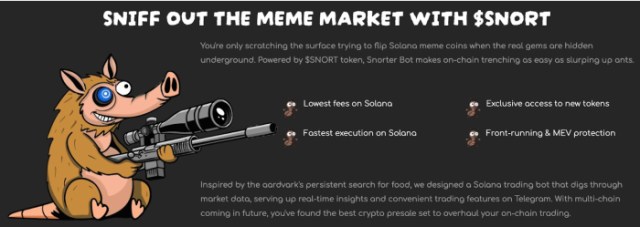
Snorter Token ($SNORT) benefits for holders

The presale has already gained attention, raising over $3.94M at a token price of $0.1045, with staking yields around 119%. The pitch resonates because Telegram bots are among crypto’s fastest-growing niches, with the market forecast to reach $154B by 2033.

Snorter positions itself as the next step in the evolution of trading bots, incorporating MEV protection, cross-chain support, and meme-driven community energy.

With strong early momentum and a discounted entry through the presale, $SNORT offers exposure to meme coin culture and a utility stack retail traders rely on to stay competitive with institutions.

Learn more about Snorter, its tokenomics, roadmap, and more in our comprehensive What is Snorter guide.

This article is not financial advice. Presales and crypto in general carry inherent risks. Please always do your own research (DYOR) before putting any capital at risk.

Authored by Bogdan Patru, Bitcoinist – https://bitcoinist.com/solana-price-prediction-in-september-snorter-token-gains/

Editorial Process for bitcoinist is centered on delivering thoroughly researched, accurate, and unbiased content. We uphold strict sourcing standards, and each page undergoes diligent review by our team of top technology experts and seasoned editors. This process ensures the integrity, relevance, and value of our content for our readers.

As a crypto writer, Bogdan’s responsibilities are split between researching and writing articles and entertaining the team with his humor bordering on the politically incorrect, an aspiring Bill Burr, if you will. Thanks to his 12+ years of writing experience in just as many fields, including tech, cybersecurity, modelling, fitness, crypto, and other topics-that-shall-not-be-named, he's become a genuine asset to the team. While his position as a senior writer at PrivacyAffairs thought him valuable lessons about the power of self-management, his entire writing career was and is an exercise in self-improvement. Now, he's ready to sink his teeth into crypto and teach people how to take control of their own money on the blockchain. With fiat as an eternally devaluing currency, Bitcoin and altcoins seem like the best-fitting alternative for Bogdan. Bogdan’s biggest professional accomplishment, aside from securing a position as a main writer for Bitcoinist, was his 5-year run as a writing manager at Blackwood Productions, where he coordinated a team of four writers. During that time, he learned the value of teamwork and that of creating a working environment that breeds efficiency, positivity, and friendship.

Related Reads

Stablecoins Becoming the Next Policy Challenge for the Fed's Walsh Version

Fed Governor Christopher Waller's speech at the June 22 conference on the U.S. dollar's international role signifies a notable policy shift: stablecoins like USDT and USDC are now being formally considered as potential channels for transmitting U.S. dollar liquidity globally. With their combined market cap surpassing $250 billion and high transaction volumes, these digital assets are moving from the periphery of crypto policy to the core of monetary system research. The key concern for policymakers is how stablecoin flows interact with traditional dollar infrastructure. Their growth could affect bank deposits, demand for short-term Treasury securities (like T-bills), and global access to dollars, depending on whether demand originates overseas or substitutes for domestic bank balances. Issuers' reserve management—holding assets in banks, money market funds, or Treasuries—links stablecoin activity directly to these core markets. The Fed's research agenda now examines whether stablecoins, by combining payment and balance-holding functions on digital rails, could complicate monetary policy implementation or transmit liquidity stress to banks. While current Treasury holdings by issuers are under 1% of the total market, their concentrated demand could marginally impact yields, especially during periods of stress. Consequently, stablecoins are evolving from mere crypto trading tools into a private-layer dollar transmission system with public policy implications, prompting closer regulatory scrutiny of their reserve robustness, redemption mechanisms, and systemic integration.

marsbit52m ago

Stablecoins Becoming the Next Policy Challenge for the Fed's Walsh Version

marsbit52m ago

A 380% Soar, Shenzhen’s 100-Billion-Yuan IPO Rings the Bell

HKC Holdings, a major Chinese display panel manufacturer, has successfully listed on the Shenzhen Stock Exchange's main board. The company's shares surged over 380% on its debut, pushing its market capitalization to around 350 billion yuan (formerly reaching 500 billion yuan). Founded by Wang Zhiyong in Shenzhen's Huaqiangbei electronics market nearly three decades ago, HKC evolved from assembling monitors to becoming a global top-tier supplier of semiconductor display panels for TVs, monitors, and smartphones. The IPO marks a significant milestone for HKC and its backers. The company's growth into the capital-intensive panel manufacturing sector was supported through partnerships with state-owned capital from regions like Chongqing, Mianyang, and Chuzhou. Its shareholder list also includes BOE Technology's investment arm. In recent years, HKC reported strong financials, with core panel business contributing over 70% of revenue and clients including Samsung, TCL, and Xiaomi. This listing is seen as part of a broader trend in Shenzhen's evolving tech landscape. Beyond established giants, the city is nurturing clusters of leading companies in specialized sectors like robotics—exemplified by the "Shenzhen Robot Valley"—and storage chips, where a group of firms dubbed the "Storage Five Tigers" has achieved a combined trillion-yuan market valuation. Shenzhen's strategic focus on emerging industries such as AI terminals, low-altitude economy, and humanoid robotics aims to build new industrial depth and foster the next generation of tech champions.

marsbit1h ago

A 380% Soar, Shenzhen’s 100-Billion-Yuan IPO Rings the Bell

marsbit1h ago

Trading

Spot
Futures
活动图片