侃爷Meme币狂飙:市值一度突破30亿美元,搅动加密市场

比推Published on 2025-08-21Last updated on 2025-08-21

作者:KarenZ,Foresight News

原文标题:引爆加密市场,侃爷Meme币最高冲至30亿美元


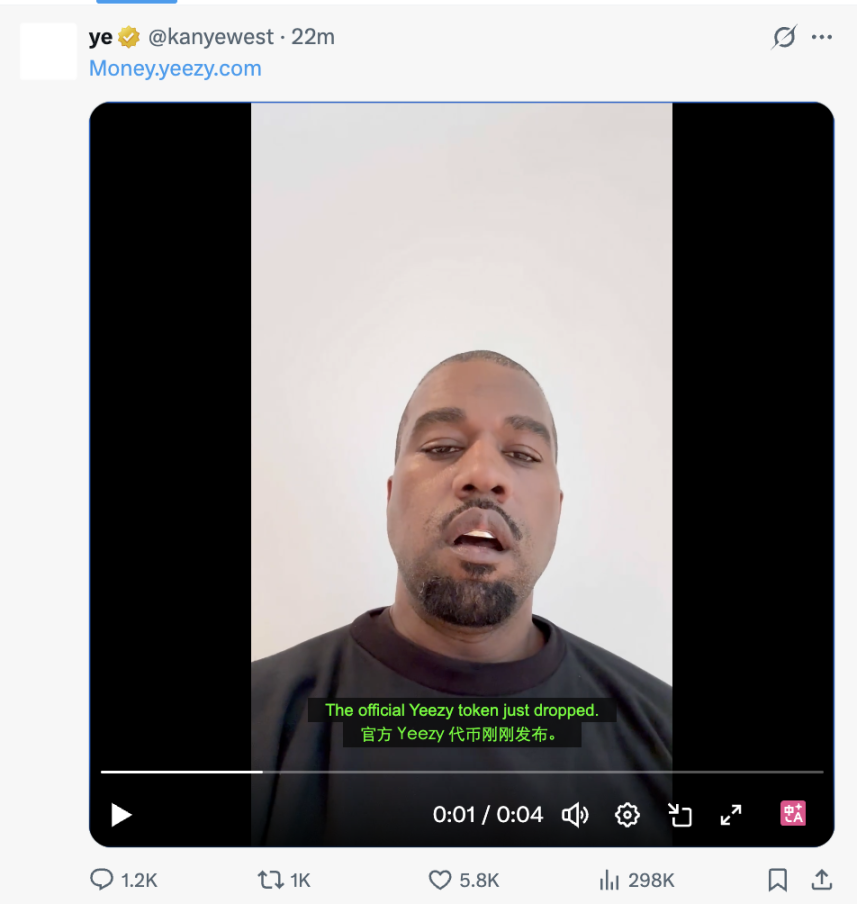
北京时间今日(8 月 21 日)09:53,著名说唱歌手 Kanye West(侃爷)在推特上发布重磅消息,「YEEZY MONEY IS HERE,A NEW ECONOMY, BUILT ON CHAIN」宣告新项目启动,并附上官网链接 money.yeezy.com。尤为值得关注的是,其推文配图中还首次披露了 YZY 代币的合约信息。

消息一经发布,YZY 代币市值随即迎来爆发式增长,市值从原本 2 亿美元左右的规模一度飙升 14 倍至 31 亿美元市值,目前市值回落到 20 亿美元左右。

事件初期,有社区成员对 Kanye West 推特账号的安全性提出质疑,猜测可能遭遇盗号。不过,随着 Moonshot 平台正式上线 YZY 代币,加之 Kanye West 再度通过推特发布视频证实 YZY 的真实性,相关争议逐渐平息。
YZY 代币经济学

YZY MONEY 的核心理念是构建一个让用户掌控所有权益、摆脱中心化权威束缚的金融生态,而 YZY 则是支撑该生态内所有交易的基础货币。

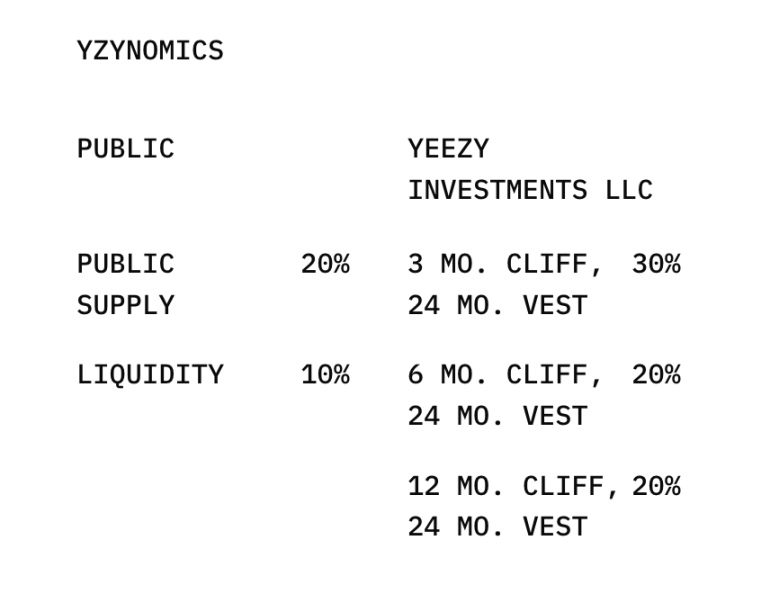
YZY 代币经济学设计如下:总供应量 10 亿枚,其中,将 10% 用于提供流动性,20% 划入公共供应(Public Supply)。

Yeezy Investments LLC 实体公司将获得 70% 的代币供应,会采用分阶段释放机制,以防止早期抛售。具体如下:

  • 30%:3 个月锁定期(cliff)+24 个月释放(vest)

  • 20%:6 个月锁定期(cliff)+24 个月释放(vest)

  • 20%:12 个月锁定期(cliff)+24 个月释放(vest)

目前,YZY 已在 Solana 生态的流动性管理平台 Meteora 开放与 USDC 的交易对。

官网信息显示,项目方共部署了 25 个 YZY 合约地址,其中仅有一个为随机选定的官方合约。此举将正确合约地址的识别概率降至 1/25,旨在有效抵御狙击手攻击。此外,该项目通过 Jupiter Lock 实现 YZY 代币的链上锁定与分配管理。

YZY MONEY 的构成体系

根据官网,YZY 、YE PAY 和 YZY CARD 卡是具有不同用途的独立实体。

具体定位如下:

  • YZY 是支撑 YZY MONEY 生态内所有交易的基础货币。

  • YE PAY 是一个加密货币支付处理器,接受信用卡和加密货币支付。

  • YZY CARD 支持在全球范围内使用 YZY 和 USDC,可能用于品牌生态内的消费。

风险与争议

Kanye West 发布的 YZY 代币作为其个人 IP 与加密货币结合的产物,引发了市场和社区的广泛关注,其背后既体现了名人效应在加密领域的影响力,也暗藏着诸多争议与风险:

  • 高度集中化: YZY 代币分配结构显示持有集中度较高,Yeezy Investments LLC 掌握着绝对主导权(70% 的代币),而流动性与公共供应部分合计仅占 30%。

  • 生态落地的模糊性:尽管项目提出了「YZY MONEY 金融体系」、「YE PAY」、「YZY CARD」等概念,但目前仅停留在官网描述阶段,缺乏具体的技术细节、合作方信息或落地时间表。

  • 投资风险: 官网明确声明 YZY 不是投资机会或证券。

  • 名人 IP 驱动的市场热度与短期效应: YZY 代币市值的爆发式增长,核心驱动力来自 Kanye West 的全球影响力。作为说唱界和时尚界的标志性人物,其个人 IP 自带流量,能够快速吸引粉丝和投机者入场,形成短期市场热度。但过往大多数名人代币(如 LIBRA)在之后热度骤减后崩盘,YZY 也面临类似质疑。

  • 侃爷过往的争议性言论和行为(如极端言论、商业决策反复等)也为项目增添了不确定性。

Kanye West 与加密货币的渊源

Kanye West 非首次与加密货币产生交集。早在 2025 年 2 月,Kanye West 就宣布计划推出名为 YZY 的 meme coin,作为其 Yeezy 品牌的官方货币。

之后,Kanye West 还公开表示正在向加密 KOL Ansem 学习比特币知识。

在此之前,社区中曾出现多个与 YZY 相关的代币,均被视为「社区自发代币」或「仿冒品」,而 Kanye West 此次的一系列举动,正式确认了官方版本 YZY 代币的落地。

当前,YZY 尚处于早期阶段,其成功取决于实际效用(如 Yeezy 商品支付)、社区支持以及 Ye 的执行力。加密项目的长期价值依赖于实际应用场景,若生态无法兑现,代币可能沦为纯粹的投机工具。对于普通投资者而言,页需警惕「粉丝滤镜」下的非理性跟风,充分认识到加密货币市场的波动性和此类项目的投机本质,谨慎决策。



说明: 比推所有文章只代表作者观点,不构成投资建议

Related Reads

3 Years, 5 Times: The Rebirth of a Century-Old Glass Factory

Corning, a 175-year-old glass company, is experiencing a dramatic revival as a key player in AI infrastructure, driven by surging demand for high-performance optical fiber in data centers. AI data centers require vastly more fiber than traditional ones—5 to 10 times as much per rack—to handle high-speed data transmission between GPUs. This structural demand shift, coupled with supply constraints from the lengthy expansion cycle for fiber preforms, has created a significant supply-demand gap. Nvidia has invested in Corning, along with Lumentum and Coherent, in a $4.5 billion total commitment to secure the optical supply chain for AI. Corning's competitive edge lies in its expertise in producing ultra-low-loss, high-density, and bend-resistant specialty fiber, which is critical for 800G+ and future 1.6T data rates. Its deep involvement in co-packaged optics (CPO) with partners like Nvidia further solidifies its position. While not the largest fiber manufacturer globally, Corning's revenue from enterprise/data center clients now exceeds 40% of its optical communications sales, and it has secured multi-year supply agreements with major hyperscalers including Meta and Nvidia. Financially, Corning's optical communications revenue has surged, doubling from $1.3 billion in 2023 to over $3 billion in 2025. Its stock price has risen nearly 6-fold since late 2023. Key future catalysts include the rollout of Nvidia's CPO products and the scale of undisclosed customer agreements. However, risks include high current valuations and potential disruption from next-generation technologies like hollow-core fiber. The company's long-term bet on light over electricity, maintained even through the telecom bubble crash, is now being validated by the AI boom.

marsbit24m ago

3 Years, 5 Times: The Rebirth of a Century-Old Glass Factory

marsbit24m ago

In the Age of AI, the Organization Itself Is the Moat

In the AI era, where products, interfaces, and narratives are easily replicated, a company's true moat is its organizational structure. The article argues that exceptional companies like OpenAI, Anthropic, and Palantir differentiate themselves not merely through technology but by inventing new organizational forms that allow a specific type of talent to thrive and become a version of themselves they couldn't elsewhere. These companies compete on identity, offering ambitious individuals a sense of being special, chosen, close to power, and part of a historic mission. However, this emotional commitment must be matched by structural commitment—real power, ownership, status, and economic participation. For founders, the key question is not how to tell a better story, but what kind of person can only truly realize their potential within their specific company structure. For individuals evaluating opportunities, the distinction between "being chosen" (an emotional feeling) and "being seen" (a structural reality of tangible power and rewards) is crucial. The most dangerous promises are those priced in future time. While AI makes copying visible elements easy, it does not make building a great, novel organization any easier. The next frontier of competition is creating organizational vessels that attract, structure, and compound the judgment of the right people—those whom traditional boxes cannot contain. The company itself becomes the moat.

marsbit51m ago

In the Age of AI, the Organization Itself Is the Moat

marsbit51m ago

Turing Award Laureate Sutton's New Work: Using a Formula from 1967 to Solve a Major Flaw in Streaming Reinforcement Learning

New research titled "Intentional Updates for Streaming Reinforcement Learning" (arXiv:2604.19033v1), involving Turing Award laureate Richard Sutton, addresses a core challenge in deep reinforcement learning (RL): the "stream barrier." Current deep RL methods typically rely on replay buffers and batch training for stability, failing catastrophically when learning online from single data points (streaming). The authors propose a fundamental shift: instead of prescribing how far to move parameters (a fixed step size), their "Intentional Updates" method specifies the desired change in the function's output (e.g., a 5% reduction in value prediction error). It then calculates the step size needed to achieve that intent. This idea is inspired by the Normalized Least Mean Squares (NLMS) algorithm from 1967. Applied to value and policy learning, this yields algorithms like Intentional TD(λ) and Intentional AC. The method inherently stabilizes learning by adapting the step size based on the local gradient landscape, preventing overshooting/undershooting. In experiments on MuJoCo continuous control and Atari discrete tasks, Intentional AC achieved performance rivaling batch-based algorithms like SAC in a streaming setting (batch size=1, no replay buffer), while being ~140x more computationally efficient per update. The work demonstrates significant robustness, reducing reliance on numerous stabilization tricks. A remaining challenge is bias in policy updates due to action-dependent step sizes. Overall, this approach advances efficient, online, "learn-as-you-go" RL, enabling adaptive systems without massive data buffers or compute clusters.

marsbit1h ago

Turing Award Laureate Sutton's New Work: Using a Formula from 1967 to Solve a Major Flaw in Streaming Reinforcement Learning

marsbit1h ago

From KYC to KYA, Is It Time to Give AI Agents Their Own 'ID Cards'?

Titled "From KYC to KYA: Is It Time to Issue 'Identity Cards' for AI Agents?", this article discusses the emerging concept of Know Your Agent (KYA) as AI agents become increasingly autonomous. In Agent-to-Agent (A2A) scenarios, where agents execute contracts, payments, and trades without human intervention, the lack of a shared identity standard creates risks like unauthorized transactions, fraud, and accountability gaps. KYA acts as a trust layer to verify an agent's origin, authority, and accountability. The need for KYA is most critical outside centralized platforms (like Google or Coinbase), such as in decentralized exchanges (DEX), A2A payments, and merchant payments. Several key players are building KYA infrastructure: - **ERC-8004**: A proposed Ethereum standard that issues a unique AgentID as an NFT, building on-chain identity, reputation, and validation systems. - **Visa TAP**: Visa's solution issues agent identity credentials, with transactions verified via triple signatures (legitimacy, delegator, payment method). - **Trulioo**: Extends its KYC/KYB compliance infrastructure using a Digital Passport for Agents (DAP), issued after verifying both the developer and user, and refreshed per transaction. - **Sumsub**: Focuses on post-issuance real-time verification, detecting agent anomalies during transactions using its existing compliance systems. Regulatory bodies are also acting. The EU AI Act mandates operator identification in logs for high-risk AI systems, the US NIST prioritizes agent identity management standards, and Singapore has released a national AI governance framework. Similar to how the 2019 FATF Travel Rule impacted crypto exchanges, possessing KYA infrastructure may determine market entry in the AI agent era. The market is expected to segment rather than produce a single winner, with success depending on integrations with merchants, payment networks, and KYC client bases.

marsbit2h ago

From KYC to KYA, Is It Time to Give AI Agents Their Own 'ID Cards'?

marsbit2h ago

Trading

Spot
Futures

Hot Articles

Discussions

Welcome to the HTX Community. Here, you can stay informed about the latest platform developments and gain access to professional market insights. Users' opinions on the price of MEME (MEME) are presented below.

活动图片