Банки требуют запретить проценты по стейблкоинам

cryptonews.ruPubblicato 2025-05-12Pubblicato ultima volta 2025-08-13

Несколько американских банковских групп во главе с Институтом банковской политики (BPI) призвали регулирующие органы закрыть, по их словам, «лазейку», которая может косвенно позволить эмитентам стейблкоинов и их аффилированным лицам выплачивать проценты или доходность по стейблкоинам.

В письме, направленном во вторник в Конгресс, BPI предупредил, что неспособность закрыть так называемую «лазейку» в новых законах о стейблкоинах в соответствии с Законом GENIUS может нарушить поток кредитов американским компаниям и семьям, что потенциально может спровоцировать отток депозитов из традиционной банковской системы на сумму $6,6 трлн.

Закон GENIUS запрещает эмитентам стейблкоинов предлагать проценты или доходность держателям токенов; однако запрет не распространяется напрямую на криптовалютные биржи или аффилированные с ними компании, что потенциально позволяет эмитентам обходить закон, предлагая доходность через этих партнеров, заявили группы.
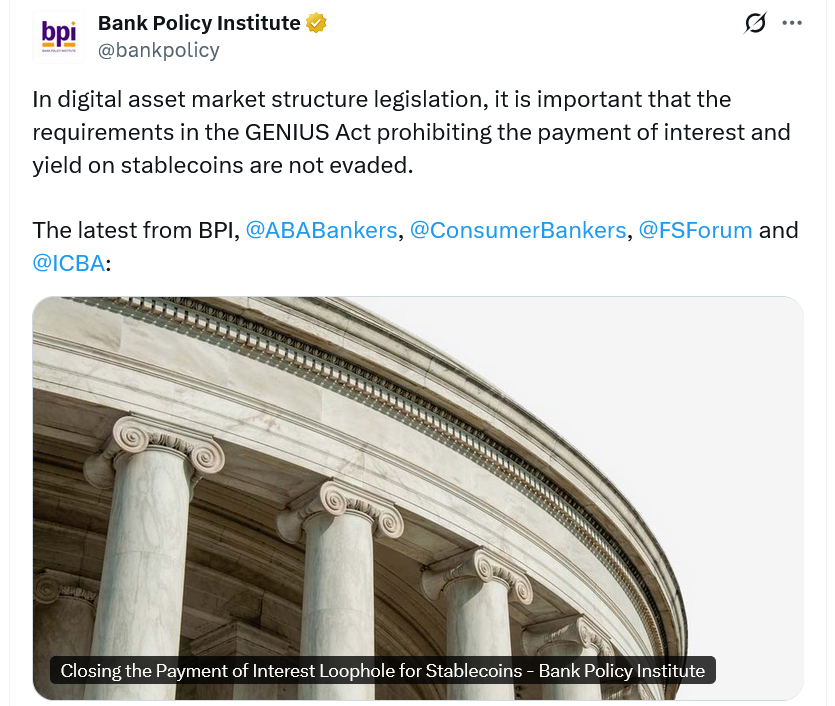

Источник: Институт банковской политики

Предложение доходности — один из главных маркетинговых ходов эмитентов стейблкоинов для привлечения пользователей. Некоторые предлагают доходность изначально для держателей, в то время как другие, например, пользователи USDC Circle, получают вознаграждение за хранение стейблкоина на таких биржах, как Coinbase и Kraken.

Банковские группы, по-видимому, обеспокоены тем, что широкое распространение доходных стейблкоинов может подорвать банковскую систему, которая опирается на привлечение банками депозитов с помощью сберегательных продуктов с высокой процентной ставкой для обеспечения выдаваемых ими кредитов.

Банкиры утверждают, что стейблкоины могут подорвать кредитную систему

В письме, подписанном также Американской ассоциацией банкиров, Ассоциацией банков-потребителей, Независимыми общественными банкирами Америки и Форумом финансовых услуг, BPI отметила, что стейблкоины принципиально отличаются от банковских депозитов и фондов денежного рынка, поскольку они не финансируют кредиты и не инвестируют в ценные бумаги для получения доходности.

«Эти различия объясняют, почему платежные стейблкоины не должны выплачивать проценты так, как это делают строго регулируемые и контролируемые банки по депозитам, и не должны предлагать доходность, как фонды денежного рынка», — говорится в письме.

Разрешение выплаты процентов или доходности по стейблкоинам может привести к оттоку депозитов в размере $6,6 трлн, отмечает BPI, ссылаясь на апрельский отчет Министерства финансов США.
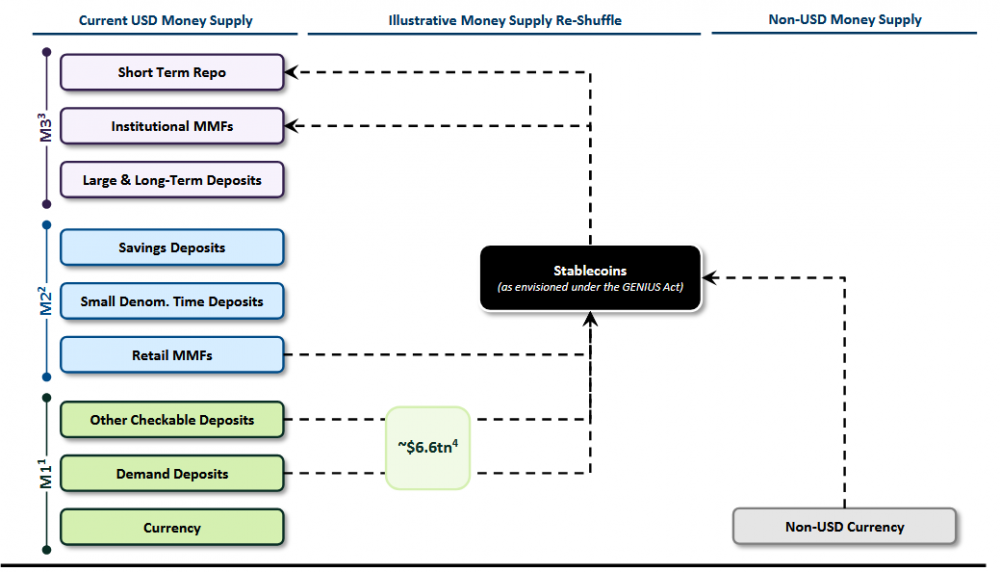

Диаграмма, иллюстрирующая, как денежная масса может «перетасоваться» в стейблкоины в соответствии с Законом GENIUS. Источник: Министерство финансов США

BPI добавила, что столь значительные изменения в финансовой системе могут представлять серьезный риск для кредитной системы Америки.

«В результате возрастет риск оттока депозитов, особенно в периоды стресса, что подорвет процесс кредитования во всей экономике. Соответствующее сокращение предложения кредитов означает более высокие процентные ставки, меньшее количество кредитов и увеличение расходов для крупных предприятий и домохозяйств», — говорится в письме.

Рынок стейблкоинов по-прежнему составляет лишь малую часть денежной массы США

Общая рыночная капитализация стейблкоинов в настоящее время составляет $280,2 млрд, что составляет лишь малую часть от денежной массы в долларах США, которая, по данным Федеральной резервной системы, на конец июня составляла $22 трлн.

По данным CoinGecko, на рынке стейблкоинов более 80% занимают Tether (USDT) и USD Coin (USDC): их объем составляет $165 млрд и $66,4 млрд соответственно.

18 июля президент США Дональд Трамп подписал закон GENIUS Act, который, по мнению многих аналитиков криптоиндустрии, усилит доминирование доллара США, способствуя развитию стейблкоинов, привязанных к доллару, что позволит им конкурировать с другими валютами и укрепить роль доллара как ведущей мировой резервной валюты.

Казначейство США ожидает, что рынок стейблкоинов вырастет до $2 трлн к 2028 году.

Letture associate

Playnance’s $GCOIN Lists on KoinBX Amid Rapid Growth in India

Playnance's native token, $GCOIN, has been listed on the cryptocurrency exchange KoinBX as of June 18. This move aims to enhance accessibility for its rapidly growing community, particularly in India, where the blockchain-powered Web3 iGaming ecosystem has gained significant traction. Over 130 partners in Playnance's "Be the Boss" program have built communities engaging thousands of active players in the region. The "Be the Boss" model allows participants to create and manage their own gaming communities, earning rewards tied to community activity. CEO Pini Peter noted India's high engagement, with community leaders successfully building player networks. One partner, Dr. Nicolas, reported earning over $57,000 through the program in recent months, highlighting both the financial rewards and the opportunity to grow an engaged community. $GCOIN serves as the ecosystem's core utility token, incentivizing participation and aligning the interests of players and community leaders ("Bosses"). The listing on KoinBX is part of Playnance's strategy to expand globally, increasing the token's utility and accessibility by combining community ownership, gamified engagement, and blockchain-based incentives. Founded in 2020, Playnance is a Web3 iGaming infrastructure company focused on creating live, non-custodial, on-chain products to onboard mainstream users. It currently processes approximately one million transactions daily, aiming to simplify the user experience while maintaining full on-chain transparency.

TheNewsCrypto40 min fa

Playnance’s $GCOIN Lists on KoinBX Amid Rapid Growth in India

TheNewsCrypto40 min fa

STRC Hits Historic Low, Saylor's Perpetual Motion Machine Grinds to a Halt

STRC, the perpetual preferred stock issued by MicroStrategy to fund its Bitcoin purchases, hit a historic low of $85.32, a 17% discount to its $100 par value. Designed as a "digital credit engine" to trade stably near par and enable continuous share issuance for buying Bitcoin, its plunge signals a breakdown in this model. Three key factors drove the decline: 1. Bitcoin's price fell over 50% from its peak, trading around $63,000 amid hawkish Fed signals. 2. MicroStrategy's cash reserves were depleted after a $1.5 billion convertible note repayment, slashing the dividend coverage for STRC's 11.5% yield to ~7 months. The company then sold 32 BTC to cover dividends—Michael Saylor's first Bitcoin sale since 2022—damaging the "never sell" narrative. 3. A competing Bitcoin-backed preferred stock, Strive's SATA, offers a higher yield (~13%) and daily dividends, drawing investors away from STRC. The drop triggers a negative cycle: STRC below par halts ATM share issuances, cutting off a key funding source for Bitcoin buys and potentially forcing more BTC sales for dividends, further eroding confidence. While Saylor argues the model is mathematically sound—needing only 2.3% annual Bitcoin growth to sustain itself—the market is testing the resilience of the leveraged Bitcoin treasury strategy in a bear market. The STRC price now reflects rising skepticism about this financial machinery's durability during downturns.

marsbit1 h fa

STRC Hits Historic Low, Saylor's Perpetual Motion Machine Grinds to a Halt

marsbit1 h fa

A Guide to Grayscale’s ‘Bottom Fishing’: Using Cash Flow to Assess Cryptocurrency Value

**Title:** Grayscale's Guide to Bottom-Fishing: Valuing Cryptoassets Using Cash Flows **Summary:** This report by Grayscale Research presents a fundamental valuation framework for cryptocurrency assets, moving beyond pure speculation to analyze those with underlying cash flows. It distinguishes between "commodity-like" assets (e.g., Bitcoin) and "cash-flow" assets, primarily within DeFi. Using the leading decentralized lending protocol Aave as a case study, the analysis applies traditional financial methodologies like Discounted Cash Flow (DCF) and Price-to-Earnings (P/E) multiples. Key findings indicate that AAVE tokens are currently undervalued. Despite recent challenges, the protocol's strong revenue growth, ~50% net profit margin, and diversified treasury support a fundamental valuation range of $80-$100 per token (compared to a ~$75 market price at the time of writing). In a base-case scenario driven by stablecoin adoption and regulatory clarity, the fair value could rise to around $175 within a year. The report emphasizes that protocol success does not automatically translate to token value. It critically examines the "value capture" mechanisms—such as buybacks, burns, and staking rewards—that channel protocol profits to token holders. Furthermore, it addresses the legal and governance complexities of Decentralized Autonomous Organizations (DAOs), noting their difference from traditional corporate equity but highlighting how robust, transparent governance can align protocol economics with holder interests. The conclusion is that the crypto market is maturing, with capital increasingly flowing towards projects with demonstrable fundamentals, real adoption, and disciplined capital allocation, creating opportunities for value-based investors.

marsbit2 h fa

A Guide to Grayscale’s ‘Bottom Fishing’: Using Cash Flow to Assess Cryptocurrency Value

marsbit2 h fa

After semiconductors lead the gains, are funds buying into AI orders or a macroeconomic rebound?

After US-Iran talks led to a temporary ceasefire and framework for reopening the strategic Strait of Hormuz, U.S. stocks rose on June 18, with the Nasdaq gaining 1.9%. The semiconductor and AI hardware sectors outperformed. This rally stemmed primarily from reduced geopolitical risk, which lowered oil prices and inflation expectations, easing discount rate pressure on high-valuation growth stocks like tech. The key question is not whether tech rebounded, but the nature of the rebound. The market appears to be selectively repricing AI infrastructure plays rather than broadly chasing AI narratives. Gains were concentrated in chips, optical interconnects, memory, and domestic manufacturing—segments tied to tangible data center build-outs and capital expenditure. Intel's ~10% surge, fueled by a Trump statement about potential Apple collaboration, exemplifies this mixed dynamic. It reflects policy catalysts and domestic manufacturing sentiment more than confirmed fundamentals. Meanwhile, strong earnings from companies like Astera Labs (revenue up 93% YoY) provided concrete evidence of AI-driven demand in hardware. In essence, the rally represents a risk-premium recalibration. Lower Middle East tensions opened a valuation repair window, and capital flowed first into AI infrastructure segments with visible near-term revenue streams. The sustainability of this move hinges on upcoming Q2 earnings, specifically continued strength in cloud provider capex, AI server orders, and hardware company guidance. Policy hopes alone are insufficient; the cycle needs validation from orders and financials.

marsbit2 h fa

After semiconductors lead the gains, are funds buying into AI orders or a macroeconomic rebound?

marsbit2 h fa

Trading

Spot
Futures
活动图片