灰度研究院:机构涌入、监管放行,以太坊强势崛起背后的多重利好

深潮Published on 2025-08-04Last updated on 2025-08-05

未来几个月的加密资产前景依然非常乐观。

撰文:grayscale

编译:白话区块链

2025 年 7 月,以太坊网络的 ETH 价格飙升近 50%。投资者们将目光聚焦在稳定币、资产代币化以及机构采用上——这些领域正是以太坊作为最古老的智能合约平台区别于其他竞争者的核心优势。

《GENIUS 法案》的通过对稳定币和整个加密资产类别来说是一个里程碑时刻。虽然市场结构相关立法在国会通过可能还需时日,但美国监管机构可以通过其他政策调整继续支持数字资产行业发展,例如批准加密投资产品中的质押功能。

短期内,加密资产估值可能会出现盘整,但我们对未来几个月的资产类别前景依然非常看好。加密资产为投资者提供了接触区块链创新的机会,同时可能对传统资产的一些风险(如美元持续疲软)具有一定的免疫力。因此,比特币、ETH 及其他许多数字资产预计将继续受到投资者的追捧。

7 月 18 日,特朗普总统签署了《GENIUS 法案》,为美国稳定币提供了一个全面的监管框架。这标志着加密资产类别的「开端结束」:公共区块链技术正从实验阶段迈向受监管金融系统的核心。关于区块链技术能否为主流用户带来实际好处的争论已经结束,监管机构现已转向确保行业在增长的同时,加入适当的消费者保护和金融稳定机制。

7 月,加密市场因《GENIUS 法案》的通过而欢欣鼓舞,同时也受到有利宏观市场条件的支撑。全球大部分地区的股市指数上涨,固定收益市场的回报则由高风险板块引领,如美国高收益公司债券和新兴市场债券(见图表 1)。随着市场波动性下降,相关投资策略表现也相当不错。

富时 / 灰度加密资产市场指数(一个按市值加权的可投资数字资产指数)上涨了 15%,比特币价格则增长了 8%。而以太坊的 ETH 成为当月明星,价格暴涨 49%,自 4 月初低点以来累计涨幅超过 150%。

图表 1:以太坊在加密资产表现强劲的 7 月中大放异彩

别称这是「王者归来」

以太坊是市值最大的智能合约平台,也是区块链金融的基础设施。然而,直到最近,ETH 的价格表现远不如比特币,甚至落后于 Solana 等其他智能合约平台。这让一些人开始质疑以太坊的发展策略及其在行业中的竞争地位(见图表 2)。
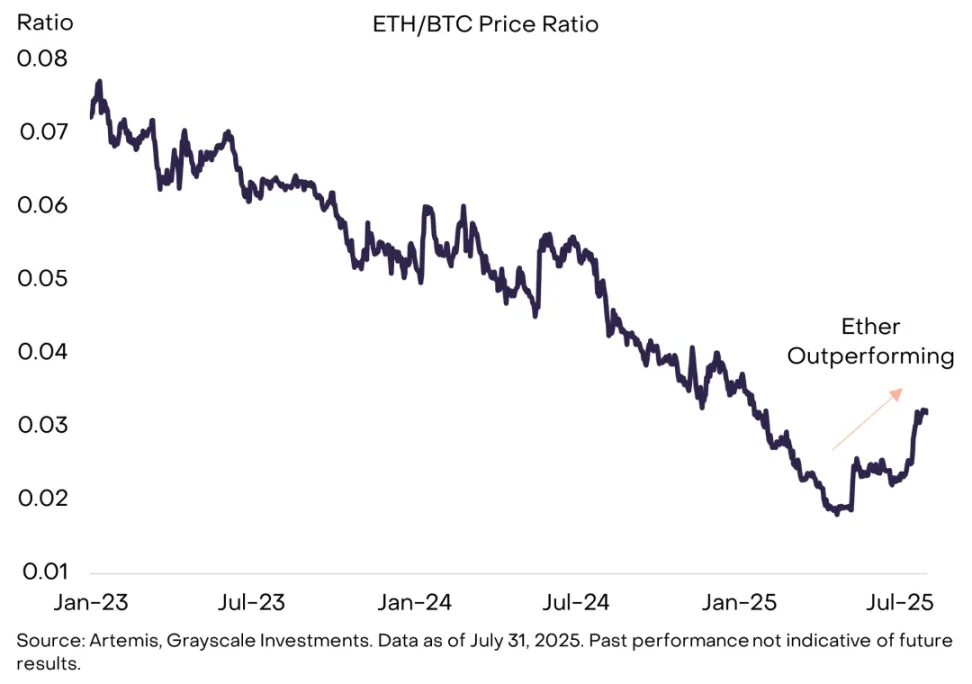
图表 2:自 5 月以来以太坊表现优于比特币

对以太坊和 ETH 的重新热情,可能反映了市场对稳定币、资产代币化和机构区块链采用的关注——这些是以太坊的强项(见图表 3)。例如,包含其 Layer 2 网络在内,以太坊生态系统承载了超过 50% 的稳定币余额,并处理约 45% 的稳定币交易(按美元价值计算)。

以太坊还是去中心化金融(DeFi)协议中约 65% 锁仓价值的所在地,以及近 80% 的代币化美国国债产品所在地。对于包括 Coinbase、Kraken、Robinhood 和索尼在内的许多构建加密项目的机构来说,以太坊一直是首选网络。
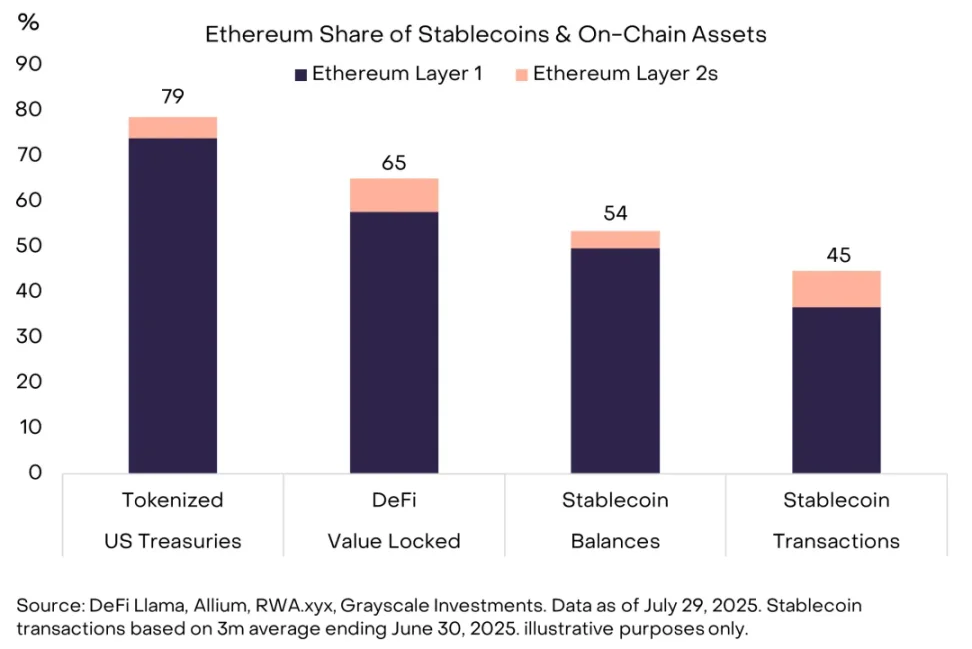
图表 3:以太坊是稳定币和代币化资产的领先区块链

稳定币和代币化资产的采用增加,将惠及以太坊及其他智能合约平台。灰度研究认为,稳定币通过更低的成本、更快的结算时间和更高的透明度,有望颠覆全球支付行业的某些领域(更多背景信息见《稳定币与未来支付》)。

稳定币相关收入有两种:一是稳定币发行商(如 Tether、Circle)赚取的净利差(NIM),二是处理交易的区块链所赚取的交易费用。由于以太坊在稳定币领域已占据领先地位,其生态系统似乎将通过更高的交易费用从稳定币采用的增长中受益。

代币化(将传统资产上链的过程)也是如此(更多背景信息见《公共区块链与代币化革命》)。当前代币化资产市场规模较小(约 120 亿美元),但增长潜力巨大。代币化的美国国债是目前最大的代币化资产类别,而以太坊是市场领导者。在另类资产领域,Apollo Global 最近与 Securitize 合作推出了链上信贷基金。

此外,代币化股权市场虽小但在增长:Robinhood 推出了 SpaceX 和 OpenAI 等私营公司的代币化股份,eToro 也计划在以太坊上代币化股票。Apollo 的产品在多个区块链上可用,而 Robinhood 和 eToro 的代币化股权产品则在以太坊生态系统中。

ETP 热潮与更多趋势

投资者对以太坊的兴趣带来了现货 ETH 交易所交易产品(ETP)的大量净流入。7 月,美国上市的现货 ETHETP 净流入 54 亿美元,这是自这些产品去年推出以来最大的单月净流入(见图表 4)。

目前,ETHETP 持有约 215 亿美元的资产,相当于近 600 万枚 ETH,约占总流通量的 5%。根据 CFTC 的交易者持仓报告数据,我们估计只有 10 亿至 20 亿美元的 ETHETP 净流入来自对冲基金的「基差交易」,其余为长期资本。
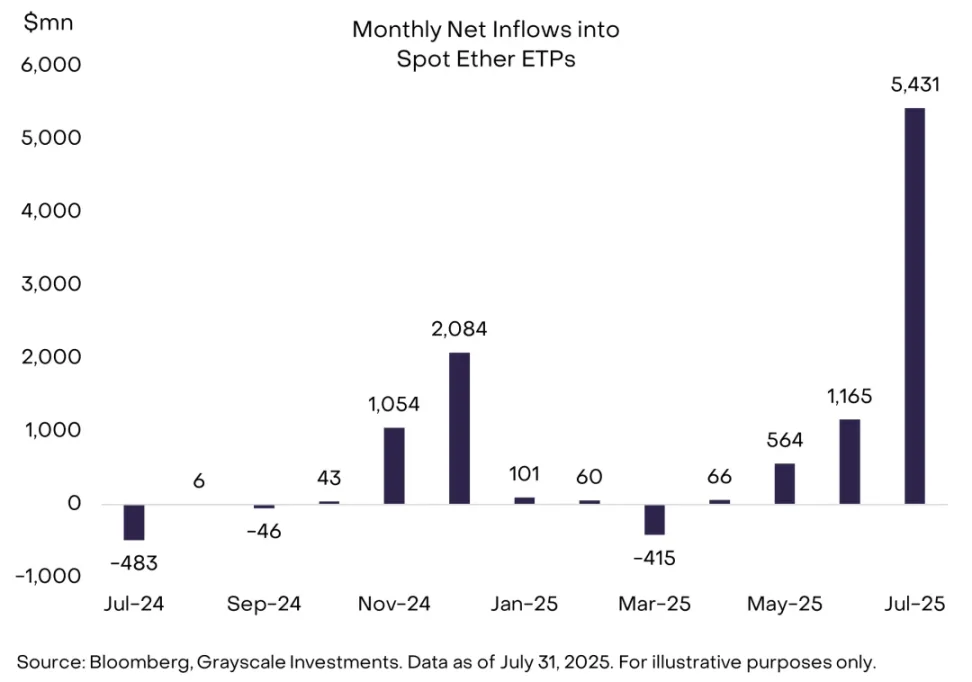
图表 4:ETHETP 净流入超过 50 亿美元

一些上市公司也开始积累 ETH,以便通过股权工具获得代币的使用权。持有 ETH 最大的两家「加密资金管理公司」分别是 Bitmine Emersion Technologies ($BMNR) 和 SharpLink Gaming ($SBET)。这两家公司合计持有超过 100 万 ETH,总价值 39 亿美元。

第三家上市公司 BTCS ($BTCS) 在 7 月下旬表示,计划通过发行普通股和优先股筹集 20 亿美元用于额外购买 ETH(BTCS 目前持有约 7 万 ETH,价值约 2.5 亿美元)。除了 ETH ETP 产品的净流入外,来自以太坊企业资金管理公司的购买压力可能也推动了价格上涨。

此外,以太坊在本月加密货币衍生品市场的份额有所增长,表明市场对该资产的投机兴趣正在上升。在芝加哥商品交易所 (CME) 上市的传统期货中,ETH 期货的未平仓合约 (OI) 增至比特币 (BTC) 期货未平仓合约的 40% 左右(图表 X)。在永续期货合约中,ETH 的未平仓合约数量增至比特币 (BTC) 未平仓合约数量的 65% 左右。本月,以太币永续期货的交易量也超过了比特币永续期货。
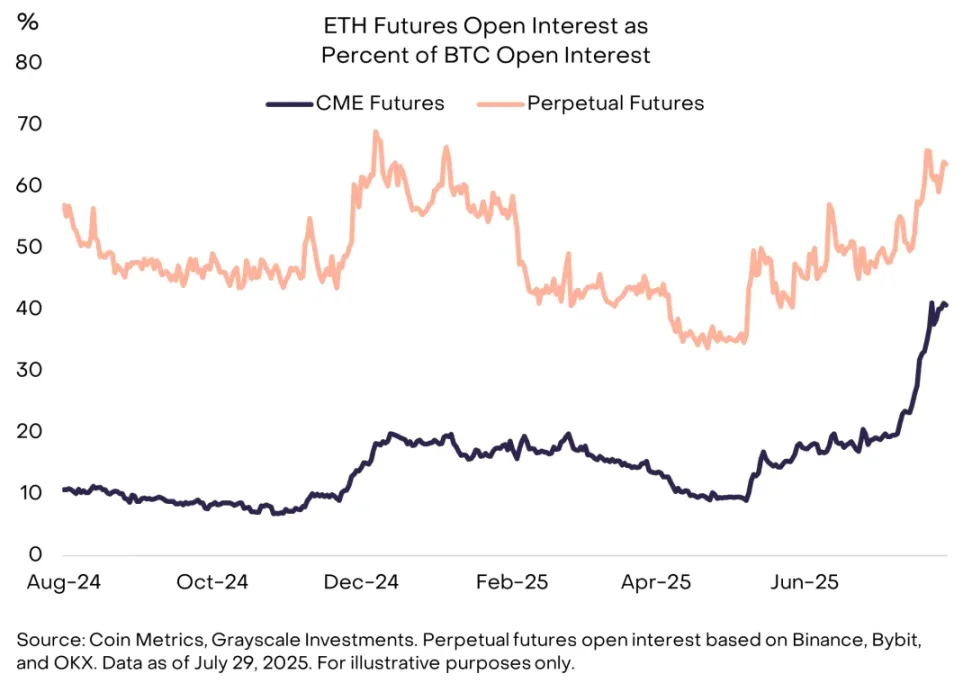
图 5:ETH 期货未平仓合约增加

尽管 ETH 在 7 月的大部分时间里备受关注,但比特币投资产品也持续受到投资者的稳定需求。在美国上市的现货比特币 ETP 净流入量达 60 亿美元,目前估计持有 130 万枚比特币。多家上市公司也扩展了其比特币资金管理策略。市场领导者 Strategy(前身为 MicroStrategy)发行了 25 亿美元的新型优先股,用于购买更多比特币。

此外,比特币早期先驱兼 Blockstream 首席执行官亚当·巴克宣布成立一家新的比特币资金管理策略公司——比特币标准资金管理公司($BSTR)。该公司将以巴克和其他早期采用者的比特币作为资本,并将筹集股本。BSTR 的交易与早先由 Cantor Fitzgerald 为 Twenty One Capital 组织的 SPAC(特殊目的收购公司)交易非常相似——Twenty One Capital 是另一家由 Tether 和软银支持的大型比特币资金管理策略公司。

加密资产热潮

7 月,加密市场各板块的估值均有所上涨。从加密资产板块角度看,表现最佳的是智能合约板块(得益于 ETH49% 的涨幅),而表现最差的是人工智能板块,受少数代币的特殊疲软拖累(见图表 6)。7 月期间,许多加密资产的期货未平仓量和融资利率(杠杆多头头寸的融资成本)均上升,表明投资者风险偏好增强且投机性多头头寸增加。
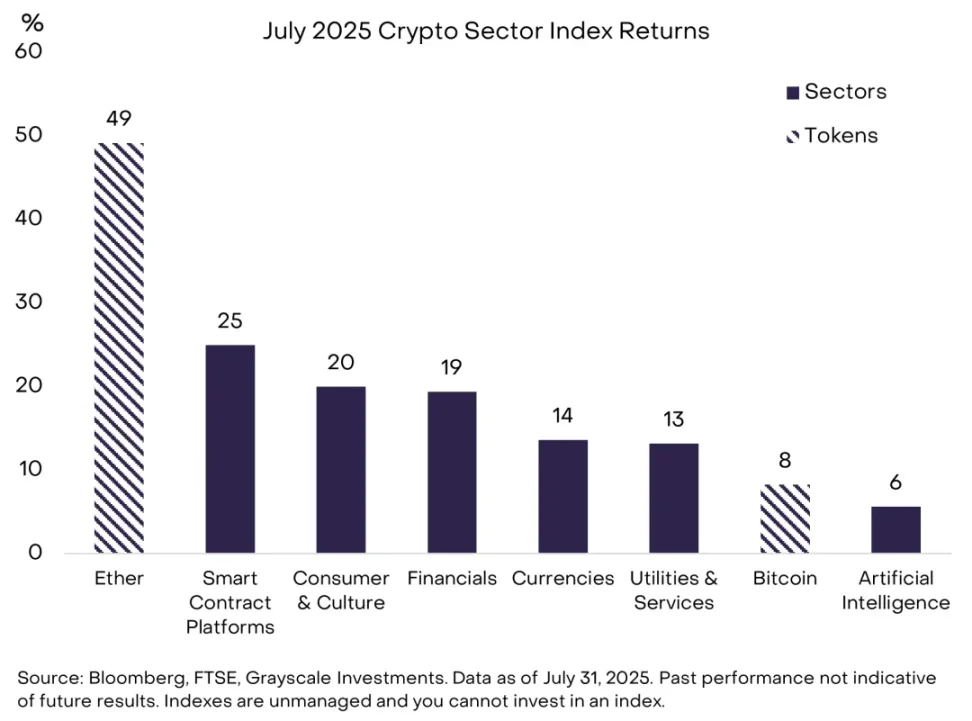
图表 6:7 月所有加密市场板块均上涨

在经历强劲回报后,估值可能会出现一定程度的回调或盘整。《GENIUS 法案》的通过是加密资产类别的重大利好,推动了绝对和风险调整后的回报。国会还在考虑加密市场结构立法,众议院的《CLARITY 法案》已于 7 月 17 日获得两党支持通过。然而,参议院正在审议自己的市场结构立法版本,预计 9 月前不会有明显进展。因此,短期内支持加密资产估值上涨的立法催化剂可能较少。

小结

尽管如此,我们对未来几个月的加密资产前景依然非常乐观。首先,即使没有立法,监管顺风依然存在。例如,白宫最近发布了一份关于数字资产的详细报告,提出了 94 项支持美国数字资产行业发展的具体建议。其中 60 项属于监管机构管辖范围(其余 34 项需要国会或国会与监管机构共同行动)。通过监管机构的支持,加密投资产品(如质押功能或更广泛的现货加密 ETP)可能吸引新资本进入该资产类别。

其次,我们预计宏观环境将继续利好加密资产。这些资产为投资者提供了接触区块链创新的机会,同时对传统资产的某些风险(如美元持续疲软)具有一定免疫力。除了 7 月通过的加密相关立法,特朗普总统还签署了《One Big Beautiful Bill Act》,锁定未来十年的大规模联邦预算赤字。

他还明确表示希望美联储降低利率,强调美元走弱将利好美国制造业,并提高了对多种产品和贸易伙伴的关税。大规模预算赤字和较低的实际利率可能继续压低美元价值,特别是得到白宫的隐性支持时。像比特币和 ETH 这样的稀缺数字商品可能因此受益,并在面临美元持续疲软风险的投资组合中充当部分对冲工具。


Related Reads

Both Suffer Massive Losses Exceeding $90 Billion, Which Is in Greater Peril: Strategy or Bitmine?

Facing massive paper losses exceeding $90 billion each amidst a sharp market downturn, "Digital Asset Treasury" (DAT) giants Strategy and Bitmine find themselves in a precarious position, but with different underlying risks. Strategy, heavily invested in Bitcoin (BTC), faces significant financial strain. Its strategy relies heavily on debt, including convertible notes and preferred stock (STRC) requiring substantial dividend payments. With its cash reserves dwindling and BTC offering no staking yield for cash flow, Strategy's high leverage makes it vulnerable. A continued price decline could force asset sales to meet obligations, potentially creating a negative feedback loop. Its market value has already fallen sharply. In contrast, Bitmine, an Ethereum (ETH) holder, appears on firmer financial ground. It primarily funds its purchases through equity offerings (like ATM programs), avoiding debt pressure. It also generates income by staking a large portion of its ETH holdings. While not immune to market drops and shareholder dilution concerns, Bitmine maintains more flexibility, recently announcing a new preferred share offering to raise further capital. The core divergence lies in their financing: Bitmine uses equity (investor money), while Strategy uses debt (borrowed money). Consequently, Bitmine currently faces less immediate liquidity pressure than Strategy, which must navigate the dual challenge of servicing debt/dividends and a declining core asset (BTC) price.

marsbitHá 4m

Both Suffer Massive Losses Exceeding $90 Billion, Which Is in Greater Peril: Strategy or Bitmine?

marsbitHá 4m

Where the AI Bubble Really Is: Which Layer of Players Are Naked

AI Bubble: Where It Really Is and Who's Swimming Naked This analysis dissects the AI industry not as a single entity but as a five-layer pyramid, arguing that bubbles are concentrated in specific tiers, not uniformly distributed. **Key Distinction from the 2000 Dot-com Bubble:** Unlike 2000, where companies had stock prices before revenue, today's leading AI players have massive, contract-backed revenue driving their valuations. Core infrastructure demand is real, with every GPU running at full capacity for paying customers. **The Five-Layer Pyramid & Bubble Assessment:** * **L0 (Fab/Manufacturing) & Top L4 (Leading AI Apps): NO BUBBLE.** Companies like TSMC, NVIDIA, major cloud providers (Microsoft, Google, Meta, Amazon), and top AI labs have real revenues and orders. Supply is tightly constrained by TSMC's disciplined capacity control and physical limits like power/land for data centers, preventing a supply glut. * **L1 (Memory): BATTLEGROUND.** Sky-high HBM margins could signal a new structural cycle or a classic "boom before bust." The oligopoly of three major players may enforce supply discipline, making this a high-stakes bet. * **L2 (Interconnect/Optical Modules): BUBBLE TERRITORY.** Companies like Lumentum and AAOI have seen stock surges (4-10x) far outpacing revenue growth. This hardware segment has lower physical barriers to expansion than fabs, allowing speculation. It mirrors the 2000 bubble's epicenter—optics. * **L3 (Infrastructure/"GPU Landlords"): VULNERABLE.** GPU leasing companies profit from the current compute shortage but own no long-term moat. Their business model relies on a temporary bottleneck that will ease as big tech expands and new tech (e.g., potential space-based data centers) emerges. * **L4 Long Tail (VC-backed Startups): STRONG BUBBLE SIGNALS.** VC funding concentration in AI is twice that of the 1999 peak. Many startups with little revenue use the valuation logic of successful giants to justify their own, creating high risk of a "valuation crunch" when funding dries up. **Critical Risks to Monitor:** 1. **GPU Depreciation & Accounting:** Companies extending the assumed useful life of GPUs artificially boost profits. The true economic life depends on future generational leaps from NVIDIA. 2. **"GPU Credit" & Off-Balance-Sheet Leverage:** Emerging structures where shell companies borrow to buy GPUs and lease them out (with chipmakers sometimes investing) move debt off major balance sheets. This echoes the "vendor financing" of 2000 and the securitization risks of 2008, though currently small-scale. 3. **TSMC Abandoning Caution:** If the primary supply bottleneck (TSMC's conservative capacity planning) breaks, runaway supply could trigger a bust. 4. **Algorithmic Efficiency Breakthrough:** A major leap in software efficiency could drastically reduce the need for raw compute hardware, undermining the investment thesis. **Conclusion:** The AI boom is expensive and has frothy areas, but its core is underpinned by real demand and physical supply constraints. The bubble risk is layered: most present in optical components, GPU leasing, and the long-tail startup ecosystem, while the foundational chip manufacturing and leading application layers remain relatively solid—for now.

marsbitHá 17m

Where the AI Bubble Really Is: Which Layer of Players Are Naked

marsbitHá 17m

Standing in the Light: A Comprehensive Guide to the Optical Module and CPO Supply Chain

"Standing in the Light: Understanding the Optical Module and CPO Industry Chain" This article analyzes the critical role of optical communication technology, specifically optical modules and Co-Packaged Optics (CPO), as the "nervous system" for modern AI data centers. With exponential growth in AI computational demands (e.g., NVIDIA's Vera Rubin architecture), traditional electrical interconnects using copper cables face severe bottlenecks in bandwidth, power consumption, and signal integrity over distance. The core function of an optical module is to act as a "translator," converting electrical signals from chips into optical signals for transmission over fiber (and vice-versa). Key internal components include lasers, modulators, photodetectors, drivers, and DSP chips. The industry is currently transitioning from 800G to 1.6T modules. However, the future lies in CPO. This next-generation technology integrates the optical engine directly with the switch ASIC/XPU on the same package substrate, drastically reducing power consumption (by ~3.5x according to NVIDIA), overcoming bandwidth density limits, and minimizing signal attenuation compared to traditional pluggable modules. Key challenges for CPO include advanced packaging capacity (dominated by TSMC), thermal management, repairability, and standardization. The article details the broader technology landscape, including Near-Packaged Optics (NPO, a pragmatic intermediate step), Linear-drive Pluggable Optics (LPO), Optical I/O (OIO for chip-level integration), and Optical Circuit Switches (OCS). A comprehensive CPO industry chain is mapped, highlighting shifting power dynamics: * **Architecture Definers:** NVIDIA, Broadcom, and Marvell now hold greater influence. * **Advanced Packaging & Manufacturing:** TSMC is central; Fabrinet is a key EMS player. * **Lasers ("The Heart"):** A strategic bottleneck. EML lasers are led by Lumentum and Coherent (both receiving major NVIDIA investments). CW lasers, favored for CPO/silicon photonics, see strong Chinese players like Source Photonics and Sicoya. * **Silicon Photonics Chips:** The mainstream path for CPO engines, with key players like Broadcom, Intel, Marvell, and China's Accelink. * **Fiber Connectivity Components:** A major new, high-growth market created by CPO, including Fiber Array Units (FAU), Polarization-Maintaining Fiber (PMF), and MPO connectors. Companies like Tianfu Communication and US Conec are leaders. * **Fiber & Cable:** Experiencing a super-cycle (e.g., Corning, Yangtze Optical Fiber). * **PCB/Substrates:** Requiring advanced materials (e.g., Shengyi Tech). * **DSP & SerDes:** Functions are integrated into switch ASICs in the CPO era (e.g., Broadcom, Astera Labs). * **Optical Module Makers:** Transitioning from standalone module suppliers to providers of optical engines and NPO/LPO solutions while riding the current pluggable boom (e.g., Zhongji Innolight, Eoptolink). The investment timeline is segmented: Short-term (2026-2027) features the "last feast" for pluggable modules and CPO's initial rollout. Medium-term (2027-2029) will see CPO expand and NPO peak. Long-term (2029-2032+) involves CPO/OIO penetration into intra-rack scaling. In conclusion, optical interconnects are fundamental to AI infrastructure. The competitive landscape sees US firms leading in architecture and high-end chips, TSMC in advanced packaging, and Chinese firms holding strong positions in modules, connectivity components, CW lasers, and fiber/cable. The future belongs to companies that can navigate the technological shift from "selling shovels" (modules) to "building highways" (CPO/OIO infrastructure).

marsbitHá 27m

Standing in the Light: A Comprehensive Guide to the Optical Module and CPO Supply Chain

marsbitHá 27m

Trading

Spot
Futures

Hot Articles

Discussions

Welcome to the HTX Community. Here, you can stay informed about the latest platform developments and gain access to professional market insights. Users' opinions on the price of ETH (ETH) are presented below.

活动图片












