SNS Insider Report: B2B Digital Payment Sector to Break $27T by 2032: $BEST to Soar?

bitcoinistPublished on 2025-08-04Last updated on 2025-08-04

Abstract

The B2B digital payment market’s value could reach $27.8T by 2032, with AI and blockchain technology paving the way for...

Trusted Editorial content, reviewed by leading industry experts and seasoned editors. Ad Disclosure

The B2B digital payment market’s value could reach $27.8T by 2032, with AI and blockchain technology paving the way for safer and faster transactions.

As the digitization of global transactions grows exponentially, we can expect crypto wallets like Best Wallet and its Best Wallet Token ($BEST) to capitalize on this development.

B2B Digital Payments: Answering the Call for Fast and Secure Transactions

Consulting company SNS Insider revealed in its report that it expects the B2B digital payment market to expand from $8T in 2024 to as much as $27.8T by 2032, translating to a compound annual growth rate (CAGR) of 16.79%.

The increasing demand for fast, secure, and transparent means of transactions in digital commerce and digital remittances will drive this growth worldwide.

S&N Insider projects that North America will register the fastest CAGR from now until 2032, with Canada potentially leading the increase in B2B digital payments in the region.
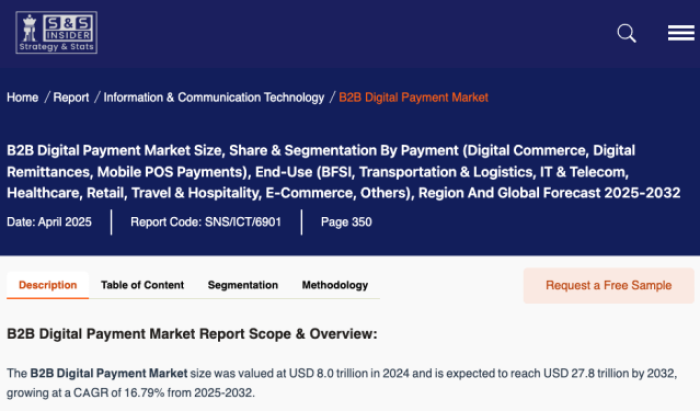
SNS Insider report snippet.

But the digitization of B2B payments also comes with risks, such as data breaches, phishing, fraud, and ransomware. This is where AI and blockchain technology will come into play.

According to the report, AI can help detect fraud, speed up the invoicing process, and personalize payment experiences. Meanwhile, blockchain will allow for the creation of transaction records that are secure, transparent, and permanent.

Growing Adoption of Digital Payments Benefits Best Wallet

The adoption of digital payments for B2B transactions will naturally spill over to the consumer space as well. While a lot of people use online banking and other online payment platforms every day, demand for crypto payment services is sure to grow, too.

This, in turn, will boost the need for crypto wallets. Aiming to grab a huge chunk of the market by 2026, Best Wallet is making waves with its mobile-based, non-custodial crypto wallet.

It’s available for both iOS and Android devices, making it ideal for those looking for convenience. With the app installed on your phone, you no longer need to carry a separate device for storing your crypto and using it for your everyday transactions.
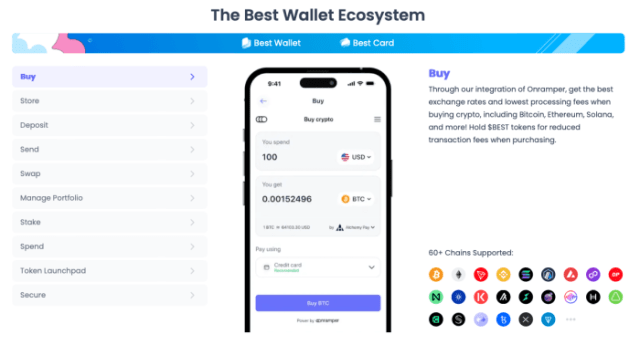
Best Wallet Ecosystem.

As a non-custodial wallet, Best Wallet ensures that only you have access to your private keys. This is crucial because these keys are used to sign your transactions and prove ownership of your crypto.

While crypto storage is its main selling point, Best Wallet offers other features too. You can use it to manage your portfolio, as well as swap, trade, and buy crypto. You can even join the best crypto presales via its Token Launchpad.

To get the most out of these features, get its native Best Wallet Token ($BEST). You’ll enjoy exclusive perks, like reduced transaction fees, higher staking rewards, early access to presales, and the ability to vote on key decisions within the Best Wallet ecosystem.

You can also choose to stake your $BEST tokens after you purchase them. The team currently offers a reward rate of 93% p.a., a compelling incentive to support the project.

Each token costs just $0.025435, which gives you an affordable way to invest in the growth of the crypto market. You can go to its official presale page to buy yours now, or check out our Best Wallet Token buying guide for more details.

But act quickly, as the token’s price will increase tomorrow.

To learn more about the presale, read the Best Wallet Token whitepaper.

There’s No Turning Back—Digital Payments are Here

As digital payments offer a fast and safe way to transfer funds, it will only be a matter of time before all businesses fully embrace them. Blockchain technology will play an important role, too, as it adds a layer of transparency to transactions.

Of course, these developments will have an impact on consumer payments too, which is where Best Wallet comes in. As a user-friendly and secure mobile crypto wallet, it’s well-positioned to capture a share of the growing crypto wallet market, boosting the value of its Best Wallet Token ($BEST).

Disclaimer: Do your own research before you invest. This is not investment advice.

Editorial Process for bitcoinist is centered on delivering thoroughly researched, accurate, and unbiased content. We uphold strict sourcing standards, and each page undergoes diligent review by our team of top technology experts and seasoned editors. This process ensures the integrity, relevance, and value of our content for our readers.

Ben is a freelance writer specializing in crypto developments (mainly altcoins) and the intricate ways global economics shape the digital asset space. His B.Ed. in Education provides a unique foundation for his writing, enabling him to distill complex crypto concepts and market shifts into clear, digestible insights. This skill is key to helping readers adapt and apply their understanding to the ever-evolving world of crypto investment. Passionate about making crypto accessible, Ben crafts content designed to educate a broad audience, from current market events to the essential foundational knowledge that underpins them. His goal is to empower readers through understanding. When he’s not immersed in crypto analysis and breaking down complex topics, Ben is an avid Pokémon fan and enjoys all things Disney.

Related Reads

When US Giants Collectively "Defect" to Chinese AI Models

When Silicon Valley Giants Turn to Chinese AI Models to Cut Costs A surprising trend is emerging: major U.S. tech companies are significantly reducing AI costs by switching to Chinese models. Coinbase, the largest U.S. cryptocurrency exchange, reportedly halved its AI spending after migrating to China's GLM-5.2 and Kimi 2.7 models, despite increasing usage. They achieved this through a sophisticated three-part strategy: implementing an automatic routing system to select the most cost-effective model per task, boosting cache hit rates from 5% to 60% to reuse computations, and employing "context engineering" to provide AI with more precise, less cluttered information. They are not alone. AI startup Lindy switched from Claude to DeepSeek, saving millions, while Snowflake's tests found GLM-5.2 solved 66% of coding tasks compared to Claude Opus's 67%—but at a fraction of the cost (output pricing is 5-7 times lower). While the top Western models may offer slightly better stability, the massive price differential is leading many businesses to reconsider their value proposition. This shift signals a deeper change in the AI industry, moving beyond pure performance benchmarks to a fierce cost competition. As pressure mounts, even OpenAI and Anthropic have begun slashing prices. For users, this means more choices, lower costs, and a crucial lesson: using multiple models based on task complexity, optimizing with caching, and keeping contexts lean are now key to leveraging AI efficiently and affordably.

marsbit2m ago

When US Giants Collectively "Defect" to Chinese AI Models

marsbit2m ago

BIS Report Compliance Watch: The Real Risks of Stablecoins Are Not Just 'De-pegging'

BIS Report Compliance Observations: The real risks of stablecoins go beyond "depegging" The BIS report "Anchoring trust in money: innovation beyond stablecoins" argues that while stablecoins and tokenization offer efficiency gains, their primary risk lies in fitting into an identifiable, monitorable, accountable, and regulatable financial system. Money's trust stems not just from technology but from institutional arrangements: a common unit of account, guaranteed redemption at par, liquidity support, regulatory frameworks, and financial integrity requirements. Stablecoins, operating on permissionless blockchains with pseudo-anonymity and non-custodial wallets, create systemic compliance gaps: unclear customer identity, incomplete fund origins, unexplained transaction purposes, fragmented cross-chain paths, and ambiguous liability. On-chain transparency does not equal compliance transparency. Public addresses don't reveal identity or intent. While blockchain analytics aid law enforcement, they cannot replace routine, large-scale AML/CFT controls. Effective compliance requires a closed-loop process encompassing customer onboarding, transaction monitoring, investigation, reporting, and audit. Stablecoin risks are not confined to the blockchain; they re-enter the traditional financial system via on/off-ramps, exchanges, and payment institutions. This forces banks to monitor client accounts for activity linked to virtual assets. The future direction is not to prohibit innovation but to embed rules into the technology. Tokenized finance should integrate with the existing two-tier monetary system, embedding compliance—like customer identification, pre-transaction screening, and auditable data trails—directly into the transaction flow. For compliance professionals, the key takeaway is that any new financial instrument must answer core questions: Who identifies the customer? Who monitors transactions? Who handles exceptions? Who is liable? Compliance is not the antithesis of innovation but the essential infrastructure for its sustainable growth.

链捕手3m ago

BIS Report Compliance Watch: The Real Risks of Stablecoins Are Not Just 'De-pegging'

链捕手3m ago

When American Giants 'Defect' to Chinese AI Models

Summary: The trend of major U.S. technology firms adopting more cost-effective Chinese AI models is gaining momentum. A prime example is Coinbase, the largest U.S. cryptocurrency exchange, which reportedly halved its AI expenditure by switching to Chinese models GLM-5.2 and Kimi 2.7, while its usage volume increased. This was achieved through a sophisticated cost-saving system featuring intelligent model routing (selecting the most suitable model per task), dramatically improving cache hit rates from 5% to 60%, and implementing "Context Engineering" to streamline prompts. This shift is not isolated. Other companies like the AI startup Lindy and data cloud firm Snowflake are making similar moves, drawn by the significant price disparity. For instance, GLM-5.2 costs $1.40/$4.40 per million tokens (input/output), compared to $5/$25 for Claude Opus 4.7. While top Western models may offer slightly higher stability or speed in complex tasks, the performance gap is narrowing, making the price difference harder to justify for many enterprise use cases. The implications are significant for both businesses and individual users. It highlights the importance of a multi-model strategy based on task requirements, the value of caching and reusing outputs, and the effectiveness of providing concise context. Ultimately, this migration signals a potential reshaping of the AI industry's pricing model, moving competition from pure performance benchmarks to practical cost-effectiveness, with increased choice and downward price pressure benefiting end-users.

链捕手9m ago

When American Giants 'Defect' to Chinese AI Models

链捕手9m ago

Trading

Spot
活动图片