Снижение глобальной денежной массы M2 указывает на завершение бычьего цикла биткоина в конце сентября

cryptonews.ru2025-08-25 tarihinde yayınlandı2025-08-25 tarihinde güncellendi

Глобальная денежная масса M2 достигла пика в $114,8 трлн в конце июня, а к началу августа сократилась до $112,7 трлн, согласно данным Bgeometrics. Падение на 1,8% может показаться незначительным, но аналитики уже бьют тревогу — этот сигнал способен кардинально изменить траекторию биткоина.

M2 предсказывает пик биткоина в сентябре

Инвестор Brett обращает внимание на тревожную картину: глобальная денежная масса M2 сформировала и «более низкий максимум», и «более низкий минимум». Такая конфигурация часто предшествует началу нисходящего тренда.

Его анализ основан на корреляции между ценой биткоина и глобальной денежной массой M2 с лагом в 84 дня. По этой модели биткоин может достичь пика текущего цикла уже к концу сентября.
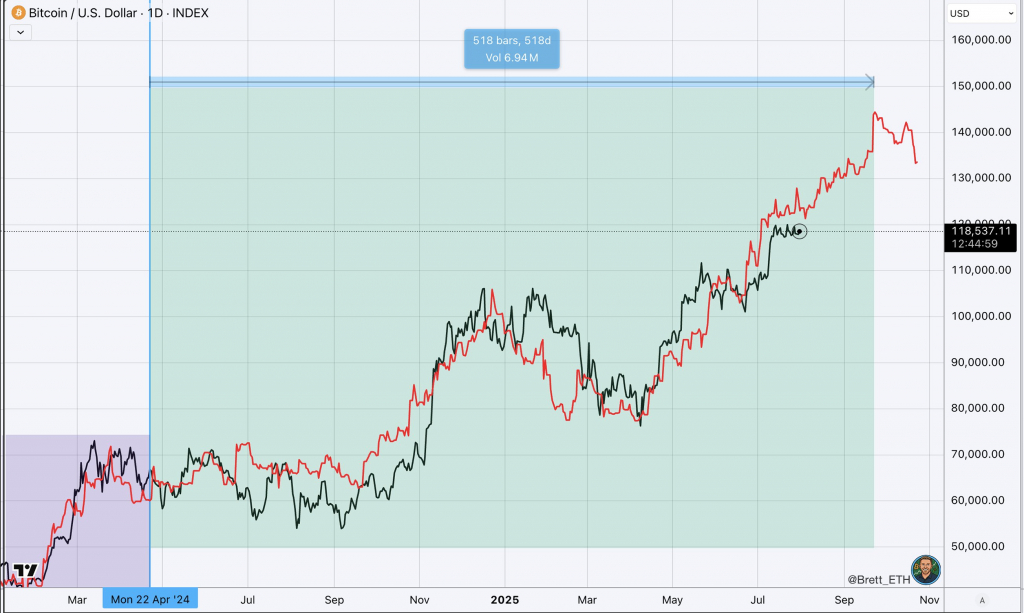
1-дневный график BTC/USD и M2 с учетом лага в 84 дня. Источник: Brett

«Глобальная M2 сформировала более низкий максимум и более низкий минимум. Используя 84-дневное смещение, текущий пик ожидается к концу сентября. Как я отмечал в своем декабрьском посте, три предыдущих пика биткоина произошли через 525–532 дня после халвинга. Текущий пик глобальной M2 наступил через 518 дней после халвинга. Совпадение?» — указал Brett.

Аналогичный прогноз: завершение цикла к началу октября

Аналитик Master Kenobi придерживается схожих взглядов, но использует 90-дневное смещение. Его прогноз еще более конкретен: текущий цикл биткоина завершится в октябре 2025 года, после чего последует значительная коррекция.
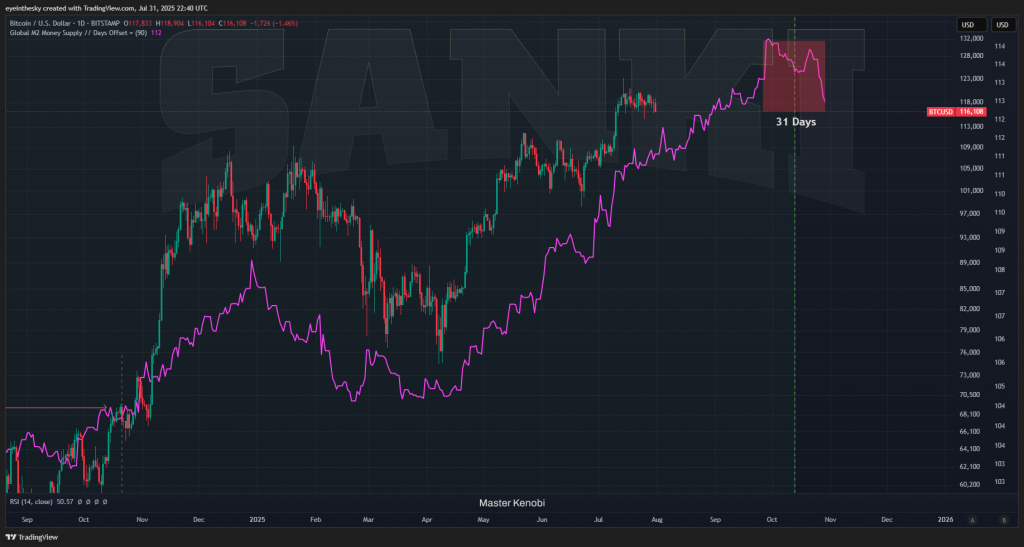
1-дневный график BTC/USD и M2 с учетом лага в 90 дней. Источник: Master Kenobi

«Судя по всему, денежная масса достигла своего локального пика 31 день назад и вошла в период спада. На основе данных M2, памп, означающий конец цикла, должен произойти между концом сентября и началом октября», — прогнозирует Master Kenobi.

Недавний разворот M2 заставляет аналитиков проявлять повышенную осторожность. Но не все спешат с выводами.

Голос скептика в хоре пессимистов

Colin Talks Crypto соглашается, что недавний откат M2 стал самым резким за последние семь месяцев. Однако он предупреждает о возможной недостоверности текущих данных.

Эксперт также признает, что сентябрь и октябрь могут стать критическими периодами, но не исключает вероятность того, что мы наблюдаем лишь промежуточный пик M2.
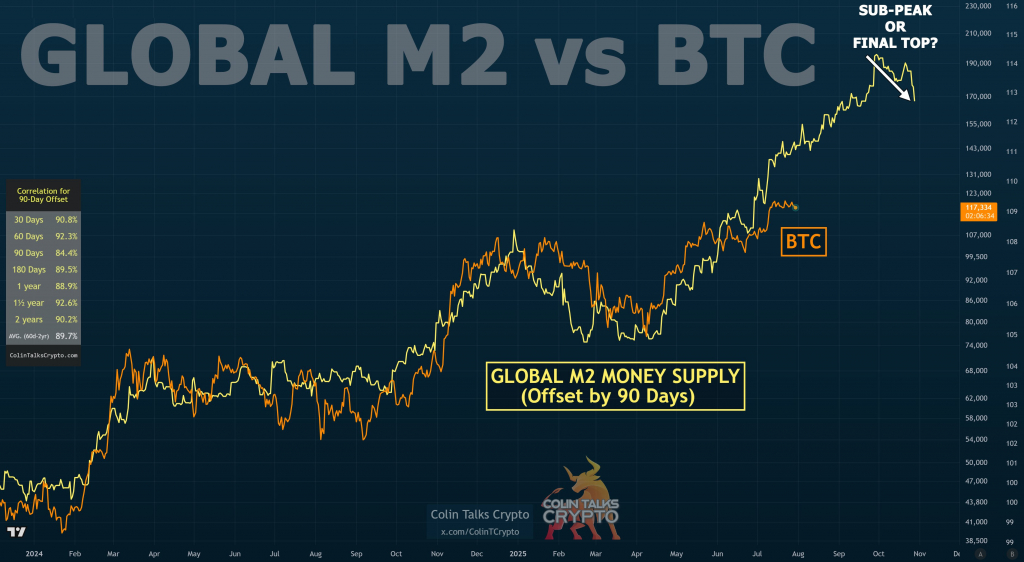
График BTC/USD и M2 с учетом лага в 90 дней. Источник: Colin Talks Crypto

«Вместо поспешных выводов на основе предварительных данных, думаю, лучшим решением будет внимательное наблюдение за глобальной линией M2 в течение следующих нескольких недель», — заявил Colin Talks Crypto.

Хотя прогнозы, основанные на 84–90-дневном смещении и цикле халвинга, рисуют тревожную картину, рынок остается под влиянием множества других факторов. Ключевые экономические события, такие как потенциальное снижение ставок ФРС, геополитические события и глобальные настроения инвесторов могут полностью изменить нынешний тренд.
İlgili Okumalar

Upbit is Anxious: A Hasty Counterattack Aimed at Regaining Stablecoin Market Share

Title: Upbit's Rushed Counterattack to Reclaim Stablecoin Market Share Facing a dramatic shift in South Korea's stablecoin market, leading exchange Upbit launched a promotional campaign from July 26 to August 9, waiving the 0.05% trading fee for stablecoins paired with the Korean Won (KRW) and rapidly listing new stablecoins like RLUSD and USDG. This move is a direct response to its plummeting market share in this sector. Historically a duopoly with Bithumb, the market has been reshaped since October 2025 when Coinone permanently removed fees for USDC trading. By June 2026, Coinone led with 34.8% of stablecoin volume, followed by Bithumb (31.1%) and Upbit (30.1%). This contrasts sharply with the overall crypto market, where Upbit commands 60%. The data shows stablecoin demand is highly sensitive to fees, as users primarily buy them to transfer capital overseas for derivatives trading or forex arbitrage. South Korean exchanges have seen a net outflow of stablecoins for 18 consecutive months, totaling approximately 14.9 trillion KRW, underscoring their role as a cross-border capital conduit. Upbit's limited-time promotion initially boosted its daily stablecoin volume by 162%, but the surge was almost entirely in USDT (98.1% of volume). The newly listed stablecoins saw negligible, fleeting interest. Furthermore, the promotional effect quickly waned in the second week, with volume dropping 33% on weekdays. A concurrent weakening of the KRW also contributed to the trading spike, independent of the fee waiver. The analysis suggests that once the promotion ends, Upbit is unlikely to retain its temporary gains unless it matches Coinone's permanent zero-fee policy, forcing a choice between market share and fee revenue. Upbit's strategic push may be less about immediate profit and more about preparing for future regulatory shifts. With South Korea's *Digital Asset Basic Act* on the horizon, which will regulate KRW-backed stablecoins, and following Dunamu's (Upbit's parent) integration into Naver Financial to build a payment ecosystem, securing a dominant position in the dollar stablecoin distribution channel holds long-term strategic value. However, potential regulatory conflicts could prevent Upbit from listing a future Naver-issued KRW stablecoin, making the current fight for dollar stablecoin flow even more critical.

marsbit4 saat önce

Upbit is Anxious: A Hasty Counterattack Aimed at Regaining Stablecoin Market Share

marsbit4 saat önce

Michael Saylor Compares Bitcoin and Gold!

Michael Saylor, founder of MicroStrategy, argues that Bitcoin fundamentally changes how wealth is stored and transferred by transforming digital scarcity into economic value. He describes Bitcoin as the first digital monetary network, combining computers, digital networks, and cryptography. It digitizes monetary assets, allowing their supply to be controlled by public protocols rather than institutions, thus converting economic value into information transmissible over global networks. Comparing Bitcoin to gold, Saylor states that while increasing Bitcoin's supply is harder, its integration with software and transfer is easier. He highlights Bitcoin's proof-of-work mechanism, which ties it to the physical world by consuming real energy to secure the ledger, making past transactions immutable. This creates a shared security system involving miners, energy companies, and investors. Saylor suggests "digital monetary energy" is a more accurate term than "digital gold." He emphasizes that the Bitcoin network is an adaptive ecosystem of miners, nodes, developers, and users. Its core design is intentionally simple, focused on maintaining a secure ledger for scarce digital assets, with complex functionalities built in higher-layer applications. This architecture allows Bitcoin to serve as a foundation for transmitting value and fostering innovation in payments and financial services. Saylor notes Bitcoin's deeper impact lies in creating digital sovereignty, where private keys give individuals permissionless control over their economic power, with ownership verified mathematically, not by institutions. He concludes that while gold's physical scarcity makes it money, Bitcoin's digital scarcity does the same, characterizing Bitcoin as the monetary energy of the digital age.

cryptonews.ru5 saat önce

Michael Saylor Compares Bitcoin and Gold!

cryptonews.ru5 saat önce

İşlemler

Spot
活动图片