Galaxy Research: компании с цифровыми активами в резервах контролируют свыше $100 млрд в криптовалютах

cryptonews.ruPubblicato 2025-04-30Pubblicato ultima volta 2025-08-01

Аналитик Galaxy Research Уилл Оуэнс (Will Owens) опубликовал отчет о новом классе публичных компаний — компаниях с цифровыми активами в резервах. Эти фирмы держат на балансах криптовалюты как основную стратегическую функцию и уже контролируют свыше $100 млрд цифровых активов.

Масштаб рынка

Компании с цифровыми активами на балансе коллективно владеют 791 662 биткоинами и 1 313 318 Ethereum — это около 3,98% от общего предложения биткоина и 1,09% от предложения Ethereum. Лидирует Strategy (MSTR) с активами на $71,8 млрд при текущих ценах. Нереализованная прибыль только этой компании превышает $28 млрд.
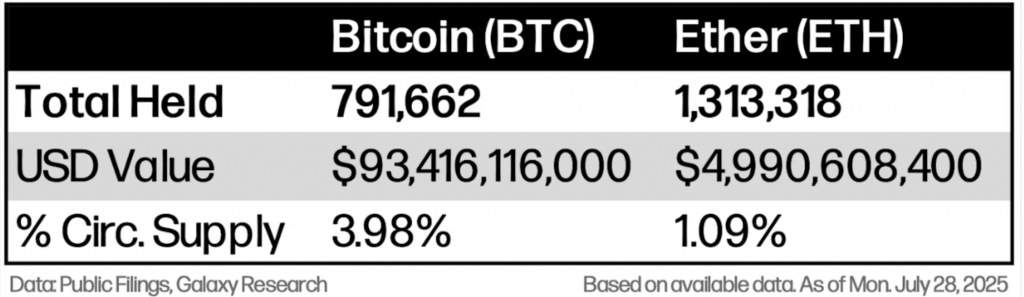
Компании с цифровыми активами в резервах: биткоин vs Ethereum. Источник: Galaxy Research

За Strategy следуют японская Metaplanet (тикер 3350.T на Токийской фондовой бирже), которая позиционирует себя как «японская Strategy», и SharpLink Gaming (SBET). Если раньше такие компании фокусировались исключительно на биткоине, то теперь диверсифицируют портфели, добавляя SOL, XRP, BNB, HYPE и другие токены.
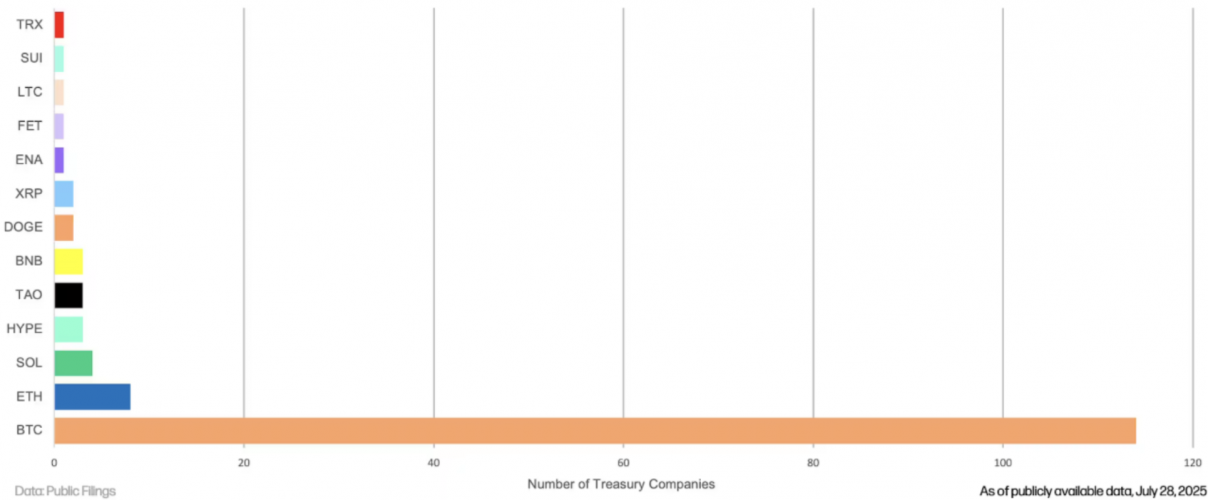
Распределение компаний по криптовалютам в корпоративных резервах (июль 2025). Источник: Galaxy Research

Торговля с премией: суть бизнес-модели

Ключевая особенность этих фирм — торговля с премией к чистой стоимости активов (Net Asset Value, NAV). NAV рассчитывается как рыночная стоимость всех криптовалют на балансе компании, деленная на количество акций в обращении.

Премия показывает, насколько дороже торгуются акции компании по сравнению со стоимостью ее криптовалютных активов в пересчете на акцию. Strategy торгуется с премией 58% — это означает, что покупая акцию за $100, инвестор получает криптовалюты на $63. Metaplanet торгуется с премией 179% — за $100 акции инвестор получает активы на $36.
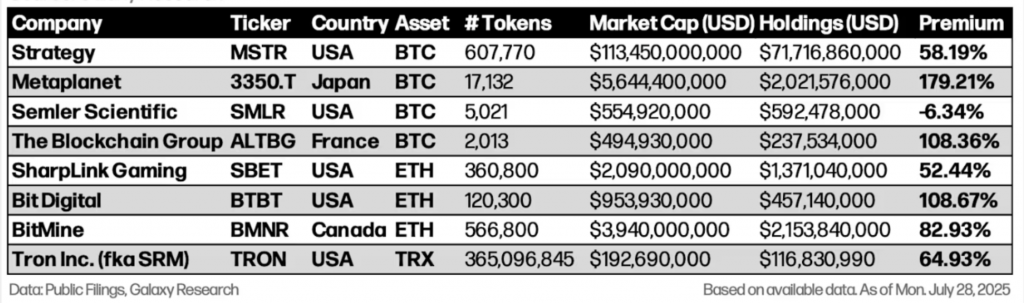
Премии к стоимости активов у компаний с резервами в биткоина, Ethereum и Tron. Источник: Galaxy Research

Почему инвесторы переплачивают? Они покупают не только существующие активы, но и способность компании привлекать новый капитал и наращивать криптовалютные позиции. Кроме того, многие институциональные инвесторы не могут напрямую покупать биткоин из-за регуляторных ограничений, но могут инвестировать в публичные акции.

География распространения

Согласно отчету Galaxy Research, феномен распространился по всему миру. США остаются центром с наибольшим количеством таких компаний, но активность растет в Японии, Европе и других регионах. Аналитики выделили три уровня концентрации: высокий (10 и более компаний или исключительно крупные резервы), средний (3-9 компаний) и низкий (1-2 компании).

География компаний с цифровыми активами в резервах. Источник: Galaxy Research

Инструменты привлечения капитала

Модель работает через два основных инструмента. Программы At-the-Market (ATM) позволяют постепенно выпускать акции по рыночным ценам, избегая резких скидок. Когда компания торгуется с премией к NAV, каждый привлеченный доллар покупает больше криптовалют на акцию, чем размывает долю акционеров. Это создает цикл «выгодного размывания» — компания привлекает капитал, покупает токены и увеличивает NAV на акцию.

Private Investments in Public Equity (PIPE) — это переговорные сделки с крупными инвесторами для быстрого привлечения капитала. Nakamoto Holdings завершила размещение на $51,5 млн всего за 72 часа в июне 2025 года. Глава компании Дэвид Бейли (David Bailey) отметил: «Мы продолжаем реализовывать стратегию по привлечению максимального капитала для покупки максимального количества биткоинов».

PIPE эффективны по скорости и объему, но создают риски размывания и будущего давления предложения.

Фокус на Ethereum: стейкинг и доходность

Новый тренд — компании, специализирующиеся на Ethereum. В отличие от биткоина, Ethereum позволяет получать доходность через стейкинг и DeFi-протоколы. Bit Digital торгуется с премией 108% к стоимости своих ETH-активов, что частично отражает потенциал дополнительной доходности.

BitMine и SharpLink Gaming используют PIPE для финансирования стратегий накопления ETH. Компании изучают возможности токенов с механизмами proof-of-stake для получения нативной доходности без размывания капитала.

Уязвимость модели: урок 1929 года

Уилл Оуэнс предупреждает о возможном развороте тренда. Модель критически зависит от сохранения премии к NAV. Если премия исчезнет или превратится в дисконт, механизм роста сломается. Некоторые компании уже торгуются близко к дисконту и могут начать выкупать собственные акции.

Аналитик проводит параллель с инвестиционными трастами 1920-х годов, которые торговались с премиями, выпускали акции и покупали активы. Когда настроения изменились, те же механизмы усилили падение, способствуя краху 1929 года и Великой депрессии.

Только на прошлой неделе минимум десять новых компаний объявили о стратегиях накопления цифровых активов. Когда сотни фирм одновременно реализуют одностороннюю торговлю (привлекают капитал, покупают криптовалюты, повторяют), это становится структурно хрупким.

Угроза для всего криптовалютного рынка

Растущая концентрация активов создает системные риски. Массовые продажи могут оказать давление на цены криптовалют. Если компании начнут выкупать акции или погашать позиции, это остановит постоянный спрос, поддерживающий рынок.

Без учета Strategy компании с цифровыми активами в резервах контролируют около $32 млрд активов — лишь 0,83% от общей капитализации криптовалютного рынка в $3,8 трлн. Однако их влияние растет, поскольку они создают постоянный спрос на цифровые активы.

Разворот тренда может ослабить аппетит публичных рынков к любым формам вложений в цифровые активы, включая криптовалютные ETF. Более крупные игроки, вроде Strategy, могут начать поглощать мелкие компании с дисконтом к NAV.

Перспективы развития

Galaxy Research ожидает дальнейшую диверсификацию протоколов, особенно в сторону Proof-of-stake блокчейнов для получения доходности без размывания капитала. Также прогнозируется географическая экспансия модели и появление гибридных стратегий, сочетающих операционные денежные потоки с накоплением цифровых активов.

Модель лучше всего функционирует при трех условиях: устойчивом росте цен на цифровые активы, сохранении премий к NAV и ликвидности на рынках капитала.

Компании с цифровыми активами в резервах стали мостом между традиционными финансами и криптовалютами, предоставляя институциональным инвесторам доступ к цифровым активам через регулируемые публичные компании. Уилл Оуэнс отмечает, что триллионы долларов находятся под управлением согласно регуляторным ограничениям, которые запрещают прямое владение криптовалютами, но разрешают инвестиции в публичные акции.

Эти компании показывают, как криптовалюты становятся частью традиционных финансов, а традиционные финансы адаптируются под криптовалюты. Они не отменяют принципы самостоятельного хранения и децентрализации, но дают крупным инвесторам легальный и удобный способ получить доступ к цифровым активам.


Letture associate

Ray Dalio's Latest Macro Analysis Full Text: Buy More Gold, Add Some Bitcoin

In his latest macro analysis, Ray Dalio applies his framework from "How Countries Go Broke: The Big Cycle" to the current global debt environment. He highlights recent events like Japan selling U.S. Treasuries and rising U.S. long-term yields as signs of an unsustainable debt dynamic. Dalio explains that excessive government debt leads to either unacceptably high interest rates, severe economic downturns, or significant currency debasement through central bank money printing. He summarizes the U.S. fiscal situation: with $5.5 trillion in revenue, $7.5 trillion in spending, a $2 trillion deficit, and total debt at six times annual revenue, debt servicing costs are immense. Without correction, U.S. debt could reach $55-$60 trillion in a decade. Dalio proposes a "3% Three-Way" solution: reducing the budget deficit to 3% of GDP through balanced spending cuts, tax increases, and interest rate reductions to avoid a traumatic adjustment. In response to FAQs, he argues that the risk of a U.S. debt crisis is high and could materialize within a few years if the current path continues. He dismisses the notion that the dollar's reserve status makes the U.S. immune, citing historical precedents of reserve currency declines. He is also unconvinced by Japan's high-debt stability, noting poor returns for yen-denominated assets. For investors, Dalio recommends diversifying globally, underweighting bonds, and overweighting assets like gold and a small allocation to Bitcoin (around 10-15% to gold) to hedge against currency debasement and poor debt returns.

marsbit9 min fa

Ray Dalio's Latest Macro Analysis Full Text: Buy More Gold, Add Some Bitcoin

marsbit9 min fa

Stripe’s 16-Year Chronicle: From 7 Lines of Code to a $100 Billion Valuation

Stripe's 16-year journey began with a simple promise: "7 lines of code to accept payments." Founded by Patrick and John Collison, the company started by hiding the complexity of bank integrations and merchant accounts behind a clean API, initially targeting developers at startups. This early focus on user experience and technical simplicity fueled rapid adoption. A key early milestone was establishing vital bank partnerships, a challenge overcome by hiring Billy Alvarado, who brought crucial institutional relationship skills. From this foundation, Stripe systematically expanded its product boundaries. It launched Connect for platform payments, Atlas for company formation, Radar for fraud prevention, and Billing for subscriptions. This transformed Stripe from a payment processor into a broader financial infrastructure suite for internet businesses. The COVID-19 pandemic accelerated growth but also led to over-hiring. A 14% layoff in 2022 marked a period of organizational correction. Subsequently, Stripe shifted its growth strategy towards strategic acquisitions to enter new domains quickly. It acquired Bridge (stablecoin infrastructure), Privy (wallet infrastructure), Metronome (usage-based billing), and agreed to buy OpenRouter (AI model routing). These moves signal Stripe's ambition to build a "programmable money system" for the emerging AI and agent-based economy, managing not just currency flows but also the measurement and pricing of computational resources like AI tokens. Internally, Stripe leverages AI agents (like "Minions") to boost engineering productivity. Despite scaling to nearly 8,000 employees and processing $1.9 trillion in payment volume annually, the company remains private. A recent employee tender offer valued it at $159 billion. The core question for Stripe's future is whether it can successfully integrate its expanding product matrix—spanning payments, crypto, and AI infrastructure—into a cohesive platform, positioning itself as the foundational economic layer for autonomous software agents.

marsbit38 min fa

Stripe’s 16-Year Chronicle: From 7 Lines of Code to a $100 Billion Valuation

marsbit38 min fa

Treasury Secretary's Move to Suppress Treasury Yields Ignites 'Currency Debasement Trade'! Gold Hits Three-Month High, Bitcoin Surges Over 25% in a Single Week

US Treasury Secretary Besant's efforts to lower long-term Treasury yields by announcing expanded buybacks had only a brief market impact. However, this move fueled a "currency devaluation trade," weakening the US dollar while boosting both gold (to a three-month high) and Bitcoin (up over 25% for the week). Analysts attribute this reaction to deepening market concerns over the massive US fiscal deficit and structural pressures keeping long-term rates elevated, including fierce competition for capital from global government borrowing and massive AI sector financing. Despite the Treasury's actions, fundamental forces like growth, inflation, and capital demand are seen as limiting its ability to sustainably suppress yields. Bitcoin's strong positive correlation with gold has reinforced its narrative as a hedge against devaluation. While equity markets have shown resilience, some strategists warn that Treasury yields nearing 5% increase pressure on the dollar and high-leverage assets. Figures like Ray Dalio have advised reducing bond exposure in favor of gold and some Bitcoin, citing US debt risks. Market opinions are divided on the sustainability of the devaluation trade, with some noting the lack of a near-term catalyst for its next leg higher. The underlying tension between the Treasury's desire for lower borrowing costs and the Federal Reserve's focus on inflation and reducing market intervention remains a key theme. Upcoming events like Nvidia's earnings and the Jackson Hole symposium will test whether AI profits can continue supporting stocks and if the Fed aligns more with Washington's preference for easier financial conditions.

华尔街日报2 h fa

Treasury Secretary's Move to Suppress Treasury Yields Ignites 'Currency Debasement Trade'! Gold Hits Three-Month High, Bitcoin Surges Over 25% in a Single Week

华尔街日报2 h fa

Alexander Shokhin: Business Needs an Interest Rate Below 10% and the Dollar at 90-95 Rubles

Alexander Shokhin, head of the Russian Union of Industrialists and Entrepreneurs (RSPP), has advocated for potentially using "non-market" tools to keep the ruble within a target exchange rate corridor. This, he argues on August 21, would help avoid excessive volatility, though he called the topic a separate discussion. Shokhin had previously raised the idea of a currency corridor in late May, noting the ruble's current exchange rate is not fully market-driven due to a limited currency segment and reduced foreign currency demand. He stated that many business community colleagues propose fixing a corridor, even through non-market methods, to ensure predictability. The business community's key targets, as outlined by Shokhin in late December 2025, are a Central Bank key rate of 12%, inflation of 4–5%, and a US dollar exchange rate of 90–95 rubles by the end of 2026. A turning point for investment, he said, would be lowering the rate to 12% with 6% inflation, though truly comfortable business conditions would require a rate below 10%. He stressed the critical importance of currency predictability for corporate investment decisions. From a data analysis perspective, the idea of a ruble corridor is not new. A similar mechanism was used in Russia from 1995 to 1998, where the central bank held the dollar within fixed boundaries through regular interventions. This regime lasted three years before ending abruptly during the 1998 default, illustrating the fragility of rigid targets under external shocks. The macro-economic link is clear: stricter corridors require more reserves to defend against currency pressure. The key unresolved technical aspect is the specific sources and volume of such interventions given the current market's limited liquidity. Whether this discussion remains theoretical or leads to concrete corridor parameters will be seen in the coming months.

cryptonews.ru4 h fa

Alexander Shokhin: Business Needs an Interest Rate Below 10% and the Dollar at 90-95 Rubles

cryptonews.ru4 h fa

Trading

Spot
活动图片