Сектор RWA достиг рекордной стоимости в 25 млрд долларов благодаря частному кредитованию и казначейским облигациям США

cryptonews.ruPublished on 2025-05-14Last updated on 2025-07-14

  • Общая стоимость рынка RWA впервые превысила 25 миллиардов долларов.
  • Лидируют такие активы, как частный кредит и казначейский долг США.
  • Ethereum продолжает доминировать с общей стоимостью RWA в $7,73 млрд и долей рынка в 58,15%.

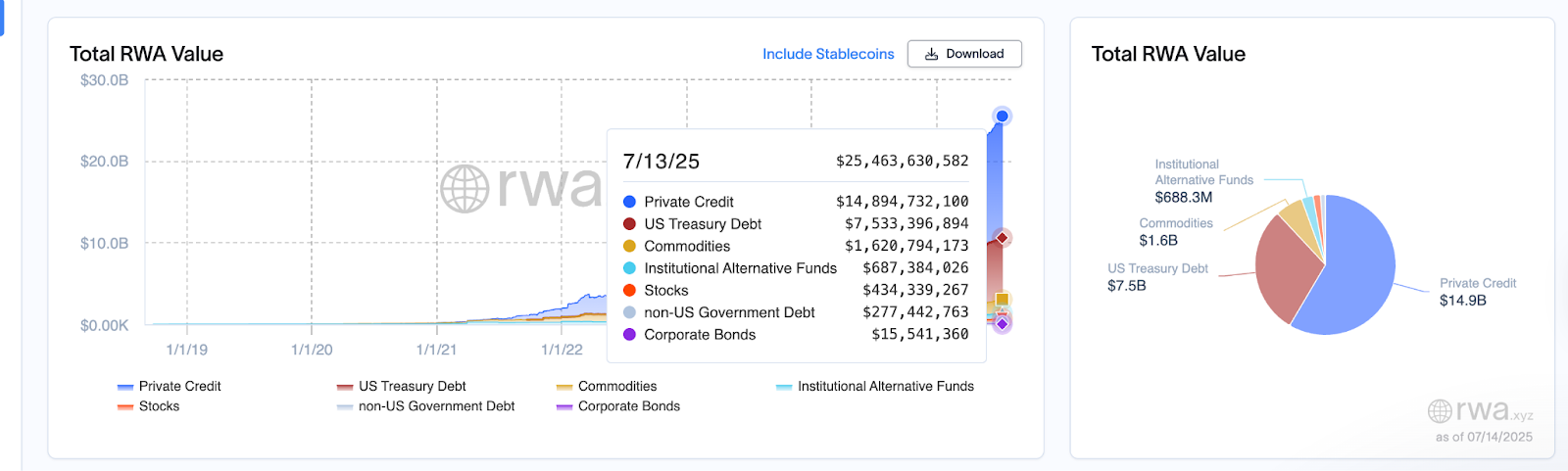
По данным RWA.xyz, объём мирового рынка токенизации реальных активов (RWA) официально превысил 25 миллиардов долларов. Это на 6,34% больше, чем за последние 30 дней.

Примечательно, что данные показывают, что число владельцев активов превысило 309 000, что на 72,83% больше, чем в предыдущем месяце, и зарегистрировано 250 эмитентов. Этот рост происходит на фоне более широкого внедрения технологии блокчейн в традиционные финансовые инструменты, которые варьируются от государственных облигаций и частных кредитов до фондов недвижимости и институциональных фондов.

Токенизированные реальные активы набирают обороты

За последние 18 месяцев внедрение RWA в блокчейне резко ускорилось. Лидерами роста являются такие активы, как частные кредиты (14,9 млрд долларов США) и казначейские облигации США (7,5 млрд долларов США). Среди других примечательных категорий — сырьевые товары (1,6 млрд долларов США), институциональные альтернативные фонды (688,3 млн долларов США), корпоративные облигации, акции и долговые обязательства, не относящиеся к государственным облигациям США.

Стремительный рост активности RWA также заметен на уровне сети. Ethereum продолжает доминировать с общей стоимостью RWA в 7,73 млрд долларов, занимая 58,15% рынка.
Однако новые экосистемы, такие как zkSync Era (2,27 млрд долларов США), Aptos (532,4 млн долларов США) и Solana (517,7 млн долларов США), быстро набирают обороты благодаря двузначному ежемесячному росту. В частности, Plume, относительно новый участник рынка, зафиксировал рост на 73,09% всего за 30 дней.

С начала 2023 года рынок RWA вырос с менее чем 3 миллиардов долларов до сегодняшних рекордных показателей, и теперь на блокчейне представлен широкий спектр классов активов.

По теме: Дубай одобрил токенизированный фонд денежного рынка, поддерживаемый Национальным банком Катара

Поддержку буму RWA оказывает параллельный рост экосистемы стейблкоинов, которая в настоящее время хранит $243,87 млрд. По данным RWA.xyz, в настоящее время стейблкоины принадлежат более 171 млн пользователей, что на 2,45% больше, чем в прошлом месяце.

Новые участники сигнализируют о расширении вариантов использования

Растущая тенденция токенизации RWA побудила больше платформ осваивать нишевые типы активов. 1 июля YieldNest анонсировала свой новый продукт $ynRWAx, который будет токенизировать недвижимость, кредиты и другие офчейн-активы. Он будет работать на базе инфраструктуры YieldNest MAX LRT (Liquid Restaking Token).

Платформа заявляет, что токен ynRWAx будет предлагать предсказуемую, автоматически начисляемую доходность, прозрачность в режиме реального времени и круглосуточную безопасность на базе искусственного интеллекта. Связывая проверенные реальные активы с инструментами DeFi, токен призван повысить ликвидность и улучшить доступ к традиционно неликвидным инвестициям, таким как недвижимость.

Примечательно, что в Дубае стартап токенизировал виллу стоимостью 477 000 долларов и продал её за считанные минуты. Prypco Mint, лицензированный дубайским Управлением по управлению активами (VARA), продал токенизированную виллу на 1,75 млн дирхамов менее чем за пять минут 169 инвесторам из 40 стран.

По теме: GAP 3 Partners получает лицензию VASP от VARA Дубая

В настоящее время платформа доступна только владельцам удостоверения личности Emirates ID, но планирует расширить доступ и для иностранных инвесторов. С запуском ещё двух объектов 15 июля Prypco продолжает свой стремительный рост на рынке токенизации недвижимости Дубая.


Related Reads

STRC Hits Historic Low, Saylor's Perpetual Motion Machine Grinds to a Halt

STRC, the perpetual preferred stock issued by MicroStrategy to fund its Bitcoin purchases, hit a historic low of $85.32, a 17% discount to its $100 par value. Designed as a "digital credit engine" to trade stably near par and enable continuous share issuance for buying Bitcoin, its plunge signals a breakdown in this model. Three key factors drove the decline: 1. Bitcoin's price fell over 50% from its peak, trading around $63,000 amid hawkish Fed signals. 2. MicroStrategy's cash reserves were depleted after a $1.5 billion convertible note repayment, slashing the dividend coverage for STRC's 11.5% yield to ~7 months. The company then sold 32 BTC to cover dividends—Michael Saylor's first Bitcoin sale since 2022—damaging the "never sell" narrative. 3. A competing Bitcoin-backed preferred stock, Strive's SATA, offers a higher yield (~13%) and daily dividends, drawing investors away from STRC. The drop triggers a negative cycle: STRC below par halts ATM share issuances, cutting off a key funding source for Bitcoin buys and potentially forcing more BTC sales for dividends, further eroding confidence. While Saylor argues the model is mathematically sound—needing only 2.3% annual Bitcoin growth to sustain itself—the market is testing the resilience of the leveraged Bitcoin treasury strategy in a bear market. The STRC price now reflects rising skepticism about this financial machinery's durability during downturns.

marsbit16m ago

STRC Hits Historic Low, Saylor's Perpetual Motion Machine Grinds to a Halt

marsbit16m ago

A Guide to Grayscale’s ‘Bottom Fishing’: Using Cash Flow to Assess Cryptocurrency Value

**Title:** Grayscale's Guide to Bottom-Fishing: Valuing Cryptoassets Using Cash Flows **Summary:** This report by Grayscale Research presents a fundamental valuation framework for cryptocurrency assets, moving beyond pure speculation to analyze those with underlying cash flows. It distinguishes between "commodity-like" assets (e.g., Bitcoin) and "cash-flow" assets, primarily within DeFi. Using the leading decentralized lending protocol Aave as a case study, the analysis applies traditional financial methodologies like Discounted Cash Flow (DCF) and Price-to-Earnings (P/E) multiples. Key findings indicate that AAVE tokens are currently undervalued. Despite recent challenges, the protocol's strong revenue growth, ~50% net profit margin, and diversified treasury support a fundamental valuation range of $80-$100 per token (compared to a ~$75 market price at the time of writing). In a base-case scenario driven by stablecoin adoption and regulatory clarity, the fair value could rise to around $175 within a year. The report emphasizes that protocol success does not automatically translate to token value. It critically examines the "value capture" mechanisms—such as buybacks, burns, and staking rewards—that channel protocol profits to token holders. Furthermore, it addresses the legal and governance complexities of Decentralized Autonomous Organizations (DAOs), noting their difference from traditional corporate equity but highlighting how robust, transparent governance can align protocol economics with holder interests. The conclusion is that the crypto market is maturing, with capital increasingly flowing towards projects with demonstrable fundamentals, real adoption, and disciplined capital allocation, creating opportunities for value-based investors.

marsbit1h ago

A Guide to Grayscale’s ‘Bottom Fishing’: Using Cash Flow to Assess Cryptocurrency Value

marsbit1h ago

After semiconductors lead the gains, are funds buying into AI orders or a macroeconomic rebound?

After US-Iran talks led to a temporary ceasefire and framework for reopening the strategic Strait of Hormuz, U.S. stocks rose on June 18, with the Nasdaq gaining 1.9%. The semiconductor and AI hardware sectors outperformed. This rally stemmed primarily from reduced geopolitical risk, which lowered oil prices and inflation expectations, easing discount rate pressure on high-valuation growth stocks like tech. The key question is not whether tech rebounded, but the nature of the rebound. The market appears to be selectively repricing AI infrastructure plays rather than broadly chasing AI narratives. Gains were concentrated in chips, optical interconnects, memory, and domestic manufacturing—segments tied to tangible data center build-outs and capital expenditure. Intel's ~10% surge, fueled by a Trump statement about potential Apple collaboration, exemplifies this mixed dynamic. It reflects policy catalysts and domestic manufacturing sentiment more than confirmed fundamentals. Meanwhile, strong earnings from companies like Astera Labs (revenue up 93% YoY) provided concrete evidence of AI-driven demand in hardware. In essence, the rally represents a risk-premium recalibration. Lower Middle East tensions opened a valuation repair window, and capital flowed first into AI infrastructure segments with visible near-term revenue streams. The sustainability of this move hinges on upcoming Q2 earnings, specifically continued strength in cloud provider capex, AI server orders, and hardware company guidance. Policy hopes alone are insufficient; the cycle needs validation from orders and financials.

marsbit1h ago

After semiconductors lead the gains, are funds buying into AI orders or a macroeconomic rebound?

marsbit1h ago

Trading

Spot
Futures
活动图片