Спотовые биткоин-ETF зафиксировали крупнейший за месяц отток капитала — более $342 млн

cryptonews.ru2025-06-02 tarihinde yayınlandı2025-07-02 tarihinde güncellendi

  • 1 июля в секторе биткоин-ETF зафиксировали отток капитала.
  • Из продуктов на базе первой криптовалюты вывели $342,25 млн.
  • Однако Ethereum-фонды привлекли более $40 млн.

1 июля 2025 года американские спотовые биткоин-ETF зафиксировали отток капитала на сумму $342,25 млн. Это самый большой отрицательный показатель за месяц. Практически весь май в секторе наблюдался приток средств, по данным SoSoValue.

Отметим, 1 июля с оттоком капитала столкнулись такие фонды, как:

  • FBTC — $172,73 млн;
  • GBTC — $119,51 млн;
  • ARKB — $27,03 млн;
  • BITB — $22,98 млн.

В остальных ETF движение средств не наблюдалось.
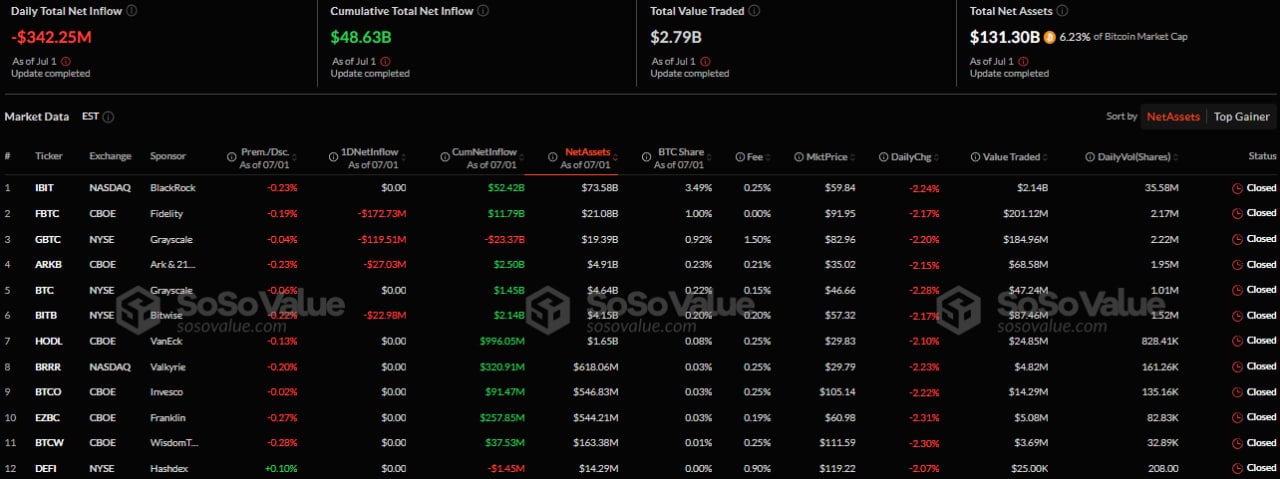
Приток/отток капитала в американском секторе спотовых биткоин-ETF. Источник: SoSoValue.

Впрочем, Ethereum-ETF уже третий день подряд фиксируют приток средств. В первый день июля в фонды на базе актива поступило $40,68 млн. Продукты ETHA и ETHE привлекли $54,84 млн и $9,97 млн соответственно. Фонд FETH от Fidelity столкнулся с оттоком на более чем $24 млн, в остальных ETF движение капитала не зафиксировано.
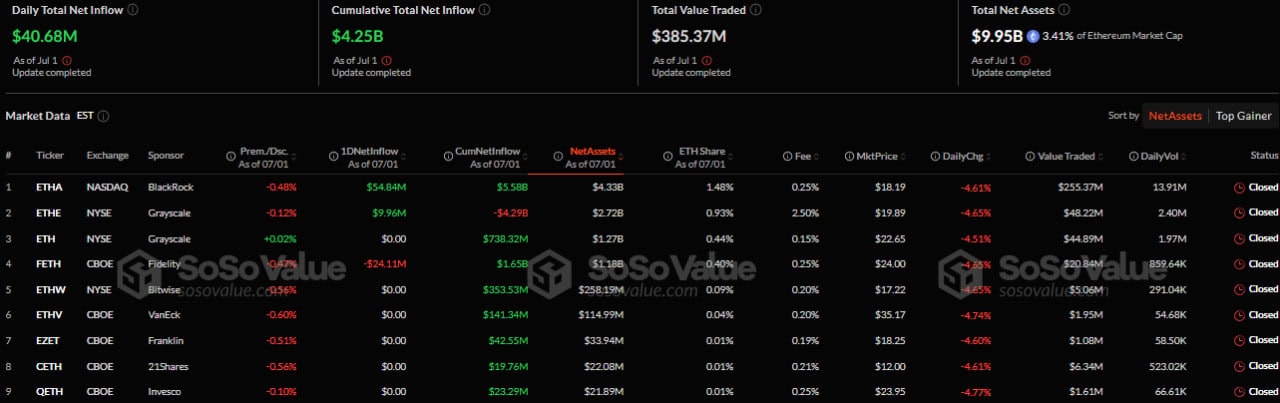
Приток/отток капитала в американском секторе спотовых Ethereum-ETF. Источник: SoSoValue.

В гонконгском секторе спотовых биткоин- и Ethereum-ETF зафиксировали отток на 0,00198 BTC и 0,02 ETH соответственно.

Напомним, ранее Аналитики Bloomberg Intelligence Эрик Балчунас и Джеймс Сейффарт представили обновленный прогноз относительно шансов на одобрение спотовых криптовалютных биржевых фондов до конца 2025 года. Подробнее в материале.


İlgili Okumalar

JPMorgan Research Report Analysis: Moderna's INT Trial Meets Endpoints, but Market Already Priced In

On August 19, J.P. Morgan (JPM) published a research report analyzing Moderna's recent Phase III trial success for its Individualized Neoantigen Therapy (INT), developed in partnership with Merck, in adjuvant melanoma. The trial met its primary endpoint of significantly improved recurrence-free survival and the key secondary endpoint of distant metastasis-free survival. While JPM acknowledged the strong clinical value of these results, particularly the prevention of distant metastasis, the bank stated that this success was widely anticipated, with an 85% prior probability of success, and is already reflected in Moderna's current market valuation. Following the announcement, Moderna's stock rose in pre-market trading. However, JPM maintained its Underweight rating and $40 price target, implying approximately 36% downside from the current price of ~$63. The core rationale is that the success in adjuvant melanoma, a relatively small market in immuno-oncology, is fully priced in. Moderna's future valuation hinges entirely on INT's ability to demonstrate similar efficacy across broader cancer indications. JPM's valuation model incorporates only a modest risk-adjusted value (~$3/share) for the melanoma approval. Approximately $15/share of its target price is attributed to INT's potential in other cancer types. The report identifies upcoming data readouts in non-melanoma cancers (e.g., lung, head & neck, renal) as the critical variable that will determine the platform's ultimate value. Upside risks include better-than-expected data in these new indications, while downside risks involve clinical failures, regulatory delays, or commercial underperformance. In conclusion, JPM views the pre-market stock move as driven by short covering and trading sentiment rather than a fundamental re-rating. The bank remains bearish, arguing that Moderna must now prove INT's efficacy as a platform technology beyond melanoma to justify its current market cap.

marsbit36 dk önce

JPMorgan Research Report Analysis: Moderna's INT Trial Meets Endpoints, but Market Already Priced In

marsbit36 dk önce

Treasury Department Directly Intervenes to Suppress Long-Term Interest Rates

The article discusses the U.S. Treasury's recent direct intervention to suppress long-term bond yields through buyback operations. While distinct from traditional Yield Curve Control (YCC), this move is interpreted as direct government intervention in its own financing costs. The author emphasizes the short-term tactical nature of this action and contrasts it with the Federal Reserve's upcoming, potentially divergent, policy stance at Jackson Hole. The core issue is framed as a long-term U.S. strategic dilemma: managing high deficit levels. The analysis argues that deficit reduction cannot realistically come from spending cuts or traditional industries, but must rely on achieving higher economic growth driven by technological breakthroughs. Current monetary tightening, while possibly curbing yields and inflation in the short term, is seen as potentially counterproductive to this necessary long-term investment in technology and supply chain resilience. The piece draws historical parallels, placing the current intervention between the 2000-2002 Treasury buybacks (for liquidity) and larger-scale Fed-led "Operation Twist" maneuvers. The effectiveness of the Treasury's action is deemed limited without Federal Reserve cooperation, which would signify a more significant policy shift. Ultimately, the author views such technical, bureaucratic interventions as treating symptoms rather than the underlying disease of the U.S. economy's structural challenges and "K-shaped" divergence. The conclusion suggests that sustained yield suppression by the Fed, combined with specific geopolitical outcomes, could serve as a catalyst for a more profound discussion on broader U.S. and dollar trajectory.

marsbit36 dk önce

Treasury Department Directly Intervenes to Suppress Long-Term Interest Rates

marsbit36 dk önce

İşlemler

Spot
活动图片