稳定币生态大爆发:从Circle IPO到全球数字货币格局变革

Odaily星球日报Published on 2025-06-22Last updated on 2025-06-22

Abstract

2025 年,数字资产市场迎来新的里程碑——Circle 成功登陆纽约证券交易所,正式成为首批以稳定币业务为核心的上市金融科技公司。此次上市不仅标志着 USDC 及美元稳定币生态进入公开资本市场,更撬动了数字资产领域一片新的蓝海。

引言

稳定币作为连接传统法币与数字货币世界的桥梁,凭借其价格稳定、跨境支付高效低成本以及深度支持 DeFi 等创新场景,正成为资本市场和金融科技企业争夺的核心战场。

在全球数字经济迅猛发展的背景下,稳定币生态迎来了爆发式增长。无论是资本的涌入,还是政策监管的逐步完善,均彰显出稳定币在未来全球支付体系、跨境结算以及资产管理中的关键角色。本文将深度剖析 Circle 及 USDC 的生态布局、背后的合规逻辑、资本套利机遇,以及全球监管趋势,全面展现稳定币如何掀起数字资产资本狂潮。

稳定币崛起的背景与价值

稳定币,作为一种锚定传统法币价值的数字资产,近年来迅速崛起,成为加密货币市场的重要组成部分。与波动剧烈的比特币、以太坊等主流数字货币不同,稳定币通过 1: 1 锚定美元等法币,实现价格稳定,极大降低了数字资产交易的风险。借助区块链技术,稳定币不仅加速了跨境转账和支付的效率,还为 DeFi、数字资产兑换及全球商户收款等多元场景提供了强有力的基础设施支持。

稳定币的核心优势体现在三方面:

  • 价格稳定,规避波动风险
    加密货币市场价格波动剧烈,稳定币锚定法币价值,保证了交易和结算金额的稳定性,大幅降低交易风险。

  • 跨境转账速度快且成本低
    稳定币基于区块链技术,实现全球数分钟到账,远低于传统银行跨境汇款的时间与手续费。

  • 支持多样化金融应用
    稳定币直接接入 DeFi 借贷、资产兑换和数字商品支付等创新场景,极大拓展了数字资产的使用边界。

这些都是传统法币难以实现的,极大提升了数字资产交易的便利性和效率。

Circle 稳定币生态布局

Circle 成立于 2013 年,专注于数字支付和区块链金融,联合 Coinbase 推出了美元稳定币 USDC。USDC 是一种 1: 1 锚定美元的中心化稳定币,资金全部储备于美国受监管银行及短期国债,每月由第三方会计师事务所审计,保障储备资产的透明与安全。

截至 2025 年 6 月,USDC 市值约 390 亿美元,位列全球稳定币第二,仅次于 USDT。其生态覆盖广泛,已部署于以太坊、Solana、Arbitrum、Optimism、Avalanche、Base、Polygon 等多条公链,支持交易所、DeFi 协议、高速支付及跨链资产转移。

Circle 通过跨链传输协议(CCTP),实现 USDC 在不同链间无滑点自由流转,践行“USDC Everywhere”的全球战略。

在合规方面,Circle 严格遵循美国财政部、SEC 及 FinCEN 监管要求,成为拜登政府眼中的“稳定币正规军”。USDC 透明公开的审计报告和合规储备制度,使其成为数字美元生态的重要基石。同时,Circle 与 SWIFT、Visa、Mastercard、Stripe 等全球支付巨头合作,积极推动 USDC 在全球支付和结算领域的落地。

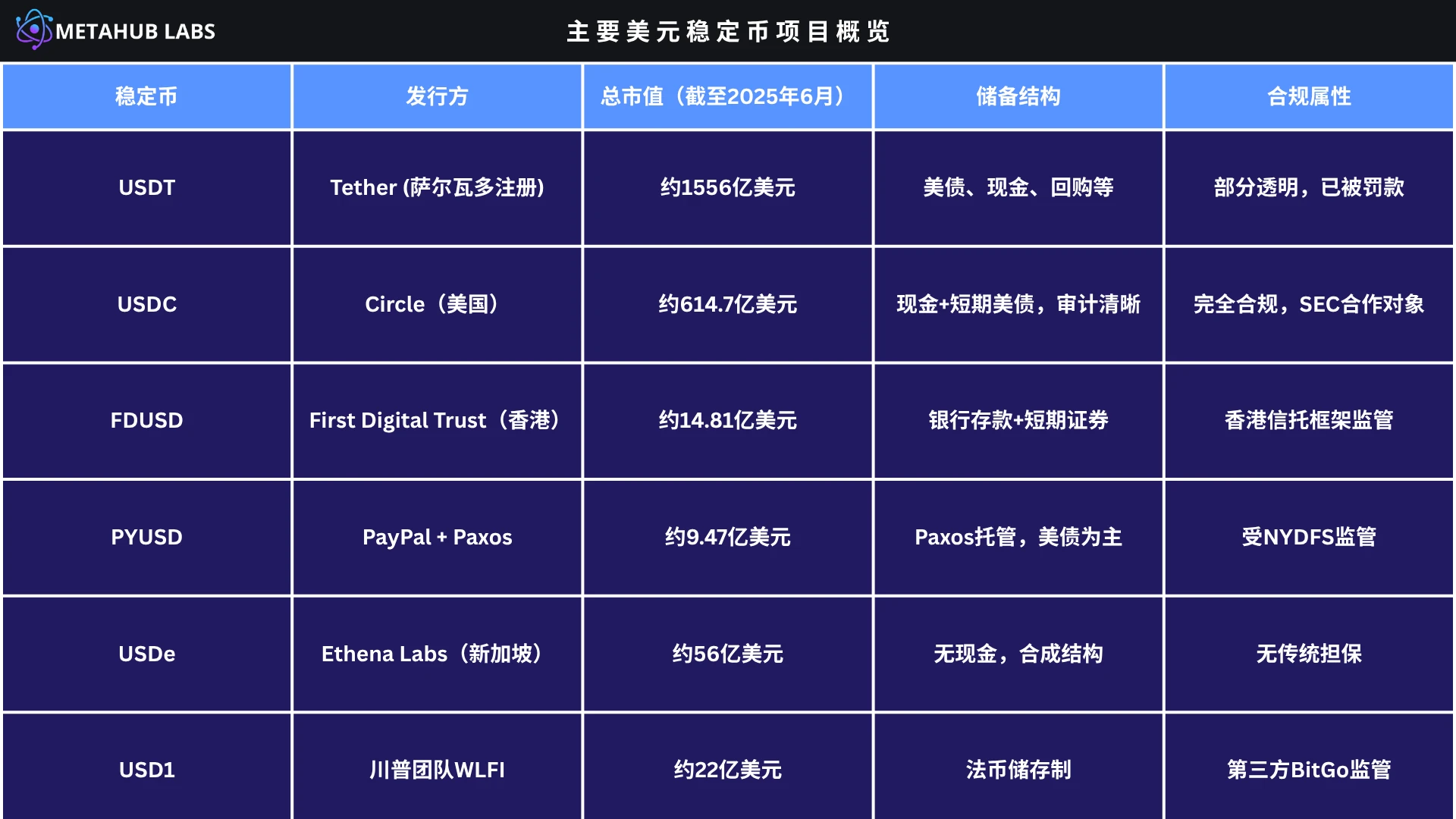
主要美元稳定币项目概览
稳定币生态大爆发:从Circle IPO到全球数字货币格局变革

稳定币底层逻辑

近年来,稳定币市场呈现爆发式增长,背后的驱动力可以归结为三个核心因素:监管真空、利差空间和国家博弈。这些因素共同作用,使得稳定币不仅成为数字货币市场的重要资产类别,更成为全球金融资本激烈争夺的新高地。

1. 监管真空 — 从野蛮生长到逐步规范

过去,稳定币发行和流通几乎没有明确的全球统一监管标准,导致市场出现“监管真空”。这种缺乏监管的环境,一方面降低了发行门槛,吸引大量资本和项目快速进入;另一方面,也带来了潜在的系统性风险。随着各国开始出台针对稳定币的法律法规,像香港在 2025 年 8 月即将正式实施的《稳定币条例》,为市场带来了制度上的规范与保障。这一制度转变既为行业发展注入信心,也将推动市场逐步走向合规化和成熟化。

2. 利差空间 — 资本眼中的“利润金矿”

稳定币发行方通过管理用户兑换的法币资金,投入低风险短期国债、质押以太坊(ETH)或运用期货空头策略等多种方式,实现远高于银行存款利率的收益。以 Ethena 的 USDe 为例,其通过 ETH 质押和期货空套策略,跑出了 20% 以上的年化收益率(APY),在市场上极具吸引力。一旦获得超高收益,资金便迅速涌入,形成资本聚集效应,推动稳定币规模快速膨胀。

3. 国家博弈 — 货币霸权与数字经济新战场

稳定币不仅是金融创新工具,更是国际货币竞争和数字主权的焦点。特朗普团队支持的USD1,正试图打造“数字美元再造计划”,挑战现有美元数字霸权;与此同时,香港积极打造港元稳定币生态,争夺亚洲金融科技高地。欧美、亚洲多国则通过法规和央行数字货币(CBDC)试点,力图在数字时代维护货币影响力。稳定币成为各国围绕数字货币主权和全球支付体系的新角力场。

4. 使用场景不断丰富,逐渐接近法币职能

稳定币最初被用于币圈内部转账,如 USDT 在加密市场中广泛流通。但随着技术和应用生态的发展,稳定币的功能持续拓展:

  • 全球交易支付:支持跨境电商、海外汇款,提供快速、低成本的结算方式。

  • DeFi 借贷与收益:成为 DeFi 平台上的主要借贷资产,用户可以借出稳定币赚取利息,或用其进行资产抵押。

  • 资产避险工具:在加密市场波动剧烈时,投资者可迅速转换为稳定币锁定资产价值。

  • 数字商品支付:游戏、NFT、内容创作等领域广泛使用稳定币作为支付手段。

随着这些多元场景不断成熟,稳定币的使用逐步从“币圈工具”向“数字法币”演进,市场规模和资本关注度因此迎来井喷。

布雷顿森林 3.0 隐喻正在上演

从国家主导、商业银行试点,到科技巨头和链上原生项目参与,稳定币正从币圈小众工具,变身下一代全球支付基础设施的关键入口。

许多人未意识到,这轮稳定币浪潮,实则是各国围绕“数字时代货币霸权”的角力。

随着美国不断通过稳定币扩大美元影响力,香港也正在积极打造稳定币生态,推动亚洲 Web3 清算中心建设。

2025 年 5 月 21 日,香港立法会正式通过《稳定币条例草案》,并于同日完成三读程序。该条例将于 2025 年 8 月 1 日正式实施,成为全球首个为法币挂钩稳定币建立全面监管框架的司法管辖区。

香港推出《稳定币条例》并非被动监管,而是出于主动抢占“下一代支付清算中心”战略高地的考虑:

  • 全球加密支付体系雏形已成,稳定币从“币圈结算工具”逐步扩展为跨境汇款、支付、资产避险的主流选择;

  • 美中欧日各自加快货币数字化,货币竞争正转向数字主权层面,香港必须建立合规护城河来确保港元国际化;

  • Web3与金融融合加速,稳定币正好成为链上应用与现实世界资产的“桥梁”与“媒介”,而香港要做桥梁之都。

因此,香港不是仅仅“堵漏洞”,而是在币圈与监管之间,找到主动定义规则的新定位。香港的长期意图非常明确:

数字港元由金管局主导,通过 CBDC 系统内结算、金融机构试点为主;
港元稳定币则由市场主导,在开放链上应用、出海支付、跨境结算中作为补充甚至替代。

这一双轨思路,将使香港在数字金融中掌握两种“发行权”:一种是官方信用,一种是商业效率。

在这场“布雷顿森林 3.0 ”时代的全球货币博弈中,稳定币已悄然成为下一个主权工具的技术载体和影响力象征。美国以 USDC、USDT 为锚,争夺数字时代的清算权;欧洲、日本以 MiCA 等法规推动本币数字化的独立战略;而香港,则以灵活而前瞻的监管框架、高度开放的市场机制,走出了一条“市场驱动、制度护航”的独立路径。

未来,当稳定币成为跨境支付的基础设施,当区块链重新定义清算网络和资产表达形式,谁能掌握这套系统的定价权、准入权与清算权,谁就将在新一轮国际金融秩序中占据先机。而香港,已率先亮出底牌。

稳定币,不只是货币的形态革命,更是数字主权、金融秩序与地缘话语权的深层博弈。接下来,还会有更多城市、更多国家,加入这场尚未命名的数字金融大战。只不过,此时此刻,站在牌桌上的香港,已不再是旁观者。

Related Reads

Bitcoin Approaches $80,000 Milestone, HYPE Hits New All-Time High | Invited Analysis

The cryptocurrency market experienced a significant surge this week, with Bitcoin rising sharply by 26.72% to approach the key psychological level of $80,000, peaking at $79,515. Simultaneously, the token HYPE broke its all-time high, reaching $83.38. This rally has shifted market sentiment from widespread pessimism to active bullish positioning. The article provides a technical analysis of both assets. For Bitcoin, the analysis details a multi-week corrective structure since October 2025, with the current price testing the upper boundary of a wide consolidation range between $57,820 and $82,850. The primary scenario anticipates a rejection near this upper resistance, leading to a pullback within the range (Path Two), though paths for a breakout or a breakdown are also outlined. On the daily chart, Bitcoin is analyzed as being in the final stages (wave c) of a five-wave rally from the July low. For HYPE, the article recounts a successful bullish call initiated on February 23, which has yielded a maximum gain of 225.7% to date. With the price achieving a new all-time high, the analysis suggests the upward trend is intact, with the next target around $90. The weekly strategy for Bitcoin involves waiting for a potential pullback to key support zones ($73,500-$75,000 or $67,300-$69,100) for short-term long opportunities, while maintaining a neutral medium-term stance. For HYPE, the strategy advises existing long positions to trail stop-losses, while new entrants could consider buying on a successful retest of the $77 support level. The article concludes with standard risk management rules and a disclaimer that the content is for informational purposes only and not investment advice.

Odaily星球日报9m ago

Bitcoin Approaches $80,000 Milestone, HYPE Hits New All-Time High | Invited Analysis

Odaily星球日报9m ago

Goldman Sachs Research Report: China's Semiconductor Self-sufficiency Rate Rises to 70%, 2030 Capital Expenditure Target $82 Billion

Goldman Sachs Report Analysis: China's Semiconductor Self-Sufficiency Rises to 70% by Quantity, 2030 Capex Target at $82 Billion. China's semiconductor industry has achieved significant progress in "quantity," but a substantial gap remains in "quality," according to a Goldman Sachs report. The analysis notes China's IC self-sufficiency rate by unit count reached 70% as of June 2026, nearly doubling from 38% in 2010, though the value-based self-sufficiency gap persists due to bottlenecks like lithography equipment. The report significantly revises China's 2030 semiconductor capital expenditure forecast upward by 79% to $82 billion, driven by self-sufficiency goals, generative AI demand, and customer localization strategies. Capex is expected to grow 10-15% annually from 2026 to 2030. Key findings include a rapidly narrowing supply-demand gap for advanced logic nodes (7nm and below), projected to shrink from 92% in 2025 to 34% by 2035, fueled by AI server demand. The China AI chip TAM is forecast to reach $678 billion by 2030 under a base case, with the DRAM market hitting $257 billion by 2028, featuring strong HBM growth. The report initiates coverage on China's leading DRAM maker, CXMT, with a Buy rating and a 129 yuan price target, citing benefits from AI-driven demand and supply chain diversification. Equipment localization is rising, but global suppliers remain crucial for advanced node yield. Risks include intensifying competition, softer end-demand, and geopolitical uncertainty. The industry is transitioning from volume expansion to quality breakthroughs, with capex, advanced node gaps, and AI/HBM demand driving a sector re-rating.

marsbit9m ago

Goldman Sachs Research Report: China's Semiconductor Self-sufficiency Rate Rises to 70%, 2030 Capital Expenditure Target $82 Billion

marsbit9m ago

Mass Production Timelines Shift Collectively, Is Glass Substrate Facing Its First Major Test?

The article discusses the shift in the glass substrate industry from initial announcements to practical delivery and reliability testing. In mid-to-late 2026, key developments include Intel and Lens Technology advancing AI-era glass substrate packaging cooperation, Avaco launching a TGV pilot line in South Korea, and reports that Samsung Electro-Mechanics is facing delays, potentially pushing mass production beyond 2028. The core challenge has moved from material comparisons to rigorous customer reliability certifications, focusing on thermal cycling, humidity resistance, and stable electrical performance post-processing. Samsung Electro-Mechanics' reported delay, linked to client sample reliability bottlenecks, reflects a broader industry trend where timelines are being adjusted. Other players like SKC/Absolics, LG Innotek, and DNP are also targeting initial supply systems or pilot lines between 2027-2028, with mainstream adoption potentially post-2030. The delays highlight that the current hurdle is supply-side technical maturity—particularly achieving stable yields and passing client certifications—rather than a lack of demand driven by AI and HPC. The collaboration between Intel and Lens Technology focuses on establishing design and verification standards. Meanwhile, Japanese firms like Shinko Electric and DNP are progressing with multi-layer wiring and stress control. Chinese panel makers, led by BOE, are rapidly entering with automated pilot lines and customer testing. On the material side, companies like Corning are exploring glass substrates for co-packaged optics (CPO), potentially offering an earlier application path than core substrates. Ultimately, the central barrier is TGV (Through Glass Via) yield, currently around 60-70%, lower than organic substrates, with higher costs due to glass brittleness and process complexity. The industry's current phase represents its first major test in transitioning from lab R&D to volume manufacturing, with success hinging on overcoming these yield and certification challenges.

marsbit24m ago

Mass Production Timelines Shift Collectively, Is Glass Substrate Facing Its First Major Test?

marsbit24m ago

Crypto Bull Is Back, Which Assets Bounced the Hardest?

The cryptocurrency market experienced a significant surge last week, with Bitcoin rallying over 26% to nearly $79,500, its strongest weekly gain since March 2023, fueling discussions of a renewed bull market. This rebound highlighted several key market dynamics. First, short-term directional shifts are increasingly tied to U.S. policy cycles. The rally was driven by two major catalysts: the U.S. Treasury's announcement to increase long-term bond buybacks, easing macro liquidity pressures, and former President Trump's push for clearer crypto legislation, boosting regulatory certainty and risk appetite. Second, Bitcoin spot ETFs solidified their role as a leading market indicator. In the week ending August 21, U.S. Bitcoin and Ethereum spot ETFs saw a combined net inflow of $2.6 billion, the highest since October 2025, signaling strong institutional re-entry. Third, the rally followed a clear capital rotation pattern: Bitcoin's breakout ignited broader gains, with Ethereum (up nearly 30%), major altcoins, and meme coins sequentially posting larger percentage increases. Analysis of the top performers among the top 50 altcoins by market cap revealed the week's biggest gainers: ENA (Ethena) led with a 100.75% surge, fueled by a Coinbase partnership. It was followed by PUMP (Pump.fun, up 88-99%), STX (Stacks, up 82-94%), TRUMP (Official Trump, up 79-91%), and ZEC (Zcash, up 75.15%), which uniquely reached a new all-time high. Meme coins like BOME on Solana also saw explosive gains, exemplifying the high-risk, high-reward sentiment. The rally illustrated a clear path: Bitcoin set the stage, major coins like Ethereum led the charge, and altcoins/meme coins delivered the most explosive returns, mapping the gradient of returning market enthusiasm.

marsbit36m ago

Crypto Bull Is Back, Which Assets Bounced the Hardest?

marsbit36m ago

Trading

Spot
活动图片