Marshall Islands officially recognizes DAOs as legal entities

CointelegraphPublished on 2022-02-16Last updated on 2022-02-16

Abstract

The Pacific Island state, long keen to adopt blockchain technology, recognizes decentralized autonomous organizations, or DAOs.

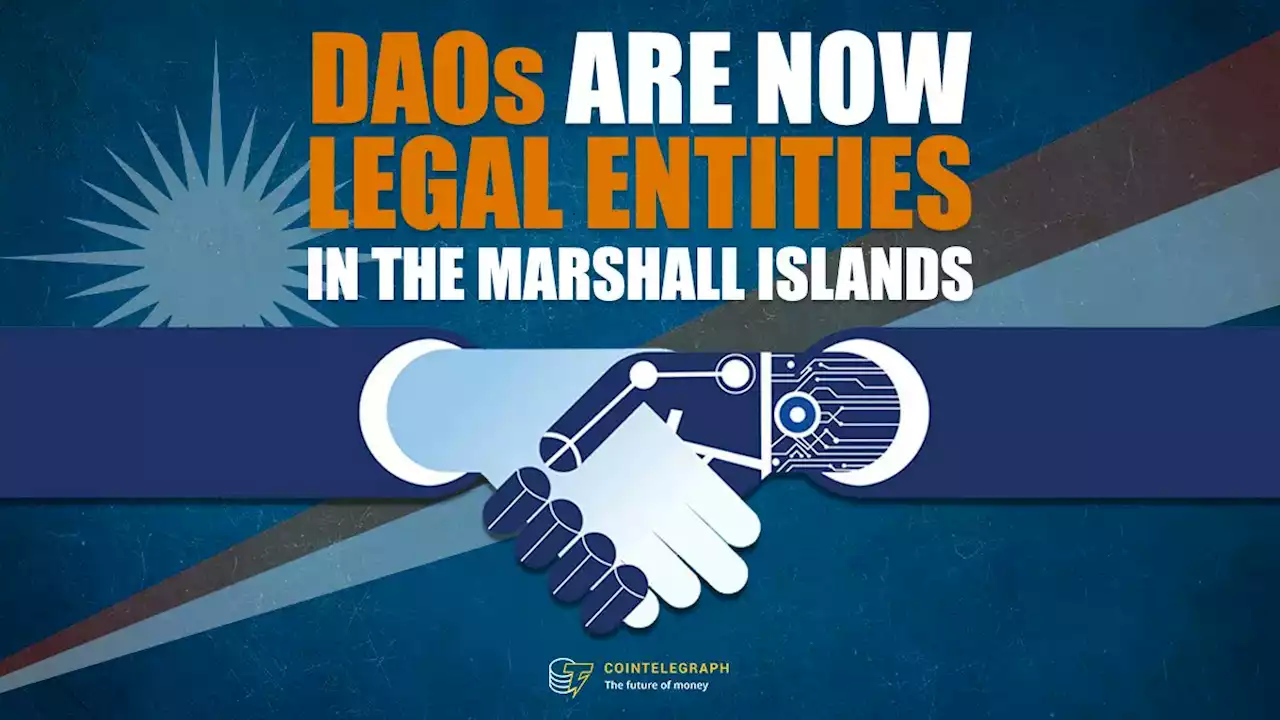
The Republic of the Marshall Islands has moved to formally recognize decentralized autonomous organizations, better known as DAOs, as legal entities — a move that gives collectively owned and managed blockchain projects formal recognition on the global stage.

DAOs, which are blockchain-based entities governed by self-organizing communities, have attained legal recognition in the Marshall Islands after the country passed the amended Non-Profit Entities Act 2021. The amendment allowed cryptocurrency trading infrastructure platform Shipyard Software to incorporate the island country’s first DAO, Admiralty LLC. The incorporation was aided by MIDAO Directory Services Inc., a domestic organization that was established to help DAOs register within the Marshall Islands.
As it currently stands, the new legislation allows any DAO to register and establish operations in the Marshall Islands.

Bobby Muller, the former chief secretary of the Republic of the Marshall Islands and co-founder of MIDAO, said his country recognizes that now is a “unique moment to lead” in the “blockchain revolution.” He said DAOs will play an important role in creating “more efficient and less hierarchical” organizations.

In a written statement to Cointelegraph, Muller said the Marshall Islands is looking to become a global hub for DAOs, “both in registering and domiciling, but also in developing out use cases and furthering mass adoption.” He further explained:

“The strategy is to provide the lowest cost for incorporation, a supportive government that has internationally recognized courts, and a receptive environment to technological advancements.”

The Marshall Islands is an independent island state located in the Pacific Ocean near the Equator with a population of around 59,000 as of 2019, according to the World Bank. The island state has been actively exploring use cases for digital assets since at least 2018, with the government introducing measures to create a blockchain-based cryptocurrency that would be recognized as legal tender alongside the United States dollar.

As Cointelegraph reported, the Marshall Islands already endorsed the creation of a new cryptocurrency, dubbed Sovereign (SOV), in February 2018. As one would expect by now, the International Monetary Fund, or IMF, has criticized the plan over concerns that a digital sovereign currency would undermine the state’s financial stability. The Washington-based lending institution has levied similar criticisms toward El Salvador, which became the first country to recognize Bitcoin (BTC) as legal tender.

However, Marshall Islands senator David Paul emphasized that the country's DAO legislation doesn’t pose the same complications as a state-backed cryptocurrency. “A sovereign digital currency is financial and generates a lot of concerns from a money-laundering perspective,” he told Cointelegraph in a written statement. “It’s a different realm for DAOs, as this is more about giving them legal recognition to make their case to regulatory bodies, investors and consumers.”

Related Reads

Trading

Spot
Futures

Hot Articles

What is $BITCOIN

DIGITAL GOLD ($BITCOIN): A Comprehensive Analysis Introduction to DIGITAL GOLD ($BITCOIN) DIGITAL GOLD ($BITCOIN) is a blockchain-based project operating on the Solana network, which aims to combine the characteristics of traditional precious metals with the innovation of decentralized technologies. While it shares a name with Bitcoin, often referred to as “digital gold” due to its perception as a store of value, DIGITAL GOLD is a separate token designed to create a unique ecosystem within the Web3 landscape. Its goal is to position itself as a viable alternative digital asset, although specifics regarding its applications and functionalities are still developing. What is DIGITAL GOLD ($BITCOIN)? DIGITAL GOLD ($BITCOIN) is a cryptocurrency token explicitly designed for use on the Solana blockchain. In contrast to Bitcoin, which provides a widely recognized value storage role, this token appears to focus on broader applications and characteristics. Notable aspects include: Blockchain Infrastructure: The token is built on the Solana blockchain, known for its capacity to handle high-speed and low-cost transactions. Supply Dynamics: DIGITAL GOLD has a maximum supply capped at 100 quadrillion tokens (100P $BITCOIN), although details regarding its circulating supply are currently undisclosed. Utility: While precise functionalities are not explicitly outlined, there are indications that the token could be utilized for various applications, potentially involving decentralized applications (dApps) or asset tokenization strategies. Who is the Creator of DIGITAL GOLD ($BITCOIN)? At present, the identity of the creators and development team behind DIGITAL GOLD ($BITCOIN) remains unknown. This situation is typical among many innovative projects within the blockchain space, particularly those aligning with decentralized finance and meme coin phenomena. While such anonymity may foster a community-driven culture, it intensifies concerns about governance and accountability. Who are the Investors of DIGITAL GOLD ($BITCOIN)? The available information indicates that DIGITAL GOLD ($BITCOIN) does not have any known institutional backers or prominent venture capital investments. The project seems to operate on a peer-to-peer model focused on community support and adoption rather than traditional funding routes. Its activity and liquidity are primarily situated on decentralized exchanges (DEXs), such as PumpSwap, rather than established centralized trading platforms, further highlighting its grassroots approach. How DIGITAL GOLD ($BITCOIN) Works The operational mechanics of DIGITAL GOLD ($BITCOIN) can be elaborated on based on its blockchain design and network attributes: Consensus Mechanism: By leveraging Solana’s unique proof-of-history (PoH) combined with a proof-of-stake (PoS) model, the project ensures efficient transaction validation contributing to the network's high performance. Tokenomics: While specific deflationary mechanisms have not been extensively detailed, the vast maximum token supply implies that it may cater to microtransactions or niche use cases that are still to be defined. Interoperability: There exists the potential for integration with Solana’s broader ecosystem, including various decentralized finance (DeFi) platforms. However, the details regarding specific integrations remain unspecified. Timeline of Key Events Here is a timeline that highlights significant milestones concerning DIGITAL GOLD ($BITCOIN): 2023: The initial deployment of the token occurs on the Solana blockchain, marked by its contract address. 2024: DIGITAL GOLD gains visibility as it becomes available for trading on decentralized exchanges like PumpSwap, allowing users to trade it against SOL. 2025: The project witnesses sporadic trading activity and potential interest in community-led engagements, although no noteworthy partnerships or technical advancements have been documented as of yet. Critical Analysis Strengths Scalability: The underlying Solana infrastructure supports high transaction volumes, which could enhance the utility of $BITCOIN in various transaction scenarios. Accessibility: The potential low trading price per token could attract retail investors, facilitating wider participation due to fractional ownership opportunities. Risks Lack of Transparency: The absence of publicly known backers, developers, or an audit process may yield skepticism regarding the project's sustainability and trustworthiness. Market Volatility: The trading activity is heavily reliant on speculative behavior, which can result in significant price volatility and uncertainty for investors. Conclusion DIGITAL GOLD ($BITCOIN) emerges as an intriguing yet ambiguous project within the rapidly evolving Solana ecosystem. While it attempts to leverage the “digital gold” narrative, its departure from Bitcoin's established role as a store of value underscores the need for a clearer differentiation of its intended utility and governance structure. Future acceptance and adoption will likely depend on addressing the current opacity and defining its operational and economic strategies more explicitly. Note: This report encompasses synthesised information available as of October 2023, and developments may have transpired beyond the research period.

363 Total ViewsPublished 2025.05.13Updated 2025.05.13

What is $BITCOIN

Discussions

Welcome to the HTX Community. Here, you can stay informed about the latest platform developments and gain access to professional market insights. Users' opinions on the price of BTC (BTC) are presented below.

活动图片