OM Token’s 90% Crash Highlights Centralization Risks: Is SUBBD Token the Decentralized Future?

bitcoinistPubblicato 2025-04-14Pubblicato ultima volta 2025-04-14

Introduzione

After cruising along at a fairly stable range, north of $6 per token, $OM – a top-100 token – plunged...

Trusted Editorial content, reviewed by leading industry experts and seasoned editors. Ad Disclosure

After cruising along at a fairly stable range, north of $6 per token, $OM – a top-100 token – plunged over 90%.

A token that had weathered much of the past month’s turmoil was undone by too much centralization, with token liquidations prompting the sudden collapse.

What happened to the $OM token? And how does the new crypto SUBBD Token ($SUBBD) avoid the same problem?

Centralized Exchange Liquidations Lead to OM Token’s Collapse

On April 13, MANTRA’s $OM token experienced a dramatic 90% drop, attributed to forced liquidations by centralized exchanges during low-liquidity hours.
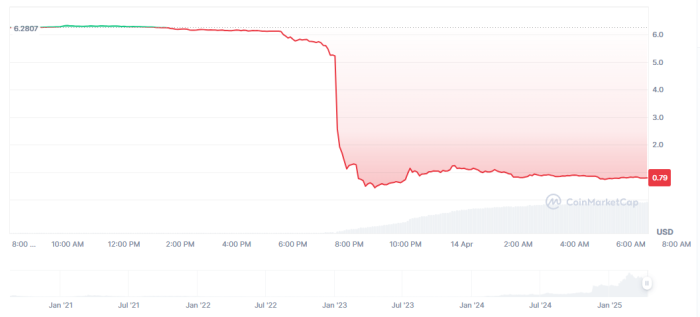
OM Token 90% drop

John Patrick Mullin, CEO of MANTRA, stated that ‘reckless forced closures’ on centralized exchanges caused the OM token’s sharp decline.

He emphasized that neither the MANTRA team nor its investors were responsible, noting that all tokens remain locked per their vesting schedules.

The crash occurred during low-liquidity hours on a Sunday evening UTC, raising questions about the timing and discretion exercised by these exchanges.

While centralizing exchanges are critical partners for the success of projects like MANTRA, they operate with little accountability.

The incident has sparked a broader conversation about the need for decentralized solutions and underscores the systemic risks associated with centralized platforms.

Could decentralized, AI-powered platforms like SUBBD Token offer a more resilient alternative?

As Mullin responded in an X statement:

‘When discretionary powers are exercised without due internal and external oversight, dislocations like what recently happened can and will occur, hurting both projects and investors alike.’

For smaller platforms to succeed, decentralization needs to be an essential part.

SUBBD Token: A Decentralized, AI-Powered Platform for Creators and Fans

MANTRA exists to provide real-world-asset solutions with top-level security. SUBBD Token ($SUBBD) exists to empower digital content creators with advanced AI tools and new ways to interact with fans and with the blockchain itself.

Crucially, SUBBD prioritizes decentralization.

SUBBD eliminates intermediaries between content creators and fans, giving them full control, while the project’s strategic tokenomics model prevents the team from dumping tokens.

The ongoing presale gives investors a way to participate in one of the best new crypto projects directly, long before the $SUBBD token appears on any centralized exchanges.

$SUBBD token holders are at the heart of the SUBBD decentralized economy. Token benefits include:

  • Access to premium, AI-enhanced content curated by top influencers.
  • Staking rewards at a fixed 20% APY for the first year.
  • Platform discounts on subscriptions and content purchases.
  • AI-driven tools for content generation, including voice notes and video editing.

Like MANTRA, SUBBD Token carefully allocates its 1B token supply to avoid sudden disruptions.
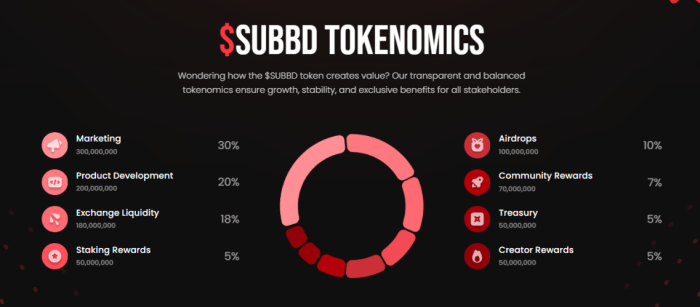
SUBBD Tokenomics

With interest in the project growing, the SUBBD Token presale has already raised over $162K. Tokens are priced at $0.05515, set to increase steadily as the presale progresses. The project is poised to join the ranks of best AI coins set for growth in 2025, so now is the best time to buy $SUBBD as price predictions target $0.3 by year-end.

Visit the SUBBD Token presale page to learn more.

SUBBD Token Stands Out for Decentralization

What MANTRA does for RWAs, SUBBD will do for the $85B content creation market – only better.

The OM token incident highlighted the fragility of centralized systems. SUBBD Token’s decentralized approach offers a compelling alternative, especially for the large and growing subscription-based content industry.
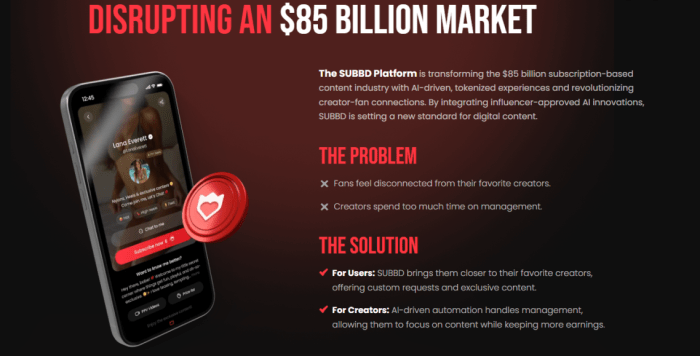
Disrupting an $85B market

By integrating AI and blockchain technology, SUBBD provides a platform where creators maintain control over their content and revenue streams.

However, never accept someone else’s analysis without doing your own research. Crypto is notoriously volatile, as MANTRA learned painfully in recent days.

The crypto community requires resilient and decentralized solutions to minimize the risk of drastic token devaluations like the one that impacted $OM. Despite market fluctuations, the best crypto to buy now are the ones that provide innovative answers to current problems.

SUBBD Token positions itself as a forward-thinking platform that addresses the shortcomings of centralized exchanges and platforms.

Editorial Process for bitcoinist is centered on delivering thoroughly researched, accurate, and unbiased content. We uphold strict sourcing standards, and each page undergoes diligent review by our team of top technology experts and seasoned editors. This process ensures the integrity, relevance, and value of our content for our readers.

Bitcoinist is the ultimate news and review site for the crypto currency community!

Letture associate

A 10,000-Word Interpretation of the "Optical Interconnect" Industry Chain: The AI Infrastructure Bottleneck Obscured by GPU Glare

**Summary: The Rise of Optical Interconnect in AI Infrastructure** This analysis explores the critical, yet often overlooked, role of optical interconnects in large-scale AI data centers. While GPUs provide raw computational power, the efficiency of AI clusters depends heavily on high-speed data transfer between thousands of cooperating GPUs during both training and inference tasks. Copper-based electrical connections are hitting physical limits in bandwidth, distance, and power consumption. Fiber optics, using light signals, offer a superior solution with exponentially higher bandwidth and lower energy use over longer distances. This shift is driving rapid growth in the optical interconnect market. The core translation device is the pluggable optical transceiver (or module), which converts electrical signals from GPUs into optical signals for fiber transmission and vice versa. Its manufacturing involves two distinct semiconductor domains: indium phosphide (InP) for optical chips (lasers, modulators, detectors) and silicon for digital signal processing (DSP) chips. A transformative next-generation technology is Co-Packaged Optics (CPO). CPO moves the optical engine (a silicon photonic integrated circuit, or PIC) much closer to the GPU or switch inside the same chip package, drastically reducing power loss and latency. CPO necessitates an external laser source and relies on silicon photonics (using Silicon-on-Insulator/SOI wafers) for integration with silicon chips. The optical interconnect ecosystem is highly fragmented, unlike the concentrated GPU market. Key bottlenecks and players span the entire supply chain: InP substrates (e.g., AXT), epitaxial wafers (e.g., IQE), laser chips (e.g., Sivers, Lumentum, Coherent), silicon photonics foundries (e.g., Tower Semiconductor), SOI wafers (e.g., Soitec), DSP/switch chips (e.g., Broadcom, Marvell), and underlying fiber (e.g., Corning). The article posits that AI infrastructure competition is extending from "who has more GPUs" to "who can secure the scarce optical interconnect supply chain." CPO represents the largest potential growth variable, with projections suggesting it could become a market worth tens of billions of dollars by 2028. Investment opportunities vary from conservative (large, diversified players) to aggressive (small, high-beta companies focused on specific bottleneck technologies), but the sector carries significant volatility and execution risks.

marsbitAdesso

A 10,000-Word Interpretation of the "Optical Interconnect" Industry Chain: The AI Infrastructure Bottleneck Obscured by GPU Glare

marsbitAdesso

a16z: RWA Has Passed the Proof of Concept, but the Real Challenges Are Just Beginning

a16z highlights that the tokenized real-world asset (RWA) market, excluding stablecoins, has grown tenfold in under two years to roughly $340 billion. This surge is primarily driven by US Treasury bonds and gold, offering investors yield on idle stablecoins and providing institutions with more efficient settlement and collateral flows. However, the core insight is that most tokenized assets today are simply digital certificates for off-chain holdings—used for ownership and transfer but not deeply integrated into DeFi as composable financial building blocks. For instance, only about 5% of tokenized bonds ($8B) are actively used in DeFi protocols. Smaller categories like reinsurance tokens show much higher DeFi utilization (84%), indicating they were designed for on-chain composability from the start. The market remains concentrated, with US Treasuries and commodities comprising two-thirds of the total. Gold dominates the commodities segment. While Ethereum holds over half the market, activity is spreading across multiple chains like BNB Chain and Solana. Predictions for the market's future size vary widely (from $2 trillion to over $30 trillion by 2030/2034), reflecting different definitions of what constitutes tokenization. All agree on significant growth. The current market is minuscule compared to traditional finance (e.g., tokenized bonds are 0.01% of the global bond market). The key takeaway is that the initial "proof-of-concept" phase for moving familiar assets on-chain is proving successful. The next, harder challenge is moving more complex financial instruments onto blockchains and enabling true on-chain composability, where these assets become programmable components within a native digital financial system, rather than just digitized records.

marsbit38 min fa

a16z: RWA Has Passed the Proof of Concept, but the Real Challenges Are Just Beginning

marsbit38 min fa

The Wind of 'Proactive' AI Blows into Silicon Valley: Hark Secures $700 Million in Funding

Hark, an AI startup founded in late 2025, has raised $700 million in Series A funding at a $6 billion valuation. Led by Parkway Venture Capital with participation from NVIDIA, AMD Ventures, Intel Capital, Qualcomm Ventures, and Salesforce Ventures, the company aims to develop next-generation human-computer interfaces using a combination of proprietary foundational models and custom-built AI-native hardware. Founded by serial entrepreneur Brett Adcock, Hark envisions a system of multimodal devices equipped with agentic capabilities, end-to-end voice models, and personalized memory. This "active" AI approach seeks to move beyond passive chatbots, creating collaborative companions that anticipate needs and interact naturally within the real world. Adcock's experience with Figure, a humanoid robotics company, informs this hardware-focused venture. The article argues that while current AI is powerful, it remains confined to screens and traditional interfaces like chat. The next paradigm shift requires dedicated hardware that is always-on, possesses persistent memory, and enables intuitive interaction, potentially rivaling the impact of the iPhone. Hark is assembling a team with talent from Apple, Meta, Google, and Tesla to tackle this complex engineering challenge across models, hardware, and interaction design. Finally, the piece suggests Chinese startups may have an advantage in this "active" AI hardware space due to strong manufacturing ecosystems, a vast domestic market, and supportive government policies, framing the competition as one that requires integrated progress in models, operating systems, and devices.

marsbit42 min fa

The Wind of 'Proactive' AI Blows into Silicon Valley: Hark Secures $700 Million in Funding

marsbit42 min fa

Competitors Going Public, Kimi Can't Sit Still

Competitors Go Public, Kimi Feels the Pressure Yue Zhi An Mian (Moonshot AI), the company behind the AI assistant Kimi, has begun dismantling its VIE and red-chip structure, clearing a key obstacle for a potential Hong Kong IPO. This marks a significant shift from six months ago when founder Yang Zhilin stated the company was in "no hurry" to list. The move comes as rivals like Zhipu AI and MiniMax have successfully listed on the Hong Kong Stock Exchange in early 2026, experiencing massive surges in market value. This has reset valuation logic for AI companies, turning "going public" from an end goal into a competitive necessity. Analysts suggest Kimi is both seizing a favorable market window and responding to competitive pressure. Kimi's valuation has skyrocketed from around $3 billion at its 2023 founding to over $20 billion by May 2026. Capital is betting on its potential as a future AI platform and gateway, though some caution this "emotional valuation" depends on sustained technological leadership and successful commercialization. Traditionally focused on core model R&D over user growth, Kimi has recently pivoted strategy. While its monthly active users declined through 2025, it shifted focus to Agent development and reducing marketing spend. The release of its K2.5 model in early 2026 reportedly generated substantial revenue, with annual recurring revenue reaching $200 million by April, driven by subscriptions and API services. A $2 billion D-round financing in May signaled investor approval of this commercial shift. However, listing will bring new pressures. Experts predict a listed Kimi would face stricter scrutiny on financial controls, compliance, and R&D efficiency. The narrative must evolve from pure technological breakthroughs to demonstrating clear commercialization paths, sustainable income, and a defensible valuation, balancing model superiority with business performance.

marsbit1 h fa

Competitors Going Public, Kimi Can't Sit Still

marsbit1 h fa

Trading

Spot
Futures
活动图片