Биткоин падает ниже $80 000: что стоит за обвалом криптовалюты?

cryptonews.ruPublished on 2024-12-28Last updated on 2025-02-28

Цена биткоина впервые с ноября упала ниже $80 000, что привело к ликвидации крупных лонговых позиций и росту панических настроений на рынке. Главной причиной снижения аналитики называют макроэкономическую неопределенность, связанную с новыми тарифными инициативами президента США Дональда Трампа.

27 февраля цена BTC обрушилась до $79 752, по данным TradingView. Согласно данным CoinGlass, падение на 2,65% всего за час вызвало ликвидацию позиций на сумму $100,01 млн.
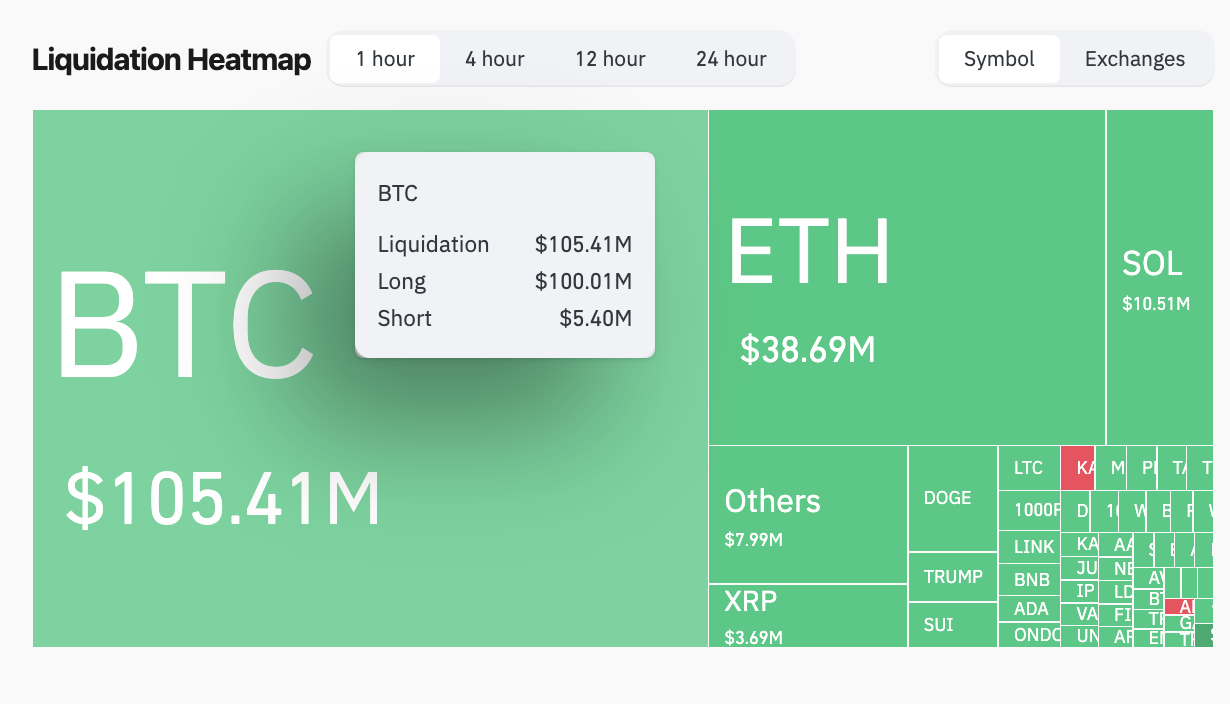
В последний раз биткоин торговался на этом уровне 11 ноября — всего через несколько дней после победы Трампа на президентских выборах. Тогда трейдеры надеялись, что его лояльная позиция в отношении криптовалют и ослабление давления регуляторов приведут к новому ралли BTC в 2025 году.

Однако на фоне неопределенности, связанной с экономической политикой Трампа, многие участники рынка теперь опасаются дальнейшего падения.

За последние дни уровень $82 000 рассматривался как потенциальное дно для биткоина, но текущее снижение заставило рынок пересмотреть прогнозы.

Трейдер dmac в посте на X (Twitter) 27 февраля заявил: «Те, кто откупает просадки, потом будут фиксировать убытки. Я по-прежнему вижу $70 000 в качестве цели».
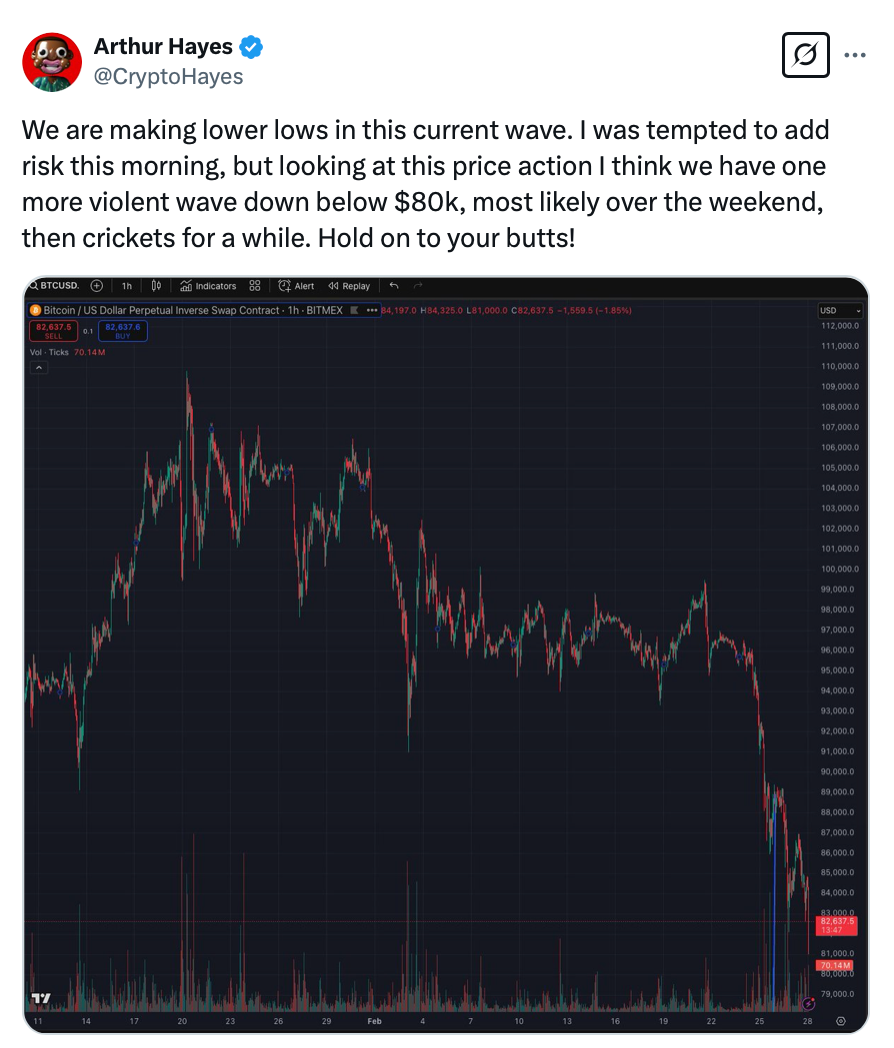
Биткоин не торговался на этом уровне с 5 ноября, когда предварительные результаты выборов указывали на лидерство Трампа.

Другой трейдер, известный под псевдонимом Mandrik, добавил: «Если Вам нравился биткоин по $80 000, то по $70 000 он точно понравится еще больше».

В то же время трейдер Rager, имеющий 201 500 подписчиков в X (Twitter), сохраняет спокойствие:

«Падение до середины или нижней границы $70 000 — вполне нормальное явление. В предыдущих циклах, даже во время бычьего рынка, биткоин падал на 30-40%».

Аналитическая платформа Polymarket показывает, что мнения в сообществе разделились. По данным сервиса, вероятность дальнейшего падения BTC ниже $70 000 оценивается примерно в 50%.

Эксперты связывают снижение биткоина с экономической неопределенностью, вызванной планами Дональда Трампа ввести новые пошлины. С момента его инаугурации 20 января, когда BTC достиг исторического максимума в $109 000, актив потерял около 26% стоимости.

Несмотря на нестабильность, институциональные инвесторы сохраняют оптимизм. 27 февраля глава отдела исследований цифровых активов в Standard Chartered Джеффри Кендрик заявил, что ожидает роста биткоина до $200 000 в этом году, а затем — до $500 000 до окончания второго президентского срока Трампа.


Related Reads

BIS Report Compliance Observations: The True Risks of Stablecoins Go Beyond 'De-pegging'

The BIS report, "Anchoring trust in money: innovation beyond stablecoins," highlights that the primary risks of stablecoins extend beyond potential de-pegging. It argues that the core challenge is whether stablecoins can be integrated into a financial system that is identifiable, monitorable, accountable, and regulatable. While acknowledging efficiency gains like faster payments and programmability, BIS emphasizes that money requires an institutional framework—including legal certainty, liquidity support, and financial integrity controls—which many stablecoins currently lack. The report details compliance risks, noting that while blockchain transactions are transparent, address visibility does not equate to identity or purpose clarity. This creates a systemic risk as pseudonymity, non-custodial wallets, and cross-chain bridges can undermine AML/CFT controls. Furthermore, these risks can spill over into the traditional financial system through on- and off-ramps. The future direction, per BIS, is not to prohibit innovation but to embed regulatory rules—such as identity verification and transaction screening—directly into the technological infrastructure of tokenized finance. The key takeaway for compliance is that any new financial instrument must clearly address questions of customer identification, transaction monitoring, accountability, and cross-border rule consistency to be viable as a mainstream payment tool.

marsbit1h ago

BIS Report Compliance Observations: The True Risks of Stablecoins Go Beyond 'De-pegging'

marsbit1h ago

When US Giants Collectively "Defect" to Chinese AI Models

When Silicon Valley Giants Turn to Chinese AI Models to Cut Costs A surprising trend is emerging: major U.S. tech companies are significantly reducing AI costs by switching to Chinese models. Coinbase, the largest U.S. cryptocurrency exchange, reportedly halved its AI spending after migrating to China's GLM-5.2 and Kimi 2.7 models, despite increasing usage. They achieved this through a sophisticated three-part strategy: implementing an automatic routing system to select the most cost-effective model per task, boosting cache hit rates from 5% to 60% to reuse computations, and employing "context engineering" to provide AI with more precise, less cluttered information. They are not alone. AI startup Lindy switched from Claude to DeepSeek, saving millions, while Snowflake's tests found GLM-5.2 solved 66% of coding tasks compared to Claude Opus's 67%—but at a fraction of the cost (output pricing is 5-7 times lower). While the top Western models may offer slightly better stability, the massive price differential is leading many businesses to reconsider their value proposition. This shift signals a deeper change in the AI industry, moving beyond pure performance benchmarks to a fierce cost competition. As pressure mounts, even OpenAI and Anthropic have begun slashing prices. For users, this means more choices, lower costs, and a crucial lesson: using multiple models based on task complexity, optimizing with caching, and keeping contexts lean are now key to leveraging AI efficiently and affordably.

marsbit1h ago

When US Giants Collectively "Defect" to Chinese AI Models

marsbit1h ago

Trading

Spot
活动图片