Сумасшедший трейдер спрогнозировал рост курса Dogecoin до $4,2

cryptonews.ruPublished on 2021-08-23Last updated on 2025-01-23

Трейдер под псевдонимом Zer0, торгующий токенами-мемами, предсказал безумный 12-кратный рост курса криптовалюты Dogecoin (DOGE).

Zer0 проанализировал исторические данные и пришёл к выводу о том, что рынок Dogecoin преодолел лишь первую фазу бычьего ралли, когда монета стремительно подорожала от $0,1 до $0,48 с октября по декабрь 2024 года. После окончания этого периода, как и во время предыдущих циклов, возникла коррекция, в результате которой цена монеты рухнула на 46%. Затем произошёл отскок ото дна, и курс пошёл вверх.

Трейдер убеждён, что в скором времени цену Dogecoin снова будут пампить, и она достигнет $4,2 в ходе двух восходящих рывков, отделённых друг от друга краткосрочной коррекцией. Если прогноз торговца криптовалютами сбудется, то DOGE подорожает в 12 раз от текущего показателя и озолотит ходлеров, которые успеют продать токены на пике.

В этом случае курс криптовалюты вырастет в 42 раза с момента старта восходящей тенденции, и текущее бычье ралли уступит двум предыдущим, в рамках которых стоимость монеты повысилась в 92 и 300 раз соответственно.
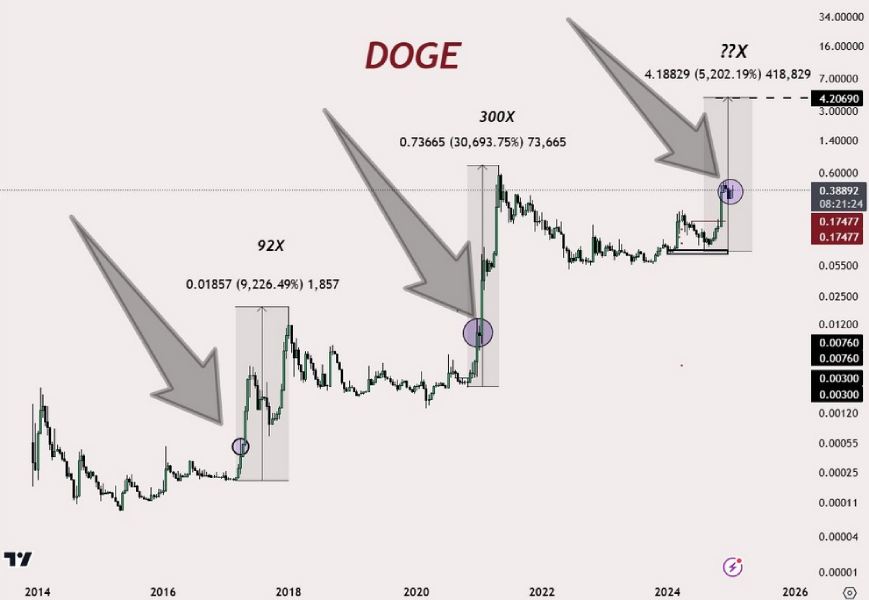
zer0-doge-pump-graph

Прогноз на изменение курса Dogecoin на графике, составленном Zer0

Одним из катализаторов второго этапа бычьего ралли на рынке Dogecoin может оказаться выпуск ETF на базе этого цифрового актива. Создать деривативы на основе DOGE хотят три американские компании: Bitwise, Osprey Funds и REX Shares.

Как полагает сотрудник Bloomberg Эрик Балчунас, торговлю Dogecoin-ETF запустят в апреле 2025-го, конечно, если всё пройдёт гладко и Комиссия по ценным бумагам и биржам США согласует выпуск фондов. Поэтому нового витка восходящей тенденции на графике изменения курса Dogecoin стоит ожидать весной.


Related Reads

Citi Research Report Analysis: U.S. Proposed Ban on Chinese Optical Modules Has No Substantial Progress, Short-term Enforcement Faces Supply Constraints

Citi Report Analysis: U.S. Proposed Ban on Chinese Optical Modules Lacks Substantive Progress, Faces Supply Bottlenecks in Short Term. Reuters reported on August 4th that the U.S. government and FCC are considering a ban on Chinese optical modules. Citi's August 9th report clarifies that optical modules are not listed on any effective FCC ban. The FCC's Order 26-50 established two restricted list mechanisms (based on manufacturer and production location), but optical modules were only mentioned once, as an example in a disclosure requirement, not as a restricted product. The reported ban remains at a proposal stage. Citi estimates Chinese suppliers provide 60-70% of high-speed optical modules for U.S. hyperscalers. Non-Chinese suppliers cannot fill this gap in the short term, making the immediate implementation of a genuine ban unlikely. Future regulatory paths could be manufacturer-based (least likely), location-based covering all offshore production (strictest), or location-based covering only China (more feasible but with unresolved definitions). A ban would pressure U.S. AI infrastructure, conflicting with stated policy goals. Citi sees low near-term implementation probability, with the issue potentially becoming a negotiation chip in bilateral talks. U.S. domestic capacity build-out is a key long-term variable. Among Chinese companies, XSENS and Dongshan Precision have the highest U.S. exposure, while Tianfu Communication, as a passive component supplier, is relatively insulated. Citi maintains Buy ratings on all three with respective price targets. The conclusion is that Chinese modules are currently irreplaceable in the U.S. AI supply chain, creating a longer timeline for potential restrictions than the market may expect.

marsbit19m ago

Citi Research Report Analysis: U.S. Proposed Ban on Chinese Optical Modules Has No Substantial Progress, Short-term Enforcement Faces Supply Constraints

marsbit19m ago

Lead Analyst Claims Bitcoin is at a Critical Stage: 'We are at the Bear Market Bottom, What Happens Next…'

Renowned cryptocurrency analyst Benjamin Cowen, in his latest analysis video, examined recent events and historical cycles in the Bitcoin market. Noting Bitcoin's trading range of $64,000 to $65,000, Cowen stated that market dynamics and investor interest show similarities to past cycles, suggesting the upcoming period marks a critical turning point. Cowen observed a significant decline in public interest and investor enthusiasm for the crypto market, with social risk metrics falling to 0.2, far below levels seen four years ago. He added that market volatility has notably decreased, and a sense of distrust prevails among investors, drawing parallels to the ends of bear markets in 2018 and 2022. Historical data indicates Bitcoin markets typically bottom in summer months, followed by a period of stagnation with low volatility, implying a major move could occur in the year's final quarter. However, Cowen noted on-chain indicators like the MVRV Z-Score have not yet signaled a definitive bottom. Cowen believes an event in the coming weeks could shake the market, potentially triggering a final sell-off wave. Such an event, he argues, would bring investors back and pave the way for a new bull cycle. He predicts October as the most likely bottoming period, while acknowledging September or November are also possible, advising crypto users to remain cautious and prepared for a decisive market moment.

cryptonews.ru28m ago

Lead Analyst Claims Bitcoin is at a Critical Stage: 'We are at the Bear Market Bottom, What Happens Next…'

cryptonews.ru28m ago

Bitcoin Community in Uproar: Deciphering the New Scaling War Sparked by BIP-110

On August 10, Luke Dashjr, a long-time Bitcoin Improvement Proposal (BIP) editor and co-founder of Ocean mining pool, was removed from the BIP editing team for bypassing discussion protocols and preemptively assigning a number to BIP-110, a controversial soft fork proposal he helped draft. The conflict stems from Bitcoin Core's version 30 release in October 2025, which removed the default 83-byte limit on OP_RETURN, a field used for embedding non-transaction data. In response, BIP-110 aimed to enforce this limit as a consensus rule. It controversially lowered the activation threshold for miners to 55% and included a mandatory activation clause, causing significant community backlash. Major mining pools like Foundry USA and AntPool did not support it, with public criticism from figures like F2Pool's Wang Chun and Michael Saylor, who argued it compromised Bitcoin's neutrality. On August 8, at block height 961,632, nodes running the BIP-110 patch rejected the main chain block, causing a chain split. The minority chain, supported by only about 2.53% of the network's hash rate, produced just one additional block before stalling. The main chain quickly outpaced it by over 240 blocks. No major exchanges have supported the minority chain. The event highlighted Bitcoin's governance reality: while rules can be proposed by a few, ultimate authority lies with the economic majority—miners willing to expend hash power and users/exchanges recognizing a chain's validity. Following the failed split, BIP-110 proponents, including Luke Dashjr, have begun discussing a change to the proof-of-work algorithm to create a separate coin, though this remains in early discussion stages.

marsbit49m ago

Bitcoin Community in Uproar: Deciphering the New Scaling War Sparked by BIP-110

marsbit49m ago

Trading

Spot
活动图片