South Korea To Reconsider Crypto ETFs In 2025 Amid Global Demand

bitcoinistPublished on 2025-01-04Last updated on 2025-01-04

Abstract

On Thursday, the South Korea Stock Exchange chairman, Jeong Eun-bo, revealed their plan to “explore” the approval of crypto-based exchange-traded...

On Thursday, the South Korea Stock Exchange chairman, Jeong Eun-bo, revealed their plan to “explore” the approval of crypto-based exchange-traded funds (ETFs) to continue with its “value-up program” and face the ongoing market challenges.

Korea Exchange To Explore Crypto ETFs

On January 2, Jeong Eun-bo announced the Korea Exchange’s plan to explore crypto-based ETFs this year at the 2025 Securities and Derivatives Market open ceremony. The Chairman stated that the South Korean capital markets faced significant challenges in 2024, which has weakened the growth potential of local companies.

Jeong also noted that global conflicts and domestic political developments made the market “significantly sluggish compared to major countries.” The South Korean market will continue facing risks this new year as “the domestic and global economic conditions are unfavorable.”

Nonetheless, the Chairman explained that the exchange will continue promoting its value-up program to “engage more leading companies and establish a management culture centered on shareholder value.”

Moreover, Jeong revealed that the Korea Exchange will “benchmark overseas cases for new business avenues such as crypto ETFs and explore new territory in the capital market.”

It’s worth noting that crypto ETFs have been banned in South Korea since 2017. The country’s regulator, the Financial Services Commission (FSC), reaffirmed its stance after the US Securities and Exchange Commission (SEC) approved the crypto-based investment products last year.

However, the financial watchdog announced in October that the newly formed advisory group for discussing digital asset policies would review the ban, signaling an apparent shift from the strict regulation. This shift seems to be influenced by the success of spot Bitcoin and Ethereum ETFs, which surpassed most experts’ expectations in their first year.

South Korea’s Political Crisis Stopping New Regulations

The Korea Exchange’s chief previously called for crypto’s institutionalization in the country to “create added value.” Jeong stated that lawmakers and financial institutions should look at digital assets differently, arguing that the industry has grown and become considerably influential in recent years.

The Chairman added that South Korea should consider incorporating digital assets into institutional finance, as the market needs revitalization to compete with other countries.

The regulator’s current stance on digital assets has made the market fail to cross various regulatory thresholds for years, challenging the market’s development and competitiveness. However, crypto-related regulations will be halted until the political crisis resolution, which could take a few months.

In December, South Korean President Yoon Suk Yeol declared the first emergency martial law in four decades. Yoon accused the country’s opposition Democratic party, which has a majority in the National Assembly, of sympathizing with North Korea and anti-state activities.

The National Assembly voted to nullify the President’s declaration and successfully ended the emergency martial law in six hours. Since then, the Assembly has impeached Yoon and Prime Minister Han Duck-soo, who became acting president after Yoon’s powers were suspended.

According to Associated Press reports, South Korea’s presidential security service prevented authorities from detaining Yoon today in a six-hour stand-off at the impeached President’s residency.

As a result, the anti-corruption agency plans to “strongly demand” that the current acting leader, Deputy Prime Minister Choi Sang-mok, instruct the service to comply with the detention warrant’s execution.

The Constitutional Court is set to determine whether to remove Yoon from office or reinstate him. To remove him, at least six justices on the nine-member court must vote in favor.
crypto, TOTAL

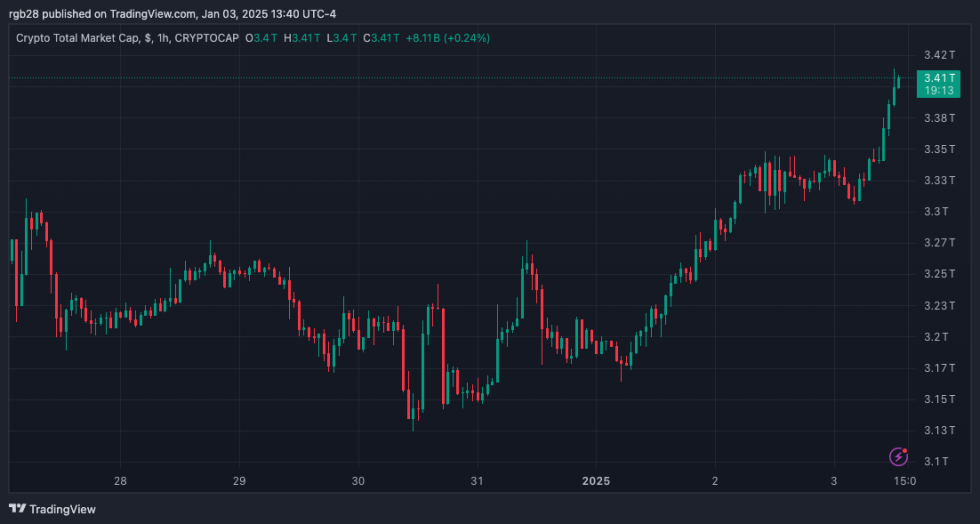
Total crypto market capitalization is at $3.41 trillion in the one-week chart. Source: TOTAL on TradingView
Featured Image from Unsplash.com, Chart from TradingView.com
Rubmar Garcia

Rubmar Garcia

Rubmar is a crypto enthusiast who likes learning and improving constantly. She enjoys reporting on the latest news and developments in the crypto industry. Rubmar also enjoys scrapbooking, crafting, simulation games, and watching football.

Related Reads

When US Giants Collectively "Defect" to Chinese AI Models

When Silicon Valley Giants Turn to Chinese AI Models to Cut Costs A surprising trend is emerging: major U.S. tech companies are significantly reducing AI costs by switching to Chinese models. Coinbase, the largest U.S. cryptocurrency exchange, reportedly halved its AI spending after migrating to China's GLM-5.2 and Kimi 2.7 models, despite increasing usage. They achieved this through a sophisticated three-part strategy: implementing an automatic routing system to select the most cost-effective model per task, boosting cache hit rates from 5% to 60% to reuse computations, and employing "context engineering" to provide AI with more precise, less cluttered information. They are not alone. AI startup Lindy switched from Claude to DeepSeek, saving millions, while Snowflake's tests found GLM-5.2 solved 66% of coding tasks compared to Claude Opus's 67%—but at a fraction of the cost (output pricing is 5-7 times lower). While the top Western models may offer slightly better stability, the massive price differential is leading many businesses to reconsider their value proposition. This shift signals a deeper change in the AI industry, moving beyond pure performance benchmarks to a fierce cost competition. As pressure mounts, even OpenAI and Anthropic have begun slashing prices. For users, this means more choices, lower costs, and a crucial lesson: using multiple models based on task complexity, optimizing with caching, and keeping contexts lean are now key to leveraging AI efficiently and affordably.

marsbit2m ago

When US Giants Collectively "Defect" to Chinese AI Models

marsbit2m ago

BIS Report Compliance Watch: The Real Risks of Stablecoins Are Not Just 'De-pegging'

BIS Report Compliance Observations: The real risks of stablecoins go beyond "depegging" The BIS report "Anchoring trust in money: innovation beyond stablecoins" argues that while stablecoins and tokenization offer efficiency gains, their primary risk lies in fitting into an identifiable, monitorable, accountable, and regulatable financial system. Money's trust stems not just from technology but from institutional arrangements: a common unit of account, guaranteed redemption at par, liquidity support, regulatory frameworks, and financial integrity requirements. Stablecoins, operating on permissionless blockchains with pseudo-anonymity and non-custodial wallets, create systemic compliance gaps: unclear customer identity, incomplete fund origins, unexplained transaction purposes, fragmented cross-chain paths, and ambiguous liability. On-chain transparency does not equal compliance transparency. Public addresses don't reveal identity or intent. While blockchain analytics aid law enforcement, they cannot replace routine, large-scale AML/CFT controls. Effective compliance requires a closed-loop process encompassing customer onboarding, transaction monitoring, investigation, reporting, and audit. Stablecoin risks are not confined to the blockchain; they re-enter the traditional financial system via on/off-ramps, exchanges, and payment institutions. This forces banks to monitor client accounts for activity linked to virtual assets. The future direction is not to prohibit innovation but to embed rules into the technology. Tokenized finance should integrate with the existing two-tier monetary system, embedding compliance—like customer identification, pre-transaction screening, and auditable data trails—directly into the transaction flow. For compliance professionals, the key takeaway is that any new financial instrument must answer core questions: Who identifies the customer? Who monitors transactions? Who handles exceptions? Who is liable? Compliance is not the antithesis of innovation but the essential infrastructure for its sustainable growth.

链捕手3m ago

BIS Report Compliance Watch: The Real Risks of Stablecoins Are Not Just 'De-pegging'

链捕手3m ago

When American Giants 'Defect' to Chinese AI Models

Summary: The trend of major U.S. technology firms adopting more cost-effective Chinese AI models is gaining momentum. A prime example is Coinbase, the largest U.S. cryptocurrency exchange, which reportedly halved its AI expenditure by switching to Chinese models GLM-5.2 and Kimi 2.7, while its usage volume increased. This was achieved through a sophisticated cost-saving system featuring intelligent model routing (selecting the most suitable model per task), dramatically improving cache hit rates from 5% to 60%, and implementing "Context Engineering" to streamline prompts. This shift is not isolated. Other companies like the AI startup Lindy and data cloud firm Snowflake are making similar moves, drawn by the significant price disparity. For instance, GLM-5.2 costs $1.40/$4.40 per million tokens (input/output), compared to $5/$25 for Claude Opus 4.7. While top Western models may offer slightly higher stability or speed in complex tasks, the performance gap is narrowing, making the price difference harder to justify for many enterprise use cases. The implications are significant for both businesses and individual users. It highlights the importance of a multi-model strategy based on task requirements, the value of caching and reusing outputs, and the effectiveness of providing concise context. Ultimately, this migration signals a potential reshaping of the AI industry's pricing model, moving competition from pure performance benchmarks to practical cost-effectiveness, with increased choice and downward price pressure benefiting end-users.

链捕手9m ago

When American Giants 'Defect' to Chinese AI Models

链捕手9m ago

Trading

Spot
活动图片