Ripple CTO Reveals Why The Payment Business Hasn’t Caught On In A ‘Big Way’

bitcoinistОпубліковано о 2024-11-14Востаннє оновлено о 2024-11-14

Анотація

In an exchange on X (formerly Twitter), Ripple's Chief Technology Officer David Schwartz, also known as “JoelKatz”, addressed criticisms about...

In an exchange on X (formerly Twitter), Ripple’s Chief Technology Officer David Schwartz, also known as “JoelKatz”, addressed criticisms about his company and the XRP Ledger.

Has Ripple Failed With Its Payments Business?

User @188ape challenged Schwartz by questioning the uniqueness of the XRPL in today’s market, stating that it seems like “most new layer 1s can do what the XRPL can do, plus more.” In response, Schwartz emphasized the XRPL’s distinctive features, highlighting that it offers functionalities like stablecoins, non-fungible tokens (NFTs), and a decentralized exchange (DEX) without exposing users to the risks associated with smart contracts.

He stated: “I don’t think there’s any other blockchain that has features like stablecoins, NFTs, a DEX, and so on that doesn’t expose you to the risks of smart contracts where your wallet has no way to know what the things you agree to are actually doing.”

The conversation intensified when another user, @dr_wonder589 (Dr. Wonder Bread), remarked that despite these features, they don’t seem to translate into market value. “Over-engineering something doesn’t mean it’s valuable to the market,” he noted.

Addressing this skepticism, Schwartz expressed surprise at the slow adoption of the payments business by Ripple. We focused very heavily on payments in the early design stages. Using cryptocurrencies or blockchains for payments hasn’t really caught on in a big way anywhere yet. I find that quite surprising,” he admitted.

When pressed further about the reasons behind this lack of widespread adoption, Schwartz cited several factors. He mentioned regulatory uncertainty and the difficulty of providing a good user experience as significant hurdles. According to him, users with access to traditional financial services prefer to use their banks, while those without such access lack the discretionary funds to experiment with new technologies.

“Users with good access to financial services would rather just use their banks. Users without good access to financial services don’t have a bunch of ‘fooling around’ money they can tolerate not having good access to and need to be able to easily pay bills with their money. Two-sided market problems and difficulty forming closed loops. One-sided flows that are inefficient because you can’t net out external flows. And so on,” Schwartz elaborated.

The dialogue took a critical turn when Dr. Wonder Bread suggested that Ripple’s challenges serve as a convenient excuse for its stagnation while it continues to fund itself through XRP sales. He insinuated that this might be a tactic to indirectly influence the price of XRP and maintain its stability.

In defense, Schwartz reiterated Ripple’s transparent strategy since 2014. “Ripple very publicly chose to focus on payments in 2014 and was completely open about our strategy and why we chose it. I don’t think anyone in the space was more successful at it than we were,” he stated.

Unsatisfied, @188ape pressed Schwartz for concrete examples of a XRP success. “Where is the success, David? Give us an example of XRP being a success story… I’ll wait,” he demanded. As of the time of writing, Schwartz has not publicly responded to this query.

Another user, @hesu_krypto, observed that Schwartz was referring to Ripple, not XRP specifically. However, @188ape countered by suggesting that the community was led to believe otherwise. Echoing this sentiment, Dr. Wonder Bread accused Ripple of manipulating the market through indirect means, implying that this could be considered securities fraud.

At press time, XRP traded at $0.70.
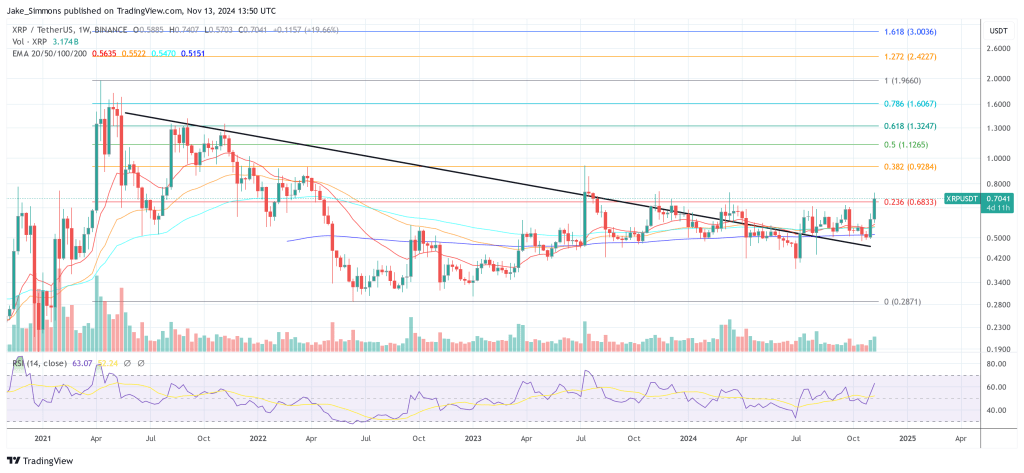
XRP price
XRP rises above the 0.236 Fib, 1-week chart | Source: XRPUSDT on TradingView.com
Featured image from YouTube, chart from TradingView.com
Jake Simmons

Jake Simmons

Jake Simmons has been a Bitcoin enthusiast since 2016. Ever since he heard about Bitcoin, he has been studying the topic every day and trying to share his knowledge with others. His goal is to contribute to Bitcoin's financial revolution, which will replace the fiat money system. Besides BTC and crypto, Jake studied Business Informatics at a university. After graduation in 2017, he has been working in the blockchain and crypto sector. You can follow Jake on Twitter at @realJakeSimmons.

Пов'язані матеріали

The World Cup is Approaching: Sports Entering the Era of 'Fragmented Finance'

With the approaching World Cup, sports are entering an era of "fragmented finance." This shift is exemplified by FIFA's new rule requiring debutant players to wear a special "World Cup debut patch." Post-tournament, these patches will be authenticated, cut, and embedded into collectible cards, potentially transforming into high-value assets. The global sports trading card market, valued at over $11.5 billion, represents a sophisticated alternative asset class with deep secondary markets and distinct bull/bear cycles. While football has a massive fanbase, its card market has historically lacked the liquidity and unified narrative of the NBA's system. The NBA's success stems from its centralized, star-driven storytelling—from draft nights to championships—which perfectly fuels financialization. The World Cup patch initiative is FIFA's attempt to create similar "financial raw material" for football. The NBA card market, evolving over 70 years, has matured into a financial ecosystem. After a 1990s crash due to overproduction, the industry rebounded by embracing scarcity: limited editions, autographs, game-worn memorabilia (patches), and serial numbering. Today, it features professional grading (e.g., PSA, BGS), auction platforms, live "break" streams, and dedicated marketplaces, mirroring aspects of cryptocurrency markets with their volatility, speculation, and community-driven trading. The core driver is narrative. A card's value is tied to a specific historic moment or player potential—like Stephen Curry's 1/1 card commemorating his Olympic game-winning shot selling for $518,500. This trade in "ownership of history" or "future greatness" parallels prediction markets, both monetizing collective emotion. Unlike many NFT projects that struggle to generate sustained narratives, sports are a perpetual emotion-generating machine. Leagues like the NBA and UFC constantly produce real-world drama—rivalries, comebacks, and triumphs—that fuels ongoing interest and investment. For younger audiences consuming sports via highlights and social media clips, trading cards become a direct financial instrument for engaging with these narratives. Thus, traditional sports leagues are leading the charge in assetization, leveraging their unique advantages: real events, global fan consensus, and endless storytelling. They are becoming platforms for issuing financial assets, turning fragments of history—a patch, a signature, a moment—into tradable commodities.

Odaily星球日报44 хв тому

The World Cup is Approaching: Sports Entering the Era of 'Fragmented Finance'

Odaily星球日报44 хв тому

Vitalik's Latest Long Read: In the AI Era, How Can Code Become More Secure?

Vitalik Buterin explores the role of formal verification as a critical tool for software security, especially in the AI era and for blockchain systems. He defines formal verification as using machine-checkable mathematical proofs to verify that code meets specified properties, moving beyond manual auditing. The article highlights that while AI can generate code and find vulnerabilities rapidly, it also makes formal verification more accessible by assisting in writing proofs. This is crucial for Ethereum's complex components like STARKs, ZK-EVMs, consensus algorithms, and high-performance EVM implementations, where bugs can lead to irreversible losses. Vitalik argues that formal verification enables a powerful "separation of concerns": AI can write highly optimized (e.g., assembly) code for efficiency, while a separate, human-readable specification defines correctness. A machine-checked proof then verifies their equivalence. This paradigm can create a more secure "trusted core" of software. However, he cautions that formal verification is not a panacea. "Proven correctness" depends on the accuracy of the specifications and proofs themselves, which can be wrong or incomplete. Risks include unverified code sections, hardware-level side-channel attacks, and overlooked assumptions. The true goal is not absolute proof but increased confidence through redundant expressions of intent—using code, tests, types, and formal proofs—and automatically checking their consistency. The article concludes that AI and formal verification are complementary: AI enables scale, while verification ensures accuracy. For critical systems, this combination offers a path toward stronger security in a future with powerful AI adversaries, helping to maintain the defensive advantage essential for a decentralized internet.

marsbit1 год тому

Vitalik's Latest Long Read: In the AI Era, How Can Code Become More Secure?

marsbit1 год тому

Торгівля

Спот
Ф'ючерси

Популярні статті

Як купити T

Ласкаво просимо до HTX.com! Ми зробили покупку Threshold Network Token (T) простою та зручною. Дотримуйтесь нашої покрокової інструкції, щоб розпочати свою криптовалютну подорож.Крок 1: Створіть обліковий запис на HTXВикористовуйте свою електронну пошту або номер телефону, щоб зареєструвати обліковий запис на HTX безплатно. Пройдіть безпроблемну реєстрацію й отримайте доступ до всіх функцій.ЗареєструватисьКрок 2: Перейдіть до розділу Купити крипту і виберіть спосіб оплатиКредитна/дебетова картка: використовуйте вашу картку Visa або Mastercard, щоб миттєво купити Threshold Network Token (T).Баланс: використовуйте кошти з балансу вашого рахунку HTX для безперешкодної торгівлі.Треті особи: ми додали популярні способи оплати, такі як Google Pay та Apple Pay, щоб підвищити зручність.P2P: Торгуйте безпосередньо з іншими користувачами на HTX.Позабіржова торгівля (OTC): ми пропонуємо індивідуальні послуги та конкурентні обмінні курси для трейдерів.Крок 3: Зберігайте свої Threshold Network Token (T)Після придбання Threshold Network Token (T) збережіть його у своєму обліковому записі на HTX. Крім того, ви можете відправити його в інше місце за допомогою блокчейн-переказу або використовувати його для торгівлі іншими криптовалютами.Крок 4: Торгівля Threshold Network Token (T)Легко торгуйте Threshold Network Token (T) на спотовому ринку HTX. Просто увійдіть до свого облікового запису, виберіть торгову пару, укладайте угоди та спостерігайте за ними в режимі реального часу. Ми пропонуємо зручний досвід як для початківців, так і для досвідчених трейдерів.

424 переглядів усьогоОпубліковано 2024.12.10Оновлено 2025.03.21

Як купити T

Обговорення

Ласкаво просимо до спільноти HTX. Тут ви можете бути в курсі останніх подій розвитку платформи та отримати доступ до професійної ринкової інформації. Нижче представлені думки користувачів щодо ціни T (T).

活动图片