Cardano Development And Research Are ‘Dramatically Speeding Up,’ Says Hoskinson

bitcoinistPublished on 2024-10-15Last updated on 2024-10-15

Abstract

Charles Hoskinson, the founder of Cardano, has revealed substantial progress in the development and research of new protocols. Via X,...

Charles Hoskinson, the founder of Cardano, has revealed substantial progress in the development and research of new protocols. Via X, Hoskinson stated: “Ouroboros Peras is one of the best prototyped protocols we have—a literate Agda specification, a CIP, simulations, and a working prototype prior to the final paper being published. Already negotiating implementation SoW.”

Moreover, Hoskinson made public that human resources are now allocated to Ouroboros Leios. “Research and innovation are dramatically speeding up. The team is now moving all resources to Leios, and 6.8 FTEs are already working on rapid innovation,” he remarked.

The mention of “implementation SoW” refers to the negotiation of an Implementation Statement of Work, a formal document that outlines the specific tasks, deliverables, timelines, and resources required to implement Ouroboros Peras into the Cardano network. Thus, Hoskinson indicates that the protocol is moving beyond theoretical research and into practical application stages.

Cardano’s Next Leap: Ouroboros Peras

Ouroboros Peras represents an enhancement to the existing Ouroboros Praos protocol, introducing a voting layer designed to achieve fast settlement of transactions. According to the project’s GitHub repository: “We propose Ouroboros Peras, an enhancement to the Ouroboros Praos protocol that introduces a voting layer for fast settlement. It is adaptively secure, supports dynamic participation, and integrates self-healing.”

The primary motivation behind Ouroboros Peras is to address the probabilistic nature of block settlement in the current Ouroboros Praos protocol. Under Praos, the probability that a Cardano block will be rolled back decreases exponentially as the blockchain grows beyond that block. However, this can lead to potentially lengthy wait times before a transaction is considered settled or finalized, which is less than ideal for certain use cases that require rapid confirmation.

Peras introduces a mechanism where blocks can receive a “boost” through a quorum of votes, dramatically reducing the likelihood of those blocks and their predecessors being rolled back. This enhancement is particularly significant for scenarios that demand high assurance in a brief period, such as partner chains, bridges, and centralized exchanges that currently require multiple confirmations before considering a transaction settled.

The protocol is designed to be adaptively secure, supporting dynamic participation and integrating self-healing capabilities. It operates effectively even when adversaries control up to one-quarter of the network’s stake. In cases where adversaries prevent voting quorums, the protocol gracefully falls back to Praos-like behavior, entering a “cool-down period” until the chain heals and achieves chain quality and a common prefix.

For realistic settings of the Peras protocol parameters, blocks can be identified post facto as being settled versus rolled back after as little as two minutes, with overwhelming probability. This post facto settlement probability is crucial for use cases where entities can monitor the ledger for a fixed time to ascertain the permanence of transactions.

Ouroboros Leios

Building on the momentum from Ouroboros Peras, Hoskinson announced that the development team is reallocating all resources to focus on Ouroboros Leios, with 6.8 Full-Time Equivalents (FTEs) dedicated to rapid innovation in this new project.

Ouroboros Leios is a new variant within the Ouroboros family of protocols and is currently in an experimental and exploratory phase. The motivation for developing Leios is to substantially increase throughput—both in terms of data and CPU processing—while maintaining or enhancing the security properties of previous Ouroboros variants.

Existing Ouroboros protocols, including Praos and Genesis, are limited in the throughput they can achieve due to inherent data and communication dependencies within the distributed algorithm. Leios aims to overcome these limitations by redesigning the algorithm to reduce these dependencies, thereby enabling higher data throughput and more efficient CPU processing.

Additionally, Leios presents an opportunity to incorporate modern features into the Cardano blockchain, such as tiered transaction fees with corresponding levels of service priority and faster chain synchronization by eliminating the need to execute every smart contract during synchronization.

At press time, ADA traded at $0.3611.
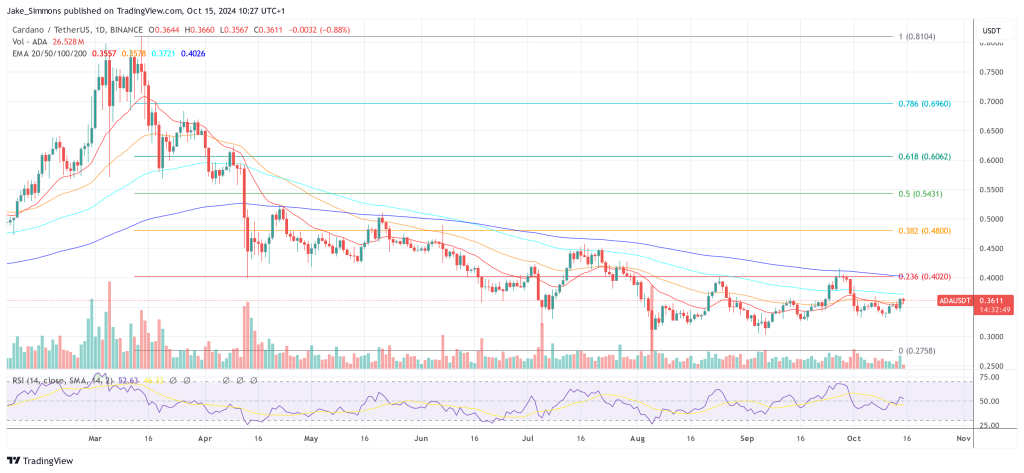
Cardano price
Cardano price, 1-day chart | Source: ADAUSDT on TradingView.com
Featured image from YouTube, chart from TradingView.com
Jake Simmons

Jake Simmons

Jake Simmons has been a Bitcoin enthusiast since 2016. Ever since he heard about Bitcoin, he has been studying the topic every day and trying to share his knowledge with others. His goal is to contribute to Bitcoin's financial revolution, which will replace the fiat money system. Besides BTC and crypto, Jake studied Business Informatics at a university. After graduation in 2017, he has been working in the blockchain and crypto sector. You can follow Jake on Twitter at @realJakeSimmons.

Related Reads

"JUST 6th Anniversary x GasFree Super Carnival Month" Grandly Arrives: Enjoy "0" Gas Transfer Freedom & Share the 10,000 USDT Bonus Pool

The "JUST 6th Anniversary x GasFree Super Carnival Month" event has launched, celebrating the JUST ecosystem's six-year milestone within the TRON network. Running from May 18th to June 7th, the event features a 10,000 USDT prize pool and is designed to promote the GasFree smart wallet. GasFree, a key product of the JustLend DAO protocol, allows users to pay transaction fees directly with the token being transferred (e.g., USDT), eliminating the need to hold the network's native token (TRX) for gas. This innovation aims to simplify on-chain transactions and lower the entry barrier for new users. The carnival offers five main activities: 1. **GasFree Activation Challenge:** New users can earn random rewards (5.2-522 USDT) for activating GasFree and completing their first transfer. 2. **Transfer Rebate:** 200 users daily are randomly selected to receive a 100% rebate on their activation and transaction fees. 3. **Bitcoin Pizza Day Special:** A dedicated event with custom rewards to celebrate crypto culture. 4. **JUST 6th Anniversary Lucky Draw:** Special anniversary reward packages for lucky participants. 5. **Knowledge Quiz:** A trivia contest where users can win prizes by answering questions about JUST and GasFree. To participate, users need a compatible wallet like TronLink (recommended), Klever, Guarda, or NOW Wallet. They must then find the GasFree feature, fund it with USDT, and complete at least one USDT transfer to qualify for the rewards. The article highlights GasFree's significant adoption, reporting over 872 billion USD in cumulative transaction volume and more than 612 million USD in saved user fees since its launch. The event underscores JUST's commitment to enhancing the DeFi user experience by making on-chain interactions more accessible and cost-effective.

链捕手37m ago

"JUST 6th Anniversary x GasFree Super Carnival Month" Grandly Arrives: Enjoy "0" Gas Transfer Freedom & Share the 10,000 USDT Bonus Pool

链捕手37m ago

BNB Chain Releases Research Report, Exploring Post-Quantum Cryptography Migration Path for BSC

BNB Chain, a leading Layer-1 blockchain ecosystem, has released a research report exploring the potential migration path for BNB Smart Chain (BSC) to post-quantum cryptography. The study evaluates replacing traditional cryptographic systems with quantum-resistant alternatives, specifically examining the use of ML-DSA-44 for transaction signing and pqSTARK for aggregating validator consensus signatures. While quantum computers are not currently a practical threat to existing blockchain cryptography, the research represents a proactive effort to ensure long-term network security and infrastructure resilience. The report assessed several core areas of the BSC tech stack, including post-quantum transaction signing, validator signature aggregation, transaction validation, public key storage, and network performance under increased data loads. A key finding is that achieving post-quantum readiness is technically feasible today but requires significant trade-offs in scalability. Test data indicates: • Transaction size would increase from ~110 bytes to ~2.5 kilobytes. • Block size would grow from ~110 kilobytes to ~2 megabytes. • Native transfer TPS would decrease from 4,973 to 2,997. The primary performance bottleneck is not signature verification itself, but the increased network transmission overhead caused by larger transaction and block sizes. Conversely, the pqSTARK aggregation technology proved highly efficient, compressing validator signatures by an approximately 43:1 ratio, which helps manage consensus-layer overhead. The report notes that post-quantum alternatives for areas like P2P handshakes and KZG commitments were not within the scope of this evaluation and require further research and broader ecosystem coordination. BNB Chain emphasizes this work is a research-oriented exploration and not a response to any imminent security threat.

marsbit1h ago

BNB Chain Releases Research Report, Exploring Post-Quantum Cryptography Migration Path for BSC

marsbit1h ago

Trading

Spot
Futures

Hot Articles

Discussions

Welcome to the HTX Community. Here, you can stay informed about the latest platform developments and gain access to professional market insights. Users' opinions on the price of ADA (ADA) are presented below.

活动图片