European Blockchain Convention 2024: Industry Experts Discuss What’s Next For Crypto Adoption, Blockchain Tech And Web3

bitcoinistPublished on 2024-09-27Last updated on 2024-09-27

Abstract

The European Blockchain Convention (EBC) took over Barcelona for its 10th edition. The two-day event featured a line-up of speakers...

The European Blockchain Convention (EBC) took over Barcelona for its 10th edition. The two-day event featured a line-up of speakers that fostered exciting dialogues between the industry experts.

The Catalan capital saw some of the crypto industry’s brightest minds discuss digital assets, Decentralized Finance (DeFi), tokenization, Web3, and sustainability, exploring the industry’s future amid the growing adoption and evolving regulatory framework worldwide.

Day 1: “Crypto Adoption Can’t Be Forced”

On September 25, EBC10 kickstarted its “biggest edition yet” with Daniel Salmeron and Victoria Gago, two of EBC’s founders, discussing why the world needs crypto. The day was followed by a debate between Alireza Siadat (Annerton), Yael Ossowski (Consumer Choice Center), and Vugar Adigozalov (Bidget).

The panelists discussed the slow adoption of the industry and the importance of user experience (UX) and self-custody, as Ossowski emphasized. He highlighted the need for “products that people can use every day,” which was countered by Adigozalov, who noted the challenges of privacy in a transparent ecosystem.

crypto, blockchain

Salmeron And Gago Welcome EBC10's attendees on Day 1.Source: EBC

During the ‘Will Crypto Payments Be THE Killer Use Case?’ panel, the experts noted that people in developing nations are “more willing” to “tolerate bad” UX to benefit from DeFi, emphasizing the “transformative power” of stablecoins in countries like Nigeria, where traditional finance (TradFi) lacks trust.

Zoltan Vardai (Cointelegraph EU) and Eric Demuth (Bitpanda) took the stage together to underscore the necessity of regulatory clarity for the industry’s long-term growth. Demuth also spoke about adoption, explaining that it can’t be forced. However, he argued that “when crypto becomes more efficient and cheaper, people will naturally switch.”

Day 2: Blockchain, A “Game-Changer” For Sustainability

On September 26, the agenda was packed with dialogues between the panelists. A crucial conversation, led by Laurent Marochini (Société Générale Securities Services), took place between Martijn Siebrand (ABN AMRO BANK N.V.) and Emilie Allaert (Luxembourg Blockchain Lab).

The panelists discussed Blockchain’s role in combating greenwashing, with Allaert highlighting the “game-changing benefits” of Distributed Ledger Technology (DLT) to prevent it. “With blockchain, you can verify if companies are truly following through on their sustainability claims,” she asserted.

Notably, the discussion tackled some misconceptions about Blockchain technology’s energy consumption. Allaert pointed out that the new technology has evolved to use 50 times less energy than before and noted that Artificial intelligence (AI) energy consumption is largely unchallenged.

Web 3 gaming and its future were discussed by Nirav Bakshi (Blockchain Founders Fund), Sebastian Borget (The Sandbox), Bay Backner (Decentraland), and Pablo Monti (BingX) in an engaging panel. Borget noted how players earn their first NFTs and experiment with blockchain through gaming, as blockchain games become a gateway to Web3.

He highlighted the industry’s shift toward empowering the creator economy, which offers a “fresh approach” from the challenges of traditional web2 gaming. Meanwhile, Monti underscored the sector’s maturity, moving from the “play-to-earn fever” to a service that “supports the broader gaming industry,” surpassing DeFi in daily wallet use.

Other panels discussed digital assets regulation in the UK, Europe, and the US. Lisa Cameron (House of Commons) passionately called for global regulatory collaboration in Web 3, remarking on the need for tailored solutions across all jurisdictions. Cameron also urged regulators to consult and engage with younger generations, highlighting the importance of shaping a beneficial future for the next generation.

Infrastructure and collaboration were also touched on EBC10’s second day. The discussion, led by Yves-Michel Leporcher (Renault), highlighted the “long-standing challenges” of each blockchain operating independently.

“There’s a digital generation, and we must ensure no one is left behind” – Lisa Cameron (House of Commons)

“Institutions are still catching up—ETFs have unlocked the door, but the best is yet to come” – Elliot Johnson (Evolve ETFs).
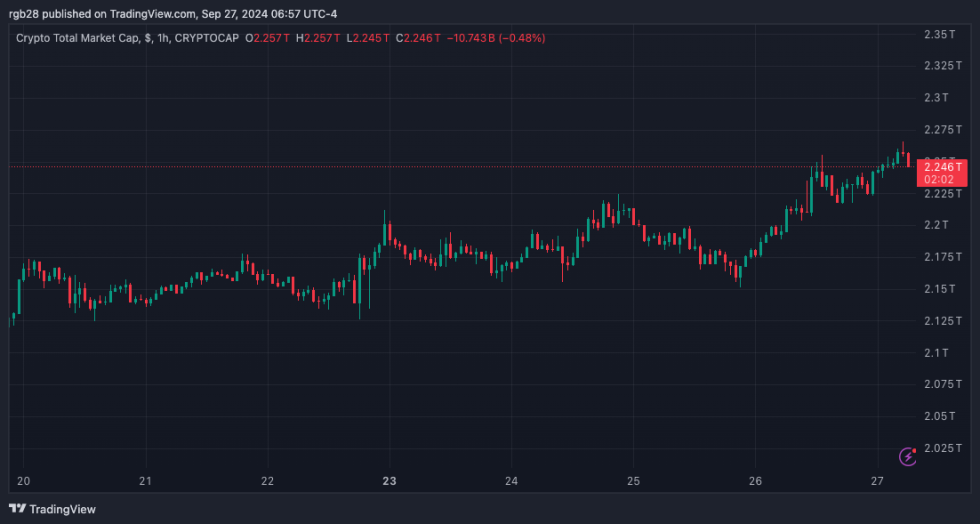
blockchain, crypto, TOTAL

Total crypto market capitalization is at $2.24 trillion in the 7-day chart. Source: TOTAL on TradingView

Bitcoinist Chats with a Gemini Top Executive on the Future of the Industry in the Old Continent

During the event, our team at Bitcoinist talked with Gillian Lynch, CEO of the crypto exchange Gemini for Ireland and Europe, about the upcoming MiCA regulation and its potential consequences for the industry and retail consumers.

During the conversation, Lynch highlighted the increase in adoption, claiming that the number of crypto holders in the region has increased from 1 in 10 to 1 in every 5 individuals over the last decade.

This rate could hike further with MiCA, the upcoming package of regulations set to be implemented by 2025 to oversee the nascent industry. Upon its implementation, crypto exchanges like Gemini, Lynch argued, and its users will finally have clarity.

The new regime of regulations could make the European region the new hub for digital assets as the US failed to provide certainty to its crypto sector. Furthermore, Lynch told us that the region and crypto actors like Gemini will benefit from increased investments as MiCA materializes.

The bigger challenge for Gemini and others will reside in educating its users on MiCA and the new regulatory regime, Lynch told us:

I think the challenge for the industry is to take regulation and educate people as to why it’s important (…) so that customers will know the difference between a regulated and a non-regulated company or exchange and make an informed choice then based on that. (…) I think we have a challenge to really educate.

Lynch said that to win the educational fight, crypto exchanges should rely on many tools, including social media and in-house educational programs such as Gemini’s CryptoPedia.

The next year will be decisive for the European crypto industry as MiCA enters the sector. Its consequences and future consequences, along with the progress of Web3, blockchain, and crypto, will be discussed during the European Blockchain Convention and its already-announced eleventh edition.

Cover image from Unsplash, chart from TradingView.com
Rubmar Garcia

Rubmar Garcia

Rubmar is a crypto enthusiast who likes learning and improving constantly. She enjoys reporting on the latest news and developments in the crypto industry. Rubmar also enjoys scrapbooking, crafting, simulation games, and watching football.

Related Reads

Warsh Takes the Helm at the Fed: A Capital Layout Clearing the Way for AI Productivity

Kevin Warsh's confirmation as the 17th Federal Reserve Chair signals a significant strategic pivot, not merely a political victory. The core narrative, as framed by the author's "Universal Code," is that capital flows towards maximizing intelligence output per unit of energy—currently represented by the AI-driven semiconductor and energy infrastructure boom. Warsh, uniquely among candidates, is a former tech investor who has personally invested in this AI "productivity miracle." His mandate is to enable this transformation by aligning monetary policy to support, not stifle, the capital-intensive AI buildout. His proposed policy framework blends elements of 1950s financial repression with Alan Greenspan's 1990s playbook: tolerating higher headline inflation driven by volatile components (e.g., energy) while relying on AI-driven productivity gains to suppress core inflation and unit labor costs. This allows for a more accommodative stance than conventional models suggest. The strategy's success hinges on a coordinated "Treasury-Fed Accord" with Treasury Secretary Bessant. Bessant's role is international: securing foreign demand for long-term U.S. debt through bilateral agreements (e.g., with China, Japan, Gulf states) that offer access to AI infrastructure in exchange for recycling trade surpluses into Treasuries. A weaker dollar and controlled real yields are essential to make this foreign duration buying viable. Warsh's Fed must avoid overly restrictive policy that would break this flow. The underlying coalition driving this agenda consists of crypto founders, AI infrastructure operators, and energy investors seeking policy stability. While Warsh's initial meetings may not deliver immediate rate cuts, they will signal a shift in focus toward core inflation and greater policy discretion. The critical variable is the bond market. If long-term yields, term premiums, or real yields rise beyond certain thresholds (e.g., 10-year yields above 5.5%), the entire architecture could fail regardless of Fed actions. The next six months will determine whether the bond market grants the new Fed Chair the space to implement this framework. If successful, the cycle extends, benefiting risk assets, cryptocurrencies, and AI capital expenditure stocks. The market's current pricing of a conventional inflation fight creates an asymmetry versus this productivity-led, financially repressive framework, which represents the potential for significant returns.

marsbit22m ago

Warsh Takes the Helm at the Fed: A Capital Layout Clearing the Way for AI Productivity

marsbit22m ago

Why the Establishment of SocialFi Originates from a Misunderstanding of Its Own Medium

"Why SocialFi's Establishment Stems from a Misunderstanding of Its Own Medium" This article critiques the failure of SocialFi projects by applying Marshall McLuhan's theory of "hot" and "cool" media. McLuhan posited that a medium's form—not its content—reshapes user behavior. "Hot" media (e.g., print, radio) deliver high-definition, complete information, promoting passive consumption. "Cool" media (e.g., cartoons, telephone calls) provide low-definition, fragmented signals, requiring active user participation to complete the meaning. Traditional social media platforms (like early Twitter) are quintessentially "cool." A tweet or like is an incomplete fragment; its significance emerges only through replies, shares, and community engagement—it's a participation engine disguised as a content system. SocialFi (e.g., Friend.tech) aimed to monetize social capital by attaching real-time, tradable prices to follows and posts. However, this didn't add an economic layer to a cool medium; it fundamentally transformed the medium itself. The explicit, high-resolution signal of price replaced the ambiguous, low-resolution signal of social interaction. The platform became a financial market dressed as a social network. Once the financial dynamics (speculative profits) faded, the underlying social fabric, which had been suffocated from the start, could not sustain it. The medium overheated and collapsed. This "heat death" pattern isn't unique to crypto. Over time, mainstream platforms often drift from cool to hot by adding features like public metrics, verification badges, and algorithmic feeds that optimize for clarity over participation, leading to user disengagement. The article proposes a viable alternative: the "condensation point." Here, capital is introduced locally and infrequently into a cool medium without saturating it. Examples include Substack (subscriptions), Patreon (memberships), and Bandcamp (music purchases). The core social medium remains cool and participatory, while capital condenses at specific, structurally separate points (e.g., a monthly fee). The key lesson: "Liquidity is heat." Adding it to a cool medium doesn't enhance it but alters its fundamental nature. The NFT boom and bust provides a starker example. Collecting is a classic cool medium, where value is built slowly through stories and community. By making floor prices, rarity scores, and real-time charts omnipresent, NFT platforms rapidly overheated the medium, turning collectors into traders and destroying the participatory culture that gave collections meaning in the first place. The conclusion is that for the next wave to succeed, designers must ask not how to price every social action, but how to let capital condense within a social system without disrupting the cool, participatory mechanics that create its enduring value.

marsbit50m ago

Why the Establishment of SocialFi Originates from a Misunderstanding of Its Own Medium

marsbit50m ago

After Storage, Are Copper and Fiber Optic Cables Facing an AI "Great Famine"?

Following the storage sector, copper and fiber optics are emerging as potentially the next major markets to experience explosive growth due to AI. Demand for copper, described by Goldman Sachs as "the oil of the AI era," is surging. Prices are near record highs, with LME copper up 41% over the past 12 months. This is driven by AI's immense and unique requirements: copper is the essential material for the massive electrical distribution (e.g., a 1GW AI data center requires ~27,000 tons) and advanced liquid cooling systems needed for high-power AI clusters like NVIDIA's GB200. Meanwhile, new large-scale copper mine discoveries have been scarce for a decade, tightening supply. Concurrently, a "fiber famine" is unfolding. AI's need for ultra-high-speed, long-distance interconnects between thousands of GPUs is pushing data transmission beyond the physical limits of copper cables. Demand for fiber optics is experiencing a step-change, with a single AI data center requiring up to 36 times more fiber than a traditional CPU rack. This has caused prices for standard G.652D fiber in China to nearly double in just three months. Supply is critically constrained due to the long (18-24 month) lead times required to expand production of the core preform material. In summary, AI's infrastructure demands are cascading down from semiconductors to foundational materials. Copper faces a structural supply-demand imbalance, while fiber optics is entering a period of severe shortage, positioning both as critical and potentially strained components of the AI build-out.

marsbit1h ago

After Storage, Are Copper and Fiber Optic Cables Facing an AI "Great Famine"?

marsbit1h ago

Trading

Spot
Futures
活动图片