На просадке Ark Invest приобрела акции Coinbase на $8,4 млн

cryptonews.ruPubblicato 2022-11-12Pubblicato ultima volta 2024-09-12

Организация Ark Invest воспользовалась волатильностью рынка после первых дебатов Дональда Трампа и Камалы Харрис. После выступления кандидатов акции Coinbase сначала упали на 5%, позже они восстановились и закончили торговый день со снижением на 0,8% на уровне $157,15.
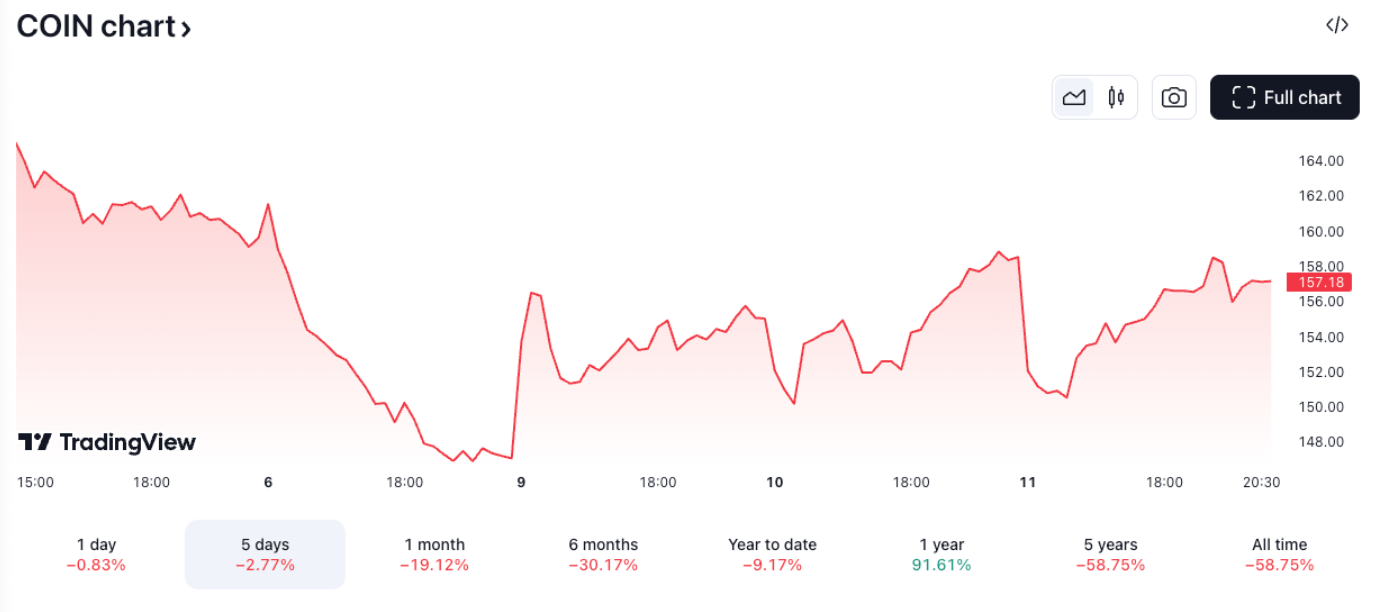
рис 4

Согласно документам Ark Invest, инвестиционная фирма под руководством Кэти Вуд приобрела 38475 акций биржи Coinbase (на $6 млн) для своего инновационного ETF (ARKK), 9349 акций (на $1,5 млн) для интернет-ETF следующего поколения (ARKW) и 5884 акции (на $925 000) для инновационного ETF в области финтеха (ARKF).

В последний раз инвесткомпания Ark Invest проводила операции с акциями Coinbase в начале августа 2024 года. Тогда она приобрела ценные бумаги криптобиржи на $21,8 млн.

Инвестиционная стратегия фонда Кэти Вуд предполагает, что акции одного эмитента не должны заниматься более 10% портфеля любого EFT Ark Invest. Это делается с целью диверсифицировать риски и сбалансировать активы.

Сейчас ценные бумаги биржи Coinbase являются четвёртым по величине активом в фонде ARKK. На него приходится 6,5% портфеля ETF или около $355 млн. Доля акций криптобиржи в ARKW составляет 5,1%, в ARKF — 7,3%.


Letture associate

GPT Designs GPT

OpenAI has unveiled its first custom AI chip, Jalapeño, a move signaling a strategic shift beyond being a mere model company. While many see it as a challenge to NVIDIA, its core aim is to control the entire intelligent production pipeline—from models and chips to data centers and energy. The key driver is the evolving competitive landscape: model advantages are shrinking, while the computational gap in areas like cost-per-token, system throughput, and energy efficiency is becoming the true long-term barrier. Jalapeño is primarily an inference chip, targeting the massive and growing "inference tax"—the daily operational cost of generating tokens for services like ChatGPT and APIs. By designing its own hardware optimized for its specific workloads and future product roadmaps (even using AI to aid the chip design process), OpenAI aims to drastically reduce token generation costs and improve system efficiency. This creates a potential flywheel: better models help design better chips, which lower costs for running next-generation models, supporting more users and products, which in turn provides more data to refine future chips. The strategy mirrors Apple’s integrated approach, building a closed loop where hardware, software, and applications are co-optimized. In the long term, OpenAI is not trying to become the next NVIDIA (a supplier of "shovels" to all AI companies) but to own and operate the entire "mine"—selling the end product of intelligence itself. This move marks OpenAI's ambition to evolve from creating the smartest models to controlling the foundational infrastructure of AI production.

marsbit12 min fa

GPT Designs GPT

marsbit12 min fa

Ethereum Foundation Interim Executive Director Speaks Out: What Is Our Mission?

The Ethereum Foundation's core mission is to ensure Ethereum remains a truly permissionless, censorship-resistant, private, and open infrastructure for large-scale, sovereign coordination. The article clarifies the EF's focus and dismisses irrelevant objectives, such as pursuing institutional popularity or short-term speculation. Its core work centers on eliminating systemic weaknesses. This involves fortifying Ethereum across multiple layers—protocol, access, user, and institutional—against exploitation, control, or surveillance. Key initiatives include minimizing harmful MEV and preventing privileged control over transaction flow, making unconditional privacy a foundational default, ensuring staking remains permissionless and decentralized, and strengthening user-facing access points to uphold autonomy. Concurrently, the EF aims to seize strategic opportunities. These include leading the transition to post-quantum cryptography, achieving a fully verifiable protocol stack, establishing Ethereum as private digital cash, integrating user-owned AI agents with personal wallets, and demonstrating that trusted-neutral infrastructure can competitively handle disintermediated coordination at an institutional scale. The article also addresses recent organizational changes, stating that personnel departures were due to strategic realignment, role fit, or natural evolution. It clarifies the approach to spin-outs, emphasizing that external funding will be provided only for work critical to the EF's mission that reduces Ethereum's dependency without creating new risks or mission drift. Ultimately, the EF is committed to building an enduring, neutral system that reshapes global coordination, focusing relentlessly on the principles of censorship resistance, openness, privacy, and sovereignty (CROP).

链捕手55 min fa

Ethereum Foundation Interim Executive Director Speaks Out: What Is Our Mission?

链捕手55 min fa

Trading

Spot
Futures
活动图片