Bitcoin May Slide To $31,500 If Market Downturn Persists, Analyst Warns

bitcoinistPublished on 2024-09-08Last updated on 2024-09-08

Abstract

According to data from CoinMarketCap, Bitcoin (BTC) has experienced a rocky start to September declining by 8.16% in the past...

According to data from CoinMarketCap, Bitcoin (BTC) has experienced a rocky start to September declining by 8.16% in the past seven days. While the crypto market leader has shown some signs of recovery in the last day, there is still much uncertainty surrounding the BTC market. Commenting on Bitcoin’s potential next movement, popular analyst Ali Martinez has sounded out a stark warning to investors.

Related Reading: Bitcoin Outperforms Ethereum By 44% Since The Merge — Here Are The Key Factors

Bitcoin Must Avoid Fall To $51,600 – Analyst

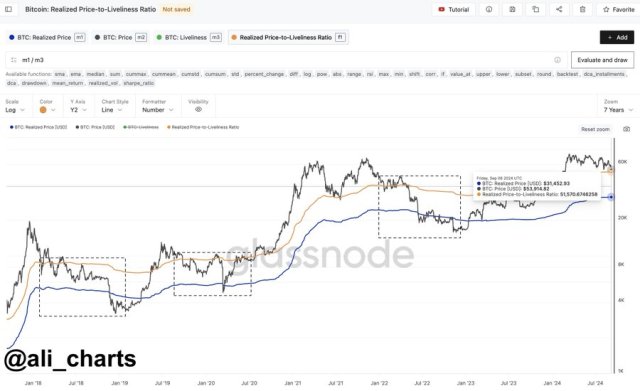
In an X post on Saturday, Ali Martinez issued a red market alert to traders, stating that whenever the price of Bitcoin plunged below its Realized Price-to-Liveliness Ratio, it often resulted in an extended price decline to the Realized Price. 

The Realized Price-to-Liveliness Ratio is a market metric used to evaluate when BTC might be overvalued or undervalued. As the name implies, it is calculated by dividing the Realized Price i.e. the average price at which all Bitcoins In circulation were purchased, by Liveliness which is a measure of Bitcoin network activity

According to Martinez, BTCs current Realized Price-to-Liveliness ratio stands at $51,600. Based on historical data, if the premier cryptocurrency falls below this level, it is likely to enter a period of massive selling pressure, plummeting to its present Realized Price which is valued at $31,500.

So far, Bitcoin has had a turbulent period in September, sliding from $59,000 to below $54,000 in the first week of the month. However, the digital asset has produced little resilience since then, rising by over 2% to nearly hit $55,000 on Saturday.  While this minor price gain could initiate a bullish trajectory, investors should take note that September is traditionally a month with bearish returns for BTC, with an average loss of 4.78% in the last 11 years.
 

Bitcoin
Source: Ali_charts on X

Bitcoin Far From ‘Seller Exhaustion’ Levels, Price Reversal May Yet Delay

In other news, another crypto analyst Rekt Capital has stated that Bitcoin’s sell-side volume is currently far from its “seller exhaustion levels” amidst recent price decline and increased volatility levels. Thus, the digital asset is likely to experience more price losses before potentially “kickstarting” a market rebound.

At the time of writing, BTC trades at $54,009 reflecting a 0.45% gain in the last 24 hours. Meanwhile, the token’s daily trading volume has declined by 60.39% and is currently valued at $19.41 billion. It is worth noting that Bitcoin presently finds itself in a strong support zone, a rebound from which could potentially drive the asset’s price as high as $60,000, indicating a potential 11% on its current price.

Bitcoin
BTC trading at $53,695 on the daily chart | Source: BTCUSDT chart on Tradingview.com
Featured image from StormGain, chart from Tradingview
Semilore Faleti

Semilore Faleti

Semilore Faleti works as a crypto-journalist at Bitconist, providing the latest updates on blockchain developments, crypto regulations, and the DeFi ecosystem. He is a strong crypto enthusiast passionate about covering the growing footprint of blockchain technology in the financial world.

Related Reads

2026 Crypto Funding Reshuffle: Game and DePIN Are Dead, Prediction Market Duo Takes 18% of All Year's Funding with Two Deals

Cryptocurrency Funding in 2026: Gaming & DePIN Falter as Prediction Markets Dominate Data from the first four months of 2026 reveals a stark shift in crypto venture funding. The gaming and DePIN (Decentralized Physical Infrastructure Networks) sectors have seen capital nearly dry up. In contrast, the "Consumer" category, led by two massive deals for prediction market platforms Kalshi ($1B) and Polymarket ($600M), captured a significant share. These two deals alone accounted for 18% of the year's total $8.65 billion raised and exceeded the combined funding of all 47 DeFi projects. Overall, the $8.65B across 305 deals is misleading. A March surge to $4.57B was largely due to two major acquisitions (BVNK at $1.8B and Kalshi). Excluding these, the underlying monthly funding rate is approximately $1B, indicating continued softness. The "Payments" and "Consumer" sectors together consumed 72% of all capital. Another notable trend is the rise of mergers and acquisitions (M&A), with 48 deals nearly matching the 57 seed-round investments. This signals a market pivot from funding new ideas to consolidating around established leaders. The most active investors so far in 2026 are Coinbase Ventures (18 deals), Tether (13 deals), Animoca Brands (11 deals), and GSR (11 deals). Notably, a16z's pace has slowed significantly compared to previous years.

marsbit43m ago

2026 Crypto Funding Reshuffle: Game and DePIN Are Dead, Prediction Market Duo Takes 18% of All Year's Funding with Two Deals

marsbit43m ago

Bitcoin Treasury Companies That Promised Never to Sell Are Now Selling. Why?

The narrative of "never selling" Bitcoin treasuries is unraveling as major holders pivot to using BTC as a liquidity tool. MicroStrategy has formally integrated selling Bitcoin into its financial framework, stating it will sell when beneficial—for instance, to pay dividends if its mNAV ratio falls below 1.22x. CEO Michael Saylor outlined a model where selling BTC is preferable to equity issuance under certain conditions, based on quantified thresholds like a 2.3% annual Bitcoin appreciation break-even. Similarly, Marathon Digital (MARA) sold 15,133 BTC to repay convertible debt, framing it as "balance sheet optimization." Sequans Communications has sold Bitcoin for two consecutive quarters to service maturing convertible bonds, using its BTC holdings as collateral and operational liquidity amidst revenue declines. The shift redefines these companies from pure "belief-based reserves" to leveraged treasuries where capital management decisions—driven by debt obligations, financing costs, and shareholder returns—can override holding dogma. The future path hinges on Bitcoin's price: a bull market above $112,000 would ease financing pressure and absorb tactical sales, while a drop toward $50,000–$58,000 could force more defensive selling to meet liabilities, potentially creating a downward spiral of selling pressure and price declines. Investors must now price in debt maturities, collateral calls, and specific financial triggers alongside Bitcoin exposure.

marsbit49m ago

Bitcoin Treasury Companies That Promised Never to Sell Are Now Selling. Why?

marsbit49m ago

Ray Dalio's Latest Interview: Can the U.S. Still Escape the Cycle of Decline?

In a comprehensive interview, Ray Dalio, founder of Bridgewater Associates, analyzes whether the US can escape its historical "great cycle" of decline. He argues the nation faces a confluence of structural pressures, not a single crisis. Key points include: 1. **The Debt Cycle:** Unsustainable fiscal deficits and rising debt-to-income ratios are eroding national capacity, constraining spending on defense, welfare, and global commitments. 2. **Internal Political & Social Conflict:** Deep wealth gaps and value differences fuel intense political polarization. Addressing deficits becomes a zero-sum political battle over "who pays and who benefits," making consensus nearly impossible. 3. **Erosion of the World Order:** The post-1945 US-led, rules-based international system is breaking down, reverting to a state of great-power competition and conflict where raw power, not multilateral rules, resolves disputes. 4. **Currency & Safe Assets:** While the Chinese yuan may gain use as a medium of exchange, Dalio doubts it will become a primary global store of wealth. In an era of fiat currency debasement, assets like gold are regaining prominence as safe havens. 5. **AI's Dual Role:** Artificial Intelligence could boost productivity and help manage debt, but it also risks exacerbating wealth inequality, job displacement, and geopolitical tensions. Dalio concludes the US is in a period of increasing disorder, with debt, domestic strife, and international realignments converging. The critical factors for national recovery are foundational: improving education and civic素养, fostering social cohesion and productivity, and avoiding war—both civil and international. The path forward depends less on markets and more on these fundamental societal choices.

marsbit1h ago

Ray Dalio's Latest Interview: Can the U.S. Still Escape the Cycle of Decline?

marsbit1h ago

Trading

Spot
Futures

Hot Articles

What is $BITCOIN

DIGITAL GOLD ($BITCOIN): A Comprehensive Analysis Introduction to DIGITAL GOLD ($BITCOIN) DIGITAL GOLD ($BITCOIN) is a blockchain-based project operating on the Solana network, which aims to combine the characteristics of traditional precious metals with the innovation of decentralized technologies. While it shares a name with Bitcoin, often referred to as “digital gold” due to its perception as a store of value, DIGITAL GOLD is a separate token designed to create a unique ecosystem within the Web3 landscape. Its goal is to position itself as a viable alternative digital asset, although specifics regarding its applications and functionalities are still developing. What is DIGITAL GOLD ($BITCOIN)? DIGITAL GOLD ($BITCOIN) is a cryptocurrency token explicitly designed for use on the Solana blockchain. In contrast to Bitcoin, which provides a widely recognized value storage role, this token appears to focus on broader applications and characteristics. Notable aspects include: Blockchain Infrastructure: The token is built on the Solana blockchain, known for its capacity to handle high-speed and low-cost transactions. Supply Dynamics: DIGITAL GOLD has a maximum supply capped at 100 quadrillion tokens (100P $BITCOIN), although details regarding its circulating supply are currently undisclosed. Utility: While precise functionalities are not explicitly outlined, there are indications that the token could be utilized for various applications, potentially involving decentralized applications (dApps) or asset tokenization strategies. Who is the Creator of DIGITAL GOLD ($BITCOIN)? At present, the identity of the creators and development team behind DIGITAL GOLD ($BITCOIN) remains unknown. This situation is typical among many innovative projects within the blockchain space, particularly those aligning with decentralized finance and meme coin phenomena. While such anonymity may foster a community-driven culture, it intensifies concerns about governance and accountability. Who are the Investors of DIGITAL GOLD ($BITCOIN)? The available information indicates that DIGITAL GOLD ($BITCOIN) does not have any known institutional backers or prominent venture capital investments. The project seems to operate on a peer-to-peer model focused on community support and adoption rather than traditional funding routes. Its activity and liquidity are primarily situated on decentralized exchanges (DEXs), such as PumpSwap, rather than established centralized trading platforms, further highlighting its grassroots approach. How DIGITAL GOLD ($BITCOIN) Works The operational mechanics of DIGITAL GOLD ($BITCOIN) can be elaborated on based on its blockchain design and network attributes: Consensus Mechanism: By leveraging Solana’s unique proof-of-history (PoH) combined with a proof-of-stake (PoS) model, the project ensures efficient transaction validation contributing to the network's high performance. Tokenomics: While specific deflationary mechanisms have not been extensively detailed, the vast maximum token supply implies that it may cater to microtransactions or niche use cases that are still to be defined. Interoperability: There exists the potential for integration with Solana’s broader ecosystem, including various decentralized finance (DeFi) platforms. However, the details regarding specific integrations remain unspecified. Timeline of Key Events Here is a timeline that highlights significant milestones concerning DIGITAL GOLD ($BITCOIN): 2023: The initial deployment of the token occurs on the Solana blockchain, marked by its contract address. 2024: DIGITAL GOLD gains visibility as it becomes available for trading on decentralized exchanges like PumpSwap, allowing users to trade it against SOL. 2025: The project witnesses sporadic trading activity and potential interest in community-led engagements, although no noteworthy partnerships or technical advancements have been documented as of yet. Critical Analysis Strengths Scalability: The underlying Solana infrastructure supports high transaction volumes, which could enhance the utility of $BITCOIN in various transaction scenarios. Accessibility: The potential low trading price per token could attract retail investors, facilitating wider participation due to fractional ownership opportunities. Risks Lack of Transparency: The absence of publicly known backers, developers, or an audit process may yield skepticism regarding the project's sustainability and trustworthiness. Market Volatility: The trading activity is heavily reliant on speculative behavior, which can result in significant price volatility and uncertainty for investors. Conclusion DIGITAL GOLD ($BITCOIN) emerges as an intriguing yet ambiguous project within the rapidly evolving Solana ecosystem. While it attempts to leverage the “digital gold” narrative, its departure from Bitcoin's established role as a store of value underscores the need for a clearer differentiation of its intended utility and governance structure. Future acceptance and adoption will likely depend on addressing the current opacity and defining its operational and economic strategies more explicitly. Note: This report encompasses synthesised information available as of October 2023, and developments may have transpired beyond the research period.

363 Total ViewsPublished 2025.05.13Updated 2025.05.13

What is $BITCOIN

Discussions

Welcome to the HTX Community. Here, you can stay informed about the latest platform developments and gain access to professional market insights. Users' opinions on the price of BTC (BTC) are presented below.

活动图片