爆火的Polymarket是一个好的预测工具吗?

Odaily星球日报Publicado em 2024-09-02Última atualização em 2024-09-02

Resumo

Polymarket仍然是一个低效的新兴市场,无法预测事件概率的微小变动(<5% )。

原文作者:Felipe Montealegre

原文编译:Luffy,Foresight News

有一次,我和朋友正在讨论罗伯特·肯尼迪支持特朗普,一位参与者自信地宣称,特朗普获胜的几率提升了 2% ,因为 Polymarket 是这样预测的。这是个很好的观察点,因为事件发生得很快,而且没有太多其他消息可以影响市场。如果 Polymarket 是有效市场,这样说似乎站得住脚。

但问题在于,Polymarket 仍然是一个低效的新兴市场,无法预测事件概率的微小变动(<5% )。

有效市场的工作方式是,大量的投资者根据事件进行交易。如果你认为罗伯特·肯尼迪的支持会使特朗普的胜算增加 10% ,那么你将通过杠杆购买以获得预期的回报。如果你认为这会降低特朗普的胜算,那么你将通过杠杆出售。市场能够对经过深思熟虑的预测进行加权平均,以反映最新信息。

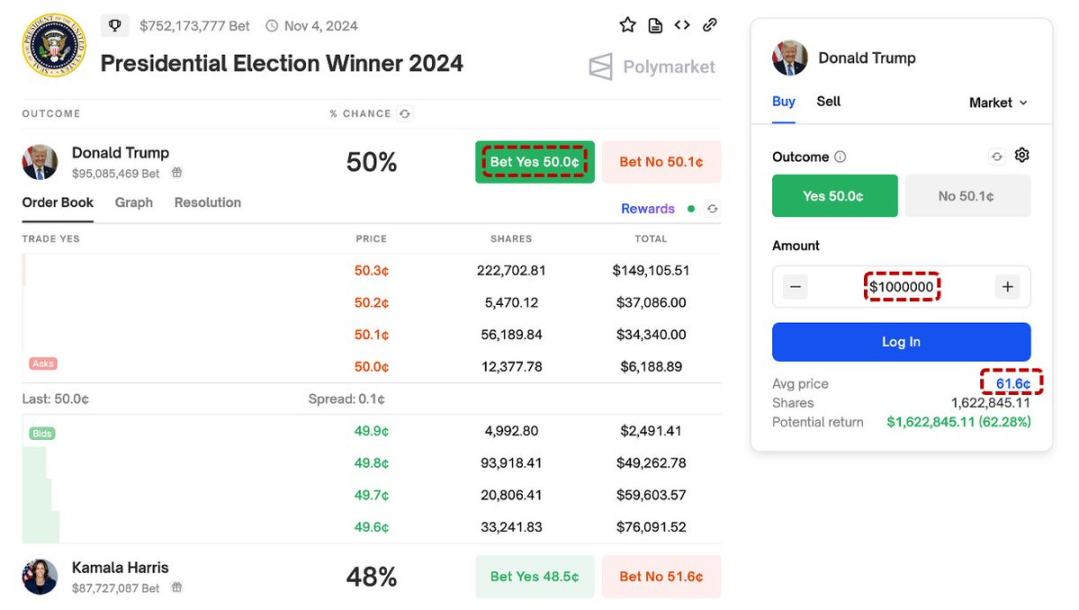
Polymarket 的问题是:价格受到的影响相对于共识的小偏差而言太大了。在下面的市场中,我认为特朗普获胜的几率为 50% ,罗伯特·肯尼迪的支持会使他的获胜几率上升到为 55% 。问题是,我无法实际进行 100 万美元的交易来赚取 10 万美元(假设我对 50% 到 55% 的预测是正确的),因为购买 100 万美元的押注会使其平均价格暴涨 62% ,如果市场的概率重新调整到 55% ,我实际上会亏损。
爆火的Polymarket是一个好的预测工具吗?

这些问题可以通过更好的流动性和利用预测代币来解决。更好的流动性将允许我在特朗普胜率 为 50% 时下注 100 万美元,并在 55% 时退出,不会出现滑点,从而获得 10% 的回报。当 100 万美元的下注使市场波动 <5% 时,市场将在 <5% 的范围内有效。

另一方面,利用预测代币可以大大提高 Polymarket 的效率。我认为这种投资的 10% 回报率很低:你必须预测正确,而且要承担新兴加密平台约 10% 的风险。如果你认为你正确的概率约为 80% ,而如果你错了,损失 5% ;那么最终的期望回报率约为 7% ,相对于市场共识,这应该是一个很好的预测。但回报率依然太低了。

利用 Polymarket 杠杆,我能够以 4 倍杠杆进行交易,剩余的资金足以支付贷款平台 5% 的贷款利息。对于花费精力和努力寻找良好交易并承担风险的研究人员来说,这是更合适的资本回报率。

传统市场我们讨论 20 个基点的利率变动,因为它们具有足够的流动性和杠杆,分析师能够通过对小幅变动的正确预测获得高回报。Polymarket 可以讨论选举胜率约 20% ,甚至是 10% 的变动,但它无法预测 <5% 水平的变动。

反驳者认为 Polymarket 的规模已经足够大,可以让群众智慧发挥作用。其理念是,数以万计的小额交易者(包括来自摇摆州的数千名交易者)不断利用最新信息对选举进行小额押注。这些投资者存在偏见和不完整的信息,但偏见来源互不相关,相互抵消,而市场会聚合许多不同的信息来源。

这种反驳的问题在于,Polymarket 每天有大约 4, 000 名活跃交易员押注美国大选,这些交易员聚集在纽约市和加利福尼亚州,并且不成比例地关注 Twitter 上的相同账户。在这 4, 000 名交易员中,我预计其中一半的交易员并没有对每项投资进行深入调查,只是为了从空投「耕作」中受益,即通过交易赚取 Polymarket 代币,因为 Polymarket 可能会用空投奖励活跃交易员。此外,还有集中化问题,因为 20 名交易员占 Polymarket 交易量的 95% 。

Polymarket 是一家出色的企业和信息来源。我相信它在预测重大政治事件方面比民意调查、专家模型和一些分析文章要好得多。Polymarket 已经展示了在主要媒体报道之前预测大动作的能力,但这并不意味着 Polymarket 是一种精准的预测工具。

原文链接

Leituras Relacionadas

Putting Markets On-Chain: Canton Network Quietly Becomes the New Backbone of Institutional Finance

**Title: Letting the Market Itself Go On-Chain: Canton Network Quietly Becomes the New Backbone for Institutional Finance** **Summary:** The Canton Network, a blockchain platform designed for institutional finance, is gaining significant traction. A key sign of its maturity was Visa's recent entry as a super-validator, a proposal approved in just three days—highlighting prior, extensive collaboration between traditional finance and crypto. Unlike public chains like Ethereum that prioritize transparency and asset onboarding, Canton focuses on enabling confidential, compliant business operations for regulated institutions. Its core design features built-in **data visibility control**, meaning transaction details are only shared between direct counterparties. This privacy is fundamental, allowing competing institutions (like banks Goldman Sachs, JPMorgan, and BNP Paribas, all validators) to interact on the same network without exposing sensitive positions or strategies. Developed by Wall Street veterans at Digital Asset, Canton has taken a slow, deliberate approach to onboard real financial activity. It now handles over **$9 trillion monthly** in transaction volume, primarily from real-world institutional use cases like **tokenized repo agreements**, Treasury settlements, and collateral mobility. Major live applications include **JPM Coin** for institutional payments and **DTCC's tokenized U.S. Treasuries** project. Canton's native token, **CC**, is framed as a "network utility asset" with zero pre-mine or VC allocations. Its value is intended to be driven by the volume of real financial activity on the network. Looking ahead, Canton aims to become the invisible foundational layer for global finance—enabling atomic settlement (where payment and asset delivery occur simultaneously), 24/7 capital flows, and the native issuance and settlement of various asset classes, from corporate bonds to potentially equities. The main challenges are no longer technical but involve navigating fragmented global regulations and integrating with legacy financial systems.

marsbitHá 15m

Putting Markets On-Chain: Canton Network Quietly Becomes the New Backbone of Institutional Finance

marsbitHá 15m

It's Bankless That Needs Ethereum, Not Ethereum That Needs Bankless

Titled "Bankless Needs Ethereum, Not the Other Way Around," this article analyzes the significant recent news involving Bankless, a prominent crypto media outlet. Bankless co-founder David Hoffman announced the sale of all his ETH holdings, while the company also reportedly underwent major layoffs, with its founders parting ways. The news, likened to a high-profile defection, initially sent shockwaves through the Ethereum community, given Bankless's historical role as a key evangelist and "semi-official" narrative builder for Ethereum. For years, through its podcasts and writings, Bankless championed core Ethereum ideas like "ultrasound money" and the blockchain's role as a new financial settlement layer, acting as a crucial community hub and belief system during its growth phase. However, the article argues this development is not necessarily negative for Ethereum. It suggests Bankless's "first mission"—serving as Ethereum's passionate, inward-facing "propaganda department"—has largely been completed. As Ethereum matures and moves towards mainstream, institutional adoption, the narrative baton has shifted. Today, the value propositions of ETH are increasingly communicated to traditional finance by asset managers like BlackRock and VanEck, public companies adding ETH to their treasuries, and established financial figures. This represents a natural evolution towards a more decentralized, professional, and institutionally-focused narrative network. Therefore, while Bankless's retreat marks the end of an era, it signifies Ethereum's growing resilience and its reduced reliance on any single entity for belief, as its story is now carried forward by a broader and more mature ecosystem of advocates.

链捕手Há 36m

It's Bankless That Needs Ethereum, Not Ethereum That Needs Bankless

链捕手Há 36m

Google Officially Declares War

Google Declares War with AI-First I/O 2026 At its 2026 I/O developer conference, Google launched an aggressive, multi-pronged offensive, embedding AI across its ecosystem and challenging rivals on performance and price. The event showcased three major releases: Gemini 3.5 Flash, the video-centric Gemini Omni Flash, and the system-level AI assistant Spark. Gemini 3.5 Flash, despite being a smaller "Flash" model, outperforms its Pro counterpart in key benchmarks like mathematical reasoning (GSM8K) and coding (SWE-bench). Google attributes this to "extreme knowledge distillation" from a larger teacher model and a novel, highly granular MoE (Mixture of Experts) architecture with 256 experts, achieving sub-65ms response times. The native multi-modal model, Gemini Omni Flash, offers real-time video understanding with 120ms latency, enabling applications like preventing a cup from overfilling. The new Spark assistant gains deep Android system integration, allowing it to automate complex multi-app workflows based on voice commands. Complementing these, Google unveiled lightweight AI glasses featuring Micro-OLED displays and on-device Gemini chips for instant, offline translation and scene analysis. CEO Sundar Pichai announced Gemini has reached 900 million monthly active users, leveraged through integration into Chrome, Android, and Workspace. Google also slashed prices dramatically: the Gemini 3.5 Flash API is priced at a fraction of competitor rates. This price war is enabled by Google's vertically integrated TPU infrastructure. The strategy signals a shift: standalone AI models are becoming commoditized. Google's advantage lies in its "device + cloud + ecosystem + hardware" integration, aiming to reshape internet traffic from user-initiated searches to AI-driven service distribution. This move pressures pure-play AI firms like OpenAI and Anthropic on business models, and challenges Apple to respond in the next-generation, screen-less device race.

链捕手Há 55m

Google Officially Declares War

链捕手Há 55m

Top 10 Promising Emerging Hyperliquid Native Protocols to Watch

Title: A Review of 10 Emerging Native Protocols on Hyperliquid Hyperliquid is evolving beyond perpetual contracts into a comprehensive on-chain financial stack. This article highlights 10 key native protocols driving this growth: 1. **Monetrix**: A yield-optimizing protocol akin to Ethena, aggregating funding rates, HLP rewards, maker rebates, and HIP-3 into a single stablecoin yield. 2. **ROSETTA**: An automated stablecoin yield router, allocating USDC across top protocols (e.g., Felix, Aave, HLP) for optimal returns, factoring in gas and slippage. 3. **papertrade.xyz**: A fair-launched perpetuals protocol offering up to 1000x leverage, no funding rates, no slippage, and fully on-chain, oracle-based execution. 4. **alt.fun**: A launchpad where tokens are paired with leveraged perpetual positions (2x-5x), linking token price to trading activity and underlying position performance. 5. **Ventuals**: Pre-IPO perpetual contracts (built on HIP-3) allowing up to 10x leveraged speculation on valuations of private companies like SpaceX and Stripe. 6. **Liminal**: A delta-neutral yield protocol that captures funding rates via automated short positions and uses generated xTokens (xBTC, etc.) as DeFi collateral. 7. **Melt**: Brings tokenized stocks, commodities, and RWAs to Hyperliquid spot markets, enabling 24/7 trading alongside crypto assets. 8. **Chainsight**: An oracle and data infrastructure protocol providing low-latency (<3s) price feeds, volatility indices, and risk metrics for novel derivatives. 9. **rip.xyz**: Tokenized vault strategies on HyperEVM; its flagship rHYPURR offers liquidity and fractional exposure to a Hypurr NFT basket, priced hourly via NAV. 10. **Markets**: A perpetuals exchange (by Kinetiq) for trading stocks, forex, commodities, bonds, and crypto with up to 50x leverage, using USDH collateral and Kaiko oracles. These protocols form the foundational layer for generating real yield, liquidity, and innovative financial products natively on Hyperliquid.

marsbitHá 1h

Top 10 Promising Emerging Hyperliquid Native Protocols to Watch

marsbitHá 1h

Trading

Spot
Futuros
活动图片