Что может помешать росту Биткоина и рынка криптовалют в целом в сентябре: версия аналитиков

cryptonews.ruPubblicato 2021-04-01Pubblicato ultima volta 2024-09-01

Биткоин до сих пор не может уверенно закрепиться выше уровня 60 тысяч долларов, ну а отсутствие динамики роста главной криптовалюты скорее всего перенесётся и на сентябрь. Причиной подобного станет дополнительное давление на рынок за счёт распределения BTC биржей Mt.Gox и продаж криптовалюты американским правительством. В теории за короткий срок предложение криптовалюты на открытом рынке в состоянии увеличиться практически на эквивалент 15 миллиардов долларов. Однако реальное положение вещей не такое плохое, как может показаться на первый взгляд.

Распределение криптовалют платформой-банкротом Mt.Gox продолжается успешно. С начала 2021 года на адресах представителей биржи находилось 141 690 BTC, стоимость которых в том числе достигала отметки в 10.12 миллиарда долларов в марте 2024 года при актуальном рекорде цены Биткоина.
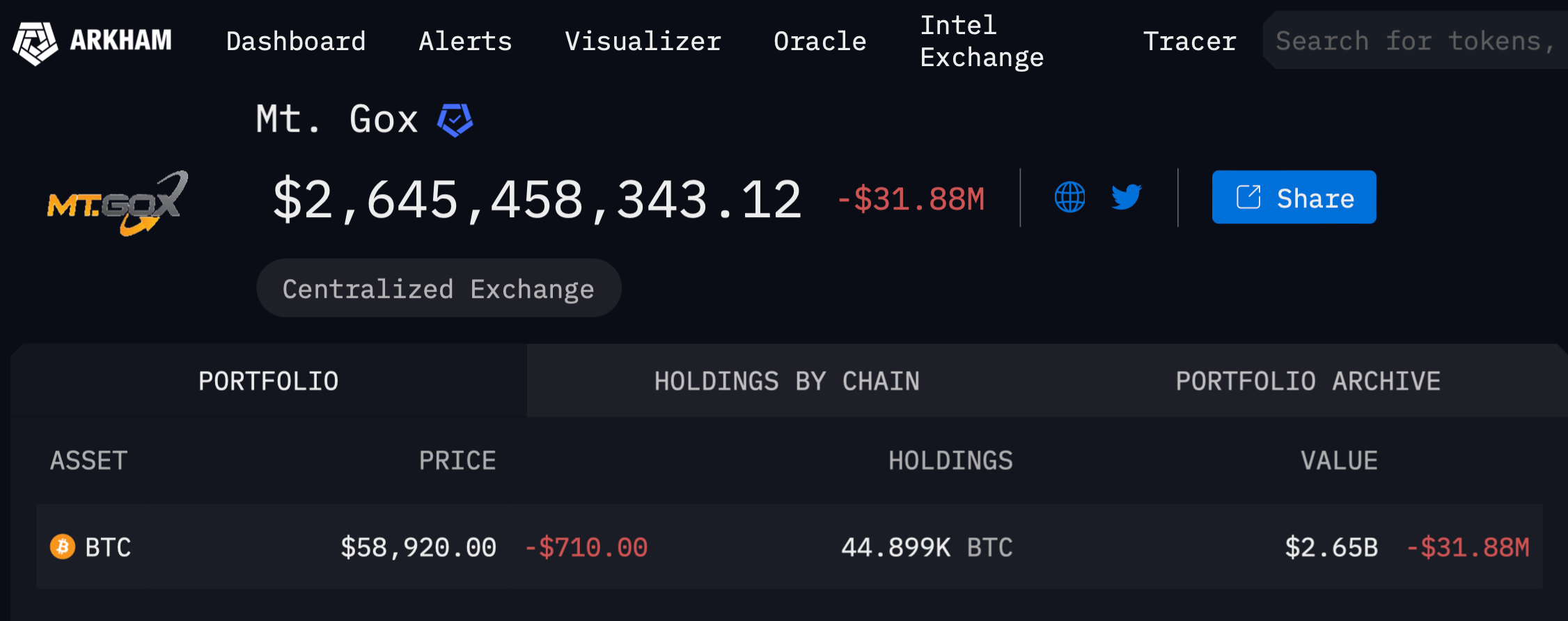
Актуальный баланс кошелька биржи-банкрота Mt.Gox

Сегодня же на кошельке платформы находятся 44 899 BTC в эквиваленте 2.64 миллиарда долларов. А это меньше трети от того, что находилось на адресе изначально.

Соответственно, кредиторы скоро получат остатки монет.

Что будет с ценой Биткоина?

Согласно данным источников Cointelegraph, правительство США всё ещё хранит более 203 тысяч BTC на сумму 12.1 миллиарда долларов.

В то же время торговая платформа Mt.Gox, которая сейчас осуществляет план реабилитации, распределит ещё около 45 тысяч BTC в рамках данной инициативы. Речь идёт о крупнейшей криптовалютной бирже, которая пережила взлом и закрылась более десяти лет назад. Всё это время пользователи торговой платформы ждали выплат возмещения, которые стартовали этим летом и продлятся до 31 октября 2024 года.

То есть после наступления этой даты опасения инвесторов из-за возможного обвала рынка на фоне продаж распределяемых биткоинов, что происходило на протяжении последних лет, окажутся в прошлом.

Вот соответствующий график возможных источников давления на Биткоин. Как можно заметить, первые три места занимают правительства США, Китая и Великобритании, общая сумма монет в распоряжении которых достигает 454 тысяч единиц.
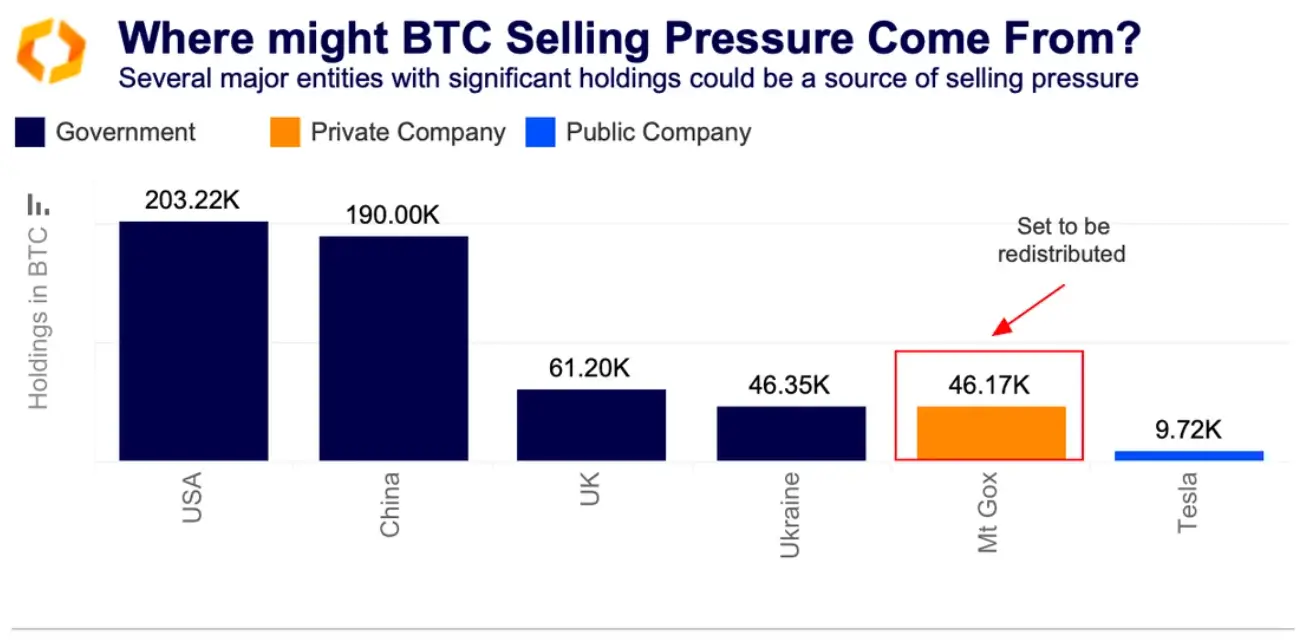
Потенциальное давление продаж на рынок из разных источников

Команде попечителя Mt.Gox Нобуаки Кобаяши остаётся распределить биткоины на несколько миллиардов долларов на протяжении ближайших двух месяцев. Однако выплаты вряд ли окажут значительное влияние на рынок, говорится в отчёте аналитиков Kaiko.

Вот реплика по данному поводу.

Kraken справилась с потоками ETF на Биткоине лишь с незначительным увеличением проскальзывания на закрытии рынка США. Профиль ликвидности позволяет предположить, что любое дополнительное давление продаж в связи с выплатами Mt.Gox вряд ли вызовет структурные проблемы, которые в состоянии повлиять на весь рынок.
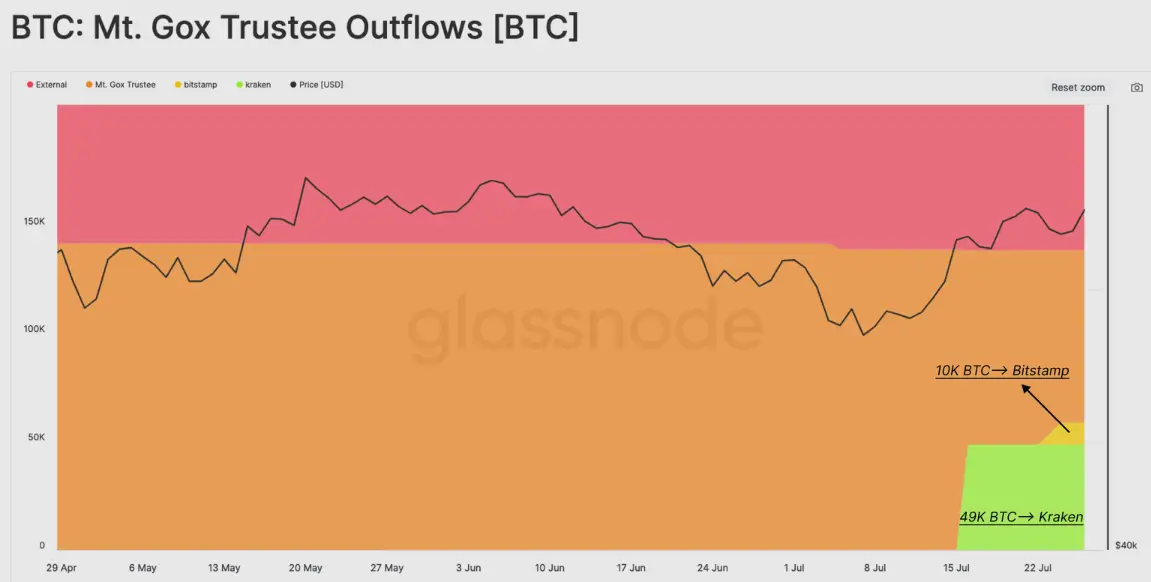
Распределение биткоинов торговой платформой-банкротом Mt.Gox

Кредиторы Mt.Gox ждали получения биткоинов на сумму более 9 миллиардов долларов в течение десяти лет. Причём с момента коллапса биржи главная криптовалюта подорожала более чем на 8500 процентов. Именно поэтому у многих возникли опасения, что получатели компенсаций тут же начнут продавать BTC, обваливая его курс.

Однако несмотря на значительный рост цены актива, кредиторы Mt.Gox преимущественно пока не продают его. Они уже получили крипту на сумму почти 4 миллиарда долларов или 41.5 процента от всей суммы выплат.

Аналитики Glassnode считают, что темпы продаж значительно ниже прогнозируемых цифр. Вот их реплика.

Кредиторы предпочли получить BTC, а не обычную валюту, что является новшеством в японском законодательстве о банкротстве. Таким образом относительно вероятно, что только часть этих распределённых монет будет действительно продана на рынке.
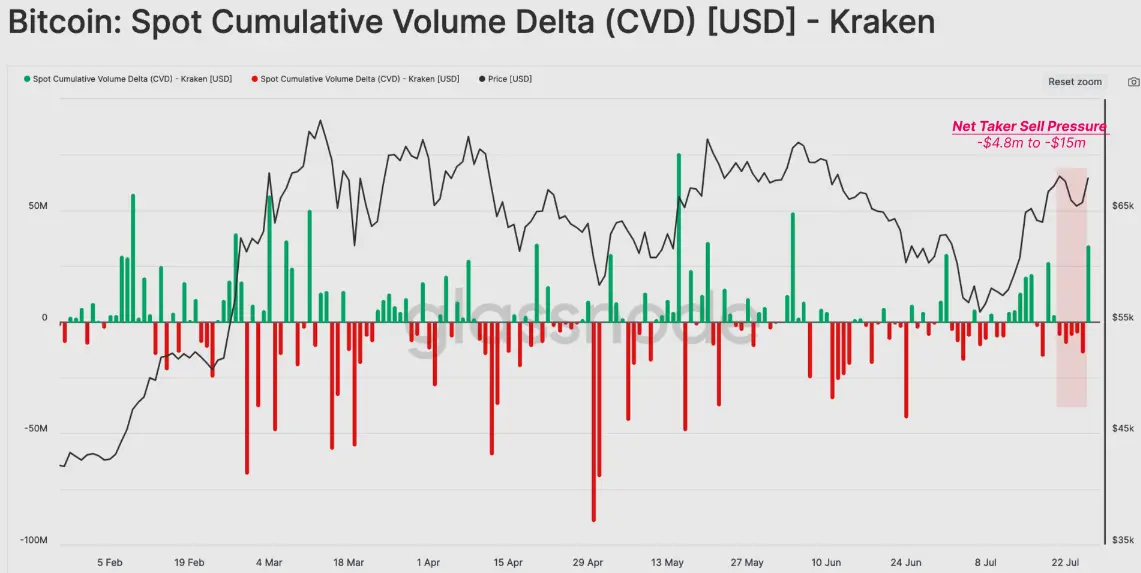
Метрика CVD для Биткоина на торговой платформе Kraken

Примечательно, что спотовая кумулятивная дельта объёма (CVD) — то есть метрика, измеряющая чистую разницу между спотовым объёмом покупки и продажи актива на централизованных биржах — не показала значительного роста на Karken после распределения биткоинов от Mt.Gox. Другими словами, ситуация остаётся относительно стабильной, а получатели крипты пока предпочитают хранить её.

Вторая переменная, которая вызывает опасения инвесторов – действия американского правительства. В теории правительственные структуры США могли бы продать все свои конфискованные биткоины в любой момент.

Однако это вряд ли случится как минимум до грядущих президентских выборов. Ну а дальше остаётся шанс на победу республиканца Дональда Трампа, который ранее пообещал вовсе не продавать биткоины из правительственных кошельков. Вместо этого политик планирует создать национальный резерв цифровых активов, которые могут быть использованы разве что для погашения части государственного долга страны.

Действия государственного аппарата в отношении криптосектора ещё жёстче в Китае. Всё же сейчас крупный китайский криптотрекер Feixiaohao находится под пристальным вниманием местных правоохранительных органов. Несколько руководителей платформы даже были арестованы в рамках продолжающегося расследования.
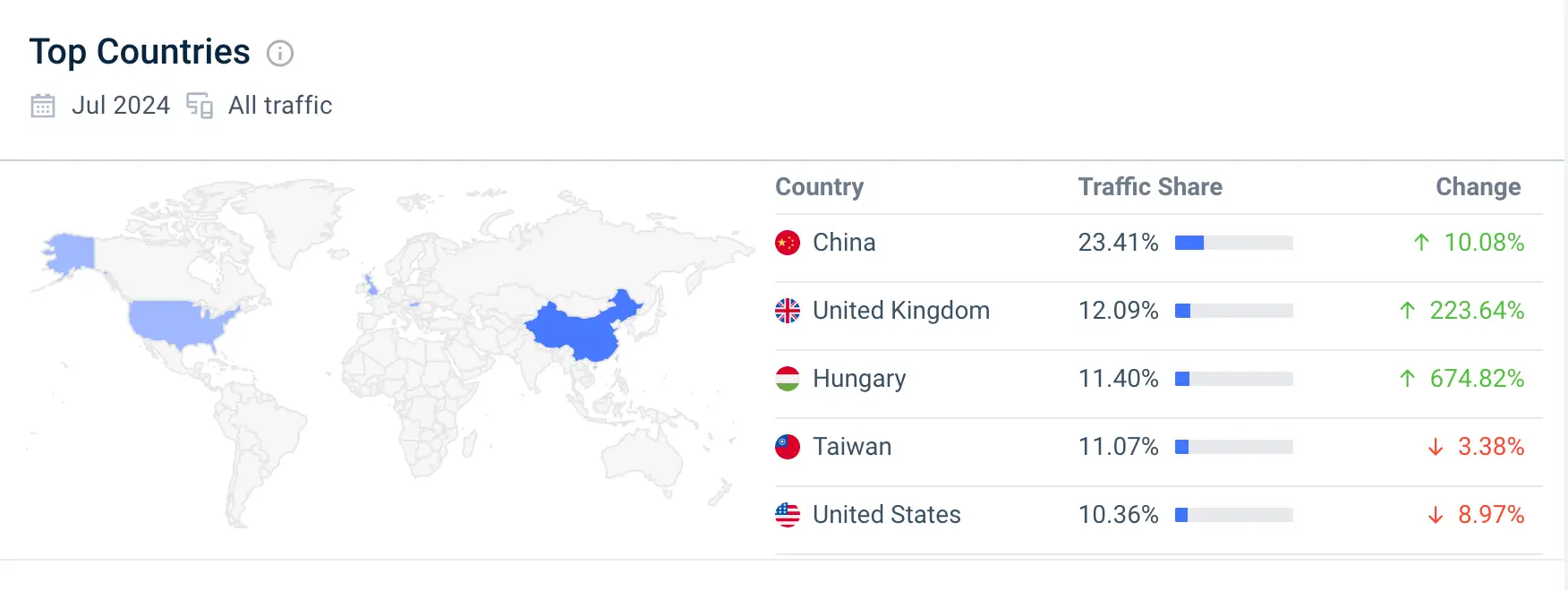
Источники трафика Feixiaohao

Согласно информации на официальном сайте Feixiaohao, платформа была запущена в августе 2017 года и стала аналогом популярных площадок CoinMarketCap и CoinGecko. Причины предполагаемого расследования в отношении Feixiaohao в настоящее время неизвестны.

Причём как утверждают источники, расследование длится уже более шести месяцев.


Пока складывается впечатление, что монеты на кошельках Mt.Gox и правительства США являются последней существенной преградой на пути к продолжению нынешнего буллрана. Всё же ситуация в экономике скоро начнёт улучшаться, тогда как Дональд Трамп, который поддерживает индустрию, по-прежнему остаётся фаворитом на грядущих президентских выборах в США. Так что холдерам остаётся просто пережить грядущие два месяца, после чего история с Mt.Gox останется в прошлом.


Letture associate

Two Legends Lost in Three Days: Is Google's AI Talent Dam Cracking?

In three days, Google lost two AI legends. On June 18, Noam Shazeer, co-author of the seminal "Attention is All You Need" paper and Gemini co-lead, left for OpenAI. Just 48 hours later, John Jumper, 2024 Nobel laureate and AlphaFold lead, departed DeepMind for Anthropic. This follows Andrej Karpathy joining Anthropic in May. These moves highlight a structural trend: top AI talent is concentrating at mission-driven, pre-IPO firms like OpenAI and Anthropic, while Google becomes a primary source. The exodus stems from a core mission mismatch. Google's ad-centric model often subordinates AI research to product and revenue goals, creating friction for pioneers like Shazeer, who returned in 2024 only to leave again. In contrast, OpenAI and Anthropic offer singular focus on pushing AI boundaries, whether towards AGI or safety-aligned models, which deeply appeals to top researchers like Jumper. Financial incentives amplify the pull. With both OpenAI and Anthropic nearing IPO, employees stand to gain immensely from equity, an upside Google's mature stock cannot match. Furthermore, the 2023 merger of Google Brain and DeepMind, intended to consolidate strength, has instead created cultural tension and slowed the path from research to product, as evidenced by Gemini's pace. This talent redistribution is reshaping the AI landscape. While Google retains vast data and compute resources, its true crisis is the quiet, continuous loss of the people who define the field's future. The real moat in AI is not infrastructure, but the concentration of brilliant minds—a battle Google is currently losing.

marsbit15 min fa

Two Legends Lost in Three Days: Is Google's AI Talent Dam Cracking?

marsbit15 min fa

Behind the AI Report Card, Lies a Chinese 'Exam Setter'

Beyond the familiar performance charts like MMLU-Pro and MMMU, which major AI models strive to ace, stands a key "examiner": Chinese-Canadian researcher Wenhu Chen. An assistant professor at the University of Waterloo and founder of TIGERLab, Chen addresses the crucial need for more rigorous AI evaluation. As models like GPT-4 began scoring near-perfect results on older benchmarks like MMLU, it became difficult to distinguish their true capabilities. In response, Chen introduced MMLU-Pro in 2024, featuring harder, more reasoning-focused questions with more answer choices, successfully reintroducing meaningful performance gaps. His work extends to multi-modal evaluation with MMMU and its enhanced version, MMMU-Pro. These benchmarks test a model's ability to understand and reason with complex information from images, charts, and text across diverse academic subjects, exposing the significant challenges even top models face in genuine comprehension. Chen's background in complex QA, table reasoning, and his experience at Google DeepMind on projects like Gemini inform his approach. He understands that effective benchmarks must anticipate how models might "cheat" by memorizing data or avoiding visual analysis. His lab also actively researches video understanding and generation models (e.g., UniVideo, Vamba), ensuring his evaluation work is grounded in practical model-building challenges. Now at Meta's Super Intelligence Lab, Chen continues his focus on multi-modal data and evaluation, representing the deep yet often unseen contributions of Chinese talent in shaping the fundamental tools of the AI industry.

marsbit27 min fa

Behind the AI Report Card, Lies a Chinese 'Exam Setter'

marsbit27 min fa

Alliance Co-founder's Letter to Entrepreneurs: Written at the Moment Cursor Sold for $600 Billion

Alliance Co-founder's Letter to Entrepreneurs: On Cursor's $60 Billion Sale Many aspiring founders see massive exits like Cursor's $60B sale and wonder why they can't achieve the same, often concluding opportunities are exhausted. But great companies aren't built in obvious, crowded spaces. Cursor, like Stripe, Figma, and Shopify before it, started with a non-consensus belief about the future. Before ChatGPT, they believed AI would transform knowledge work. They focused on a genuinely exciting domain, became their own customer, and obsessed over power users. Their journey involved years of "glass-chewing" effort before the market was ready. The pattern is consistent: identify a long-term technological shift, find a missed entry point, and execute for years before the trend becomes obvious. First-generation products (PayPal, Adobe, Amazon) prove a market exists. Second-generation winners (Stripe, Figma, Shopify) rebuild that market around new insights, technology, or changing customer behaviors. Founders must identify their phase in the cycle. Early entrants like Coinbase or Cursor focus on making new technology usable for power users. Later entrants find the "yin" to the established "yang"—the blind spots incumbents miss as they grow distant from individual users. The key is deep market immersion. Use every product in your space. Talk to users. Build an audience. Stop looking for ideas and start *seeing* them everywhere. Then, choose one. The idea must offer a 10x improvement or solve a "hair-on-fire" pain point—something severe enough that users are already crafting workarounds. When building, avoid feature bloat. Ask: why would someone switch? Great startups rarely force new behaviors; they improve familiar workflows with drastically lower friction (e.g., Cursor forked VS Code instead of creating a new editor). Distribution is the underestimated moat. Before product-market fit, achieve distribution-market fit. How do customers discover new tools? Founders like those at Airbnb, Stripe, and Cursor did unscalable, manual work to recruit early users. The final, unteachable ingredient is resilience. Cursor built for years pre-market, faced rejection, and persisted. So did Airbnb, Nvidia, and Rain (which launched post-FTX collapse). The lesson isn't that these founders were smarter, but that they stayed in the game long enough for their insights to compound. Framework: Spot technological cycles. Cultivate unique insight. Obsess over your market. Talk to customers. Find a hair-on-fire problem. Build the simplest wedge. Win your distribution channel. Above all, don't quit when it gets hard. Most people won't do these things consistently. The few who do build the next generation of great companies. Go build.

marsbit30 min fa

Alliance Co-founder's Letter to Entrepreneurs: Written at the Moment Cursor Sold for $600 Billion

marsbit30 min fa

Weekly Editor's Picks (0613-0619)

Weekly Editor's Picks (0613-0619): Market Insights & Analysis This weekly digest curates in-depth analysis often lost in the information flow, focusing on key insights across macro trends, investment, and technology. **Macro & Geopolitics:** With the Strait of Hormuz reopening and military conflict shifting to negotiation, markets are pivoting from "war shock" to "supply restoration." Trades include shorting crude risk premiums, longing airlines/tourism, Asian energy importers, and bond duration, while shorting inflation expectations. LNG, fertilizer, and chemical chains are also being repriced. **Investment & VC:** Ray Dalio advises against betting on concentrated AI giants dominating indices, advocating for diversified portfolios of high-quality, low-correlation assets instead. Analysis covers the 4-year crypto cycle, predicting the core surviving product by 2029 will be asset trading markets. Current BTC metrics suggest a potential bottoming zone, presenting a patient accumulation window. SpaceX's high-profile IPO at a $2.1T valuation faces scrutiny over fundamentals, with key watchpoints being its likely inclusion in the Nasdaq index and Q2 earnings. Concerns are raised about potential "gamma squeeze" and systemic risks if its narrative-driven valuation gets amplified by passive index funds. Robinhood (HOOD) is noted for breaking its high correlation with crypto, bolstered by its stock trading and new underwriting business. **Web3 & AI:** A warning highlights ~$1.8T in off-balance-sheet AI infrastructure commitments (purchase commitments, leases) as a potential systemic risk if AI monetization lags. AI models are being used for World Cup predictions, adding a new layer for betting markets. A cost breakdown of a $20 AI subscription reveals the supply chain from model companies to cloud, GPUs, and power. **Prediction Markets:** The emergence of prediction market "concept stocks" is noted, with Robinhood developing its own platform, Rothera, signaling a shift from market competition to a "channel war" for user access. **CeFi & DeFi:** The SpaceX IPO tested perpetual contract mechanisms for pre-IPO assets, highlighting challenges in handling corporate actions like stock splits on-chain. The de-pegging of STRC (Strategy's preferred share) to ~$89 reflects market concerns over MicroStrategy's capital structure and BTC-backed leverage model. BlackRock's covered-call Bitcoin ETF (BITA) offers yield but caps upside, appealing to yield-seeking institutions. **Ethereum:** An opinion piece argues Ethereum's core strength is its vast developer community and composability, solidifying its role as the default operating system for the financial internet. **Weekly Hot Topics:** Include the US-Iran deal reopening the Strait of Hormuz, Fed's hawkish hold, Anthropic restricting model access, SpaceX acquiring Cursor, and a humorous stock surge for "Liuliumei" due to its "LLM" ticker.

marsbit35 min fa

Weekly Editor's Picks (0613-0619)

marsbit35 min fa

Alliance's Co-Founder's Letter to Entrepreneurs: Written on the Occasion of Cursor's $60 Billion Sale

In this letter to entrepreneurs, Alliance reflects on the success of Cursor's $60 billion sale to Elon Musk, using it as a case study to counter the misconception that opportunities in crowded fields like AI or crypto are exhausted. The piece argues that great companies like Cursor, Stripe, Figma, and Shopify are not built by geniuses with perfect ideas, but by founders who start with a non-consensus belief about the future and build for years before that future becomes obvious to everyone. They identify long-term shifts, find overlooked entry points, and execute relentlessly. The framework for success involves: 1. **Identifying your place in the technology cycle**: Early-stage opportunities focus on making new tech usable for power users (e.g., Coinbase, Cursor). Later-stage opportunities involve finding the "yin" to an existing "yang"—the blind spots of first-generation players (e.g., Stripe vs. PayPal, Figma vs. Adobe). 2. **Cultivating unique insights**: Immerse yourself deeply in the market. Use every product, talk to users, and build an audience. Insights will emerge naturally from deep engagement. 3. **Finding a "hair-on-fire" problem**: Look for a 10x improvement or a severe, urgent pain point. The strongest signal is people already building clumsy workarounds. 4. **Building a focused MVP**: Don't just add features because you can. Ask why users would abandon their current tool for yours. The best startups rarely force new behaviors; they improve familiar workflows with drastically lower friction. 5. **Winning a distribution channel**: Distribution is often the moat. Before product-market fit, achieve channel-market fit. Find where your customers are and build an engine to reach them, even through unscalable, manual efforts initially. 6. **Persistence**: The final, unteachable ingredient is resilience. Success stories like Cursor, Airbnb, and Nvidia involved years of grinding, rejection, and perseverance when the path forward seemed unclear. The conclusion is that there is no secret. Most people fail to consistently execute these steps over the long term. The few who do build the companies that define the next era. The world is yours to create.

链捕手40 min fa

Alliance's Co-Founder's Letter to Entrepreneurs: Written on the Occasion of Cursor's $60 Billion Sale

链捕手40 min fa

Trading

Spot
Futures
活动图片