CoinGecko调研:加密人士都从哪里获取加密新闻?

marsbitPublished on 2024-08-22Last updated on 2024-08-23

加密人士青睐哪些社交媒体?

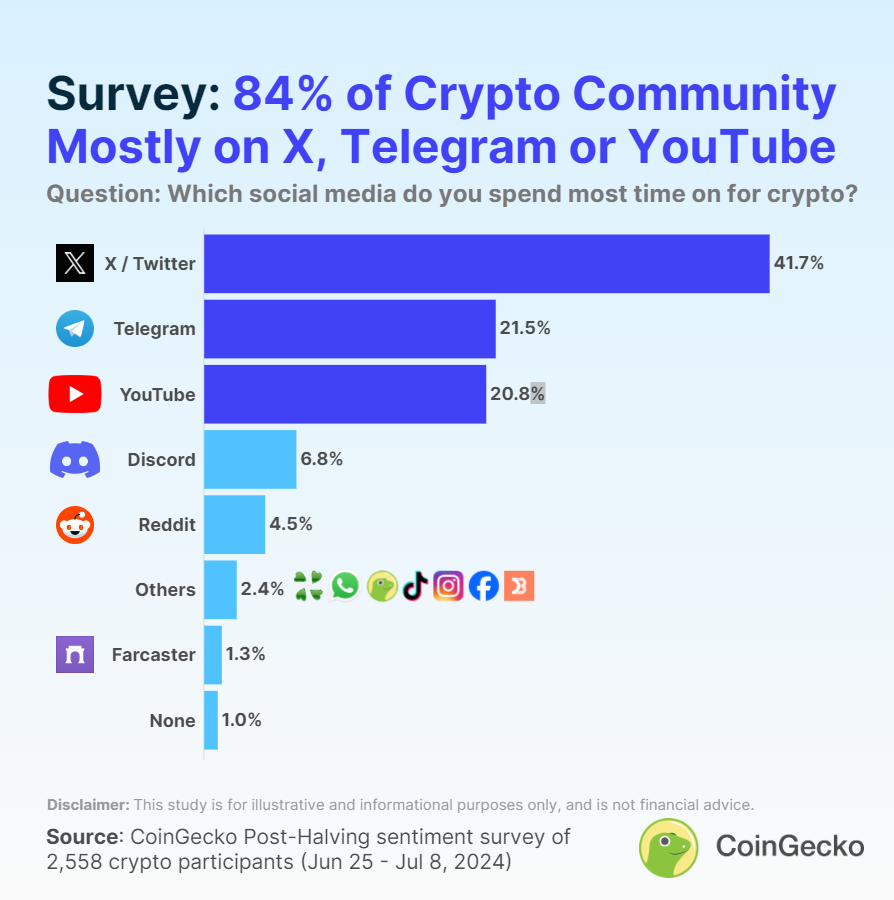
加密最常用的社交媒体平台是 X(以前称为 Twitter)、Telegram 和 YouTube,在CoinGecko的一项调查中,它们占加密社区回复总数的 84.0%。另外 15.0% 的人主要使用 Discord、Reddit 或其他社交媒体平台,剩下的 1.0% 的人自称不属于任何加密社交媒体。

虽然 X 毫无意外地成为最受欢迎的加密社交媒体,但只有 41.7% 或不到一半的加密社区认为它是他们花时间的主要平台。这表明,尽管加密 Twitter 是众所周知的,CT 内容和对话通常会被引用或参考用于行业发展,但 X 并不是加密社区主要聚集的唯一在线空间。
Telegram

调查发现,Telegram 和 YouTube 在加密社区中的受欢迎程度相似。21.5% 的人表示他们大部分时间都花在加密 Telegram 上,紧随其后的是 20.8% 的人,他们主要将时间花在加密 YouTube 上。

加密 Discord 是 6.8% 参与者的主要社交媒体平台,略高于主要使用加密 Reddit 的 4.5%。这可能是因为 Discord 和 Reddit 被更广泛地视为加密社区的补充社交媒体平台。

与此同时,只有 1.3% 的参与者主要是 Farcaster 用户。去中心化的社交媒体一经推出就引起了轰动,并继续受到关注,但 Farcaster 是否能够巩固其在加密社交媒体平台中的中流砥柱地位还有待观察。

最后,2.4% 的参与者表示他们主要使用其他社交媒体,而这些社交媒体不在提供的选项中。例如,有几个人提到了 4chan、WhatsApp 和 TikTok。更不寻常的答案包括 DeBank、Odysee 和 GitHub。

人们从哪里获取加密新闻?

调查发现,大多数加密社区成员都是从社交媒体平台而非新闻网站获取新闻和信息。73.8% 的人从 X、YouTube 或 Telegram 获取大部分加密相关信息,而新闻网站则落后很多,只有 6.5% 的参与者将新闻网站作为主要信息来源。

Telegram

最受欢迎的加密信息和新闻来源是 X,34.4% 的参与者依赖它。具体来说,在主要使用加密 Twitter 的 1,065 名参与者中,710 人(66.7%)也将其视为主要信息来源。

加密 YouTube 以 23.4% 的市场份额排名第二,超过加密 Telegram。在 531 名使用加密 YouTube 作为主要社交媒体的参与者中,365 人(68.7%)也从视频共享平台上获取信息。

另有 16.0% 的人表示,他们从 Telegram 获取了大部分加密信息,这使得该消息平台的受欢迎程度是新闻网站的两倍多。在 548 名主要使用 Telegram 加密社交媒体的参与者中,312 人(56.9%)也主要在那里消费信息,这略低于加密 Twitter 和 YouTube 上的重叠媒体消费行为。

然而,总体而言,三个平台上超过一半的社区成员倾向于从他们花费时间最多的社交媒体上获取信息,而不是求助于其他来源。

不太受欢迎的加密信息来源是 Discord(5.3%)、时事通讯(3.8%)、Reddit(3.3%)、播客(1.6%)和 Farcaster(0.8%)。最后,4.6% 的人表示加密信息的其他主要来源,例如数据分析网站、个人联系、4chan 和研究提供商。值得注意的是,许多参与者强调使用多种信息来源,而不是依赖特定的信息来源。


Related Reads

Why Do We Need an AI Content Perspective Today?

The article "Why Do We Need an AI Content Perspective Today?" explores the complex and often contentious integration of AI into the cultural and creative industries, particularly film and television. It begins with the cancellation of Amazon's AI-generated animation "Punky Duck," highlighting the ethical debates surrounding AI content. AI's rapid advancement is transforming video production, enabling cost-effective, full-length AI films (e.g., "RAPHAEL," "Dreams of Violets") while sparking industry resistance over issues like "synthetic actors." The core debate has shifted from whether to use AI to how to use it responsibly. The article analyzes why AI's entry into film is uniquely unsettling. It distinguishes between "cultural fast food" (short-form, fast-paced content like micro-dramas) and "cultural main courses" (traditional, long-form film/TV). AI currently excels at the former, matching its fragmented narratives, shallow emotional needs, and free-to-consumer models. However, venturing into the latter challenges the human-centric essence of storytelling—creativity, emotional depth, and the unique value of human labor and experience. While AI can generate massive volumes of content and lower costs, it risks devaluing human creativity, leading to homogenized output, and creating unfair competition through potential intellectual property infringement. Its efficiency also amplifies content safety risks, making preemptive governance crucial. To counter these risks, the article proposes establishing clear boundaries guided by a human-centered AI content perspective. It outlines four principles: 1) Amplify, rather than displace, human creative space; 2) Respect and protect human creative output; 3) Ensure human creative control and responsibility remain paramount; and 4) Guarantee transparency and traceability in AI creation. The conclusion emphasizes that humans must act as the "helmsmen" of technology, steering AI development to enhance, not replace, the core human values at the heart of cultural expression.

marsbit20m ago

Why Do We Need an AI Content Perspective Today?

marsbit20m ago

Planck Retracted? The Father of Quantum Tripped by an Algorithm

The recent discovery that two articles (published in 1940 and 1942) by Max Planck, the Nobel laureate and founder of quantum theory, are marked as "retracted" on Springer's digital platform highlights a curious clash between historical publishing practices and modern automated systems. An investigation suggests these retractions are algorithmic errors, not due to fraud or misconduct. The papers, philosophical reflections on science published in *Die Naturwissenschaften*, were likely flagged by the platform's systems. One article, a republished lecture, may have been mistaken for duplicate publication. Another, sharing a title with a prior article by a different author (a common practice for continuing debates at the time), may have triggered a similar automated check. The digital versions have even been replaced with blank pages, contrary to normal practice of preserving retracted texts. This incident underscores how contemporary digital infrastructure, built around concepts like "self-plagiarism" and strict copyright, can misclassify and obscure legitimate historical scholarly communication. It serves as a warning that digital archives are not neutral mirrors of the past but are filtered by platform rules, potentially distorting the scientific record. As AI systems increasingly rely on such databases, such erroneous metadata could propagate, affecting how future tools interpret and access historical knowledge.

marsbit23m ago

Planck Retracted? The Father of Quantum Tripped by an Algorithm

marsbit23m ago

Refunds! Claude 4.8 Sees Overnight Major 'Dumb-Down', GPT-5.6's Computational Power Reportedly 'Halved'

The AI community is currently alarmed by widespread reports of significant performance degradation in two leading models. This article details a "mass self-testing frenzy" triggered by a mysterious prompt designed to detect a hidden "Juice" value, representing a model's reasoning compute budget. On OpenAI's side, users suspect a covert, limited test of a "GPT-5.6-sol" model is underway. When using a specific XML prompt on the Codex platform, a normal "gpt-5.5 xhigh" model reportedly returns a Juice value of 768. However, some users routed to the suspected GPT-5.6 test receive a drastically reduced value of 128—a six-fold decrease. This has sparked debate on whether it signifies a major efficiency leap or a "watered-down, low-cost version" achieved by slashing reasoning depth to save computational expenses. Simultaneously, Anthropic's Claude models, particularly the flagship Opus 4.8 Max, are facing intense user backlash for a perceived "physical brain cut." Users on platforms like Reddit report a dramatic decline in the model's once-impressive reasoning, with complaints of it becoming "absurdly" weakened, performing worse than older, lighter models like Haiku. Specific criticisms include: losing long-context memory, refusing to think deeply even in high-reasoning modes, providing instant incorrect answers, and engaging in unhelpful, argumentative, or "gaslighting" behavior where it contradicts users unnecessarily. The article speculates these "stealth downgrades" might be a calculated corporate strategy. Companies could initially release models with temporarily boosted compute to create an illusion of a major breakthrough, then silently scale back parameters later to manage unsustainable inference costs. A proposed underlying cause is a tightened funding environment, potentially exacerbated by SpaceX's massive IPO soaking up market liquidity, which could delay AI company IPOs and force cost-cutting measures like model "nerfing." The core issue highlighted is the asymmetry of information: subscribers pay for a service that can be silently and fundamentally altered without notification or explanation. The viral "Juice test" resonates because it represents users' desire for transparency about what they are actually paying for.

marsbit59m ago

Refunds! Claude 4.8 Sees Overnight Major 'Dumb-Down', GPT-5.6's Computational Power Reportedly 'Halved'

marsbit59m ago

Trading

Spot
活动图片