当前的加密市场存在泡沫吗?投资者的真实需求如何?

币界网Pubblicato 2024-08-21Pubblicato ultima volta 2024-08-21

币界网报道:

作者:Axel Adler Jr,来源:作者博客;编译:陶朱,

今天,我们将讨论以下主题:

1. 市场回顾。

2. 为何说牛市尚未结束?

3. 之前昂贵的代币的真正需求是什么?

4. 整合的结束和支撑位。

5. 结论。
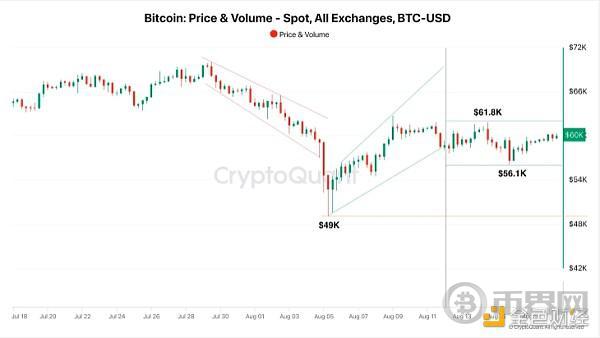
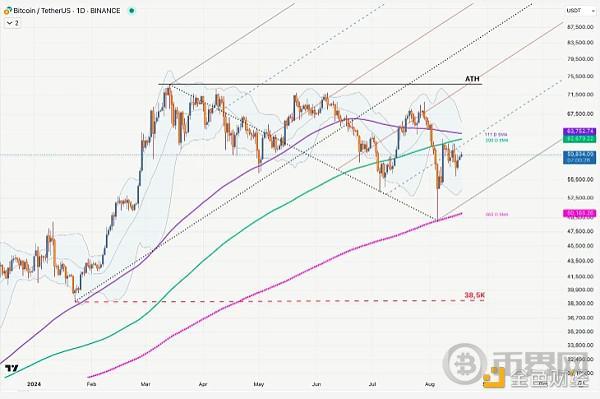
整个一周,比特币交易价格在 61-56K 美元之间,没有形成明显的趋势。这基本上是一个非常平静的交易周。阻力位是 200 日均线 68.2K 美元,价格未能守住该水平。

本周一个有趣的事件是来自迪拜的消息,迪拜承认加密货币是支付工资的可接受方式,这表明数字货币的采用日益增加。

另一个重要事件涉及 ETF:贝莱德的资产管理规模超过了灰度,这得益于灰度的资金流出和贝莱德的资金流入。此外,灰度任命了一位新首席执行官。如果你不知道,前任首席执行官 Michael Sonnenshein 推出了一个比特币信托基金,吸引了总计 653K BTC 的大量投资。问题是客户不知道市场上有聪明的资金玩家,他们很乐意将昂贵的加密货币卖给新手。结果,一些客户不得不等待四年才能实现盈利。事实上,比特币的四年复合年增长率从未低于 24%,但该基金的投资者不得不等待四年的事实却相当惊人。

牛市结束了吗?

当购买昂贵代币的需求小于想要出售代币的供应时,牛市就会结束。让我们看看数据,确定当前的市场情况是否可以被视为牛市周期的结束。

我们需要了解的第一件事是,现在市场是否存在泡沫。
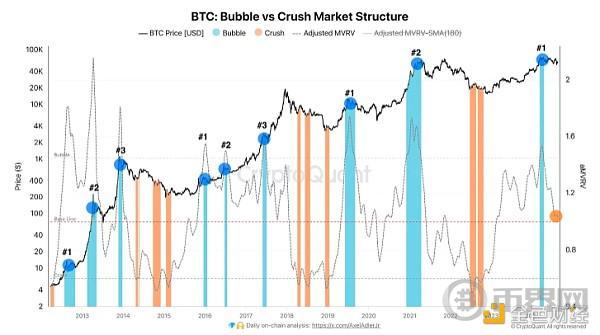
泡沫与崩盘市场结构指标显示,本周期的第一个泡沫形成于 73,000 美元的水平。当前值已降至 1.02,这是基线,表明市场没有泡沫。当比特币的市值增长速度快于其实际市值时,就会形成泡沫,这本质上反映了投机兴趣。换句话说,在这种时候,许多投资者由于 FOMO(害怕错过)而以高昂的市场价格购买比特币。

下一个有助于我们了解牛市是否已经结束的指标是 MV/RV 的标准差,由 30 天和 365 天内的两个移动平均线平滑。
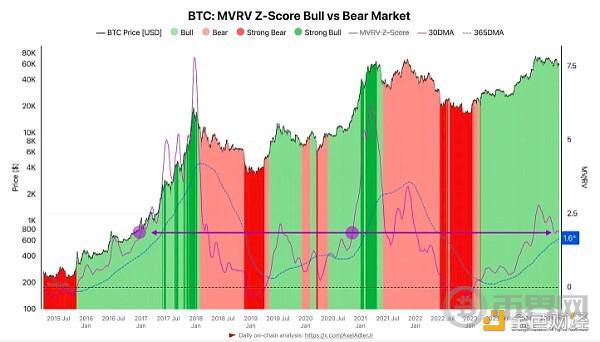
在图中,我们可以看到当前的牛市周期发展相当稳定,没有出现重大异常或急剧上涨。30DMA MVRV Z 分数为 1.8,表明与年平均值 1.6 相比,比特币的估值过高程度最小。我们看到,在之前的周期中,30DMA MVRV Z 分数升至 5 以上,这通常伴随着价格高峰和随后的调整。这证实了当前的牛市周期正处于活跃阶段,只要该指标没有达到可能预示重大调整风险的极端水平,市场就可以被视为看涨。

对加密货币的真实需求是多少?
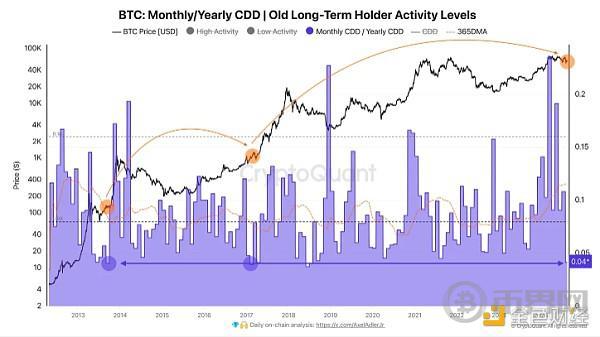
首先,让我们来看看经验丰富的投资者的行为。我们看到,当比特币达到 73,000 美元时,长期持有者的活动达到了顶峰。这意味着在这个水平上,相当一部分经验丰富的投资者决定获利了结,导致该指标上升至 23%。

目前,经验丰富的投资者的活动已降至 4%。这表明,尽管目前的价格水平如此之高,但长期持有者并不急于出售资产。这可能是对进一步增长的信心以及对未来价格上涨的预期的标志。
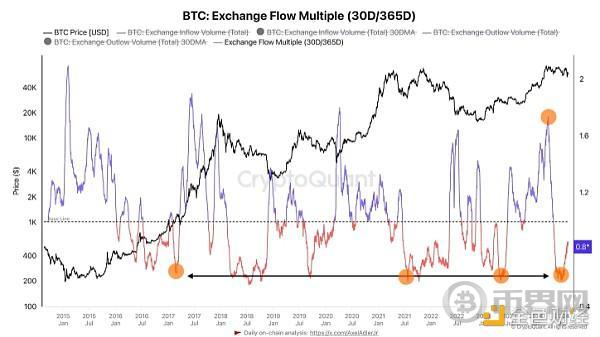
让我们来看看有多少人愿意在交易所出售比特币。交易所流量倍数指标的值从 1.73 下降到 0.8,表明交易所的销售活动显著下降。

所有这些都告诉我们,目前市场面临的看跌压力很小,投资者并不急于在交易所出售资产。
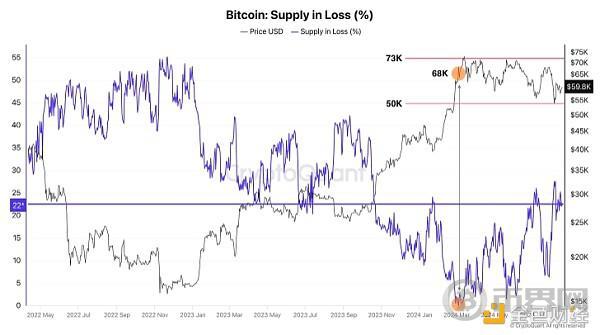
让我们通过查看当前亏损且以高于当前市场价格 59.8 万美元的价格购买的代币数量来评估需求。

亏损供应量指标显示当前亏损的比特币总量(百分比)。当前值为 22%,这意味着所有比特币中有 22% 是以高于 59.8 万美元的价格购买的,约为 430 万 BTC。过去五个月发生了如此数量的代币交易。这可以被视为对以前昂贵的代币的可持续需求吗?显然是的。

最后,让我们来看看已实现利润和亏损的指标。
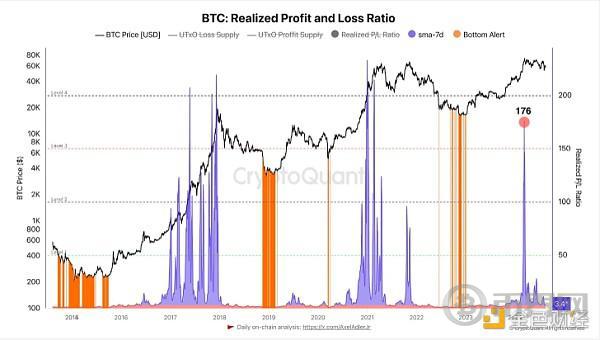
当前值为 3.4 点,这实际上意味着亏本销售。该指标进一步下跌 3.4 点将触发橙色警报,并将其定义为局部底部。因此,当前 BTC 的 365 天 SMA 平均购买价格可被视为持续盘整的强劲支撑位。
结论

我们即将迎来整合的尾声,在我看来,整合进展非常顺利。我们看到,之前昂贵的代币现在有需求,而且是在牛市周期的框架内发生的。我们看到,代币的当前变现处于盈亏平衡或亏损状态,这表明整合即将结束。我们还看到,市场没有泡沫,MV/RV 指标的标准差表明,当前的比特币价格并未超买。我们还了解到,交易所的看跌压力很小,比特币的 365 天 SMA 平均购买价格(50,000 美元)可能在整合结束时充当强劲支撑位。

祝您在即将到来的交易周好运!

Letture associate

Three Scenarios for BTC's Future Direction and a Duel Between Two Strong Forces | Special Invited Analysis

**Title: Three Scenarios for BTC's Future Trajectory and a Key Duel | Invited Analysis** The market remains at a critical juncture. Over the past week, Bitcoin (BTC) consolidated broadly between $79,500 and $80,600, validating previous technical analysis. The current focus is on whether this marks the start of a new uptrend or a pause within a larger correction. **BTC Multi-Cycle Analysis & Three Possible Scenarios** BTC's daily chart structure, following its peak at $126,200 in October 2025, presents three primary technical scenarios based on Elliott Wave theory: 1. **Bullish Scenario (End of Correction):** The corrective A-B-C wave from $126,200 ended at the $60,000 low in February 2026. The current price action is the start of a major Wave I uptrend. A subsequent Wave II pullback would not break below $60,000. 2. **Bearish Scenario 1 (Complex Correction):** The correction is unfolding as an A-B-C-D-E pattern. The current move from $60,000 is a D-wave rally. After its completion, a final E-wave decline could potentially breach the $60,000 level. 3. **Bearish Scenario 2 (Larger Correction):** The entire move down from $126,200 to $60,000 was a large A-wave. The current rally is a B-wave correction within a larger A-B-C structure, to be followed by a C-wave decline below $60,000. *Analysis suggests Scenario 2 is less probable due to time disproportions between waves. The battle is effectively between the Bullish Scenario (1) and Bearish Scenario (3).* **Key BTC Levels & Weekly Strategy** On the 4-hour chart, BTC trades above a crucial consolidation zone ("Central Pivot C"). * **Key Resistance:** $83,500-$84,500; $89,000-$90,500. * **Key Support:** $78,500-$79,500 (pivot upper bound); $73,500-$75,000; $69,500-$70,500. **Weekly Outlook:** The market direction hinges on BTC's ability to hold above or break below the $78,500-$79,500 support zone. * **Mid-term Strategy:** Neutral/Wait-and-see stance due to unclear direction. * **Short-term Tactics:** Two contingency plans using 30% max capital: * **Plan A (Bullish):** Look for long entries if price holds above $78,500-$79,500 with confirming signals. Initial stop-loss below $78,500. * **Plan B (Bearish):** Consider short positions if price breaks below $73,500-$75,000 with confirming signals. Initial stop-loss above $76,500. **HYPE Analysis & Strategy** HYPE's daily chart shows a seven-segment structure from its January low of $20.46, forming a "rising pivot" zone. * **Key Level to Watch:** $45.76 (previous high). A break above would confirm the bullish structure remains intact. * **Short-term Strategy:** Focus on pivot zone boundaries ($38.41 upper, $34.44 lower). * **Long:** Consider on support near $38.41 with bullish confirmation signals. * **Short:** Consider on a break below $34.44 with bearish confirmation signals. * Position size must be below 30% with strict stop-loss discipline. **Risk Management Reminder:** Always set an initial stop-loss upon entry. Move stop-loss to breakeven at +1% profit, then trail it upwards to lock in profits dynamically. All views are based on technical analysis for informational purposes only and do not constitute investment advice. The market is inherently risky.

Odaily星球日报9 min fa

Three Scenarios for BTC's Future Direction and a Duel Between Two Strong Forces | Special Invited Analysis

Odaily星球日报9 min fa

Sequoia Interview with Hassabis: Information is the Essence of the Universe, AI Will Open Up Entirely New Scientific Branches

Demis Hassabis, co-founder and CEO of Google DeepMind and Nobel laureate, discusses the path to AGI and its profound implications in a Sequoia Capital interview. He outlines his lifelong dedication to AI, tracing his journey from game development (e.g., *Theme Park*)—a perfect AI testing ground—to neuroscience and finally founding DeepMind in 2009. He emphasizes the critical lesson of being "5 years, not 50 years, ahead of time" for successful entrepreneurship. Hassabis reiterates DeepMind's two-step mission: first, solve intelligence by building AGI; second, use AGI to tackle other complex problems. He highlights the transformative potential of "AI for Science," particularly in biology where tools like AlphaFold have revolutionized protein folding. He envisions AI-powered simulations drastically shortening drug discovery from years to weeks and enabling personalized medicine. Furthermore, he predicts AI will spawn new scientific disciplines, such as an engineering science for understanding complex AI systems (mechanistic interpretability) and novel fields enabled by high-fidelity simulators for complex systems like economics. He posits a fundamental worldview where information, not just matter or energy, is the essence of the universe, making AI's information-processing core uniquely suited to understanding reality. He defends classical Turing machines as potentially sufficient for modeling complex phenomena, including quantum systems, as demonstrated by AlphaFold. On consciousness, Hassabis suggests first building AGI as a powerful tool, then using it to explore deep philosophical questions. He believes components like self-awareness and temporal continuity are necessary for consciousness but that defining it fully remains an open challenge. He predicts AGI could arrive around 2030 and, once achieved, would be used to probe the deepest questions of science and reality, much as envisioned in David Deutsch's *The Fabric of Reality*.

链捕手27 min fa

Sequoia Interview with Hassabis: Information is the Essence of the Universe, AI Will Open Up Entirely New Scientific Branches

链捕手27 min fa

Morgan Stanley 2026 Semiconductor Report: Buy Packaging, Buy Testing, Buy China Chips, Avoid Traditional Tracks

Morgan Stanley 2026 Semiconductor Report: Buy Packaging, Buy Testing, Buy Chinese Chips; Avoid Traditional Segments. The core theme is the shift in AI compute supply from NVIDIA dominance to a three-track system of GPU + ASIC + China-local chips. The key opportunity is capturing share in this expansion, while non-AI semiconductors face marginalization due to resource reallocation to AI. Key investment conclusions, in order of priority: 1. **Advanced Packaging (CoWoS/SoIC) - Highest Conviction**: TSMC is the primary beneficiary of explosive demand, driven by massive cloud capex. Its pricing power and AI revenue share are rising significantly. 2. **Test Equipment - Undervalued & High-Growth Certainty**: Chip complexity is causing test times to double generationally, structurally driving handler/socket/probe card demand. Companies like Hon Hai Precision (Foxconn), WinWay, and MPI offer compelling value. 3. **China AI Chips (GPU/ASIC) - Long-Term Irreversible Trend**: Export controls are accelerating domestic substitution. Companies like Cambricon, with firm customer orders and SMIC's 7nm capacity support, are positioned to benefit from lower TCO (30-60% vs NVIDIA) and growing local cloud demand. 4. **Avoid Non-AI Semiconductors (Consumer/Auto/Industrial)**: These segments face a weak, structurally hindered recovery due to AI's resource "crowding-out" effect on capacity and supply chains. 5. **Memory - Severe Internal Divergence**: Strongly favor HBM (Hynix primary beneficiary) and NOR Flash (Macronix). Be cautious on interpreting price rises in DDR4/NAND as true demand recovery. The report emphasizes a 2026-2027 time window, stating the AI capital expenditure cycle is far from over. Key macro variables include persistent export controls and AI's systemic "crowding-out" effect on traditional semiconductor supply chains.

marsbit1 h fa

Morgan Stanley 2026 Semiconductor Report: Buy Packaging, Buy Testing, Buy China Chips, Avoid Traditional Tracks

marsbit1 h fa

Circle:Sluggish Market? The Top Stablecoin Stock Continues to Expand

Circle, the issuer of the stablecoin USDC, reported its Q1 2026 earnings on May 11th, Eastern Time. Against a backdrop of weak crypto market sentiment, USDC's average circulation in Q1 was $752 billion, with a modest 2% sequential increase to $770 billion by quarter-end. New minting volumes declined due to the poor crypto market, but remained high, indicating demand expansion beyond crypto trading. USDC's market share remained stable at 28% of the total stablecoin market, while competition from Tether's USDT persists. A key highlight was "Other Revenue," which reached $42 million, more than doubling year-over-year, though sequential growth slowed to 13%. This revenue stream, including fees from services like Web3 software, the Cipher payment network (CPN), and the Arc blockchain, is critical for diversifying away from interest income. Circle's internally held USDC share increased to 18%, helping to improve gross margin by 130 basis points to 41.4% by reducing external sharing costs. However, profitability was pressured as total revenue growth slowed, primarily due to the significant weight of interest income, which is tied to USDC规模 and Treasury rates. Adjusted EBITDA was $133 million with a 19.2% margin. Management maintained its full-year 2026 guidance for adjusted operating expenses ($570-$585 million) and other revenue ($150-$170 million). The long-term target for USDC's CAGR remains 40%, though near-term volatility is expected. The article concludes that while Circle's current valuation of $28 billion appears reasonable after a recent recovery, further upside depends on the pace of stable币 adoption and potential positive sentiment from the advancement of regulatory clarity acts like CLARITY.

链捕手1 h fa

Circle:Sluggish Market? The Top Stablecoin Stock Continues to Expand

链捕手1 h fa

Tech Stocks' Narrative Is Increasingly Relying on Anthropic

The narrative of tech stocks is increasingly relying on Anthropic. Anthropic, the AI company behind Claude, has become central to the financial stories of major tech giants. Elon Musk dissolved xAI, merging it into SpaceX as SpaceXAI, and secured an exclusive deal to rent the massive "Colossus 1" supercomputing cluster to Anthropic. In return, Anthropic expressed interest in future space-based compute collaborations. Google and Amazon are also deeply invested. Google plans to invest up to $40 billion and provide significant compute power, while Amazon holds a 15-16% stake. Both companies reported massive quarterly profit surges largely due to valuation gains from their Anthropic holdings. Crucially, Anthropic has committed to multi-billion dollar cloud compute contracts with both Google Cloud and AWS. This creates a clear divide: the "A Camp" (Anthropic-Google-Musk) versus the "O Camp" (OpenAI-Microsoft). The A Camp's strategy intertwines equity, compute orders, and profits, making Anthropic a "systemic financial node." Its performance directly impacts its partners' financials and stock prices. In contrast, OpenAI, while leading in user traffic, faces commercialization challenges, lower per-user revenue, and a recently restructured relationship with Microsoft. The AI industry is shifting from a race for raw compute (symbolized by Nvidia) to a focus on monetizable applications, where Anthropic currently excels. However, this concentration of market hope on one company amplifies systemic risk. The rise of powerful open-source models like DeepSeek-V4 poses a significant threat, as they could undermine the value proposition of closed-source models like Claude. The article suggests ongoing geopolitical efforts to suppress such competitors will be a long-term strategic focus for Anthropic's allies.

marsbit1 h fa

Tech Stocks' Narrative Is Increasingly Relying on Anthropic

marsbit1 h fa

Trading

Spot
Futures
活动图片