泰国证券交易委员会发布新的指导方针,推出加密监管沙盒

币界网Pubblicato 2024-08-12Pubblicato ultima volta 2024-08-12

币界网报道:

泰国证券交易委员会(SEC)推出了加密监管沙盒。此次发布的主要愿景是尝试将加密货币融入现实生活中。

在最近的一份新闻公告中,泰国证券交易委员会表示,监管机构正在推出沙盒,以进行实验和开发创新,支持在现实生活中提供加密货币。

SEC在公告中表示,SEC董事会已于3月通过了一项批准加密沙盒的决议。还举行了一次公开听证会,以收集公众的建议。

在获得大多数人的批准后,美国证券交易委员会决定发布确定合格服务特征的规定。

美国证券交易委员会宣布六项符合条件的加密货币相关服务

泰国证券交易委员会在其公告中列出了六项符合条件的加密货币相关服务。这些是加密货币交易所、加密货币经纪人、加密货币交易商、加密货币基金经理、加密货币顾问和加密货币资产托管钱包提供商

美国证券交易委员会将研究各种资格标准,包括沙盒下的工作系统、管理结构、资本充足率和其他条件,以确保参与者有资格提供服务。

美国证券交易委员会表示:“参与者必须指定沙盒的具体服务范围,以降低自批准之日起不超过一年的沙盒期间可能发生的风险和广泛影响。”。申请现在对希望参与沙盒的参与者开放。

泰国实施加密货币友好规则

今年早些时候,泰国证券交易委员会更新了其加密货币监管框架。现在,监管机构正在根据《数字资产业务法令》考虑加密货币。根据这一规定,美国证券交易委员会将重点关注ICO、交易和销售等领域。

愿意在该国经营的公司也应获得许可证并遵守规则。在公告中,监管机构还取消了对房地产或基础设施支持的散户投资者的投资限制。

此前,投资上限为8500美元。据报道,美国证券交易委员会还批准了该国首个比特币ETF。据报道,该基金的政策是投资11只全球基金。最近的举动表明,该国现在正在向加密货币友好的立场过渡。

Letture associate

Annualized Revenue Exceeds $20 Billion, Kalshi Aims to Become the First Prediction Platform IPO?

Kalshi, a leading U.S. prediction markets platform, is reportedly in early, informal discussions for an Initial Public Offering (IPO). The company's annualized revenue now exceeds $2 billion, fueled by its dominance of over 90% of the domestic prediction market activity. This growth stems from a surge in trading volume—reaching a total of $52.7 billion—and an increase in fee rates, largely driven by sports event contracts like the NBA playoffs and the 2026 FIFA World Cup. Monthly active users are approximately 2 million. Kalshi recently raised $1 billion in a funding round led by Coatue Management, valuing the company at $22 billion. It has also expanded its offerings to include Bitcoin perpetual contracts and plans to launch a dedicated trading platform, Kalshi Pro. However, Kalshi's path to an IPO faces significant regulatory hurdles. The core risk involves jurisdictional conflicts, as multiple U.S. states are challenging its operations under local gambling laws. For instance, Arizona has filed criminal charges against the platform, while states like Kentucky have filed lawsuits. Kalshi and the Commodity Futures Trading Commission (CFTC) argue that its event contracts fall under exclusive federal jurisdiction as "swaps." The outcomes of these ongoing legal battles could critically impact Kalshi's core revenue and its IPO timeline. Analysts suggest that while an IPO could theoretically occur by late 2026, a more likely timeframe is late 2027 or 2028, contingent on resolving legal issues and favorable market conditions. If successful, its fundraising could significantly exceed $1 billion, given its current valuation and revenue multiple.

Foresight News15 min fa

Annualized Revenue Exceeds $20 Billion, Kalshi Aims to Become the First Prediction Platform IPO?

Foresight News15 min fa

Financing Weekly Report | 11 Public Financing Events, Stablecoin Payment Infrastructure Company Trace Finance Completes $32 Million Series A Round Led by CoinFund

Financing Weekly Report | 11 public funding events recorded, with a total scale exceeding $264 million. The stablecoin payment infrastructure sector remains a hot spot. Key Deals: - Trace Finance, a stablecoin payment infrastructure firm, raised $32 million in a Series A round led by CoinFund to expand in Latin America and Asia-Pacific. - Galaxy Ventures co-led a $140 million Series A round for Karta, a US credit card provider for global travelers without requiring an SSN. - Instant payment platform Interchecks completed a $50 million Series C round. - Paradigm led a $9 million Series A for Latin American cross-border payment app El Dorado. - Range, a stablecoin compliance startup, raised $8.3 million in an oversubscribed Series A. - RWA infrastructure project Renaiss raised $1.5 million to expand its on-chain collectibles platform. Sector Breakdown: - Infrastructure & Tools: 6 deals, including the above-mentioned Trace Finance, Range, and Renaiss. - Centralized Finance (CeFi): 3 deals, led by Karta's $140 million round. - DeFi: 1 deal – reinsurance protocol Re secured strategic investment from Coinbase Ventures. - Prediction Markets: 1 deal – K25.ai completed a $10 million Pre-A round from NewGen. Other notable transactions include digital asset depository RDC raising $7 million, ad-tech startup EarnOS securing $6 million, and a $1 million strategic investment in LitVM, a ZK Layer 2 for Litecoin. The report highlights sustained investor interest in stablecoin payment infrastructure, compliant on-chain finance, and real-world asset (RWA) tokenization.

marsbit57 min fa

Financing Weekly Report | 11 Public Financing Events, Stablecoin Payment Infrastructure Company Trace Finance Completes $32 Million Series A Round Led by CoinFund

marsbit57 min fa

When Transfers Become Truly Frictionless: How Sui Uses 'Zero Gas' to Become the Underlying Infrastructure for Stablecoin Payments

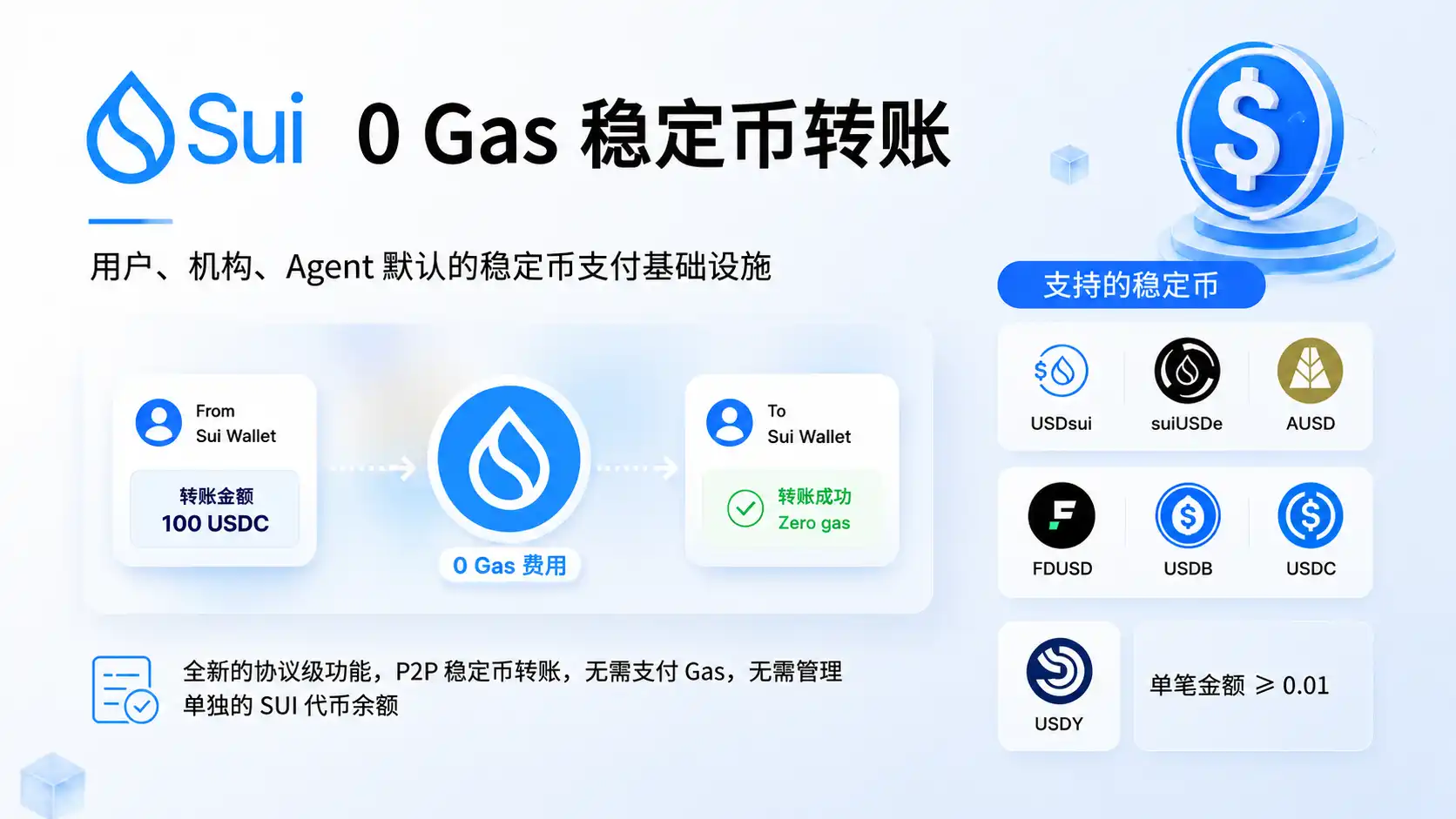
Title: Sui Launches Zero-Gas Stablecoin Transfers to Become the Foundation for Stablecoin Payments Sui has introduced a zero-gas fee feature for peer-to-peer stablecoin transfers, eliminating the need for users or businesses to hold separate SUI tokens to pay transaction costs. This innovation, built on a new underlying account architecture called Address Balances, significantly reduces validator processing costs for eligible transactions. Currently, the feature applies to a whitelist of stablecoins for transfers meeting a minimum amount, effectively preventing spam. This development aims to unlock mainstream payment use cases for stablecoins—such as everyday purchases, remittances, and subscriptions—by removing cost and complexity barriers. It is also positioned to benefit high-frequency micro-payments for AI agents and institutional B2B payments, reducing operational friction. Major custody provider Fireblocks has already announced support. The move follows Sui processing over $1 trillion in stablecoin transfer volume since August 2025. Looking ahead, Sui plans to enhance this infrastructure with protocol-level confidential transactions later in 2026, aiming to provide scalable, free, and privacy-preserving payments. Together, these advancements strengthen Sui's goal of becoming the default settlement layer for stablecoin payments.

marsbit59 min fa

When Transfers Become Truly Frictionless: How Sui Uses 'Zero Gas' to Become the Underlying Infrastructure for Stablecoin Payments

marsbit59 min fa

Ethereum Is Retracing the Path of the Internet and Linux: No One Yields, and the Neutral Party Ultimately Prevails

This article argues that Ethereum is following the historical path of open, neutral systems like the Internet and Linux, which eventually triumphed over proprietary, centrally-controlled alternatives. Major financial institutions like JPMorgan, Stripe, and Circle are building their own proprietary blockchains or networks (e.g., Tempo, Arc), but will never agree to build on a competitor's controlled infrastructure. This creates the perfect opportunity for Ethereum as the only neutral, credibly neutral settlement layer that no single entity controls. The piece draws parallels to the 1990s, when experts like Bill Gates predicted proprietary networks (from Microsoft, Oracle) would win over the open Internet, and when Sun Microsystems' Unix lost to the open-source "bazaar" development model of Linux. This model, described in Eric Raymond's "The Cathedral and the Bazaar," thrives on permissionless innovation where countless contributors improve the system, outpacing any centralized competitor. Ethereum embodies this through its decentralized development, broad validator distribution, and credible neutrality—rules that are transparent, equally applied, hard to change, and open to all. This has attracted over a million developers and major institutions like Coinbase, BlackRock, and JPMorgan, who choose Ethereum for its security, ecosystem, and sovereignty (the inability of any single party to change the rules). While proprietary chains offer initial speed and control, they inherit the downsides of both centralization and decentralization without the long-term innovation benefits. The article concludes that, just as open systems historically win, Ethereum is poised to become the foundational, neutral settlement layer for global finance.

marsbit1 h fa

Ethereum Is Retracing the Path of the Internet and Linux: No One Yields, and the Neutral Party Ultimately Prevails

marsbit1 h fa

Trading

Spot
Futures
活动图片