Nexera уничтожила украденные хакером 32,5 млн токенов NXRA

cryptonews.ruPubblicato 2022-09-08Pubblicato ultima volta 2024-08-08

Согласно данным компании по блокчейн-безопасности PeckShieldAlert, DeFi-протокол Nexera навсегда изъял из обращения 32,5 млн токенов NXRA. Все эти активы были украдены хакером в результате недавнего эксплойта.
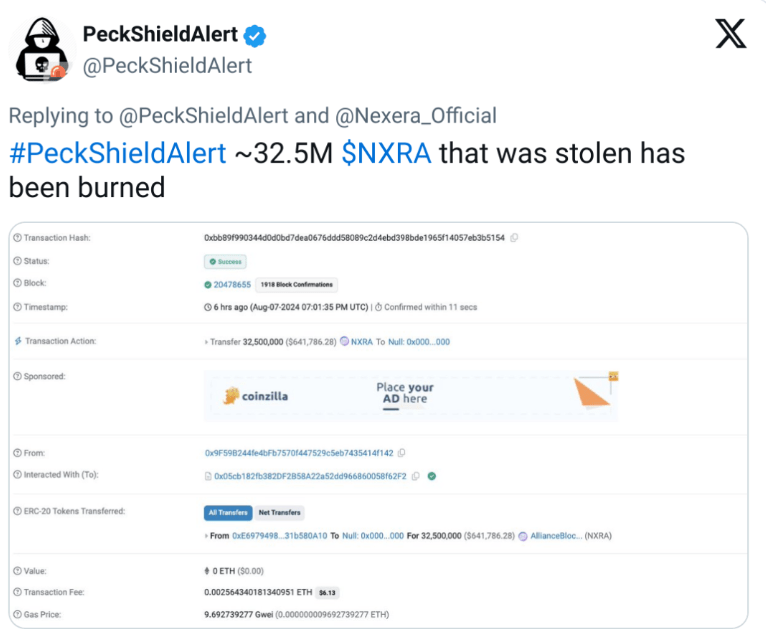
Это один из шагов разработчиков Nexera, которые они предприняли, чтобы справиться с последствиями хакерской атаки. Команда протокола уже сообщила о завершении расследования технической стороны взлома и о том, что смарт-контракты платформы не были скомпрометированы.

Чтобы уменьшить ущерб, причинённый эксплойтом, команда Nexera быстро заморозила оставшиеся 32,5 млн токенов NXRA в кошельке злоумышленника, а затем сожгла их. Благодаря этому преступник не сможет использовать похищенные активы.

Напомним, что 7 августа DeFi-протокол Nexera подвергся хакерской атаке, в результате которой мошенник похитил цифровые активы на сумму более $1,5 млн, включая 47 млн NXRA. Часть токенов преступник успел перевести в сеть BNB, некоторые активы он конвертировал в эфир.

Этот инцидент произошёл после аналогичного взлома индийской криптовалютной биржи WazirX, которая в июле потеряла 45% средств пользователей на сумму более $230 млн. Этот взлом стал вторым по величине с начала 2024 года.


Letture associate

DRAM ETF Issuer: Samsung, SK Hynix, Micron All Surpass $1 Trillion, the AI Era of Memory Chips Has Only Just Begun

Authors: Dave Mazza, Thomas DiFazio | Source: Deep Tide TechFlow The article, written by Roundhill Investments (issuer of the DRAM ETF), responds to Morningstar's caution about investing in memory chip stocks. Morningstar warns of the sector's history of boom-bust cycles, a lack of economic moats, and potential momentum-driven overvaluation. Roundhill argues the current situation is structurally different due to AI. Key points in Roundhill's rebuttal include: * **Changed Demand & Supply Dynamics:** AI infrastructure, not consumer electronics, is now the primary growth driver for memory demand. New, strict long-term supply agreements with hyperscalers reflect the high capital intensity of advanced manufacturing. * **Existence of a Moat:** High-Bandwidth Memory (HBM), essential for AI, has extremely high manufacturing barriers. The market is dominated by Samsung, SK Hynix, and Micron, with new entrants blocked by technological complexity and long lead times for equipment like ASML's EUV machines. * **Strong Fundamental Outlook:** Analyst consensus projects the three companies will rank among the world's most profitable by 2027, with combined profits of $704 billion on over $1 trillion in revenue. Their operating margins have already reached record highs. * **Valuation Re-rating:** Despite significant stock price gains, memory stocks trade at attractive valuations (e.g., a median NTM P/E of 8.37x for the DRAM ETF) relative to projected explosive EPS growth. Roundhill suggests historical valuation frameworks may no longer apply given the new profitability paradigm. Conclusion: Roundhill contends the rally is justified by fundamentals, marking a structural shift for the memory industry into a new era of sustained, AI-driven demand against constrained supply, rather than a repeat of past cycles.

marsbit43 min fa

DRAM ETF Issuer: Samsung, SK Hynix, Micron All Surpass $1 Trillion, the AI Era of Memory Chips Has Only Just Begun

marsbit43 min fa

EF's Epic Reorganization: 20% Layoffs, Budget Halved, Is Ethereum Gearing Up for a Leaner Future?

The Ethereum Foundation (EF) has announced a major organizational restructuring, involving a 20% staff reduction (approx. 54 employees) and a division into functional clusters like Protocol, Access, User, Community, and Institutional layers. Co-founder Vitalik Buterin further revealed plans to cut the EF's budget by around 40% over the coming years, aiming to reduce its annual spending rate from about 15% to roughly 5% by 2030, transitioning to an endowment-driven model. This overhaul is seen as a long-overdue correction to the EF's ambiguous role. As Ethereum grew, the foundation faced persistent criticism over ETH sales, perceived lack of execution, and unclear strategy, often becoming a focal point for community frustration amid ETH's price stagnation. The reform aims to redefine the EF's boundaries, narrowing its focus to core protocol research, public goods funding, and ecosystem coordination, while offloading more applied development work to the broader market. Concurrently, ecosystem forces like the newly formed Ethlabs (founded by ex-EF researchers) and other independent groups are stepping in to fill the space, signaling a shift from a centralized model to a more distributed, collaborative ecosystem structure. The move was notably praised by Solana co-founder toly, who viewed a "leaner" EF as potentially more decisive and agile.

Odaily星球日报1 h fa

EF's Epic Reorganization: 20% Layoffs, Budget Halved, Is Ethereum Gearing Up for a Leaner Future?

Odaily星球日报1 h fa

Trading

Spot
Futures
活动图片