美国经济衰退的担忧打击了加密货币和股票,但日本加息才是真正的罪魁祸首

币界网Published on 2024-08-05Last updated on 2024-08-05

币界网报道:

周五盘后公布的就业增长数据引发的美国经济衰退担忧周一对全球股市和加密货币行业造成了压力。美国劳工部强调,7月份的失业率环比上升。

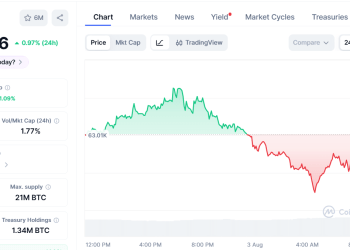
根据Coinglass的分析,超过27.7万名交易员在24小时内清算了他们持有的BTC,短暂地将比特币价格推至5万美元以下。市场对最新发展的反应引发了人们对经济衰退的担忧。加密货币分析师Alex Krüger表示,问题似乎在于美联储在日本收紧货币政策时没有降息。

美国经济衰退担忧和延迟降息拖累加密货币

美国劳工部报告称,7月份就业市场仅增加了11.4万个工作岗位。这一数字低于预期。失业率也从6月份的4.1%上升到4.3%。在通货膨胀的背景下,美国央行在2022年至2023年期间收紧了货币政策。

与此同时,日本央行在7月底公布了0.25%的利率。

加密货币分析师Alex Krüger表示,整体市场低迷是经济担忧的结果,并超出了加密货币的范围。8月5日,比特币(BTC)短暂跌破50000美元的心理关口。投资者随后进行了清算。根据Coinglass的数据,在过去24小时内,至少有27.7万名交易员清算了约10亿美元的资产。

市场疲软之前,有报道称美国经济即将衰退。克鲁格认为,主要问题不是美国经济状况。他认为,问题似乎在于美联储没有降息,而日本却提高了自己的关键利率。

他在X上的一篇帖子中说:“主要由一系列杠杆化的日本投机者推动的金融危机,比美国陷入衰退引发的金融危机要好得多。”

摩根大通分析师预计,美联储可能会在9月份将政策利率下调50个基点。然而,该行认为,如果在联邦公开市场委员会会议之前公布工资数据,它将至少降息25个基点。据彭博社报道,摩根大通分析师还预计11月将再降息50个基点。

全球股市下跌,石油受到打击

市场动荡超出了加密货币市场。据报道,日本日经225指数是1987年“黑色星期一”崩盘以来最糟糕的一天。周一,油价也触及近八个月低点,因为美国的经济担忧损害了其作为世界最大石油消费国的地位。

据报道,高盛将美国经济衰退的可能性从15%提高到25%。经济学家Mohamed A.El-Erian发现,这一概率仍为35%。此外,由于中东局势的混乱,地缘政治局势似乎也在恶化。

现在的重点是美联储可以稳定股市的行动。紧急降息可能会为市场注入更多流动性,也有利于BTC,因为加密货币市场在疲软的整体环境中难以找到立足点。
Related Reads

Wall Street Begins to Question Tech Giants' AI Narrative

Wall Street Questions the AI Narrative of Tech Giants Wall Street is shifting its focus from the hype surrounding artificial intelligence (AI) to a rigorous financial reality check. Following strong earnings reports from companies like Google and a massive $500 billion financing initiative from Nvidia for AI infrastructure, the market reaction has been mixed and skeptical. The core concern revolves around the massive capital expenditure (CapEx) required for AI development—building data centers and acquiring chips—and whether future cash flows can justify these upfront costs. Investors are now scrutinizing free cash flow (FCF), which measures the cash left after operational expenses and capital investments. A negative FCF, as seen recently with Alphabet (Google's parent company), signals heavy immediate spending, even if profits are growing. The divergent stock reactions highlight this new scrutiny. Microsoft's stock surged after its earnings, supported by strong operating cash flow, growing cloud revenue (Azure), and a large backlog of committed business. In contrast, Alphabet's stock fell despite profit growth because its capital spending caused FCF to turn negative for the first time. Similarly, Nvidia's announcement of a $500 billion financing platform, while potentially expanding its market, raised questions about whether AI build-out has become too expensive for tech companies to fund internally. Analysts are moving beyond simply asking if there is AI demand—which cloud revenue growth confirms—to deeper questions: the speed at which AI investments translate into revenue, profit, and ultimately, cash returns. The market is evaluating the "return on invested capital" (ROIC) over the long term, considering factors like rapid chip obsolescence, energy costs, and future competition. In summary, Wall Street's AI narrative is evolving from grand vision to a detailed financial and operational examination. The key question is no longer if AI is transformative, but whether companies can generate cash returns fast enough to outpace the immense costs of building it. Free cash flow has become a critical first filter in this reassessment.

marsbit3m ago

Wall Street Begins to Question Tech Giants' AI Narrative

marsbit3m ago

An Unexpected Player Enters the Lithography Machine Arena

In the spring of 2026, Elon Musk unveiled the TeraFab chip manufacturing plan, aiming to meet the immense computing power needs of SpaceX and Tesla. He subsequently signaled a move into the photolithography machine market, with speculation centering on a Free Electron Laser (FEL) approach to challenge the dominance of traditional EUV technology. Currently, ASML, utilizing Laser-Produced Plasma (LPP) EUV光源, holds a near-monopoly. However, LPP faces bottlenecks in energy conversion efficiency, tin debris contamination, and a power ceiling. In contrast, FEL technology, pursued by companies like xLight (where former Intel CEO Pat Gelsinger serves as executive chairman), offers a different path. It generates EUV light by accelerating electrons, potentially providing higher power without plasma conversion and its associated contamination, targeting the sub-13.5nm "beyond-EUV" wavelength range. The photolithography landscape shows three main trajectories: ASML's incremental evolution (like High-NA EUV),光源革新 like FEL targeting ASML's core component, and non-EUV alternatives like Nanoimprint Lithography (NIL) or Electron Beam Lithography (EBL). While ASML remains the dominant player with strong financials and产能 expansion plans, new entrants are challenging the status quo. xLight claims its FEL could boost productivity by 50-100%. Other paths include Substrate's particle-accelerator-based X-ray lithography and Chinese research into LPP alternatives. Musk's TeraFab is a high-stakes bet that FEL can move from lab to fab, that "plug-and-play"光源 replacement can circumvent ASML's ecosystem, and that massive future compute demand justifies a new supply chain. His public endorsement of FEL signifies that the photolithography business is no longer ASML's game alone.

marsbit4m ago

An Unexpected Player Enters the Lithography Machine Arena

marsbit4m ago

Bitcoin Policy Institute Calls on AI Developers to Provide Crypto Infrastructure Defenders with Access to Advanced Models

The Bitcoin Policy Institute (BPI) has issued an open letter urging leading AI developers to grant trusted access to advanced AI models for defenders of critical crypto infrastructure. Analysts warn that sophisticated AI systems, capable of analyzing large codebases and finding vulnerabilities, could be leveraged by malicious actors before open-source defenders can use them, posing a significant risk to the trillion-dollar digital asset ecosystem. Vulnerable points include wallets, signing devices, cryptographic libraries, node software, exchanges, and payment networks. BPI highlights that developers of key open-source projects like Bitcoin Core currently lack access to the specialized cybersecurity programs and most powerful AI models available to leading AI labs and their partners. This creates a dangerous asymmetry. The institute calls on AI labs to establish or expand permanent trusted access programs, providing qualified developers and researchers with early, supervised access to cutting-edge models, sufficient computing resources for security audits, secure environments for analyzing sensitive code, and direct channels for vulnerability disclosure and coordinated fixes. The goal is to enable defenders to identify and patch security flaws before attackers can exploit them. BPI also urges the crypto industry to assist AI labs in identifying reliable participants for such access programs and coordinating response efforts.

cryptonews.ru21m ago

Bitcoin Policy Institute Calls on AI Developers to Provide Crypto Infrastructure Defenders with Access to Advanced Models

cryptonews.ru21m ago

Trading

Spot
活动图片