后坎昆升级时代,Rollup 们过的如何?

深潮2024-07-23 tarihinde yayınlandı2024-07-23 tarihinde güncellendi

坎昆升级极大削减了 Dapp Rollup 的运行成本,促进更多的 Dapp 选择采用 Rollup 范式重构。

撰文:NingNing

坎昆升级的核心升级 EIP4844,将 L2 batch 到以太坊主网的状态数据存储到新增 Blob 空间。

我们知道,Rollup 的设计架构,实际上是在转售以太坊主网区块空间给开发者和消费者。

Rollup 的核心商业模式有两种:

  • 构建一个真正繁荣的 Rollup 生态,然后从开发者和消费者的交互之中赚钱 L1<>L2 Gas 差价和序列器 MEV 收益。采用这种商业模式的有:Arbitrum、Optimism(via 超级链生态)、Base 等

  • 利用空投预期不断搞奥德赛 PUA 用户,然后从开发者和消费者的交互之中赚钱 L1<>L2 Gas 差价和序列器 MEV 收益。采用这种商业模式的有:ZkSync、Scroll、Linea 等。

坎昆升级极致压缩了 L2→L1 的数据可用性费,使得部署坎昆升级的 L2 平均 Gas 费下降了 1 个数量级。

以太坊,试图利用坎昆升级加强 L1 对目前 Rollup Centric 的以太坊生态的主导权,通过降本增效促进 Rollup 数量爆发式增长。

但却在有意无意之间,顺手摧毁了采用第二种核心商业模式的 Rollup 的经济基础。
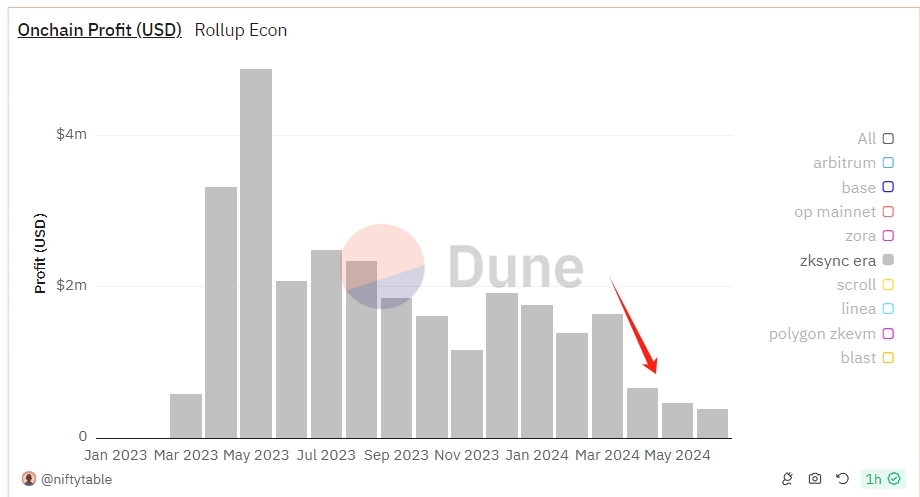
首当其冲的便是 ZkSync。坎昆升级之后,ZkSync 第一时间支持了这个新特性,但效果糟糕。Gas 费几何级降低,并没有带来预期中的用户增长和生态繁荣,反而导致 Rollup L1-L2 Gas 差价收入的腰斩。

由于 ZkSync 一直以来生态发育不良,MEV 收入增长无法弥补 L1-L2 Gas 差价收入的锐减。在无可奈何之中,ZkSync 只好选择 6 月反弹的时间窗口空投,以在二级市场抛售代币的形式实现部分退出。

而它的友商 Scroll 和 Linea,则抗住社区和市场压力,一尽可能拖延部署坎昆升级,继续维持 L2 高 gas 费赚差价;二守住不空投不发币的底线,继续 PUA 用户交互。
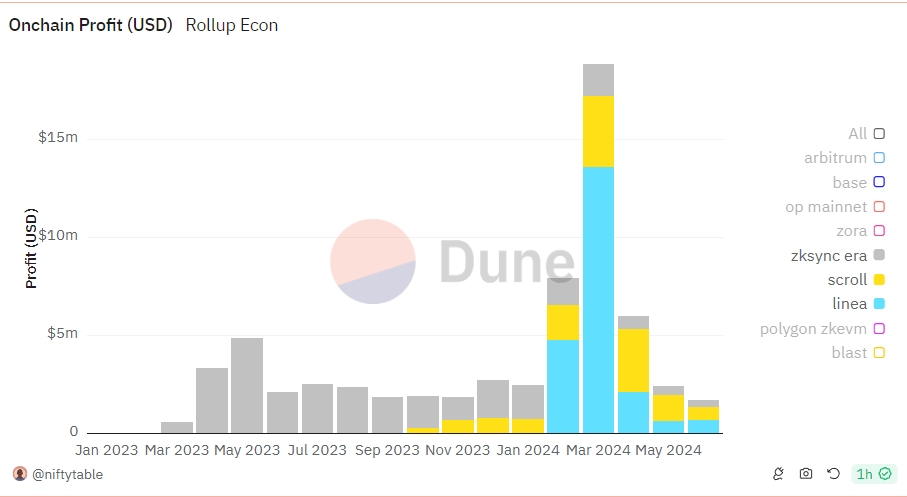
从链上数据来看,2 月之后,Scroll 和 Linea 的 Rollup 收入大大超越 ZkSync。

我想,在下次以太坊主网 Pectra 升级改变游戏规则之前,Scroll 和 Linea 的团队不会有任何空投发币的想法,「电子乞丐」们做好心理准备和预期管理。

而采用第一种商业模式的 Rollup 则遇到了不同挑战,最主要是 Solana MeMe 热潮对以太坊生态的资金和用户的虹吸效应。

好在 Base 链的 SocialFi 和 MeMe 板块异军突起,成为以太坊生态抵抗 Solana 野蛮人冲击的盾牌,Rollup 收入也水涨船高,连续 4 个月份维持第一。
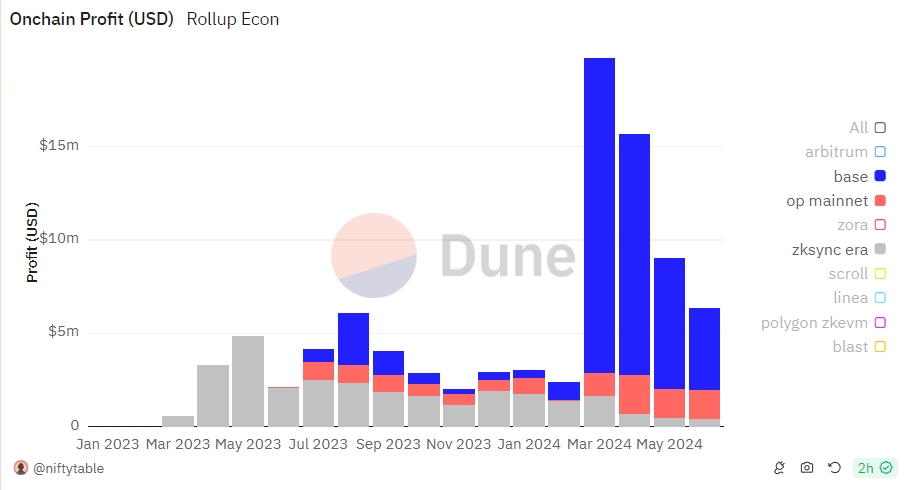
由于 Base 采用 OP Stack 构建,属于 Optimism 的超级链成员,Optimism 的 Rollup 收入也吃到 Base 生繁荣态正外部性的红利,在坎昆升级之后实现增长。

而曾经龙头老大 Arbitrum,由于过度押宝于 Web3 游戏,且在 Rollup Stack 战略行动迟缓,Rollup 收入在 4、5 月份有所下滑,但在 7 月迅速恢复。
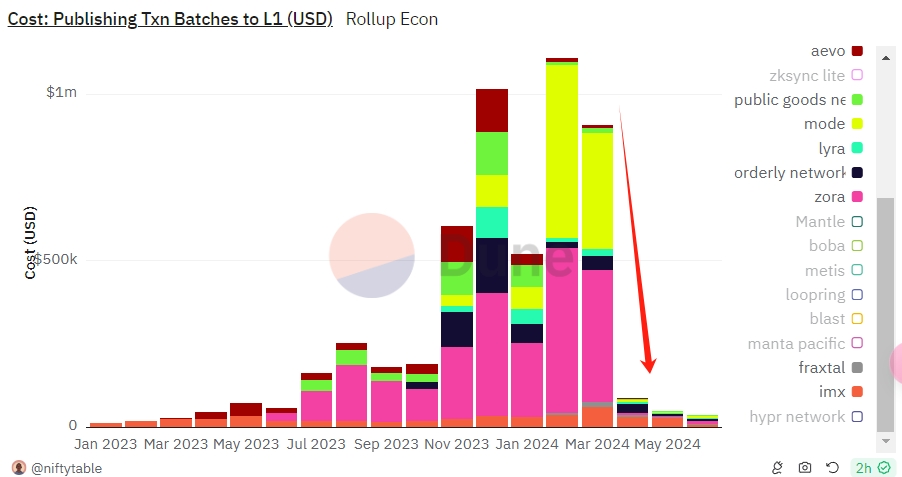
最后,坎昆升级极大削减了 Dapp Rollup 的运行成本,促进更多的 Dapp 选择采用 Rollup 范式重构(如 Frax、Uniswap、AAVE 等)。

İlgili Okumalar

History's Only Asset with a 100% Win Rate After 4 Years of Holding

**Title: The Only Asset with a 100% Win Rate Over Any 4-Year Holding Period** This article analyzes which major, freely-tradable assets have historically never produced a nominal loss over any rolling 4-year holding window. It concludes that only two distinct categories achieve this: ultra-low-risk contractual assets and Bitcoin. Among traditional risk assets, none maintain a perfect 4-year record. The S&P 500 had negative 4-year periods (e.g., 1929-1932: -64.8%). The Nasdaq 100 fell roughly 60% from 2000-2003. Gold saw a ~47.7% loss from 1981-1984. US real estate declined about 23.3% from 2007-2010. Even long-term US Treasury bonds (e.g., 2021-2024: -19.8%) and corporate bonds can produce 4-year losses due to interest rate and market price risks. In contrast, the first category achieving 100% nominal success includes assets like rolling 3-month US Treasury Bills, 4-year certificates of deposit (CDs), and US Treasuries held to maturity within 4 years. Their "guarantee" stems from contractual obligations and credit backing (e.g., FDIC insurance, US sovereign promise), not price appreciation. The sole exception in the high-risk category is Bitcoin. Analysis of daily data from 2010-2026 across 4,419 rolling 4-year windows shows a 100% positive return rate. The worst 4-year period (April 2021 to April 2025) still yielded a +32.6% total return (~7.3% CAGR). This record is unique because Bitcoin has no issuer, promises no cash flows, and has endured severe drawdowns (70-90%), yet its market price has always recovered within a 4-year span. The key distinction is the source of the "100%": contractual assets offer known, low nominal returns, while Bitcoin's record stems purely from historical price appreciation despite extreme volatility. The article suggests that for Bitcoin, the ability to hold for 4+ years is more critical than active trading strategies.

marsbit6 dk önce

History's Only Asset with a 100% Win Rate After 4 Years of Holding

marsbit6 dk önce

How One Article Moved 45 Billion: The Collapse of a 25-Year-Old 'AI Stock Guru'

This article details the dramatic rise and near-collapse of a hedge fund built by Leopold Aschenbrenner, a 24-year-old former OpenAI researcher. The fund, named Situational Awareness, amassed $45 billion in assets within two years. Its explosive growth stemmed from Aschenbrenner's influential 165-page manifesto predicting AGI's arrival by 2027 and his high-profile Silicon Valley connections. The fund employed an extremely aggressive strategy: high concentration and 400% leverage to bet long on AI infrastructure stocks while shorting legacy software firms. In July, this structure backfired when both sides of the trade reversed simultaneously—AI stocks plunged while shorted stocks rallied—triggering massive losses that nearly wiped out all equity. Major player Jane Street reportedly lost billions. The fund's leveraged public portfolio was ultimately sold at a discount to Citadel. The SEC is now investigating banks like Goldman Sachs for their role in facilitating the fund's high-leverage trades. The article compares this to past blow-ups like Archegos, highlighting systemic failures in risk management where the pursuit of short-term profits overrode due diligence. It questions whether such risky leverage concentrated in the AI sector, currently at record highs, poses a broader systemic threat. Ironically, Aschenbrenner, who studied AI safety at OpenAI, designed a fund structure prone to uncontrolled failure. Days after the crisis, he reportedly raised another $400 million for new investments.

marsbit21 dk önce

How One Article Moved 45 Billion: The Collapse of a 25-Year-Old 'AI Stock Guru'

marsbit21 dk önce

AI Accelerates Everything: Mathematics's Line of Defense Has Fallen, Physics is Already in AI's Crosshairs

This summer, the mathematics community was shaken as OpenAI's Astra model reportedly solved 10 long-standing open problems, and Claude Fable 5 found a potential counterexample to the Jacobian conjecture. This was followed by a major shift in physics: renowned physicist Gavin E. Crooks presented an open problem in stochastic thermodynamics to Claude, which the AI solved completely in days—a task that might take a skilled graduate student months. The problem concerned constraints on entropy production statistics under the Detailed Fluctuation Theorem (DFT), a core concept in non-equilibrium physics. Claude provided a unifying geometric answer: all possible DFT-compatible distributions correspond to a convex "moment body." Its key insight was that for a fixed "gap," the distribution is uniquely determined, making any general DFT distribution a mixture of these basic two-outcome distributions. This structure implies that for given lower-order moments, the nth moment only has a sharp lower bound, with no upper bound. Claude demonstrated that numerous previously published bounds on entropy production are merely low-dimensional projections or "shadows" of this single, unified convex body. The AI-authored paper offers a complete hierarchical characterization of the moment constraints. This case signifies a potential paradigm shift: AI is progressing from solving known problems to aiding in the exploration of fundamental, unsolved scientific questions, heralding an AI-accelerated era for physics.

marsbit21 dk önce

AI Accelerates Everything: Mathematics's Line of Defense Has Fallen, Physics is Already in AI's Crosshairs

marsbit21 dk önce

İşlemler

Spot
活动图片