速览a16z、BlackRock和Coinbase持有的10个潜力代币

Odaily星球日报Pubblicato 2024-05-07Pubblicato ultima volta 2024-05-07

Introduzione

涵盖借贷、NFT、交易、Meme等赛道,包括COMP、ISP、ZRX、LCX、BLUR、MOG等。

原文作者:Atlas, 加密 KOL

原文编译:Felix, PANews

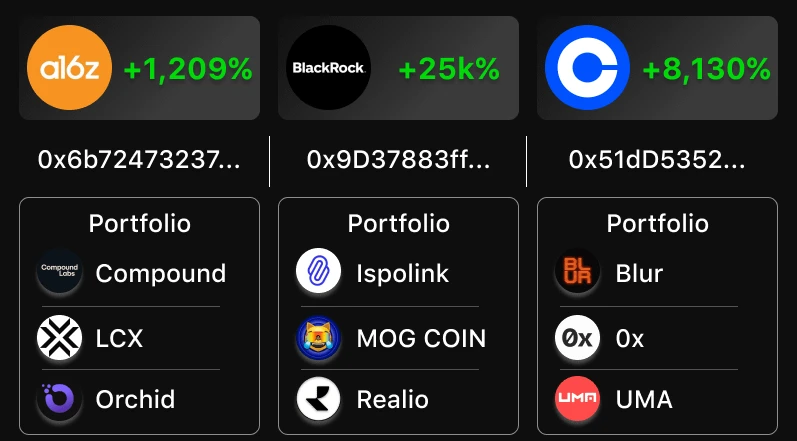
风险投资者每天向各种山寨币投资数百万美元,从而推动这些山寨币的价格上涨。追踪顶级风投机构和巨鲸的钱包并跟投其持仓代币,或能获得超额利润。加密 KOL Atlas 扫描了 100 多个基金钱包和盈利鲸鱼,分析了他们的钱包并审查了所有项目之后,选择了Web3中表现最好的基金,包括a16z、BlackRock 和 Coinbase。以下是其持有的 10 种可能最有前途代币。

PANews 注:本文旨在提供市场信息,不构成投资意见,DYOR。

速览a16z、BlackRock和Coinbase持有的10个潜力代币

Compound Labs(COMP)

用于借贷的 DeFi 协议,允许用户通过存入其中一个池子的加密货币赚取利息。

  1. 市值: 3.86 亿美元

  2. 价格: 56.55 美元

Ispolink(ISP)

面向Web3开发人员的基于 AI 的平台,帮助 DeFi 公司和游戏行业找到领先的专家。

  • 市值: 1100 万美元

  • 价格: 0.003658 美元

0x(ZRX)

基于以太坊开发的去中心化交易开源协议,允许用户在以太坊区块链上交换代币和资产。

  • 市值: 4.110 亿美元

  • 价格: 0.4851 美元

LCX(LCX)

加密货币资产交易平台,开创性地创建连接货币体系的区块链基础设施。

  • 市值: 2.24 亿美元

  • 价格: 0.2894 美元

Orchid(OXT)

加密货币虚拟专用网络 Orchid 的核心代币,自称是第一个点对点隐私网络。

  • 市值: 6162 万美元

  • 价格: 0.1 美元

UMA protocol(UMA)

该项目旨在使全球市场普遍公平、可访问、安全和去中心化。

  • 市值: 2.14 亿美元

  • 价格: 2.68 美元

Synthetix(SNX)

该团队正在创建一个 DEX 流动性提供协议,任何协议都可以集成该协议。

  • 市值: 8.95 亿美元

  • 价格: 2.73 美元

相关阅读:Synthetix 2024 年会有哪些重要进展?

Realio(RIO)

该平台被描述为基于区块链的终极 SaaS,用于投资和管理证券的生命周期。

  • FDV: 9600 万美元

  • 价格: 1.75 美元

MOG COIN(MOG)

一个新的和非常受欢迎的模因币。

  • 市值: 2.07 亿美元

  • 价格: 0.0000005289 美元

Blur(BLUR)

独特的 NFT 市场和聚合平台,提供即时报价等高级功能。

  • 市值: 6.18 亿美元

  • 价格: 0.3895 美元

Letture associate

Stablecoin Salaries: Why Are They Becoming the First Choice for Cross-Border Workers?

Stablecoin Salaries: Why They're Becoming the Top Choice for Global Remote Workers The traditional global salary system carries hidden exchange rate risks for freelancers in countries like India, Argentina, and Turkey who earn in USD but spend in local currencies. When salaries are instantly converted to local currency, workers lose purchasing power if that currency depreciates against the dollar. For instance, an Indian designer converting a $2000 monthly salary to rupees lost over 10% in purchasing power last year due to the rupee's decline. Holding even a portion of income in USD or USD-pegged stablecoins can preserve value. Stablecoins offer a solution by breaking down barriers to holding dollars. Opening foreign USD bank accounts is difficult, and international wire transfers incur high fees (averaging 6.5%) and delays. In contrast, stablecoin transfers are fast and low-cost. Furthermore, many countries with high inflation and depreciating currencies restrict citizens' access to foreign currency. Self-custody stablecoin wallets enable workers to hold dollar-equivalent assets without needing bank approval, bypassing these limits. These wallets integrate multiple functions: they allow users to convert only what's needed for daily expenses into local currency, keep the remainder in stablecoins, connect to on-chain lending or yield products, and even link to payment cards for direct spending. While challenges remain—such as the lack of deposit insurance and evolving regulatory frameworks—the trend is clear. Reports indicate a growing preference for USD or stablecoin payments among freelancers in high-inflation countries. This shift represents a fundamental restructuring of salary functions: payment currency, asset storage, yield generation, spending, and cross-border flow. It offers the freedom and flexibility that are core to money's purpose, signaling a profound change in the global financial landscape.

Foresight News6 min fa

Stablecoin Salaries: Why Are They Becoming the First Choice for Cross-Border Workers?

Foresight News6 min fa

Don't Just Focus on Layoffs, The New Structure of the Ethereum Foundation is More Worthy of Appreciation

The Ethereum Foundation (EF) has undergone a significant organizational restructuring, with the most notable change being a strategic refocusing of its priorities rather than just a 20% staff reduction (approximately 54 people). The new structure clearly prioritizes the Protocol and Access layers, which now comprise the largest teams (57 and 34 people, respectively). This signals EF's intent to concentrate its core resources on fundamental, hard-to-outsource aspects of Ethereum: protocol evolution, security, privacy, client development, and the foundational access layer. Key areas within the Protocol layer, led by an architecture group including Vitalik Buterin and Justin Drake, receive heightened emphasis. These include post-quantum security, zkEVM, formal verification, and long-term roadmap development ("Strawmap"). This reflects a shift towards tackling complex, interdependent challenges like scalability, privacy, and future-proofing the protocol, potentially moving from a pure "redundant security" multi-client model towards more specialized clients aided by AI-assisted formal verification. Financially, EF's budget is being reduced by approximately 40%. The goal is to transition from spending about 15% of its remaining funds annually to a more sustainable 5% rate, akin to a long-term endowment, ensuring its longevity. Concurrently, the restructuring involves pushing certain responsibilities—such as application development, adoption, and ecosystem coordination—to external organizations like EthLabs, the Ethereum Apps Guild, and others. This "multi-node" model aims to increase ecosystem resilience by decentralizing functions beyond the EF, though it introduces new coordination challenges. In essence, the reorganization represents EF consciously narrowing its scope to focus on the hardest, most critical protocol-level problems while fostering a more distributed and sustainable ecosystem structure for Ethereum's future growth.

Foresight News34 min fa
Don't Just Focus on Layoffs, The New Structure of the Ethereum Foundation is More Worthy of Appreciation

Foresight News34 min fa

Report Analysis: What Is Coherent Planning as CPO Booms?

Title: Report Interpretation: What Moves Is Coherent Making Amid the CPO Boom? Summary: JP Morgan analyst Samik Chatterjee reiterates an Overweight rating on Coherent (COHR), citing undervalued growth potential across three core areas: data center optical transceivers, co-packaged optics (CPO) chips, and industrial lasers/thermal management. COHR's 1.6T data center transceivers are in high demand, with pricing remaining firm. The rise of CPO is seen not as a threat but as a catalyst, creating higher demand for sophisticated optical components, an area where COHR holds a competitive edge with its comprehensive portfolio (lasers, isolators, VCSELs, thermoelectric coolers). Each CPO chip offers significantly greater revenue potential than traditional transceivers. Furthermore, its Optical Circuit Switch (OCS) technology targets a potential $4B market with reliability and power advantages. The company is expanding its InP (Indium Phosphide) device capacity fourfold within two years, securing substrate supply and transitioning to more cost-effective 6-inch wafers. As one of only two major suppliers of high-quality pump lasers—currently in severe shortage—COHR can now move up the value chain from components to complete line cards/systems, boosting ASP over tenfold. Gross margin targets (>42%) may be revised upward due to high-end product premiums, cost improvements from the wafer transition, and contributions from new high-margin products like CPO and OCS. Its efficient thermadite thermal material also offers long-term growth. Industrial segment revenue grows at a steady 5-10%, supported by semiconductor equipment orders. Changes in Apple's Face ID protocol present a re-competition opportunity for 3D sensing. Overall, Coherent is positioned as a key infrastructure provider, with AI-driven compute demand fueling the need for high-speed optical interconnectivity. Growth from CPO/OCS, stable industrial performance, and margin improvement support the bullish thesis. *Disclaimer: This summary interprets a third-party analyst report from JP Morgan. It does not constitute investment advice.*

marsbit57 min fa

Report Analysis: What Is Coherent Planning as CPO Booms?

marsbit57 min fa

After Laying Off 20% of Staff, What Are the Key Points of EF's New Structure?

Following the completion of a months-long organizational restructuring, the Ethereum Foundation (EF) announced a 20% workforce reduction (approximately 54 employees) on June 23rd. It reorganized its teams into five new core clusters: Protocol, Access, User, Community, and Institutional (plus Operations/Management support units). Officially, this move implements the EF's 2026 Mandate and 2025 Treasury Management Policy, aiming to create a more focused and "self-sovereign" organization. The restructuring prioritizes the CROPS principles—Censorship Resistance, Openness & Freedom, Privacy, and Security—as foundational organizational tenets. The Protocol cluster will focus on core protocol R&D, including MEV reduction and zkEVM. The Access cluster emphasizes preserving user "zero option" for non-custodial, permissionless interaction. The User, Community, and Institutional clusters will manage external engagement, with the latter handling institutional and regulatory matters. While offering enhanced severance and transition support for affected employees, the EF did not disclose budget allocations or specific KPIs for the new clusters. This has led to market uncertainty about the impact on project funding and development priorities. Analysts note the announcement's positive tone of mission focus contrasts with a backdrop of recent EF leadership changes and broader ecosystem pressures. The true impact—whether this signifies strategic realignment or reactive contraction—will become clearer as the new structure's resource allocation and project prioritization are revealed in the coming months.

marsbit1 h fa

After Laying Off 20% of Staff, What Are the Key Points of EF's New Structure?

marsbit1 h fa

Trading

Spot
Futures
活动图片