Bitcoin’s Correlation With Nasdaq at All Time Highs

KAIKOPubblicato 2022-05-18Pubblicato ultima volta 2022-05-18

Introduzione

Price Movements: Yuga Labs’ virtual land sale clogged the Ethereum network and caused ApeCoin to soar, then plummet.

Price Movements: Yuga Labs’ virtual land sale clogged the Ethereum network and caused ApeCoin to soar, then plummet.

Market Liquidity: Turkish lira crypto trade volume surged to yearly highs amid soaring inflation.

Derivatives: Funding rates spiked during last Thursday’s spot-driven sell off.

Macro Trends: Bitcoin’s correlation with the tech-focused Nasdaq is nearly as high as its correlation with Ethereum.

Special Feature: Introduction to Value at Risk (VaR) for cryptocurrencies.

Trend of the Week

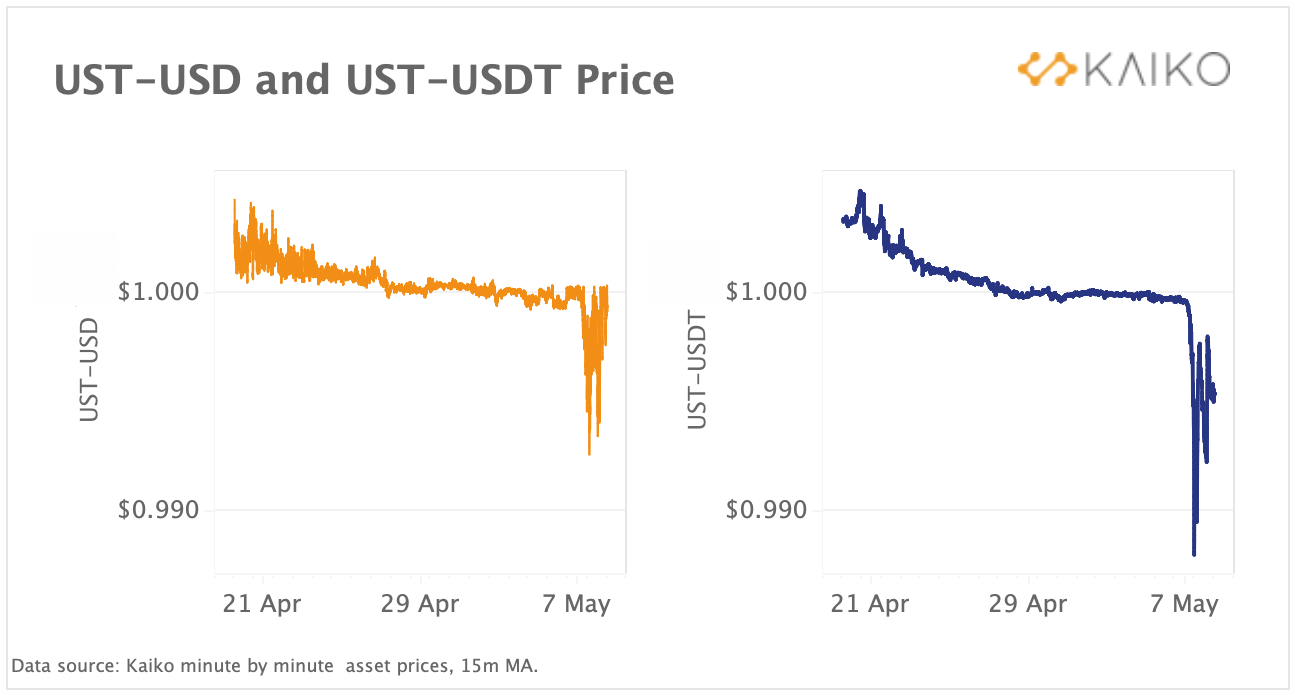
TerraUSD de-pegs, highlighting algorithmic stablecoin risk.
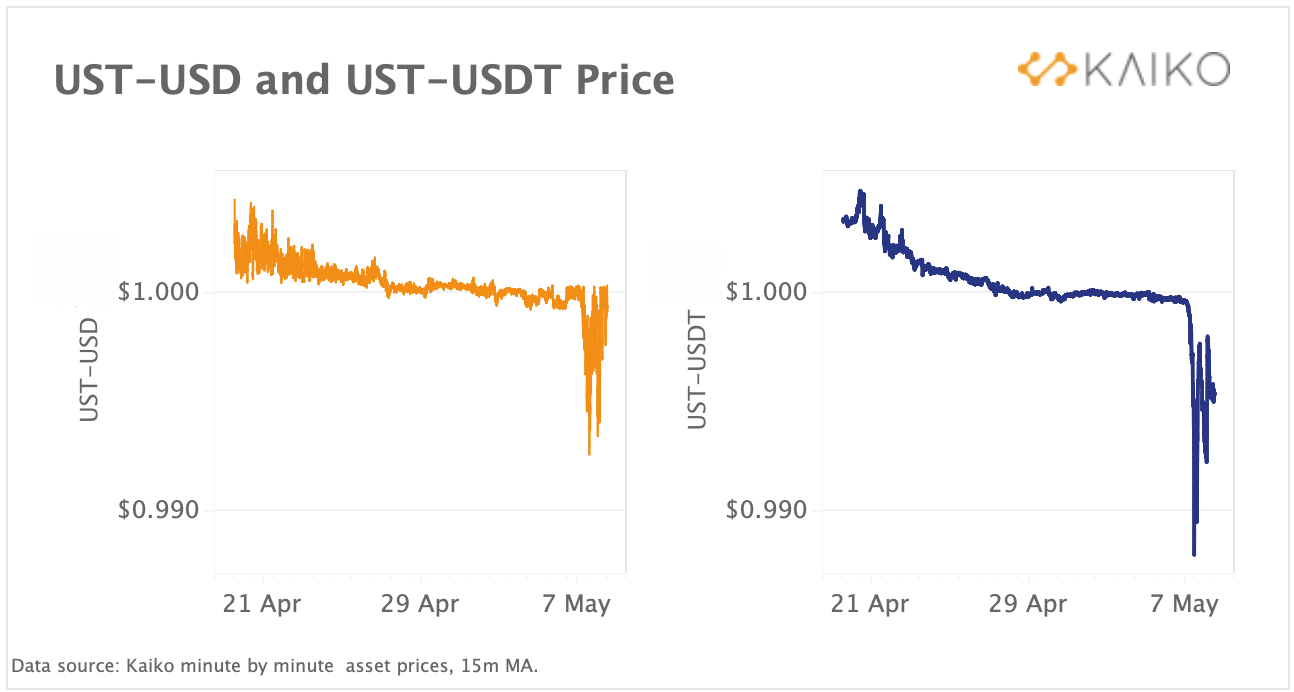
Terra’s UST stablecoin briefly lost its peg to the U.S. Dollar over the weekend due to strong selling pressure after a series of multi-million UST selloffs. The bulk of the selling was reportedly executed on stablecoin-focused decentralized exchange Curve and centralized exchange Binance. Above we chart UST’s price against Tether (USDT) and the U.S. Dollar, aggregated across all UST pairs on both CEXs and DEXs.

At around 11pm on May 7th, UST traded as low as .988 for 1 USDT. UST-USDT daily volumes also surged, hitting a record high level of over $1B, reportedly forcing Binance to temporarily halt UST borrowing. Last month, UST became the third largest stablecoin by market cap at around $18bn, flipping Binance’s BUSD. However, its tremendous growth has been mainly driven by the Terra ecosystem’s lending and borrowing protocol Anchor, which offers attractive double-digit yields to users, raising questions regarding the sustainability of this model.

Price Movements

Bitcoin trades at 10-month lows.
As of Monday morning, Bitcoin is now trading at 10-month lows in the latest sign that macro headwinds and the Fed’s hawkish policies could continue to weigh on risk assets in the near term. Equities didn’t fare much better, with the Nasdaq composite registering its biggest one-day loss since 2020, bringing its correlation with Bitcoin to historic highs. Despite the overall bearishness, Binance had a very good week. The exchange gained regulatory approval to operate in France, contributed $500 million to Elon Musk’s twitter takeover bid, and had its BUSD stablecoin listed on rival Coinbase.

ApeCoin plummets as land mint clogs Ethereum network.
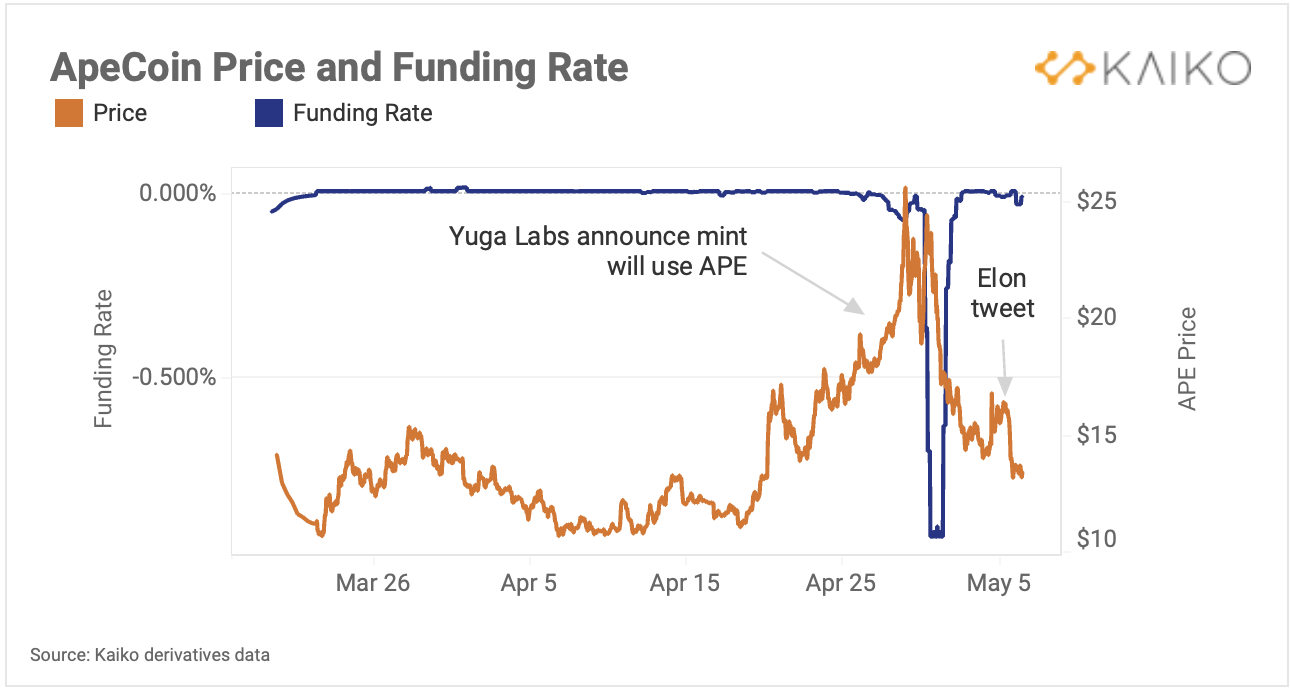
Yuga Labs, the company behind NFT collection Bored Ape Yacht Club, entered the metaverse last week with a much-anticipated virtual land sale for its forthcoming Otherside metaverse platform. A record $561 million in virtual parcels were sold in just 24 hours, which were paid for using the associated token ApeCoin(APE), creating a type of “pump and dump” which saw the value of APE surge to all time highs in the run-up to the mint, before plummeting more than 50%. Funding rates also dropped precipitously, suggesting that traders were aggressively shorting the token following completion of the hotly demanded sale.

In the aftermath of the NFT launch, Elon Musk briefly changed his twitter profile picture to Bored Apes, spiking APE’s price 20% before he tweeted “I dunno … seems kinda fungible”, after which price returned to previous levels.
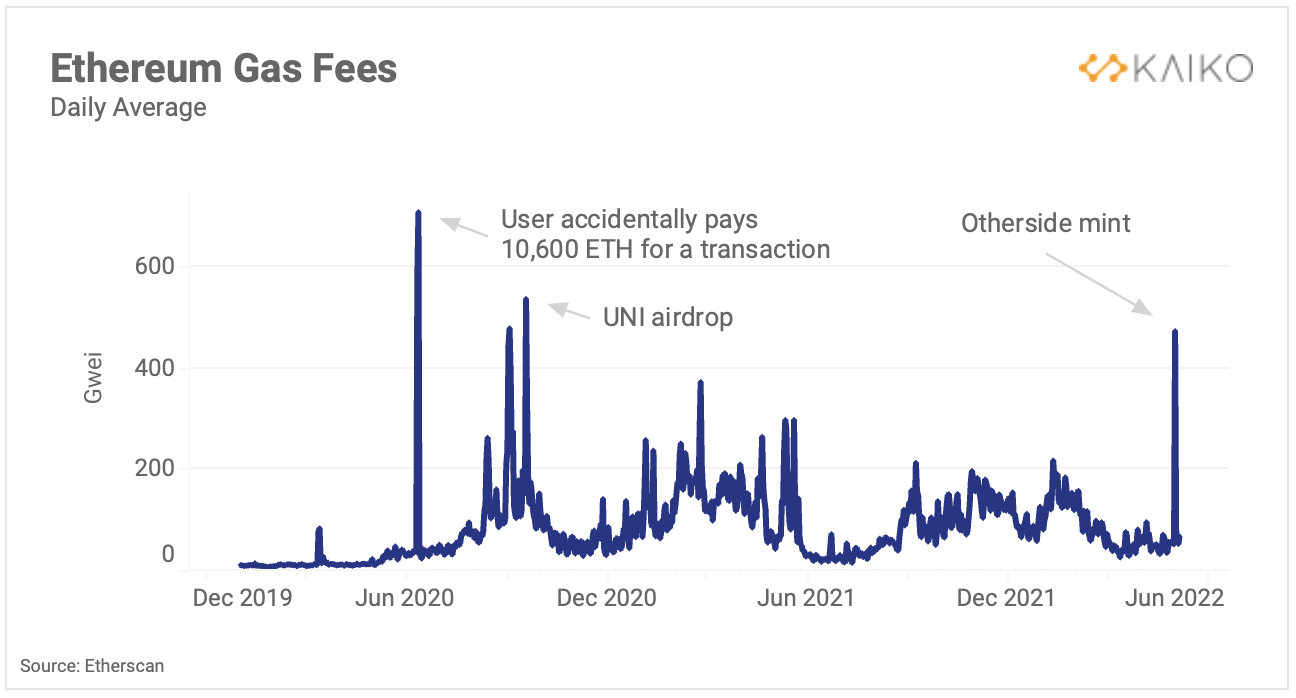
Not only did APECoin holders lose out during the minting frenzy, but the entire Ethereum network became clogged, causing gas fees to spike to levels not seen since the midst of DeFi summer. Transactions associated with the mint consumed more than $180 million in gas fees. Yuga Labs was severely criticized for the chaotic mint, and has promised to refund failed transaction fees.

Market Liquidity

Turkish crypto demand soars amid galloping inflation.
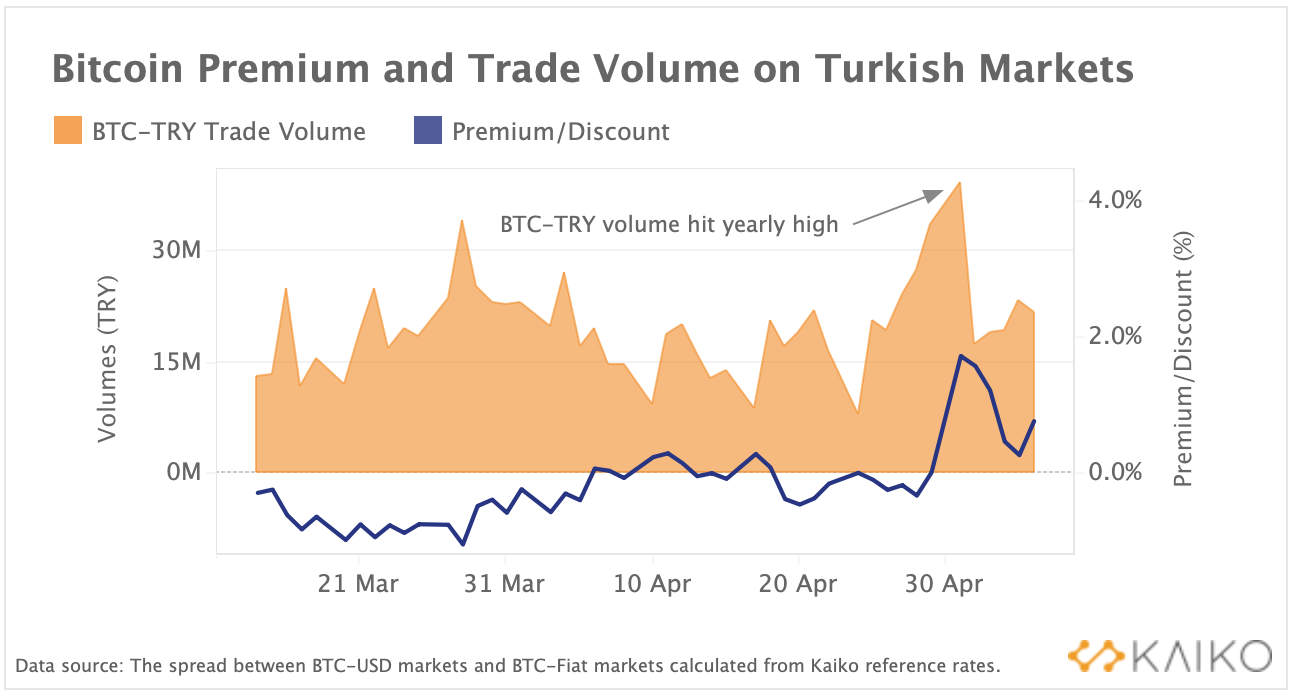
The recent decline in Bitcoin spot prices alongside geopolitical turmoil is boosting crypto adoption in inflation-ridden emerging economies such as Turkey, which saw volume spike to yearly highs in April. Bitcoin’s premium on Turkish markets rose to 1.7% in early May as inflation hit a staggering 70% in April. This has been mirrored by a steady rise in both BTC-TRY and USDT-TRY trade volumes since the start of the war in Ukraine suggesting geopolitical tensions have also played a role in boosting local crypto demand.

The fast growing Turkish market has attracted the attention of major crypto exchanges such as Binance and Coinbase which seek to expand their operations in the country, although Turkey has made recent attempts to regulate the industry.

Euro stablecoin volume spikes despite remaining relatively low.
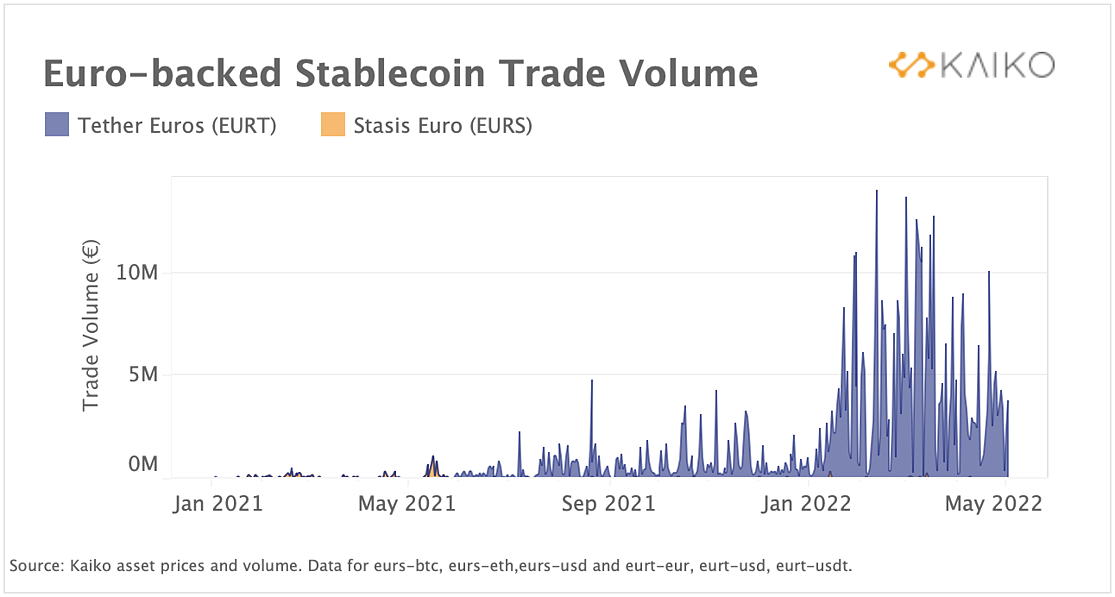
Euro stablecoin volumes have spiked to all time highs in 2022, despite remaining magnitudes lower than volumes for their USD-counterparts. There are only a handful of Euro backed stablecoins in the market today, and we’ve charted above the two largest: Tether Euros and Stasis. Both are operated by private, centralized companies; Tether Euros is a Euro-pegged stablecoin supported by Tether, the company that operates USD Tether (USDT).

Clearly EURT has the largest shares of volume on centralized exchanges and those volumes have spiked quite dramatically this year, albeit from a base considerably lower than the overall stablecoin market. It would be fair to expect Euro volumes to be larger asuuming European traders should want to avoid any FX exposure in their trades. Combine this with the current amount of USD-denominated stablecoin volume and we’re left wondering why Euro stablecoins have not had a similar rate of adoption.

The answer to this is twofold: stricter European regulation on stablecoins and their collateral; and the current regime of persistent negative interest rates from the ECB. The benchmark ECB deposit rate has been negative for over a decade now, which means anyone holding Euro collateral, i.e stablecoins, is actually guaranteed to lose money on their holdings. One thing to watch will be how trade volumes and Euro stables adoption will look if the ECB decides to adopt positive interest rates, something that was hinted at last week. It is very possible that the recent spike in volumes the last few months has been due to expectations that the ECB would follow a similar rate hike pattern as the Fed, which so far has failed to materialize.

Market depth dips before sell off.
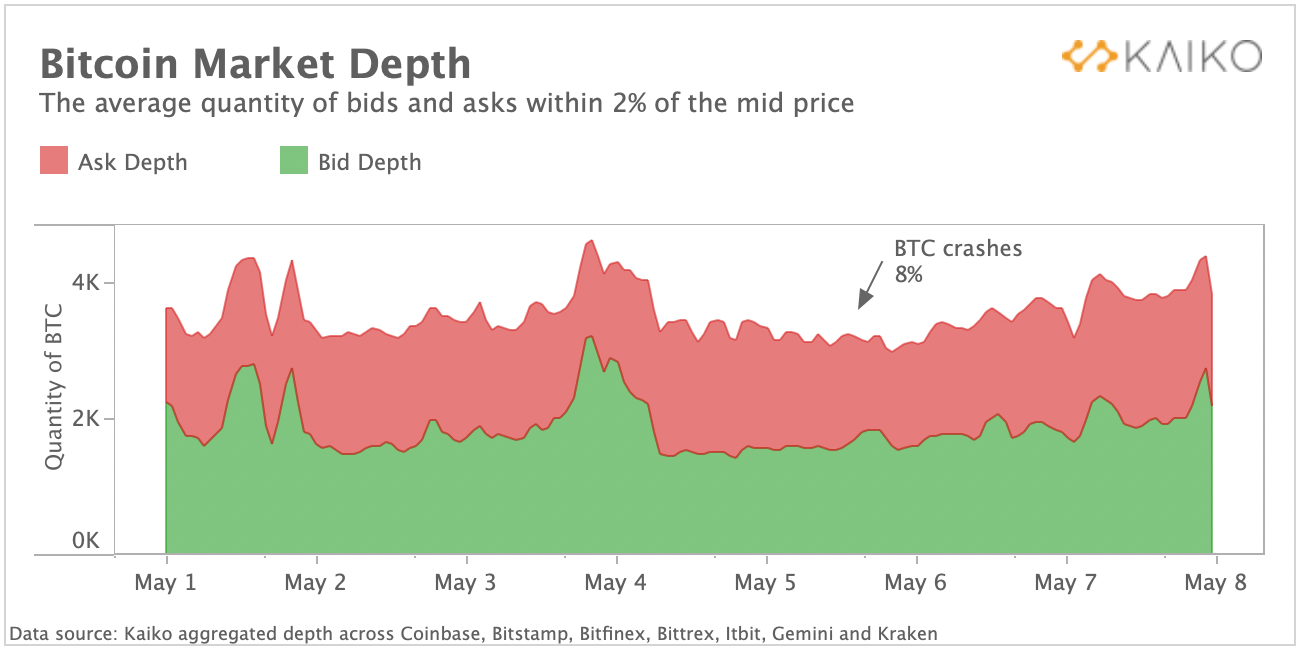
In the day preceding Bitcoin’s 8% price crash, market depth for BTC-USD within 2% of the mid price remained volatile, fluctuating between 3,400 and 4,400 BTC. The crash itself did not cause a noticeable dent in market depth, although liquidity conditions remained lower than earlier in the week, which can often perpetuate a sell-off as market makers remain cautious before re-entering their positions. Following the initial drop, Bitcoin’s price continued to dip over the weekend. However, we can observe that liquidity conditions improved by May 7th to pre-crash levels.

Special Feature: Value at Risk for Cryptocurrencies

Risk management is a crucial (and often obligatory) component of the investment lifecycle. In cryptocurrency markets, risk management remains a complex and evolving area of study due to frequent changes in market structure, high volatility, and limited availability of historical data.

Kaiko’s new Value at Risk (VaR) estimator leverages a proprietary and thoroughly backtested methodology that accounts for the idiosyncrasies of crypto market structure. Value at Risk is one of the most common risk indicators to quantify the extent and probability of potential losses in a portfolio. Kaiko’s VaR data can be applied to any cryptocurrency portfolio to accurately track VaR over time. For example, below we chart the Daily P&L and Daily VaR of an equally weighted $1 million portfolio of BTC and ETH.
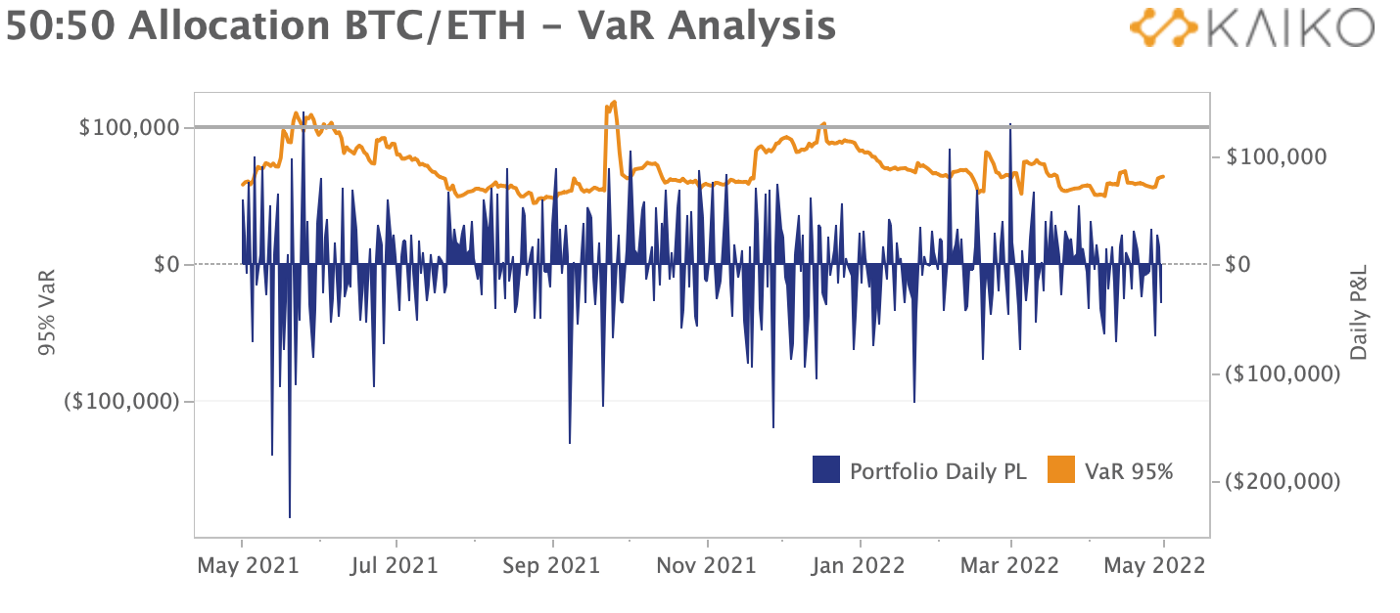
Suppose you are setting a risk budget for this portfolio, and don’t want to lose more than $100k one in every 20 days on average. You would set your VaR risk level to 95%, charted above, and monitor when your portfolio exceeds that $100k level. If VaR exceeds that level you would look to de-risk the portfolio until VaR remains under that $100k threshold. View our full VaR case study below:

VaR Case Study

Derivatives

Funding rates move positive during sell-off.

So far this year, BTC funding rates have remained mostly neutral amid Bitcoin’s sideways price action and low derivatives volumes. During last year’s bullish market conditions, funding rates were strongly positive as traders bid up futures prices, leaving the futures price higher than the spot price. However, recently we’ve noted a divergence in this trend, exemplified by last week’s sell off which saw funding rates flip positive despite bearish market conditions. The likely explanation is that spot markets sold off faster than futures, causing the funding rate to stay positive, which suggests bearish activity is spot-driven.

Bitcoin perpetual futures open interest showed resilience last week despite spot market volatility which spurred over $300mn in long liquidations.
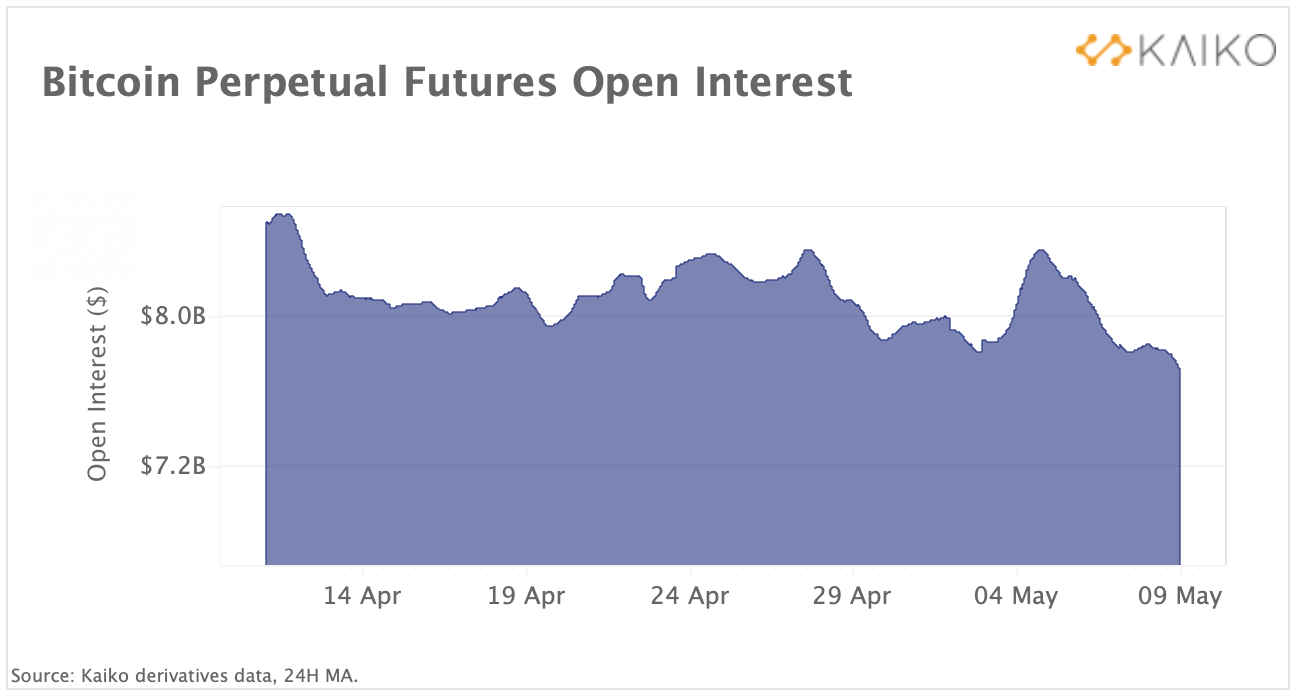
Above we chart the aggregated open interest on four exchanges — Binance, Derbit, FTX and Bybit. We observe the amount of open contracts shrank by just 8% to $7.7B between May 4–8 while spot prices tumbled by 13% over the same period. Overall, the decline in open interest was more gradual than during previous selloffs.

Macro Trends

Bitcoin’s correlation with Nasdaq at all time highs.
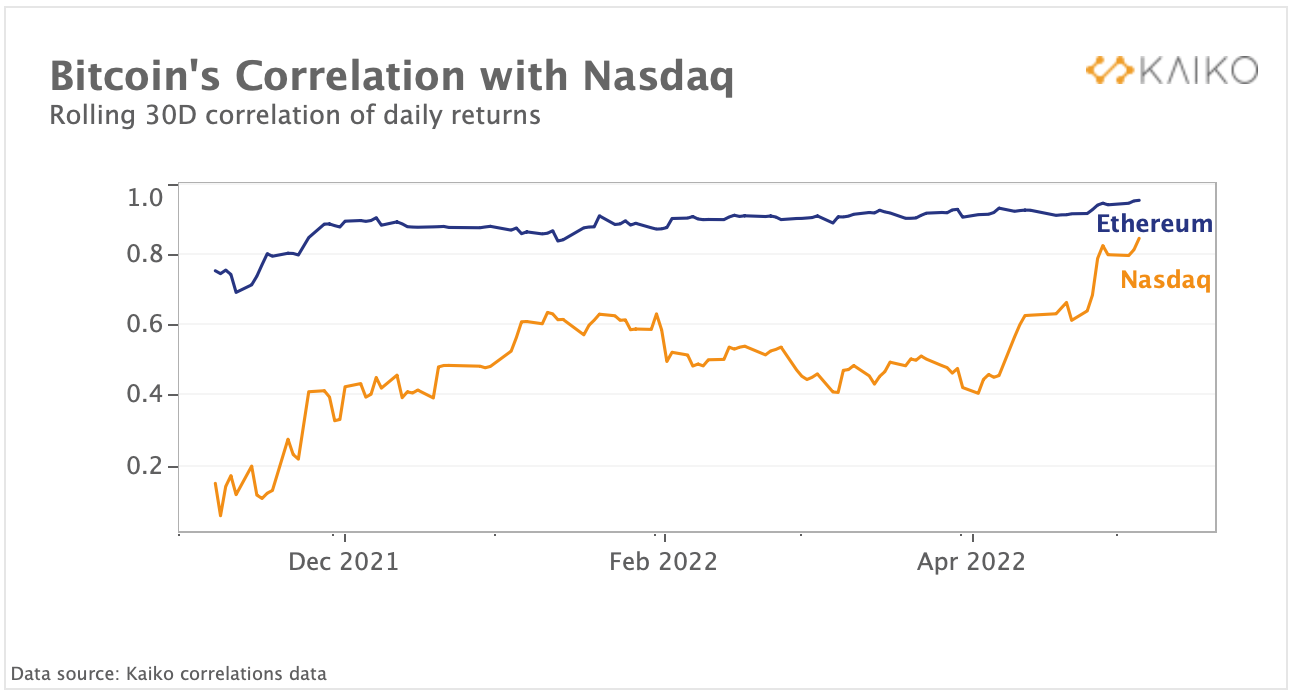
Risk assets continued to move in tandem last week, whipsawing as the U.S. Fed hiked its key policy rate by 50bps — the largest rate increase in about two decades. Bitcoin’s rolling correlation with the tech-focused Nasdaq 100 to hit a historically high level of .8. It is now nearing its traditionally strong correlation to Ethereum which is also on the rise and currently hovers around .9.

However, despite being strongly correlated with the Nasdaq 100, Bitcoin has been performing slightly better since the start of the year. We noticed that when inflation expectations are increasing, Bitcoin tends to outperform tech stocks, which could add credence to the narrative around BTC’s role as an inflation hedge.
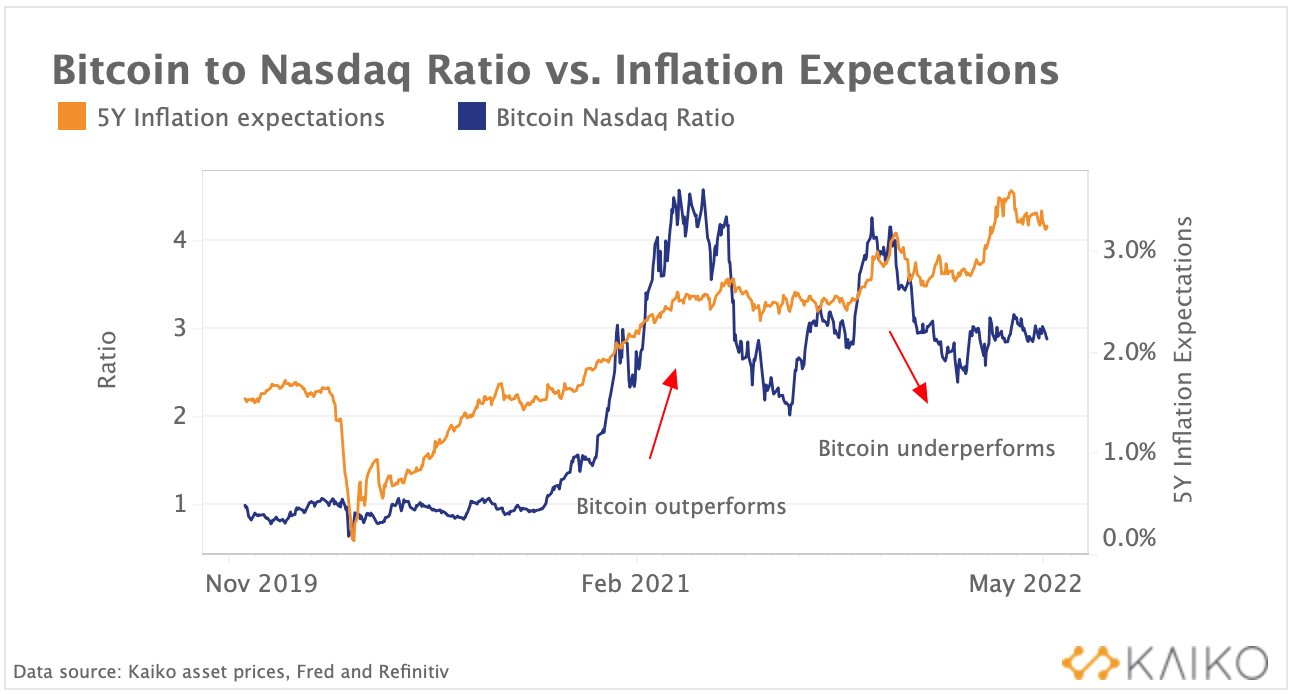
We chart the Bitcoin to Nasdaq price ratio alongside 5-year inflation expectations — a market based measure of the expected inflation over the next 5 years — and can observe this trend in action. However, it could also mean that Bitcoin is perceived as a riskier asset and it suffers more when the Fed’s credibility in fighting inflation is improving.

Bitcoin mining stocks are more volatile than Bitcoin.
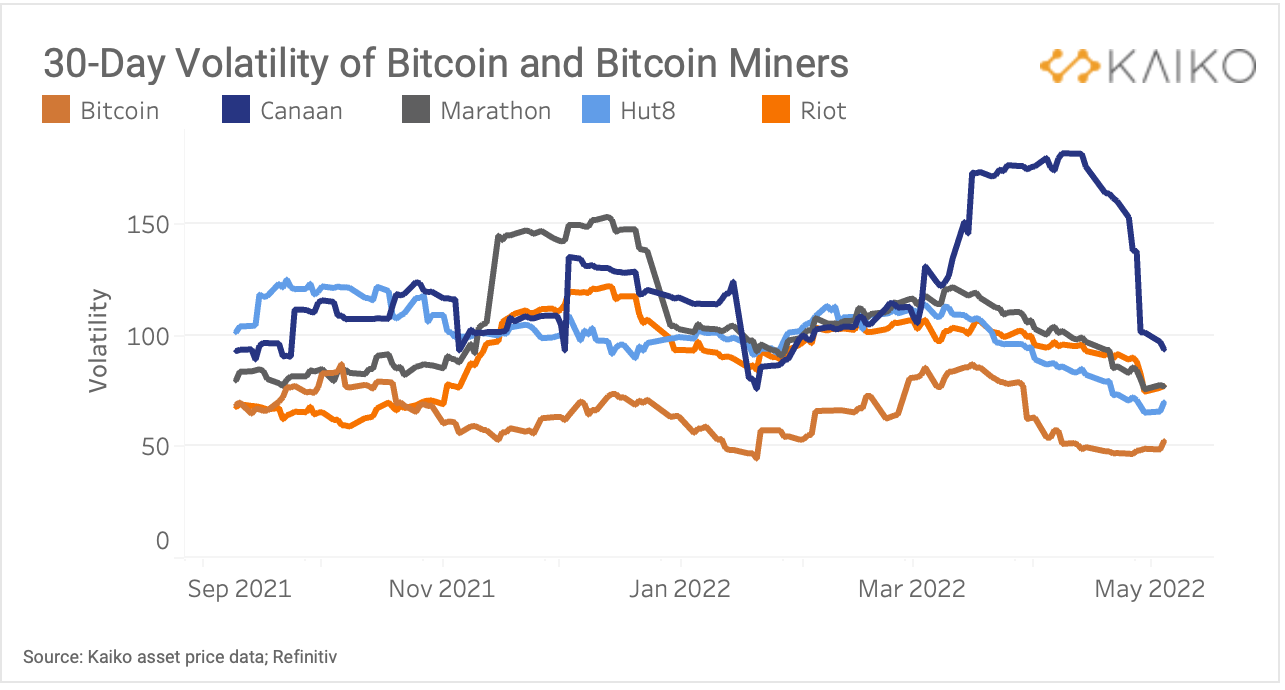
Bloomberg last week reported that Bitcoin miners are “selling Bitcoin call options to wring money out of their holdings, turning to a yield-generating strategy deployed throughout conventional finance.” This strategy involves selling calls on BTC, which often will expire worthless, generating a return for the miner. However, if BTC were to increase rapidly in price, the miners’ upside would be limited. One would thus expect that, all else being equal, miners would have relatively less volatility than BTC itself. However, as charted above, they are all more volatile, especially the Chinese company Canaan, which has seen significant swings as a result of regulatory changes in the country.

Letture associate

On-chain Analyst: Why Are Most Zcash Transactions Still Traceable?

Title: Why Most Zcash Transactions Remain Traceable Zcash, a privacy-focused cryptocurrency launched in 2016, was designed to offer anonymity by hiding transaction details like sender, receiver, and amount using zero-knowledge proof technology (zk-SNARKs). However, in practice, a significant portion of ZEC transactions are still traceable on-chain. The key reason is Zcash's dual-address system. It features transparent addresses (t-addresses), which work like standard Bitcoin addresses with all data public, and shielded addresses (z-addresses) that encrypt transaction details. There are four transaction types with varying privacy levels: fully transparent (t→t), partially shielded (t→z and z→t), and fully private (z→z). Despite its privacy capabilities, most real-world Zcash activity involves transparent addresses, primarily because major exchanges and institutions use them for regulatory compliance. As a result, blockchain analytics platforms like Arkham can track and attribute a substantial volume of Zcash transactions. Arkham reports it has identified entities behind over $420 billion in ZEC transaction volume. Case studies highlight this traceability: the U.S. government holds seized Zcash from a dark web case, visible via its transparent wallet, and individual traders' profitable moves are trackable from purchase to exchange deposit. In conclusion, Zcash's privacy is not inherent but user-dependent. While purely shielded (z→z) transactions remain cryptographically private, the prevalence of transparent address usage makes much of the network's activity traceable. The actual privacy protection offered depends entirely on how users choose to transact.

marsbit17 min fa

On-chain Analyst: Why Are Most Zcash Transactions Still Traceable?

marsbit17 min fa

From Power Infrastructure to Token Economy: The 'Seven-Layer Cake' of the AI Industry Chain

From Power Grid to Token Economy: The AI Industry's "Seven-Layer Cake" The AI industry is shifting from a "model-centric" paradigm focused on massive training to a "token-centric" industrial era driven by inference demand. This new phase revolves around the production, distribution, scheduling, and consumption of tokens—the units of computation used by AI agents for every interaction and task. The article proposes a "seven-layer cake" framework for the AI economy: 1. **Power**: The foundational energy source, with competition shifting to securing stable, low-cost electricity. 2. **AIDC (AI Data Centers)**: Large-scale "Token factories." A trend toward smaller, modular, and regionally deployed AI Factories is emerging for efficiency and proximity to users. 3. **GPU**: The core production hardware for tokens. While NVIDIA dominates, competition exists from AMD, ASIC makers, and Chinese chipmakers, with a growing focus on inference efficiency. 4. **LLMs**: The "engines" that generate tokens. The competition is evolving beyond model size to prioritize factors like token cost, inference efficiency, and operational synergy with infrastructure. 5. **Token Distribution**: The "grid" that allocates and rents out compute resources, led by cloud giants and specialized AI-native platforms. 6. **Token Optimization & Intelligent Scheduling**: The critical "brain" layer that intelligently routes tasks (e.g., to local, cloud, or edge models) for optimal cost, latency, and privacy—maximizing the value of each token. 7. **AI Agents & Models**: The end consumers of tokens. The vision involves billions of AI agents working and interacting concurrently, consuming vast amounts of tokens. Currently, the industry faces fragmentation and inefficiencies between these layers. The true "mass adoption era" of AI will begin only when this seven-layer infrastructure is fully integrated and operates as a cohesive, intelligent network—transforming AI from a software tool into a global industrial system spanning energy, hardware, and compute logistics.

marsbit38 min fa

From Power Infrastructure to Token Economy: The 'Seven-Layer Cake' of the AI Industry Chain

marsbit38 min fa

Trading

Spot
Futures

Articoli Popolari

Cosa è BITCOIN

Comprendere HarryPotterObamaSonic10Inu (ERC-20) e la sua posizione nel mondo delle criptovalute Negli ultimi anni, il mercato delle criptovalute ha assistito a un aumento della popolarità delle meme coin, catturando l'interesse non solo dei trader, ma anche di coloro che cercano coinvolgimento comunitario e valore di intrattenimento. Tra questi token unici c'è HarryPotterObamaSonic10Inu (ERC-20), un progetto intrigante che mescola riferimenti culturali nel tessuto delle criptovalute. Questo articolo esplora gli aspetti chiave di HarryPotterObamaSonic10Inu, analizzando i suoi meccanismi, l'etica guidata dalla comunità e il suo coinvolgimento con il panorama crittografico più ampio. Che cos'è HarryPotterObamaSonic10Inu (ERC-20)? Come suggerisce il suo nome, HarryPotterObamaSonic10Inu è una meme coin costruita sulla blockchain di Ethereum, classificata secondo lo standard ERC-20. A differenza delle criptovalute tradizionali che possono enfatizzare l'utilità pratica o il potenziale investimento, questo token prospera grazie al valore di intrattenimento e alla forza della sua comunità. Il progetto mira a creare un ambiente in cui gli utenti coinvolti possono riunirsi, condividere idee e partecipare ad attività ispirate a diversi fenomeni culturali. Una caratteristica notevole di HarryPotterObamaSonic10Inu è la zero tassa sulle transazioni. Questo elemento allettante tende a incoraggiare il trading e il coinvolgimento della comunità, privo di costi aggiuntivi che possono scoraggiare i trader di piccole dimensioni. L'offerta totale della moneta è fissata a un miliardo di token, un numero che segna la sua intenzione di mantenere una circolazione sostanziale all'interno della comunità. Creatore di HarryPotterObamaSonic10Inu (ERC-20) Le origini di HarryPotterObamaSonic10Inu sono avvolte in un certo mistero; i dettagli sul creatore rimangono sconosciuti. Lo sviluppo di questo token non presenta un team identificabile o un piano esplicito, cosa non rara nel settore delle meme coin. Invece, il progetto è emerso organicamente, con il suo progresso fortemente dipendente dall'entusiasmo e dalla partecipazione della sua comunità. Investitori di HarryPotterObamaSonic10Inu (ERC-20) Per quanto riguarda investimenti esterni e finanziamenti, HarryPotterObamaSonic10Inu rimane ambiguo. Il token non elenca alcuna fondazione di investimento conosciuta o un sostegno organizzativo significativo. Invece, la linfa vitale del progetto è la sua comunità di base, che informa la sua crescita e sostenibilità attraverso azioni collettive e coinvolgimento nello spazio crittografico. Come funziona HarryPotterObamaSonic10Inu (ERC-20)? In quanto meme coin, HarryPotterObamaSonic10Inu opera principalmente al di fuori delle strutture tradizionali che governano spesso il valore degli asset. Ci sono diversi aspetti distintivi che definiscono il funzionamento del progetto: Transazioni senza tasse: Senza costi fiscali sulle transazioni, gli utenti possono comprare e vendere liberamente il token senza preoccuparsi di costi nascosti. Coinvolgimento della comunità: Il progetto prospera sull'interazione della comunità, sfruttando le piattaforme social per creare entusiasmo e facilitare il coinvolgimento. Discussioni, condivisione di contenuti e coinvolgimento sono elementi cruciali che aiutano ad espandere la sua portata e a favorire la lealtà tra i sostenitori. Nessuna utilità pratica: Va notato che HarryPotterObamaSonic10Inu non offre un'utilità concreta all'interno dell'ecosistema finanziario. Piuttosto, è classificato come un token principalmente per attività di intrattenimento e comunitarie. Riferimento culturale: Il token incorpora astutamente elementi della cultura pop per attirare interesse, collegandosi a appassionati di meme e seguaci delle criptovalute. HarryPotterObamaSonic10Inu esemplifica come le meme coin operino in modo diverso rispetto ai progetti di criptovalute più tradizionali, entrando nel mercato come costrutti sociali innovativi piuttosto che come asset utilitari. Cronologia di HarryPotterObamaSonic10Inu (ERC-20) La storia di HarryPotterObamaSonic10Inu è segnata da diversi traguardi notevoli: Creazione: Il token è emerso da un meme virale, catturando l'immaginazione di molti appassionati di criptovalute. Le date di creazione specifiche non sono disponibili, sottolineando la sua crescita organica. Inserimento negli scambi: HarryPotterObamaSonic10Inu ha fatto il suo ingresso in vari scambi, consentendo un accesso e un trading più facili da parte della comunità. Iniziative di coinvolgimento della comunità: Attività in corso volte a migliorare l'interazione della comunità, comprese gare, campagne sui social media e generazione di contenuti da parte di fan e sostenitori. Piani di espansione futura: La tabella di marcia del progetto include il lancio di una collezione NFT, merchandising e un sito di eCommerce relativo ai suoi temi culturali, coinvolgendo ulteriormente la comunità e cercando di aggiungere più dimensioni al suo ecosistema. Punti chiave su HarryPotterObamaSonic10Inu (ERC-20) Natura guidata dalla comunità: Il progetto dà priorità al contributo collettivo e alla creatività, garantendo che il coinvolgimento degli utenti sia al centro del suo sviluppo. Classificazione come meme coin: Rappresenta l'epitome delle criptovalute basate sull'intrattenimento, distinguendosi dai veicoli d'investimento tradizionali. Nessuna affiliazione diretta con Bitcoin: Nonostante la somiglianza nel nome del ticker, HarryPotterObamaSonic10Inu è distintivo e non ha alcuna relazione con Bitcoin o altre criptovalute consolidate. Focus sulla collaborazione: HarryPotterObamaSonic10Inu è progettato per creare uno spazio per la collaborazione e la condivisione di storie tra i suoi detentori, fornendo un canale per la creatività e il legame comunitario. Prospettive future: L'ambizione di espandersi oltre il suo presupposto iniziale verso NFT e merchandising delinea un percorso per il progetto per potenzialmente entrare in strade più mainstream all'interno della cultura digitale. Poiché le meme coin continuano a catturare l'immaginazione della comunità crittografica, HarryPotterObamaSonic10Inu (ERC-20) si distingue per i suoi legami culturali e il suo approccio centrato sulla comunità. Anche se potrebbe non adattarsi al modello tipico di un token orientato all'utilità, la sua essenza risiede nella gioia e nella camaraderia coltivate tra i suoi sostenitori, evidenziando la natura in evoluzione delle criptovalute in un'epoca sempre più digitale. Con la continuazione dello sviluppo del progetto, sarà importante osservare come le dinamiche della comunità influenzano la sua traiettoria nel panorama in continuo cambiamento della tecnologia blockchain.

1.5k Totale visualizzazioniPubblicato il 2024.04.01Aggiornato il 2024.12.03

Cosa è BITCOIN

Come comprare BTC

Benvenuto in HTX.com! Abbiamo reso l'acquisto di Bitcoin (BTC) semplice e conveniente. Segui la nostra guida passo passo per intraprendere il tuo viaggio nel mondo delle criptovalute.Step 1: Crea il tuo Account HTXUsa la tua email o numero di telefono per registrarti il tuo account gratuito su HTX. Vivi un'esperienza facile e sblocca tutte le funzionalità,Crea il mio accountStep 2: Vai in Acquista crypto e seleziona il tuo metodo di pagamentoCarta di credito/debito: utilizza la tua Visa o Mastercard per acquistare immediatamente BitcoinBTC.Bilancio: Usa i fondi dal bilancio del tuo account HTX per fare trading senza problemi.Terze parti: abbiamo aggiunto metodi di pagamento molto utilizzati come Google Pay e Apple Pay per maggiore comodità.P2P: Fai trading direttamente con altri utenti HTX.Over-the-Counter (OTC): Offriamo servizi su misura e tassi di cambio competitivi per i trader.Step 3: Conserva Bitcoin (BTC)Dopo aver acquistato Bitcoin (BTC), conserva nel tuo account HTX. In alternativa, puoi inviare tramite trasferimento blockchain o scambiare per altre criptovalute.Step 4: Scambia Bitcoin (BTC)Scambia facilmente Bitcoin (BTC) nel mercato spot di HTX. Accedi al tuo account, seleziona la tua coppia di trading, esegui le tue operazioni e monitora in tempo reale. Offriamo un'esperienza user-friendly sia per chi ha appena iniziato che per i trader più esperti.

3.8k Totale visualizzazioniPubblicato il 2024.12.12Aggiornato il 2025.03.21

Come comprare BTC

Cosa è $BITCOIN

ORO DIGITALE ($BITCOIN): Un'Analisi Completa Introduzione all'ORO DIGITALE ($BITCOIN) L'ORO DIGITALE ($BITCOIN) è un progetto basato su blockchain che opera sulla rete Solana, con l'obiettivo di combinare le caratteristiche dei metalli preziosi tradizionali con l'innovazione delle tecnologie decentralizzate. Sebbene condivida un nome con Bitcoin, spesso definito “oro digitale” a causa della sua percezione come riserva di valore, l'ORO DIGITALE è un token separato progettato per creare un ecosistema unico all'interno del panorama Web3. Il suo obiettivo è posizionarsi come un asset digitale alternativo valido, anche se i dettagli riguardanti le sue applicazioni e funzionalità sono ancora in fase di sviluppo. Cos'è l'ORO DIGITALE ($BITCOIN)? L'ORO DIGITALE ($BITCOIN) è un token di criptovaluta esplicitamente progettato per l'uso sulla blockchain di Solana. A differenza di Bitcoin, che fornisce un ruolo di stoccaggio di valore ampiamente riconosciuto, questo token sembra concentrarsi su applicazioni e caratteristiche più ampie. Aspetti notevoli includono: Infrastruttura Blockchain: Il token è costruito sulla blockchain di Solana, nota per la sua capacità di gestire transazioni ad alta velocità e a basso costo. Dinamiche di Offerta: L'ORO DIGITALE ha un'offerta massima fissata a 100 quadrilioni di token (100P $BITCOIN), sebbene i dettagli riguardanti la sua offerta circolante siano attualmente non divulgati. Utilità: Sebbene le funzionalità precise non siano esplicitamente delineate, ci sono indicazioni che il token potrebbe essere utilizzato per varie applicazioni, potenzialmente coinvolgendo applicazioni decentralizzate (dApp) o strategie di tokenizzazione degli asset. Chi è il Creatore dell'ORO DIGITALE ($BITCOIN)? Attualmente, l'identità dei creatori e del team di sviluppo dietro l'ORO DIGITALE ($BITCOIN) rimane sconosciuta. Questa situazione è tipica tra molti progetti innovativi nel settore blockchain, in particolare quelli allineati con la finanza decentralizzata e i fenomeni delle meme coin. Sebbene tale anonimato possa favorire una cultura guidata dalla comunità, intensifica le preoccupazioni riguardo alla governance e alla responsabilità. Chi sono gli Investitori dell'ORO DIGITALE ($BITCOIN)? Le informazioni disponibili indicano che l'ORO DIGITALE ($BITCOIN) non ha alcun sostenitore istituzionale noto o investimenti di venture capital prominenti. Il progetto sembra operare su un modello peer-to-peer incentrato sul supporto e sull'adozione della comunità piuttosto che su percorsi di finanziamento tradizionali. La sua attività e liquidità si trovano principalmente su exchange decentralizzati (DEX), come PumpSwap, piuttosto che su piattaforme di trading centralizzate consolidate, evidenziando ulteriormente il suo approccio di base. Come Funziona l'ORO DIGITALE ($BITCOIN) Le meccaniche operative dell'ORO DIGITALE ($BITCOIN) possono essere elaborate in base al suo design blockchain e alle caratteristiche della rete: Meccanismo di Consenso: Sfruttando il proof-of-history (PoH) unico di Solana combinato con un modello di proof-of-stake (PoS), il progetto garantisce una validazione efficiente delle transazioni contribuendo all'alta performance della rete. Tokenomics: Sebbene meccanismi deflazionistici specifici non siano stati dettagliati ampiamente, l'ampia offerta massima di token implica che potrebbe soddisfare microtransazioni o casi d'uso di nicchia che devono ancora essere definiti. Interoperabilità: Esiste il potenziale per l'integrazione con l'ecosistema più ampio di Solana, inclusi vari piattaforme di finanza decentralizzata (DeFi). Tuttavia, i dettagli riguardanti integrazioni specifiche rimangono non specificati. Cronologia degli Eventi Chiave Ecco una cronologia che evidenzia traguardi significativi riguardanti l'ORO DIGITALE ($BITCOIN): 2023: Il dispiegamento iniziale del token avviene sulla blockchain di Solana, contrassegnato dal suo indirizzo di contratto. 2024: L'ORO DIGITALE guadagna visibilità poiché diventa disponibile per il trading su exchange decentralizzati come PumpSwap, consentendo agli utenti di scambiarlo contro SOL. 2025: Il progetto assiste a un'attività di trading sporadica e a un potenziale interesse per impegni guidati dalla comunità, sebbene non siano state documentate partnership significative o avanzamenti tecnici fino ad ora. Analisi Critica Punti di Forza Scalabilità: L'infrastruttura sottostante di Solana supporta alti volumi di transazioni, il che potrebbe migliorare l'utilità di $BITCOIN in vari scenari di transazione. Accessibilità: Il potenziale basso prezzo di trading per token potrebbe attrarre investitori al dettaglio, facilitando una partecipazione più ampia grazie a opportunità di proprietà frazionata. Rischi Mancanza di Trasparenza: L'assenza di sostenitori, sviluppatori o di un processo di audit pubblicamente noti potrebbe generare scetticismo riguardo alla sostenibilità e all'affidabilità del progetto. Volatilità del Mercato: L'attività di trading è fortemente dipendente dal comportamento speculativo, il che può comportare una significativa volatilità dei prezzi e incertezze per gli investitori. Conclusione L'ORO DIGITALE ($BITCOIN) emerge come un progetto intrigante ma ambiguo all'interno dell'evolvente ecosistema di Solana. Sebbene tenti di sfruttare la narrativa dell'“oro digitale”, la sua partenza dal ruolo consolidato di Bitcoin come riserva di valore sottolinea la necessità di una chiara differenziazione della sua utilità e struttura di governance. L'accettazione e l'adozione future dipenderanno probabilmente dall'affrontare l'attuale opacità e dalla definizione più esplicita delle sue strategie operative ed economiche. Nota: Questo rapporto comprende informazioni sintetizzate disponibili a ottobre 2023, e potrebbero essersi verificati sviluppi oltre il periodo di ricerca.

99 Totale visualizzazioniPubblicato il 2025.05.13Aggiornato il 2025.05.13

Cosa è $BITCOIN

Discussioni

Benvenuto nella Community HTX. Qui puoi rimanere informato sugli ultimi sviluppi della piattaforma e accedere ad approfondimenti esperti sul mercato. Le opinioni degli utenti sul prezzo di BTC BTC sono presentate come di seguito.

活动图片