2026 Cryptocurrency Exchange Listing Decision Questionnaire Survey Report

marsbitОпубліковано о 2026-01-21Востаннє оновлено о 2026-01-21

Анотація

The 2026 Cryptocurrency Exchange Listing Decision Survey Report, conducted by RootData, gathered 313 valid responses from professionals including Listing BD personnel, researchers, and listing committee members. Key findings reveal that over 69% of respondents are directly involved in or responsible for listing decisions, with many handling over 50 projects annually, leading to significant information overload. Major pain points in the decision-making process include fragmented and outdated data, with approximately 50% of respondents citing these issues. High "hidden costs of trust" and data inaccuracy often prolong the review process. Over 30% of respondents noted that data delays significantly impact decisions, potentially causing missed opportunities or errors. Transparency of project information—such as details about institutional investors, valuation, team, and product roadmap—is critical. More than half of the respondents rely on third-party data platforms like RootData (used by 88.9% of participants) for verification. Projects listed on authoritative platforms with detailed information can improve listing efficiency by at least 30%. Conversely, low transparency often triggers extended defensive reviews, with 16.7% of respondents likely rejecting such projects outright. The report concludes that data transparency is vital in listing approvals, significantly affecting both the efficiency and outcome of a project’s capitalization efforts.

Source: RootData

Recently, RootData initiated a survey questionnaire focusing on cryptocurrency exchange listing decisions, collecting a total of 313 valid responses. Participants included Listing BD personnel, researchers, and listing committee members, among others. The survey results are now compiled into this research report for reference.

Respondent Profile: Covering Frontline Practitioners and Decision-Makers in Listing
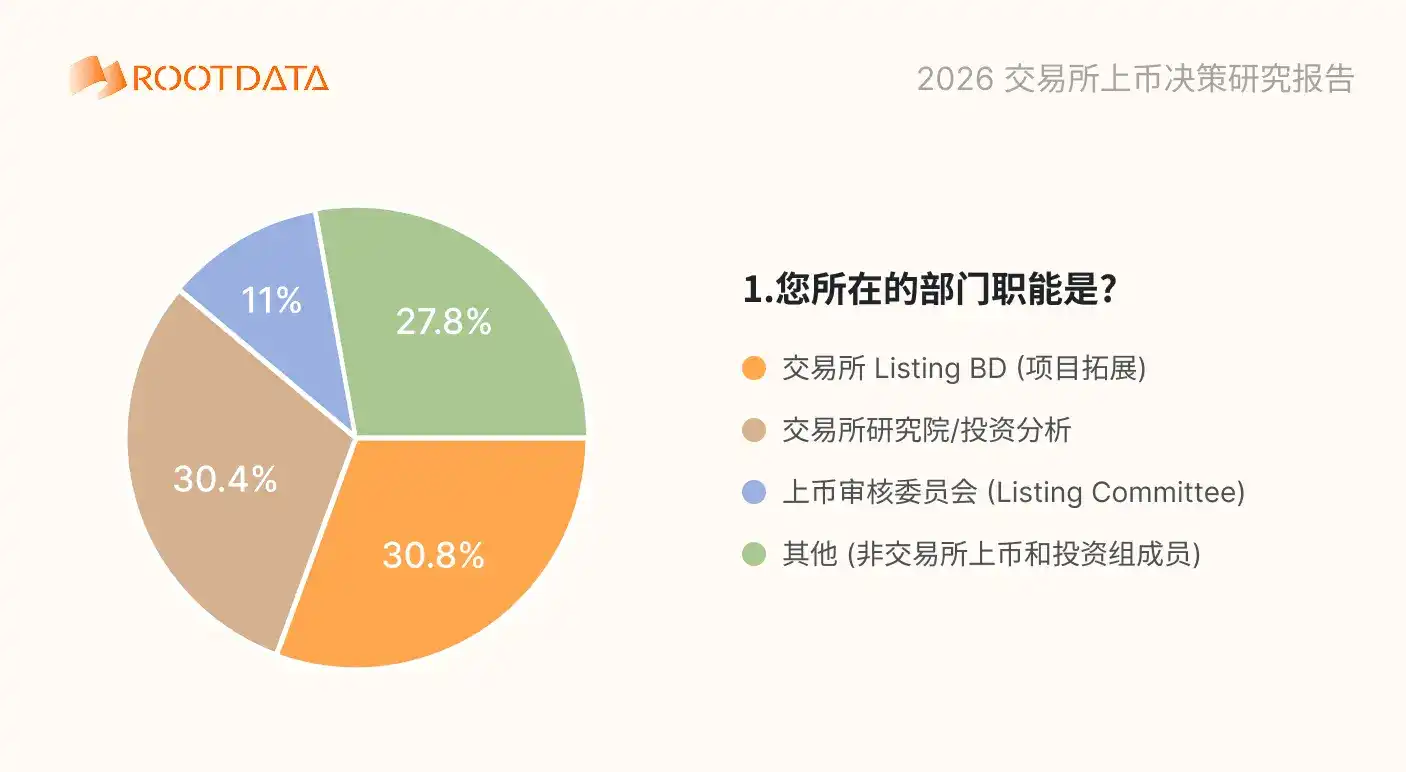
Over 69% of respondents are involved in or directly decision-makers for Listing work. Survey participants were primarily from exchange Listing BD and research institute/investment analysis roles. They are the "value discovery" and "access control" departments of exchanges, and decision-makers face immense information processing pressure.

Decision-Making Pain Points: Fragmented Data and Delayed Updates
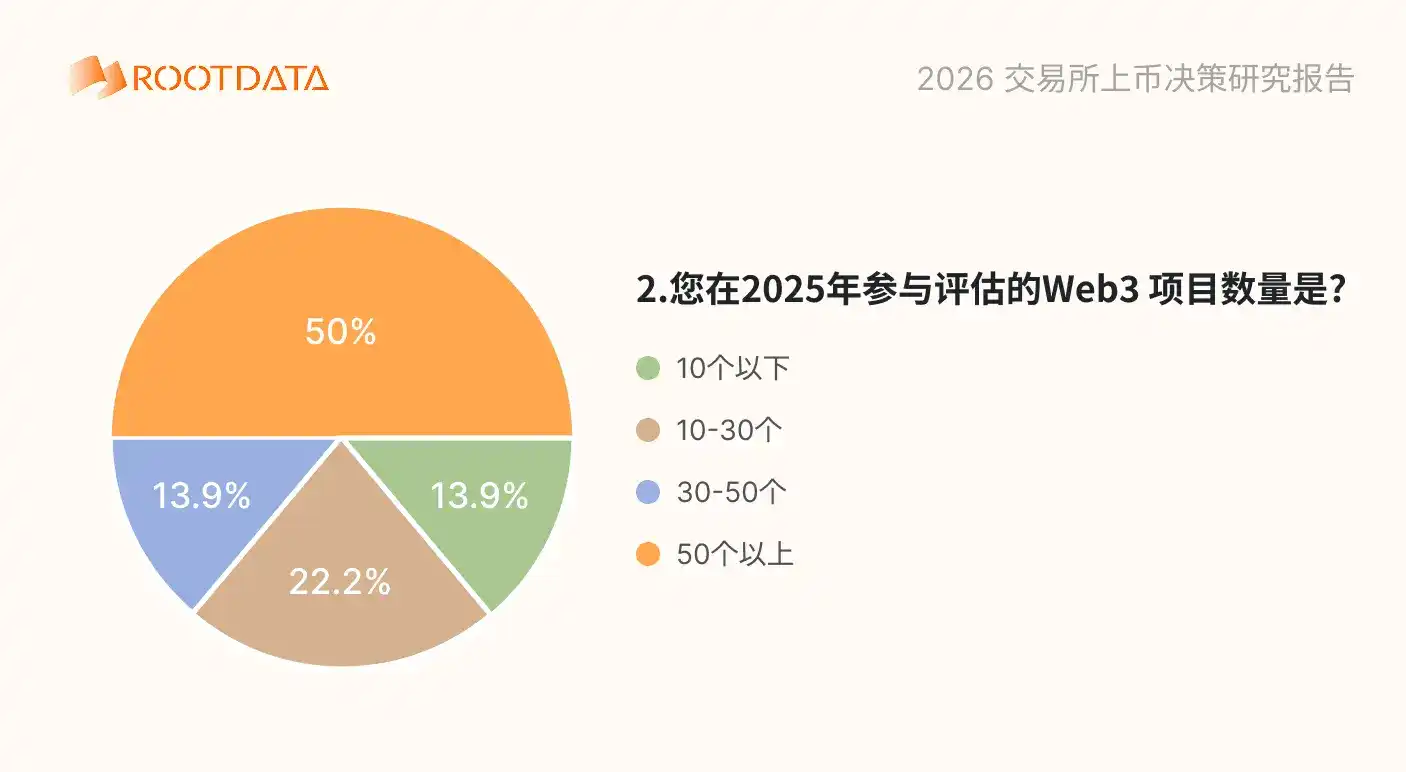
Approximately 50% of respondents evaluate over 50 projects annually. Decision-makers are in a state of severe "information overload." Among the vast number of projects, those that can provide structured and transparent data significantly reduce the cognitive cost for decision-makers. This also indicates that "transparency" has become one of the important metrics for projects to stand out within the extremely short evaluation window.

Distribution of Core Work Responsibilities
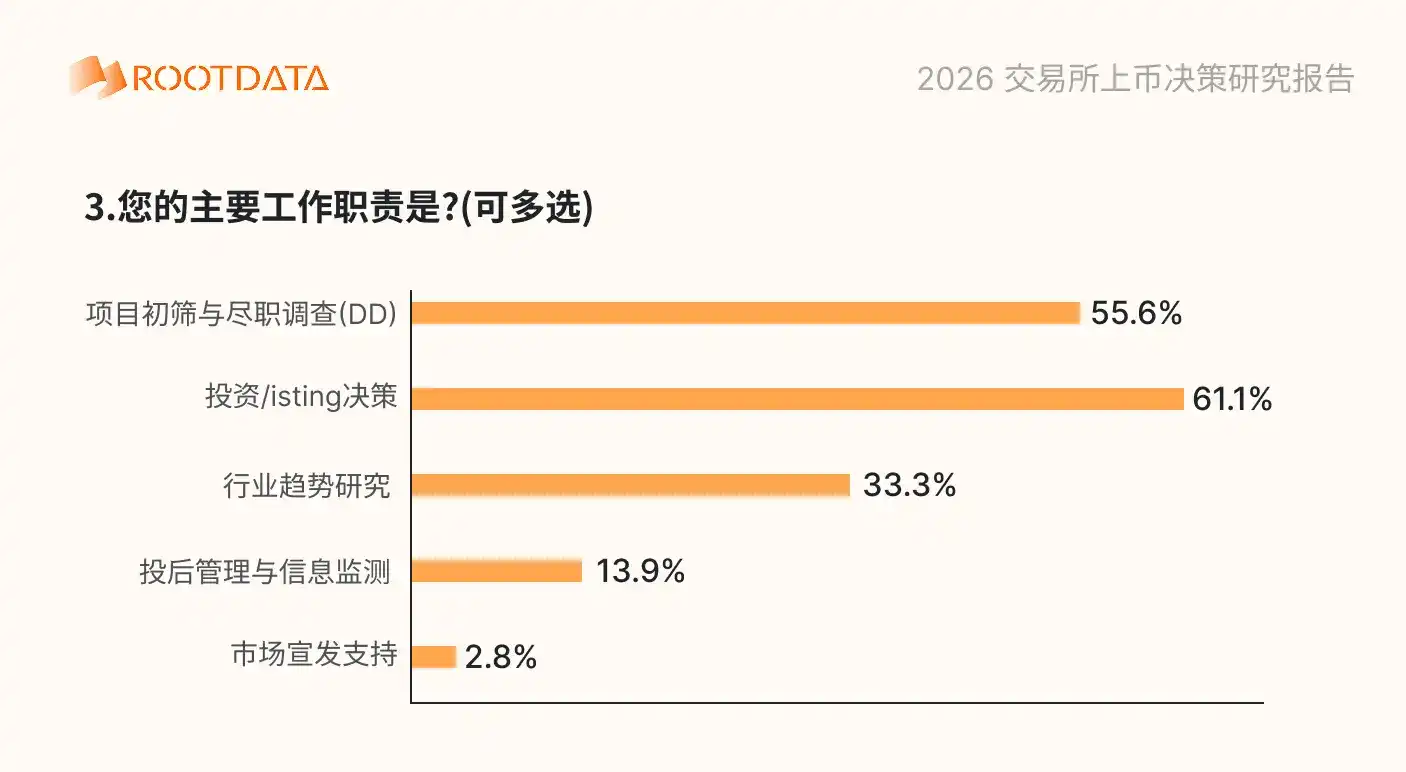
Due diligence and decision-making are highly overlapping functions. This means that data platforms are no longer just auxiliary tools but are integrated into the decision-making chain.

The "Stumbling Block" to Decision-Making Efficiency

"Trust cost" is the most expensive hidden cost for exchanges. Uncertainty in data can cause the decision-making process to repeatedly backtrack. As the compliance trend further intensifies, the accuracy and effectiveness of asset information disclosure will become important factors affecting the exchange listing cycle.

The "Hidden Penalty" of Data Delay
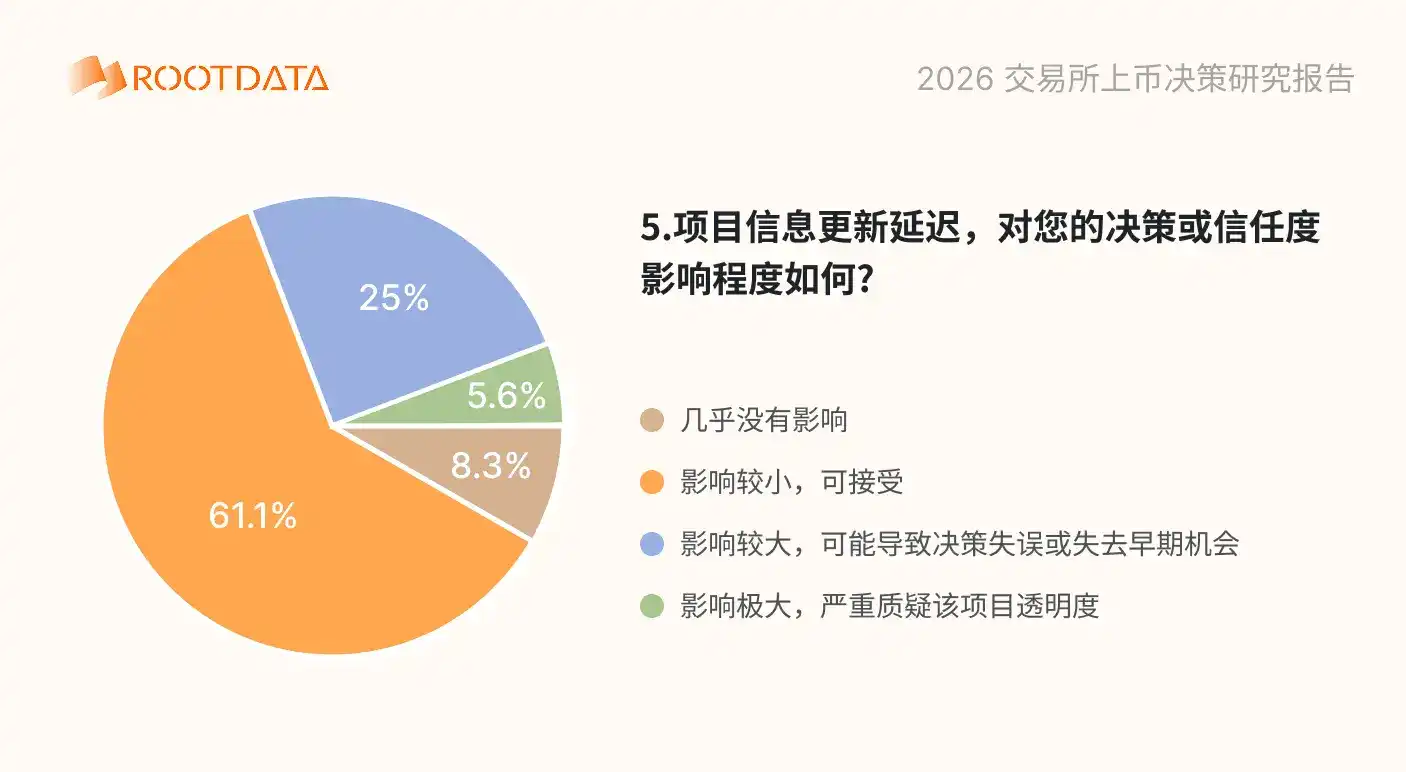
Over 30% of respondents believe delays have a significant or极大 impact, potentially leading to decision-making errors, missed opportunities, or even质疑 project transparency. Even though 60% of respondents表面 "can accept it," delayed information updates from projects may result in a hidden penalty during the Listing evaluation.

Handling of Outdated Information
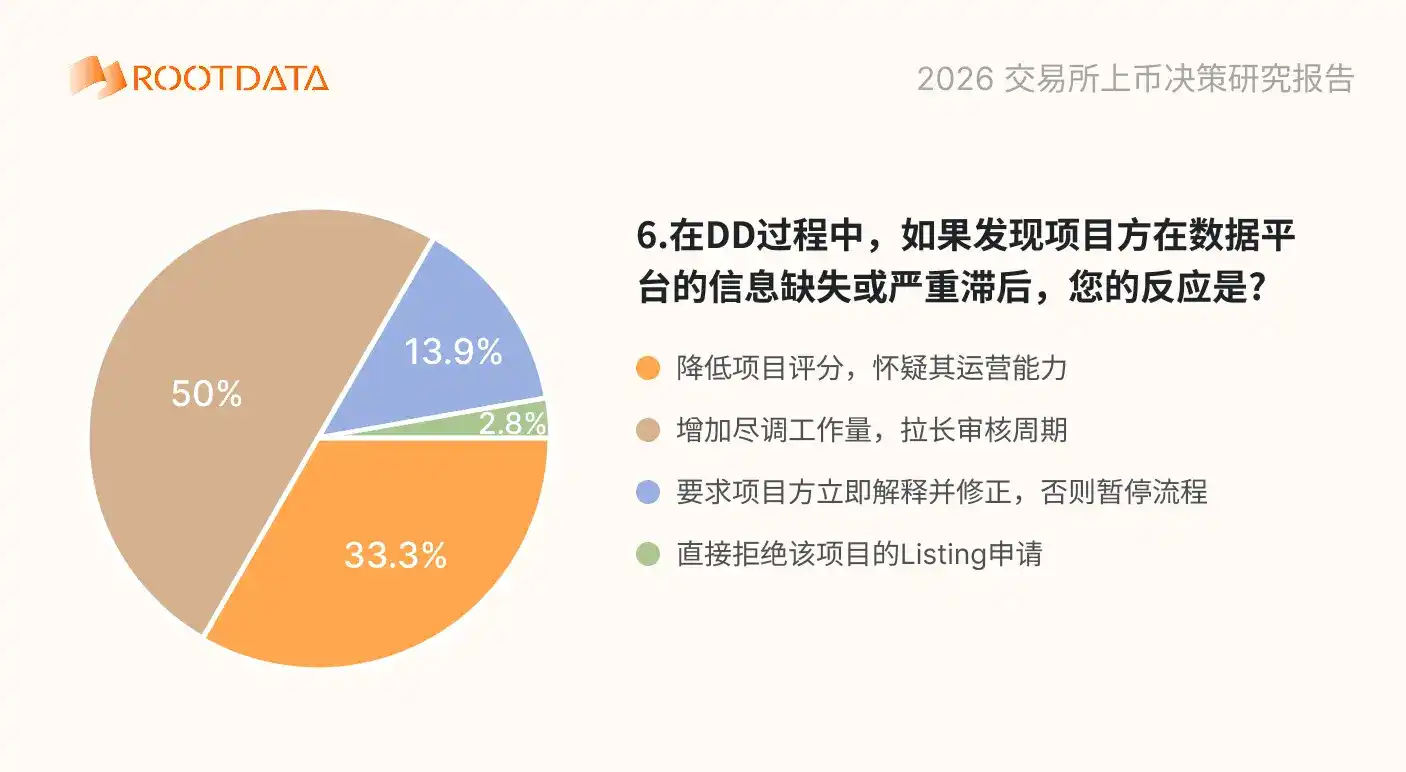
50% of respondents indicated that if project data is not transparent, it will trigger the exchange's "defensive due diligence," prolonging the review time. 16.7% of respondents explicitly stated they would stop the review process or even directly reject the project's Listing application.

The "Required Course" for Listing Review
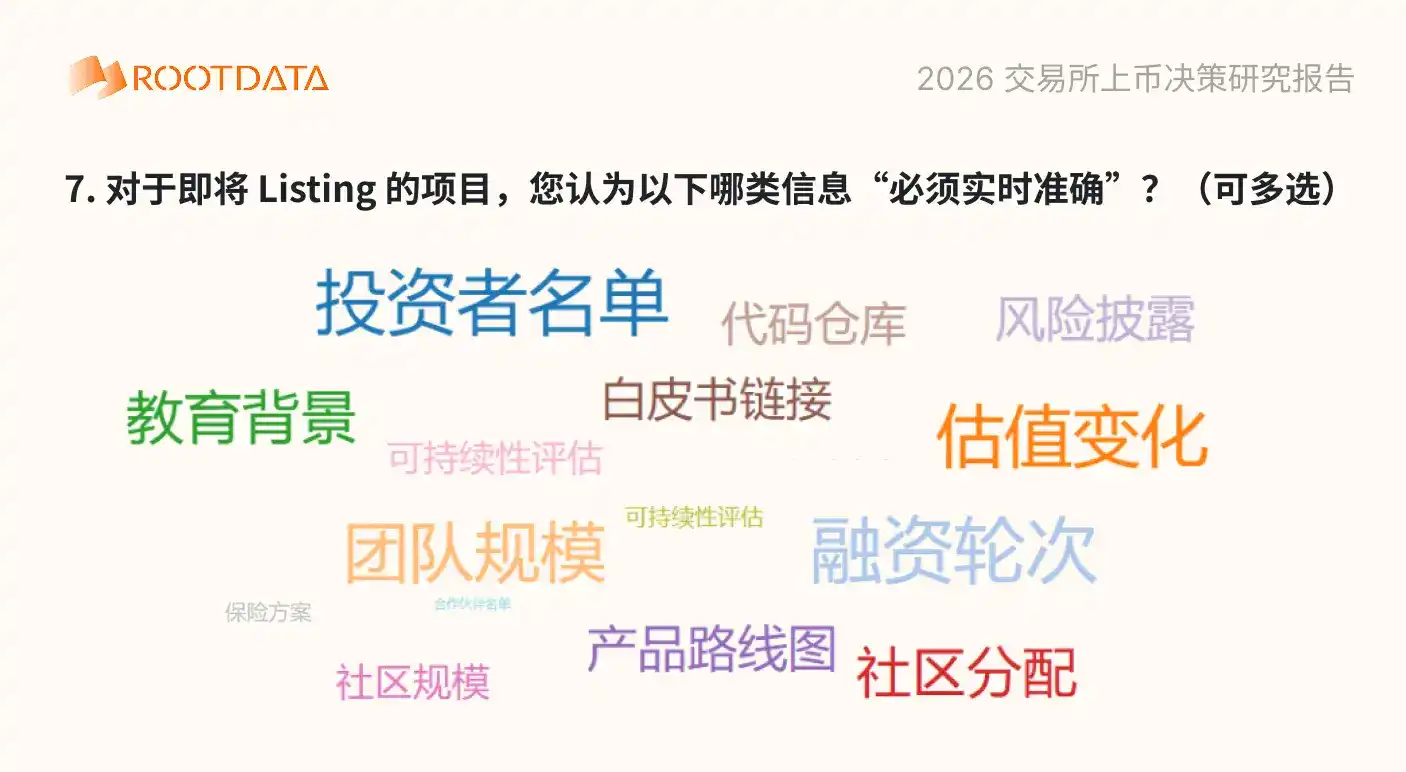
The historical track record of institutional investors, valuation, team, product roadmap, and other asset-related "essential dimensions" constitute the credit cornerstone of Web3 projects. In reality, this information is also very easy to falsify. Therefore, over half of the respondents indicated a strong need for third-party data platforms to help them cross-verify information.

Preferred Commonly Used Data Platforms
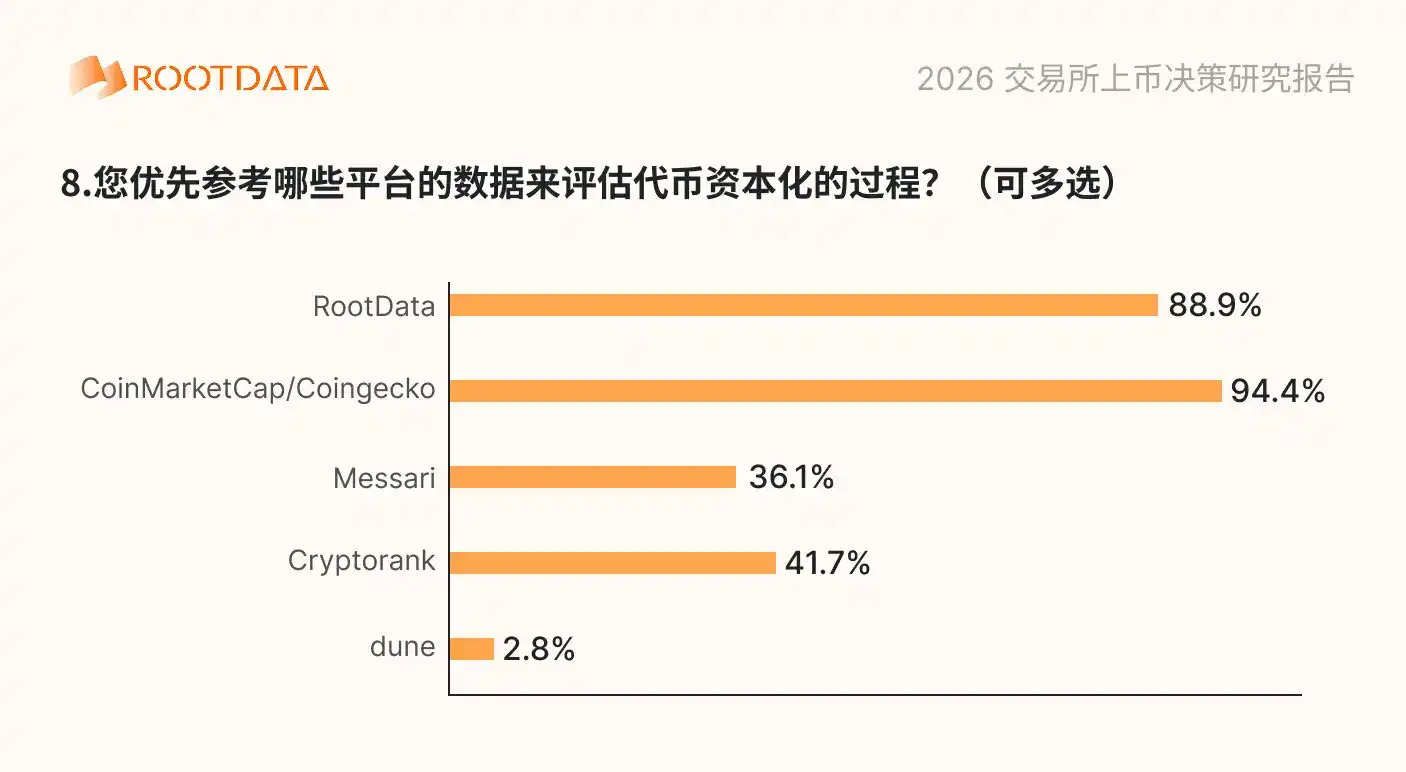
88.9% of respondents stated they choose to reference RootData's data, making it a "desktop essential" tool for exchange Listing teams. This is particularly evident for projects with lower token capitalization (primarily those with their first TGE or not yet listed on major global crypto exchanges). This high penetration rate signifies that the data structure and quality control established by RootData for Web3 projects are becoming an industry standard. For projects with very high token capitalization, 94.4% of respondents会选择 Coingecko or Coinmarketcap platforms for data cross-verification.

Efficiency Boost from Detailed Project Information
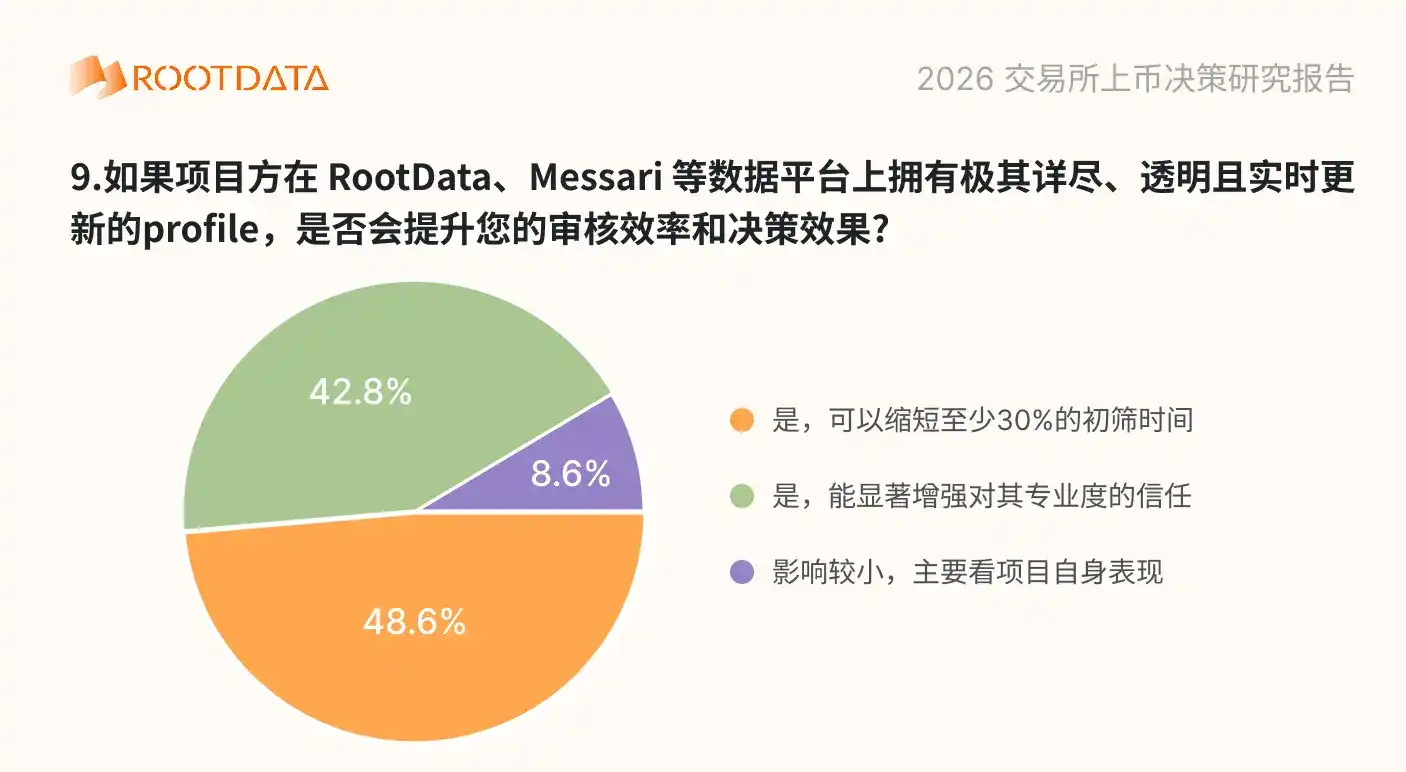
91.4% of respondents explicitly stated that a project being listed on authoritative third-party data platforms like RootData and Crunchbase with detailed information will significantly improve Listing efficiency and好感度,至少可以带来 30% 的审核效率的提升 (at least bringing a 30% improvement in review efficiency).

The Role of Data Platforms in Web3 Development

Only 2.7% of respondents believe projects do not need to focus on data transparency. Listing, being one of the most mysterious links in the industry, has over 80.6% of users agreeing that data platforms are very important for their Listing decisions. This further indicates that whether a project values data information disclosure will directly affect the effectiveness and efficiency of its capitalization.

Summary

The survey results reflect that over half of the professionals in exchange listing departments regard project information transparency as a crucial part of the listing review process, especially information regarding institutional investors, valuation, team, and product roadmap. Sufficient information transparency on third-party data platforms can effectively speed up the review progress (by over 30%), while the review cycle for projects with low transparency will be prolonged.

In the current state of industry development, a large number of projects are陷入 "launching the token only for it to break issue price immediately"窘境, and users have lost trust in the vast majority of crypto projects. The reasons include both the projects' own lack of highlights and reliable business models, as well as many projects being in an information-opaque "black box" state. The disclosure status of a project's core information has become one of the core factors affecting its capitalization progress and effectiveness.


Пов'язані питання

QWhat percentage of survey respondents are directly involved in or make decisions about exchange listings?

AOver 69% of respondents are directly involved in or make decisions regarding exchange listings.

QWhat is considered the most expensive hidden cost for exchanges during the listing process, according to the report?

A"Trust cost" is considered the most expensive hidden cost for exchanges, as data uncertainty leads to repeated backtracking in the decision-making process.

QWhich data platform is used by the vast majority (88.9%) of listing teams for reference, especially for projects with low token capitalization?

A88.9% of respondents use RootData as a reference, making it a 'desktop essential' tool for exchange listing teams, particularly for projects with low token capitalization.

QHow does having detailed information on authoritative third-party data platforms like RootData impact the listing efficiency?

A91.4% of respondents stated that having detailed information on platforms like RootData significantly improves listing efficiency and favorability, increasing audit efficiency by at least 30%.

QWhat are the 'mandatory dimensions' or core information that form the credit foundation for a Web3 project during listing reviews?

AThe 'mandatory dimensions' include institutional investors, valuation, team, product roadmap, and the asset's historical evolution, which form the credit foundation for a Web3 project.

Пов'язані матеріали

Why Do You Always Lose Money on Polymarket? Because You're Betting on News, While the Pros Read the Rules

Why do you always lose money on Polymarket? Because you bet on news, while the pros study the rules. This article explains how top traders ("che tou") profit by meticulously analyzing market rules, not just predicting events. Polymarket, a prediction market platform, often sees disputes over event outcomes due to ambiguous rule wording. For instance, a market asking "Who will be the leader of Venezuela by the end of 2026?" was misinterpreted by many who bet on Delcy Rodríguez, assuming she held power. However, the rules specified "officially holds" as the formally appointed, sworn-in individual. Since Nicolás Maduro was still recognized as president officially, he won the market—even being in prison. To resolve such disputes, Polymarket uses a decentralized arbitration system via UMA protocol. The process involves: 1. Proposal: Anyone can propose a market outcome by staking 750 USDC, earning 5 USDC if unchallenged. 2. Dispute: A 2-hour window allows challenges with a 750 USDC stake; successful challengers earn 250 USDC. 3. Discussion: A 48-hour period on UMA Discord for evidence and debate. 4. Voting: UMA token holders vote in two 24-hour phases (blind then public). Outcomes require >65% consensus and 5M tokens voted; otherwise, four re-votes occur before Polymarket intervention. 5. Settlement: Results are final and automatic. Unlike traditional courts, Polymarket’s system lacks separation between arbitrators and stakeholders—voters often hold market positions, creating conflicts of interest. This leads to herd mentality in discussions and non-transparent outcomes without explanatory rulings, preventing precedent formation. Thus, success on Polymarket hinges on deep rule interpretation, not just event prediction, exploiting gaps between reality and contractual wording.

marsbit2 год тому

Why Do You Always Lose Money on Polymarket? Because You're Betting on News, While the Pros Read the Rules

marsbit2 год тому

DeepSeek Funding: Liang Wenfeng's 'Realist' Pivot

DeepSeek, a leading Chinese AI company, has initiated its first external funding round, aiming to raise at least $300 million at a valuation of no less than $10 billion. This move marks a significant shift from its founder Liang Wenfeng’s previous idealistic stance of rejecting external capital to maintain independence. Despite strong financial backing from its parent company, quantitative trading firm幻方量化 (Huanfang Quant), which provided an estimated $700 million in revenue in 2025 alone, DeepSeek faces mounting challenges. Key issues include a 15-month gap in major model updates, delays in its flagship V4 release, and the loss of several core researchers to competitors offering significantly higher compensation. The company is also undergoing a strategic pivot by migrating its infrastructure from NVIDIA’s CUDA to Huawei’s Ascend platform, a move aligned with China’s push for technological self-reliance amid U.S. export controls. However, DeepSeek lags behind rivals like智谱AI and MiniMax—both now publicly listed—in areas such as product ecosystem, multimodal capabilities, and commercialization. The funding round, though relatively small in scale, is seen as a way to establish a market-validated valuation anchor, making employee stock options more competitive and facilitating talent retention. It also signals DeepSeek’s transition from a pure research-oriented organization to a commercially-driven player in the global AI ecosystem.

marsbit3 год тому

DeepSeek Funding: Liang Wenfeng's 'Realist' Pivot

marsbit3 год тому

Торгівля

Спот
Ф'ючерси
活动图片