2026 Crypto Predictions: Dragonfly’s Hadick Calls Outlook ‘Constructive’

bitcoinistPublished on 2025-12-25Last updated on 2025-12-25

Abstract

Dragonfly general partner Rob Hadick expresses a constructive outlook for crypto in 2026, emphasizing long-term adoption trends over recent volatility. He highlights significant growth in stablecoins, noting they now handle 3% of cross-border payments and could see a tenfold increase. Prediction markets, like Polymarket, are also expanding beyond sports into broader financial use cases. Hadick avoids favoring Ethereum or Solana, stating both will coexist as the market matures, with Ethereum strong in value and stablecoins, and Solana optimized for high-volume, low-cost transactions. He remains optimistic about macroeconomic conditions, tokenization, and continued innovation driving the industry forward.

Dragonfly general partner Rob Hadick struck an upbeat tone on crypto’s medium-term setup, arguing that recent volatility has obscured a broader trend of adoption, especially in stablecoins and prediction markets, that he expects to accelerate into 2026.

Speaking on CNBC’s Squawk Box on Dec. 24, Hadick pushed back on the idea that crypto has entered a new “winter,” framing the year’s disappointment as a function of recency bias rather than a clean break in market structure.

“It hasn’t had a great year. But I think it’s important to zoom out,” Hadick said. “If you look at the returns for bitcoin relative to the day before the election in ’24, bitcoin is up about 26%, Nasdaq is up about 28%... even further than that two years, bitcoin’s doubled, Nasdaq is up 50%.”

Hadick emphasized he’s not trading chart patterns. “I’m not a technical investor. I’m a long-term investor. We’re a VC fund,” he said, adding that he “continue[s] to see a strong and constructive 2026.

2026 Crypto Predictions

Pressed on what “a good 2026” means in practice for the crypto market, Hadick tied his outlook to macro conditions and what he sees as compounding real-world usage. “For the token prices themselves—bitcoin, ethereum—there’s likely to be continued momentum,” he said. “I think from a macroeconomic perspective... we’ll have better monetary policy. And then we’re going to have more and more adoption of tokenized assets.”

One data point he said: “McKinsey just said that they think 3% of all cross-border payments is happening in stablecoins right now. That’s up from basically 0% a year ago,” Hadick said, adding that he expects “another tenfold increase.”

Hadick described Dragonfly as deliberately non-ideological across chains and sectors, positioning the firm less as a “bitcoin vs. ethereum” shop and more as a bet on market-structure innovation. “We invest in everybody that’s doing anything that’s interesting in tokenized digital assets,” he said. “We’re not what I would say ideological about crypto. What we are is investing in the future of innovation in financial markets.”

When the conversation turned from majors to categories, Hadick leaned into two themes: stablecoins and prediction markets. “Stablecoins I think are here to stay. I think it’s going to grow tenfold,” he said. “I think prediction markets are here to stay. I think they’re going to grow tenfold.”

On prediction markets specifically, Hadick argued the addressable market extends well beyond sports betting, despite the current overlap. He pointed to Polymarket’s growth as evidence of expanding use cases. “If you look at Polymarket volume today, they’ve gone from $50 million a month in early ’24... they’re now going to do probably about $4 billion of volume this month,” he said, adding that “only about 35% of that is sports,” putting Polymarket in contrast with Kalshi, which he characterized as “more of a sports platform because they’re infrastructure for Robinhood.”

Hadick also invoked Intercontinental Exchange CEO Jeff Sprecher’s long-running tokenization thesis to argue prediction markets may converge with broader financial infrastructure rather than remain a niche wagering product. “If you talk to Jeff Sprecher over at ICE... he’ll tell you he believes in the tokenization of all markets,” Hadick said. “I talked to him before he made the investment in Polymarket... his perspective is that this is going to be as big as ICE itself. Probably.”

He suggested the functional framing is less “bets” and more programmable risk transfer. “I talked to an insurance company maybe a month ago that was thinking about how they can hedge out risk in weather related activities,” Hadick said. “That’s just one use case... every single thing and every single market and outcome that can be put [into] a market—or really just a binary option, which is what it is.”

Ethereum Vs. Solana

Asked to pick sides in the Ethereum–Solana debate, Hadick refused the “MySpace vs. Facebook” framing. “No, they’re both Facebook,” he said, arguing the market will require multiple settlement environments if tokenization becomes mainstream. In his view, Ethereum’s advantage is where value and stablecoin liquidity already sit, while Solana’s edge is high-throughput, low-cost flow.

“Most stablecoins today are on Ethereum,” Hadick said. “Ethereum is where a large amount of... economic activity exists... but if you look at the trading volume, it’s happening more on Solana, which is more optimized for that type of transaction flow and for low cost transactions.”

Still, Hadick conceded the platform layer is not frozen. He said Dragonfly is invested in a newer chain, Monad, describing it as “trying to be a Solana killer,” and cited figures he said reflected early-stage market positioning: a roughly $2 billion valuation and a token price around $0.002.

At press time, the total crypto market cap stood at $2.92 trillion.
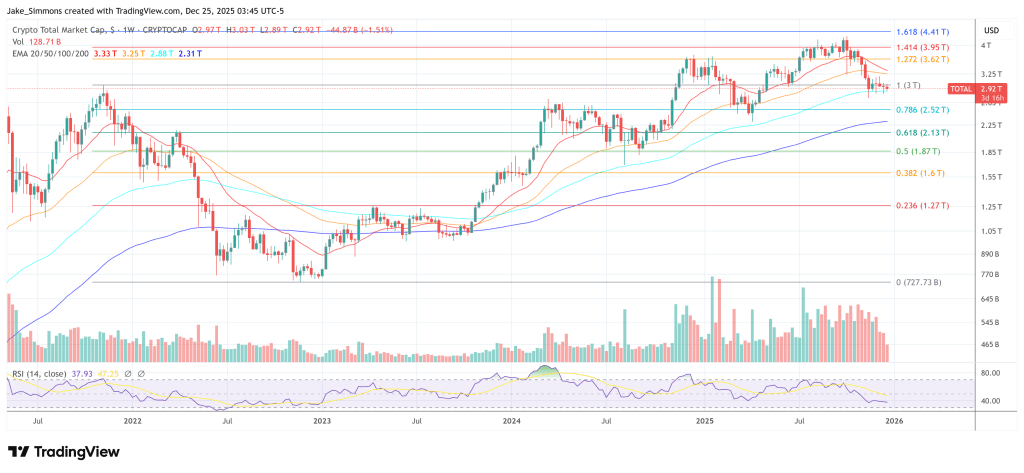
Total crypto market cap sits below the 2021 high, 1-week chart | Source: TOTAL on TradingView.com

Related Questions

QWhat is Rob Hadick's overall outlook for the crypto market in 2026?

ARob Hadick has a 'constructive' and positive outlook for the crypto market in 2026. He expects continued momentum for major tokens like Bitcoin and Ethereum, better monetary policy, and accelerated adoption of tokenized assets, stablecoins, and prediction markets.

QAccording to Hadick, what is the current percentage of cross-border payments happening in stablecoins and what growth does he predict?

AHadick cited a McKinsey report stating that 3% of all cross-border payments are currently happening in stablecoins, up from nearly 0% a year ago. He predicts this will see 'another tenfold increase.'

QWhich two specific crypto categories does Hadick highlight as having significant growth potential?

AHadick highlights stablecoins and prediction markets as two categories with massive growth potential, stating that he believes each is 'here to stay' and will 'grow tenfold.'

QHow does Hadick characterize the debate between Ethereum and Solana?

AHadick refuses to frame it as a 'MySpace vs. Facebook' debate, instead stating 'they’re both Facebook.' He believes the market will require multiple settlement layers, with Ethereum's strength being its existing value and stablecoin liquidity, and Solana's being its high-throughput, low-cost transaction flow.

QWhat example does Hadick give to show that prediction markets extend beyond sports betting?

AHadick gives the example of an insurance company that was exploring how to use prediction markets to hedge risk in weather-related activities. He suggests the functional framing is less about 'bets' and more about programmable risk transfer for various markets and outcomes.

Related Reads

The Value Distribution of Stablecoins

**Summary: The Value Distribution of Stablecoins** The article argues that stablecoins are evolving from mere trading tools into broader channels for dollar access. It divides the stablecoin ecosystem into four layers to analyze how value is distributed: 1. **Issuance Layer:** Mints stablecoins, holds reserve assets, and captures the spread between reserve yield and user costs (e.g., Tether, Circle). This layer currently earns the largest profit margin. 2. **Infrastructure Layer:** Connects stablecoins to the traditional financial system, handling fiat on/off-ramps, banking integration, compliance (KYC/AML), and asset management (e.g., Bridge, BVNK). This is the "unglamorous" but critical work, building the essential bridges between crypto and real-world finance. 3. **Acquiring/Distribution Layer:** Integrates stablecoins into merchant systems, manages payment flows, and provides enterprise financial software (e.g., Stripe, Coinbase). They act as the access point for businesses. 4. **Application Layer:** The end-users and businesses that ultimately use stablecoins for payments, settlements, or as a store of value. They benefit from convenience but have little pricing power. The core thesis is that while the issuance layer currently dominates profits, the often-overlooked **infrastructure layer holds significant long-term potential**. The real challenge and barrier to mass adoption is not the on-chain transfer of stablecoins (which is simple), but the complex "last mile" integration into existing business workflows, banking systems, and regulatory frameworks across different countries. Companies in this layer are currently in a "land grab" phase, investing heavily to build networks, secure bank partnerships, and establish compliance pathways. While their position is currently pressured by the profitable issuers above and distribution platforms below, the article suggests that if stablecoins become a default financial rail for businesses, the infrastructure providers who have done the hard work of integration will ultimately gain strong pricing power and become entrenched, essential players.

marsbit3h ago

The Value Distribution of Stablecoins

marsbit3h ago

The Value Distribution of Stablecoins

The Value Distribution of Stablecoins The article argues that stablecoins are evolving from a mere trading tool into a broad "dollar channel." It analyzes the industry's value chain through four layers: 1. **Issuance Layer (e.g., Tether, Circle):** The top layer that mints stablecoins, holds reserve assets, and captures the thickest interest rate spread. 2. **Infrastructure Layer (e.g., Bridge, BVNK):** Connects stablecoins to the traditional financial system, handling critical but complex "dirty work" like fiat on/off-ramps, banking integration, compliance (KYC/AML), and cross-border settlement. 3. **Acquiring/Distribution Layer (e.g., Stripe, Coinbase):** Embeds stablecoins into merchant systems, manages payment flows, and integrates with enterprise software. 4. **Application Layer:** End-users and businesses that ultimately use stablecoins for payments, settlement, or storing value. The author posits that while the issuance layer currently captures the most profit, the most overlooked and potentially critical layer is infrastructure. The core challenge for stablecoin adoption isn't the on-chain transfer (which is simple), but bridging the gap between blockchain and the real-world financial system. This involves solving practical problems for businesses: fiat conversion, reconciliation, tax handling, and user onboarding. Infrastructure companies are currently in a difficult "land-grab" phase—building networks, securing banking relationships, and achieving compliance country-by-country. They face pressure from both the profitable issuance layer above and distribution platforms below. However, the author suggests this layer is building a crucial moat. Once stablecoins become a default business rail, the infrastructure players who have done the hard work of integration may gain significant, durable value and pricing power.

链捕手3h ago

The Value Distribution of Stablecoins

链捕手3h ago

How to Do Research Well: Deliberately Practice the Real Skills That Matter

No one truly teaches you how to do research. You're often given a desk, a pre-selected problem, and vague instructions to "create something new." Consequently, many people reverse-engineer the job based on visible outputs—papers, posts, announcements—learning only how to *appear* like a researcher rather than how to *become* one. True research capability is built from stacking small, trainable skills, nearly all of which can be developed through deliberate practice. **Pick Your Own Problem:** Most researchers absorb problems from advisors or trends, lacking the underlying reasoning. Choosing a problem you genuinely care about, as John Schulman advises, leads to original work. Develop "taste" like a muscle: predict experiment outcomes, guess paper results from methods, and track which findings remain important over time. **Upgrade Your Inputs:** Relying on shared reading lists (arXiv hot lists, filtered group chats) leads to unoriginal conclusions. Undervalued old literature often holds crucial insights (e.g., MoE, LSTM, backpropagation). Richard Sutton's "The Bitter Lesson" or Claude Shannon's 1952 talk on creative thinking are more predictive than lengthy modern surveys. Breadth matters as much as depth: draw from neuroscience, mechanism design, hardware knowledge, and honest statistics. Read papers directly, especially appendices and limitations sections. **Write Everything Down:** As Paul Graham noted, writing exposes flaws in seemingly mature ideas. Writing is the cheapest defense against self-deception. Following Feynman's principle, Darwin programmatically wrote down facts contradicting his theory to combat memory bias. Maintain a detailed log of hypotheses, setups, predictions, results, and updated understandings. Reviewing past logs fosters essential humility.

marsbit5h ago

How to Do Research Well: Deliberately Practice the Real Skills That Matter

marsbit5h ago

Trading

Spot
Futures

Hot Articles

Discussions

Welcome to the HTX Community. Here, you can stay informed about the latest platform developments and gain access to professional market insights. Users' opinions on the price of S (S) are presented below.

活动图片