2026 Crypto Industry Investor Relations and Token Transparency Status Report

marsbitPublished on 2026-04-16Last updated on 2026-04-16

Abstract

The 2026 Crypto Investor Relations & Token Transparency Report by Novora analyzes over 150 protocols across major sectors. Key findings reveal a severe transparency gap: less than 1% disclose market maker terms, only 3% have dedicated IR hubs, and just 9% submitted the Blockworks Token Transparency Framework. While 91% of protocols have accessible revenue data, the communication infrastructure to present this to investors is largely absent. Additionally, 62% of tokens offer only governance rights with no active value capture mechanisms. The report concludes that while raw data is available on-chain and via third-party platforms, the critical "translation layer" for institutional adoption is missing. Protocols investing in IR infrastructure now are positioned to gain a significant advantage.

Author: Connor King, Founder of Novora

Compiled by: Hu Tao, ChainCatcher

Last month, we released our "Does Investor Relations Matter in Crypto?" This is the follow-up. We expanded the initial dataset of 53 protocols to over 150 protocols, covering all major sectors: DEX, lending, perpetuals, liquid staking, L1, L2, bridges, DePIN, AI, stablecoins, infrastructure, and CEX tokens. The fully diluted valuation (FDV) of the protocols ranges from $40 million to $45 billion.

We checked 15 binary, verifiable indicators for each protocol: Does the protocol disclose this information? Yes/No. Each data point was cross-verified through public sources: Artemis, Tokenterminal, Blockworks, Dune, DefiLlama.

Here's what we found:
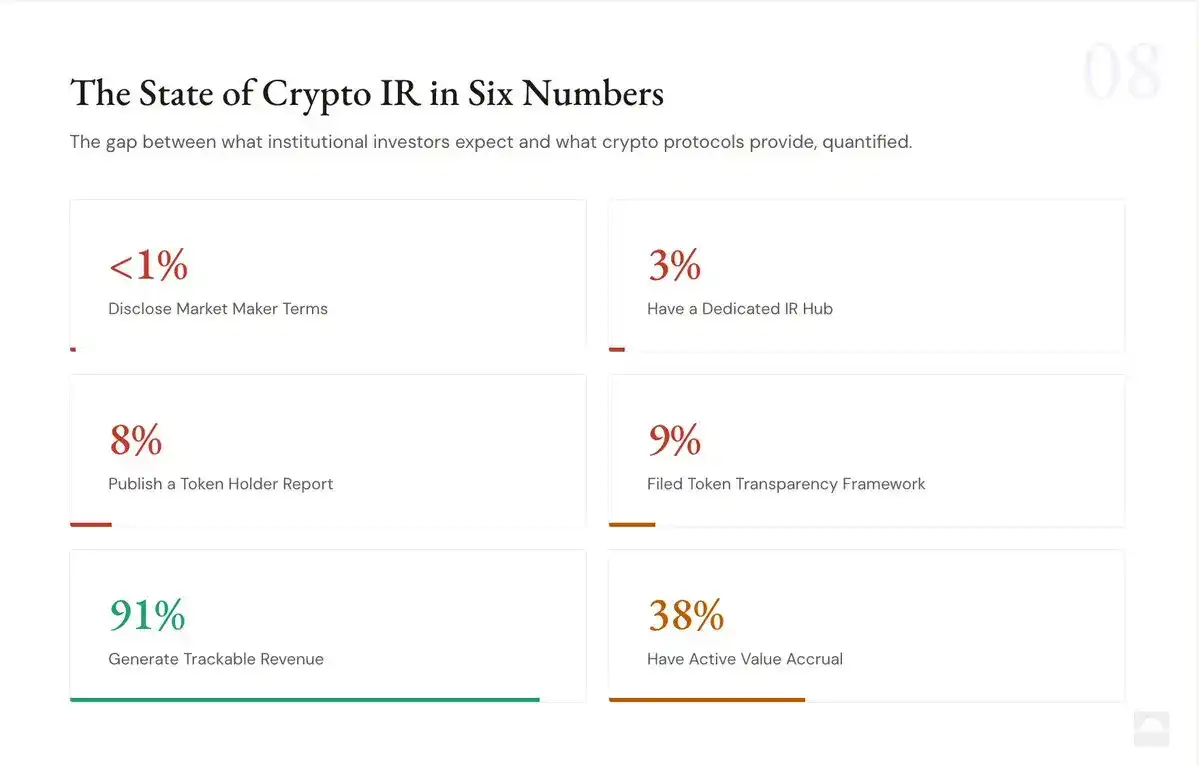
Less than 1% of market makers disclose their market maker terms.

50 protocols. Billions in daily trading volume combined. But only one protocol publicly disclosed information about its market making arrangements.

Market makers set the terms for token trading. These agreements often include token lending, option structures, and performance incentives that directly impact price discovery. In traditional markets, such material agreements are disclosed. But in crypto, every market participant is trading in the dark.

Meteora was the only protocol in the dataset that disclosed its market making arrangements through its 2025 Token Holder Annual Report. One out of over 150.

This is the most impactful transparency gap in the industry.
91% have revenue data. 3% have an Investor Relations hub.

Nearly every protocol in this audit publicly provides revenue data, either through third-party platforms or their own data dashboards. The raw data exists.

But only 3% have built a dedicated Investor Relations hub that consolidates this data into an investor-facing experience. The exceptions include Meteora, Jito, Jupiter, Raydium, MetaDAO. Every other protocol scatters information across blogs, governance forums, X threads, and third-party platforms. There is no centralized, institutional-grade investor experience. The gap isn't data availability, it's communication infrastructure.
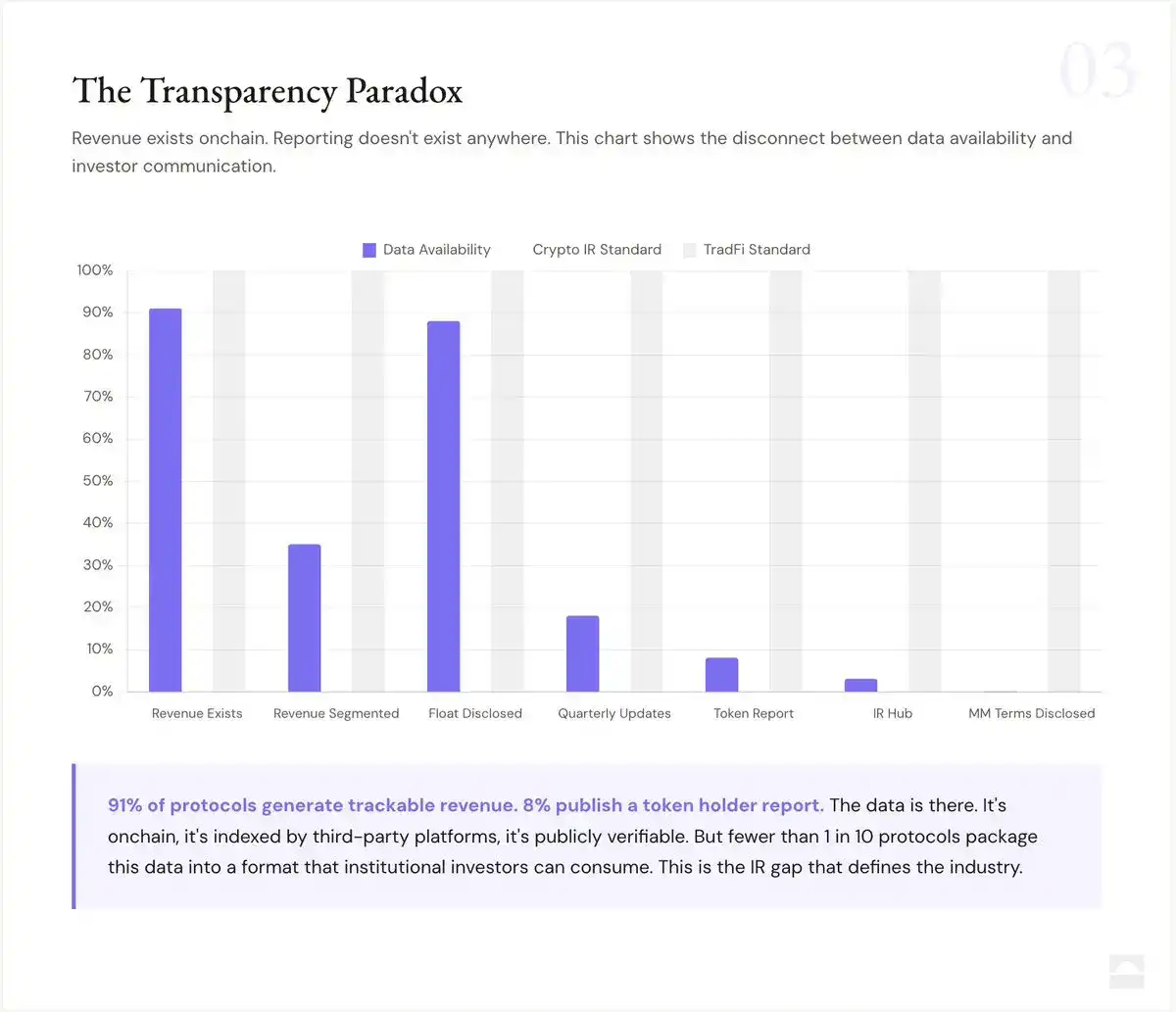
9% submitted the Blockworks TTF

The Blockworks Token Transparency Framework was submitted to the U.S. SEC in June 2025, covering 18 disclosure standards across supply, distribution, financials, and market structure, backed by Pantera, L1D, and Theia. Out of the 150+ protocols reviewed, only 13 submitted the framework: Jito, Jupiter, Raydium, Morpho, Aerodrome, MetaDAO, Maple, dYdX, Euler, Marinade, EtherFi, Gains Network, and Meteora.

This is a material improvement from zero submissions. But the submission rate dropped from 25% in the initial 53 protocols to 9% at 150+. The original dataset was skewed towards early TTF-adopting DeFi protocols. With a broader sample, the picture is clearer: the vast majority of the market is not opting in. Zero L1s, zero L2s, zero infrastructure protocols submitted the framework. The framework exists. More protocols should use it.

38% have active value accrual, 62% return nothing

We used a broad definition of "active value accrual": Does the protocol have at least one live mechanism that directs economic value directly to token holders (excluding governance rights)? Across 150+ protocols, we identified six distinct models:

  • Direct fee sharing (JUP, DYDX, GMX)
  • Buyback and burn (HYPE, RAY, MET)
  • Staking revenue share (PENDLE, AAVE, ETHFI)
  • Conditional buybacks (LDO)
  • ve-model epoch distribution (AERO)
  • Governance-only, no economic rights (MORPHO, LINK, ARB)
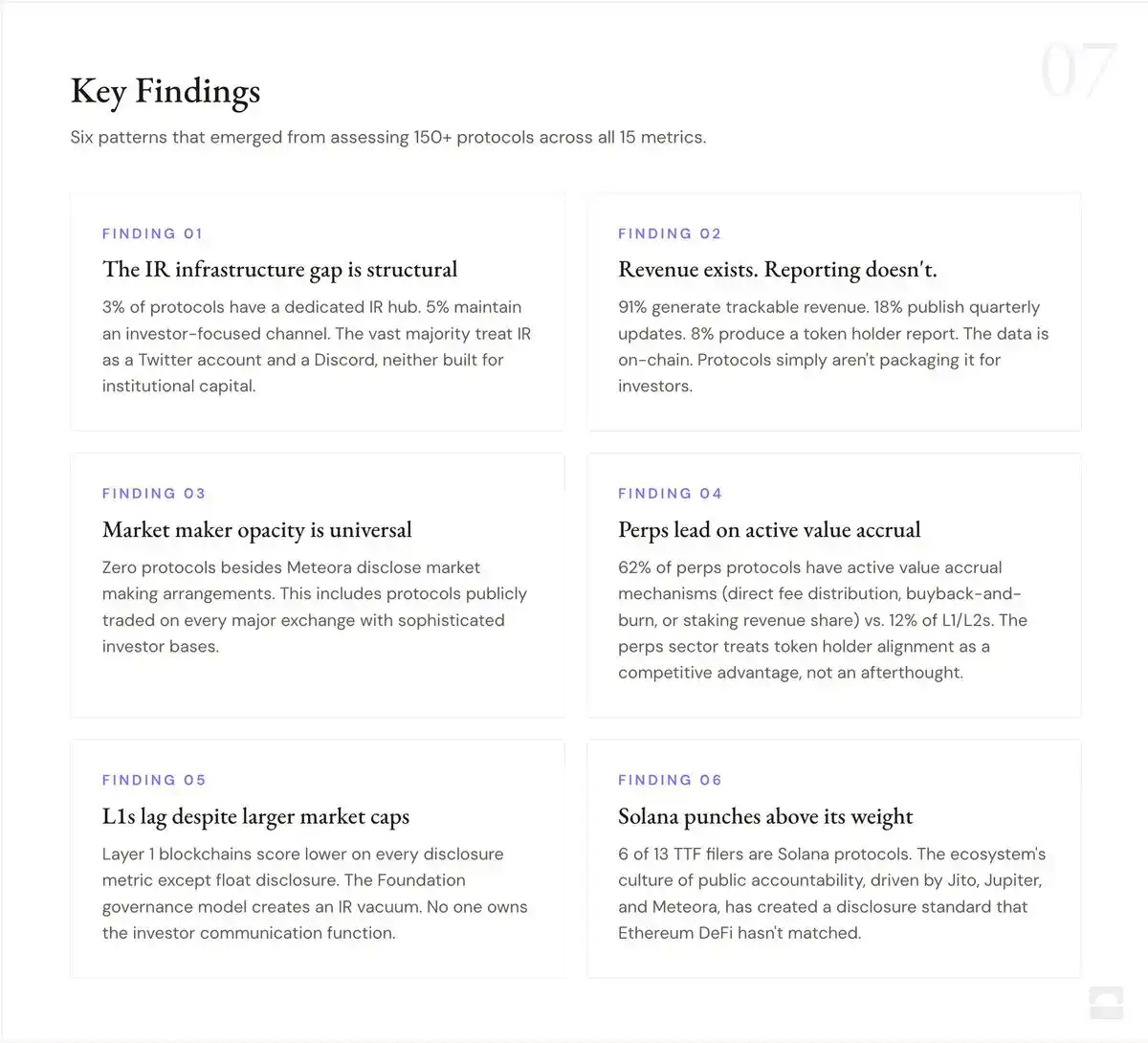
62% of protocols fall into the last category – governance-only tokens with no value accrual, including some of the largest market cap projects in the industry. Sector differences are stark: 62% of Perpetuals protocols have active value accrual, versus just 12% of L1/L2 tokens. Perpetuals treat token holder alignment as a competitive advantage. L1 foundations have not yet done the same. A deep dive into which models actually work is coming next week.

The data layer is built, the communication layer is not

We checked five major third-party platforms: Token Terminal, Dune Analytics, Artemis, DefiLlama, and Blockworks Research. The first four platforms each cover 85-95% of the dataset. 72% of protocols appear on 4 or more platforms. Every protocol in the audit appears on at least one platform. The raw data infrastructure for institutional analysis is largely built. What's missing is the interpretation, packaging, and communication layer that turns data into investable narratives.

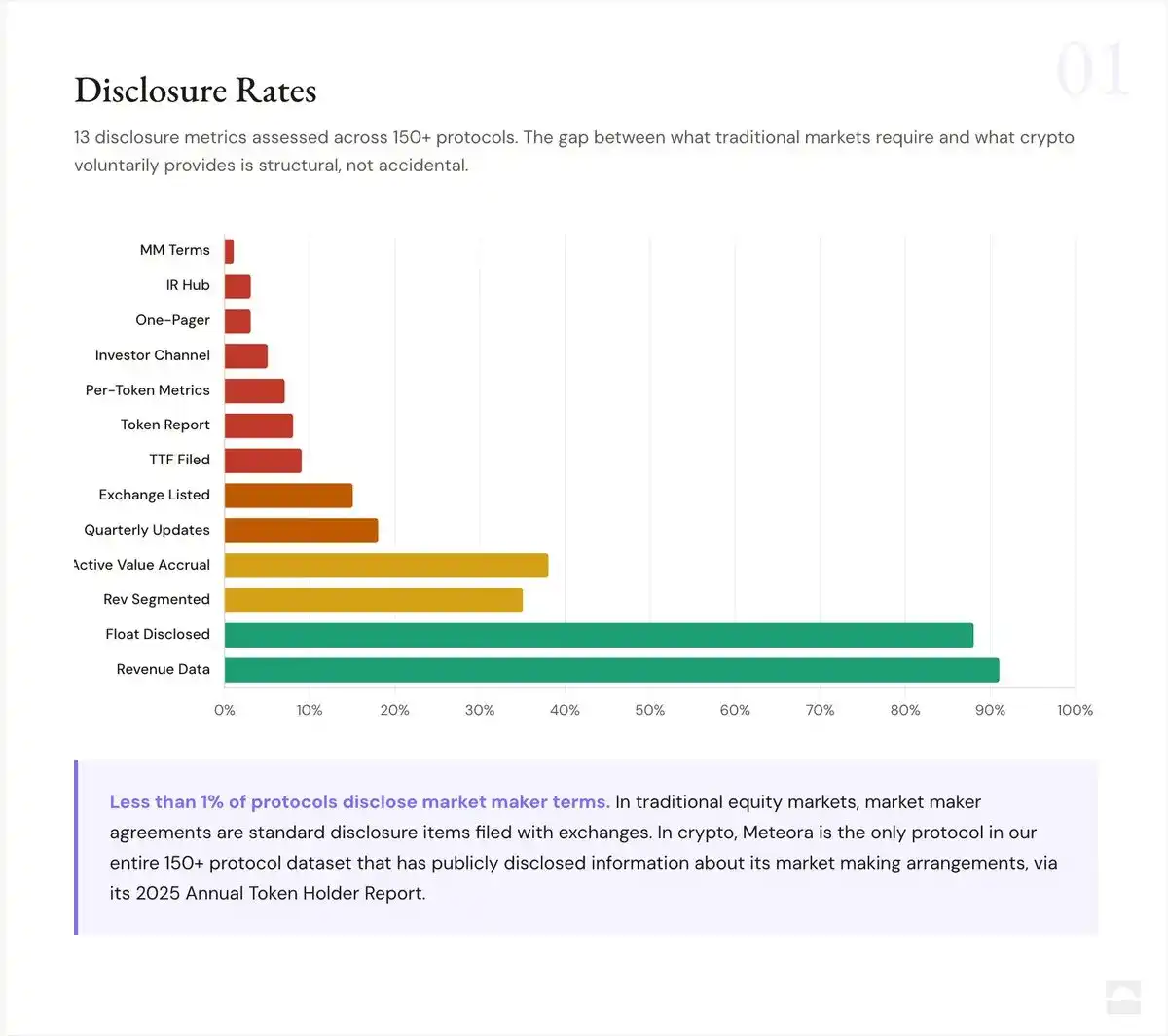
The full disclosure breakdown for 150+ protocols is as follows:

<1% —— Disclose Market Maker Terms
3% —— Dedicated IR Hub
3% —— Provide a One-Pager
5% —— Dedicated Investor Channel
7% —— Publish Single-Token Metrics
8% —— Token Holder Reports
9% —— Submitted TTF
15% —— Disclose Exchange Listings
18% —— Quarterly Updates
35% —— Disaggregated Revenue Disclosure
38% —— Active Value Accrual
88% —— Disclose Circulating Supply
91% —— Revenue Data Available

What this means

The thesis from "Does Investor Relations Matter in Crypto?" holds. The data is even more sobering with the sample size expanded to 150+. Crypto protocols aren't hiding the fundamentals, they're failing to present them. The raw inputs for fundamental analysis exist on-chain and on third-party platforms, but the "translation layer and IR infrastructure that turns data into institutional confidence barely exists. Only 3% have an IR hub, <1% disclose market maker terms, and 91% of the market has not adopted the only available standardized disclosure framework.

The opportunity for protocols is clear: the cost of building IR infrastructure is negligible relative to capital markets upside. Protocols investing in this now will be the first to earn the trust of institutional allocators. The full interactive report with all 150+ protocols is live now:
http://novora.co/research/ir-transparency-2026.html

Next week, we will release the comparative report for this series: "Which Token Value Accrual Model Works?". That report will break down the six token value accrual mechanisms we identified, their empirical performance, and what this means for token classification and institutional adoption.


Related Questions

QWhat percentage of the 150+ crypto protocols studied publicly disclose their market maker arrangements?

ALess than 1% (only one protocol, Meteora, disclosed this information).

QAccording to the report, what is the state of data availability versus communication infrastructure for investor relations in crypto?

AThe data layer is built (91% of protocols have revenue data available on third-party platforms), but the communication layer is not (only 3% have a dedicated IR hub to present this data effectively).

QHow many of the protocols analyzed had submitted the Blockworks Token Transparency Framework (TTF)?

A9% (13 out of the 150+ protocols).

QWhat percentage of the protocols were found to have 'active value capture' mechanisms for token holders?

A38% of the protocols had active value capture, while 62% offered only governance rights with no economic value returned to holders.

QWhat is identified as the most significant transparency gap in the crypto industry within the report?

AThe disclosure of market maker terms, as it is a critical agreement that directly impacts price discovery and is standard in traditional markets, yet is almost entirely undisclosed in crypto.

Related Reads

Wall Street's Most Famous 'Cassandra' Now Has His Sights Set on Nvidia

Michael Burry, the famed "Big Short" investor, has once again captured Wall Street's attention with a series of short positions against major tech and semiconductor stocks, most notably Nvidia. In late June and July, through his "Cassandra Unchained" newsletter, Burry disclosed short bets against Nvidia, Tesla, Applied Materials, Caterpillar, the SOXX semiconductor ETF, and later, Micron Technology. His core thesis revolves around potential distortions in the AI infrastructure boom, specifically questioning whether extended depreciation schedules (e.g., 6 years vs. a realistic 2-3 years for AI chips) by cloud giants like Microsoft and Google artificially inflate profits. He also raises concerns about possible "off-balance-sheet circular financing," where chip demand might be propped up by vendor-backed funding to clients. Nvidia's stock experienced volatility following these disclosures, briefly dipping but largely holding near Burry's reported entry points, leaving his positions roughly flat or slightly underwater as of late July. This move is part of a pattern for Burry, whose track record since his legendary 2008 bet is mixed. He has faced notable losses, such as on Tesla in 2021, while scoring on broader market turns like the 2020 pandemic crash. His methodology focuses intensely on free cash flow and scrutinizing original financial documents to spot overvaluation and structural risks, but it often struggles with timing the market. The article contrasts Burry's stance with other prominent investors. Steve Eisman, another "Big Short" figure, is not shorting Nvidia, citing strong fundamentals but expressing nervousness about sustainability. Jim Chanos agrees with the broad "accounting mismatch" concern—comparing it to the dot-com bubble—but targets financial leverage in private equity firms rather than the chip stocks themselves. While Nvidia's short interest remains relatively low at 1.3-1.4% of float, the massive stock size means absolute short losses have been significant, exceeding $5 billion earlier this year. The piece concludes that for ordinary investors, the key takeaway is not replicating specific short bets but learning from the critical frameworks these investors use: questioning rosy accounting, identifying structural vulnerabilities, and maintaining skepticism during market euphoria, even if pinpointing the exact catalyst for a downturn remains elusive.

marsbit19m ago

Wall Street's Most Famous 'Cassandra' Now Has His Sights Set on Nvidia

marsbit19m ago

Weekly Selection丨Epic Stock Market Volatility, Changxin Tech's IPO Reshapes Storage Landscape, Saylor Aims to Re-Anchor STRC Around September 8th

PANews Weekly Digest: Market Turmoil, Tech Breakthroughs, and Crypto Developments. The week saw significant volatility across global markets. South Korea's KOSPI index experienced extreme turbulence, including multiple trading halts, largely driven by sharp declines in AI hardware stocks like SK Hynix. In contrast, China's Changxin Xinqiao (CXC) achieved a landmark IPO with a market cap surpassing 4 trillion yuan, marking a major success for the domestic DRAM industry after a decade of losses. In the crypto and Web3 space, several key narratives emerged. AI is driving demand for new infrastructure, with projects like AI agent wallets and programmable payments gaining traction, attracting interest from firms like Coinbase. The Bitcoin mining sector is pivoting, with companies like MARA focusing on energy management as electricity becomes a core AI-era asset. Meanwhile, the RWA (Real World Assets) sector faces a "utilization puzzle," with hundreds of billions in on-chain assets remaining dormant. Notable market movements included a historic single-day surge of over 17% for the KOSPI index and a significant migration of $16.5 billion in staked ETH within the Lido ecosystem. Michael Saylor announced a target to re-peg the STRC stablecoin around September 8th. Other highlights include discussions on Ethereum's ambitious 2030 roadmap for scaling and privacy, analysis showing high protocol revenues not always translating to token price gains, and warnings from Citi about potential extreme commodity price shocks by late 2026.

marsbit24m ago

Weekly Selection丨Epic Stock Market Volatility, Changxin Tech's IPO Reshapes Storage Landscape, Saylor Aims to Re-Anchor STRC Around September 8th

marsbit24m ago

When the Market Begins to Question AI Capex: A Full Analysis of Q2 Earnings Reports from Five Tech Giants

In late July 2026, five major US tech giants—Alphabet, Intel, Microsoft, Meta, and Apple—released their Q2 earnings reports. While all companies exceeded revenue and profit expectations, driven by strong AI-related business growth, investor reactions diverged sharply due to concerns over escalating AI capital expenditures (capex) and their impact on free cash flow. Alphabet reported strong revenue growth and a surging cloud business, but its stock fell after announcing a doubled year-on-year capex and negative quarterly free cash flow for the first time. Intel posted its strongest revenue growth in over 15 years, but its stock experienced volatile trading after significantly raising its full-year capex guidance. Microsoft saw its stock surge after beating estimates and, crucially, lowering its capex forecast while projecting positive free cash flow. Meta faced the most severe sell-off as its profits declined despite revenue beats, with free cash flow plunging over 90% and its capex guidance raised. Apple reported record June-quarter results, but its stock plummeted after providing Q4 revenue guidance that fell short of expectations, citing supply chain constraints and forex headwinds. The overall takeaway is that the market's focus has shifted from validating AI demand to scrutinizing the timeline for returns on massive AI investments. Companies demonstrating a clearer path to managing capex and preserving free cash flow, like Microsoft, were rewarded, while those signaling continued aggressive spending faced investor skepticism.

Odaily星球日报34m ago

When the Market Begins to Question AI Capex: A Full Analysis of Q2 Earnings Reports from Five Tech Giants

Odaily星球日报34m ago

a16z: From Companies to DAOs, DUNA May Become the Next Generation Organizational Form

This article, "From Companies to DAOs: How DUNA Could Become the Next Organizational Form," traces the 500-year evolution of business collaboration. It begins with medieval structures like the *commenda* and Florentine *compagnia*, which exposed partners to personal risk. The modern corporation, exemplified by the Dutch East India Company (VOC), was a revolutionary leap, enabling large-scale, capital-intensive ventures by offering limited liability and reducing coordination costs. However, corporations introduced new challenges like principal-agent problems and bureaucratic overhead. The piece argues that software and internet-native protocols are now reducing these traditional overheads. Decentralized Autonomous Organizations (DAOs) emerged as a new model for coordination without centralized management. Yet, DAOs face a significant legal vacuum: they lack legal recognition, leaving members exposed to unlimited personal liability, and their tokens are vulnerable to being classified as securities under unclear regulations (e.g., the Howey Test). This has forced projects into suboptimal workarounds like offshore foundations. The article identifies the Decentralized Unincorporated Nonprofit Association (DUNA) as a potential solution. Recently legalized in states like Wyoming, the DUNA provides a legal wrapper for decentralized networks. It grants key protections—legal personality, limited liability, and perpetual existence—to a group without imposing a traditional hierarchical management structure. This allows token-holder communities to govern, hold assets, and contract as a single legal entity, aligning with their decentralized nature. While DUNA doesn't solve all governance challenges or magically resolve securities law questions, it represents a crucial step. It fills the legal recognition gap, offering a native legal form for internet-scale, decentralized collaboration and extending the separation of personal risk from organizational venture into a new domain.

marsbit1h ago

a16z: From Companies to DAOs, DUNA May Become the Next Generation Organizational Form

marsbit1h ago

2026 Mid-Year Report On-Chain RWA: Tokenized Stock Market Cap Doubles in a Year, But 90% of Rights Are Hollow Shells

The 2026 Mid-Year Report on On-Chain RWA highlights a significant growth in tokenized stock market capitalization, which nearly doubled from $951 million in March to $1.89 billion by July. However, the report reveals a fundamental contradiction in this "layer 2.5" ecosystem: products with the strongest legal foundation (like regulated U.S. infrastructure) lack liquidity and distribution, while freely tradable offshored wrapper products often lack substantive ownership rights. The increase is driven largely by a few products (SECZ, FGRS, STRCx) and platforms (Ondo, xStocks, Securitize collectively hold over 85% share). While distributed value across networks like Ethereum, Solana, and BNB Chain has grown, the market remains fragmented. Products referencing the same underlying asset (e.g., Apple stock) are distinct legal liabilities with different intermediaries and jurisdictional rules, offering varying degrees of legal claim. The report cautions that headline numbers are misleading, as they reflect changes in distributed token value—driven by issuance, conversions, and price movements—not pure investor inflows. True "canonical shares" with legal ownership, wide wallet distribution, institutional liquidity, and independent on-chain price discovery do not yet exist at scale. Tokenized treasuries show stronger product-market fit, and ETFs may be easier to scale than single stocks. The core takeaway is a trade-off: legal certainty versus liquidity and composability.

marsbit2h ago

2026 Mid-Year Report On-Chain RWA: Tokenized Stock Market Cap Doubles in a Year, But 90% of Rights Are Hollow Shells

marsbit2h ago

Trading

Spot
活动图片