解析Baseline(YES):庞氏新王?

Odaily星球日报Published on 2024-03-04Last updated on 2024-03-04

Abstract

下有“托底价格”支撑,上有“左脚踩右脚”登天术,OHM的魔术能否再现?

原创 | Odaily星球日报

作者 | Azuma

解析Baseline(YES):庞氏新王?

围绕着 Blast 生态新兴代币 YES 的情绪正在快速升温。

虽然距离代币创世尚不足 48 个小时,但靠着“只涨不跌”、“循环杠杆”等吸睛叙事以及 Olympus DAO 前开发者的“神奇”光环,再加之足够亮眼的开盘表现,YES 及背后的 Baseline 俨然已成为了 Blast 生态最受关注的项目。

最近一天,你可以在社交媒体上看到大量的知名 KOL 在讨论 YES 的机制设计,比如 NFT 巨鲸 Machi、CEHV 合伙人 Adam Cochran 以及 Yearn 核心开发者 banteg 等等。

那么,YES 究竟带来了哪些新玩法呢?所谓的“只涨不跌”究竟只是噱头还是真的有什么机制性设置?让我们在接下来的文章中逐一拆解。

解析Baseline(YES):庞氏新王?

在文章开始之前,我们首先要明确 YES 及 Baseline 的基础定位。从定位上看,Baseline 是一个基于 Uniswap V3 所构建的自动化流动性管理协议,而 YES 则是基于 Baseline 所发行的第一个代币。

简单来说,Baseline 是协议,我们所讨论的机制设计均是围绕着 Baseline 展开,YES 则是代币(但并非 Baseline 的治理代币),我们后续所讨论的价格变化则都是以 YES 为对象。

只涨不跌?实际并不是指市价

结合 Baseline 的官方文档介绍来看,该协议内确实存在一个“只涨不跌”的价格标准,但并非指的是用户直接接触到的市价,而是指协议可利用自有流动性来承接所有潜在抛压的最低价格 —— Baseline 将该价格称为“基准价值”(Baseline Value),简称为 BLV。

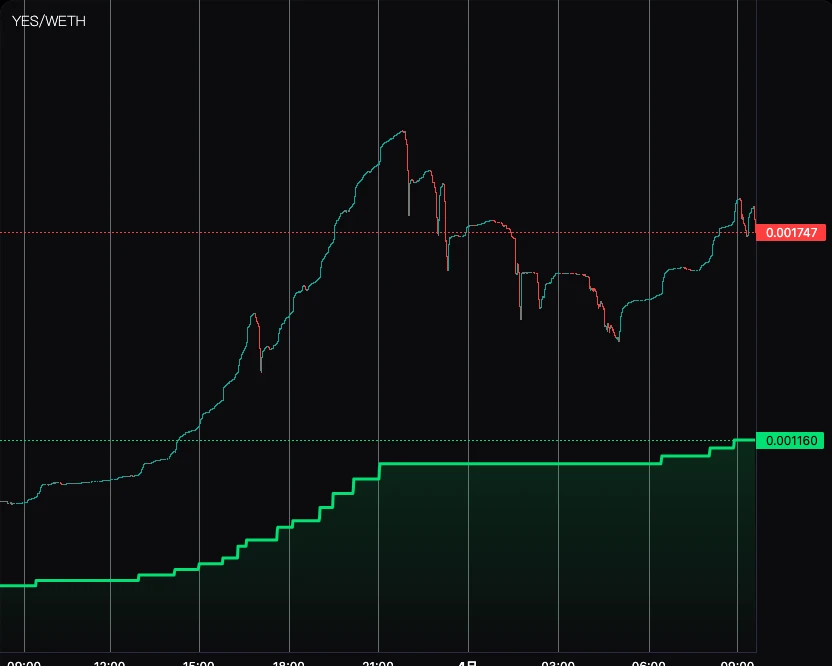
以 YES 当前的价格表现为例,其市价在创世后的数十个小时内一直存在着较大的涨跌波动,暂报 0.001747 WETH,但“基准价值”(BLV)却一直在维持着上涨态势,暂报 0.001160 WETH,二者之间实际上还存在着一定的价格距离。
解析Baseline(YES):庞氏新王?

那么,BLV 究竟如何取值?协议可利用的自有流动性又从何而来呢?

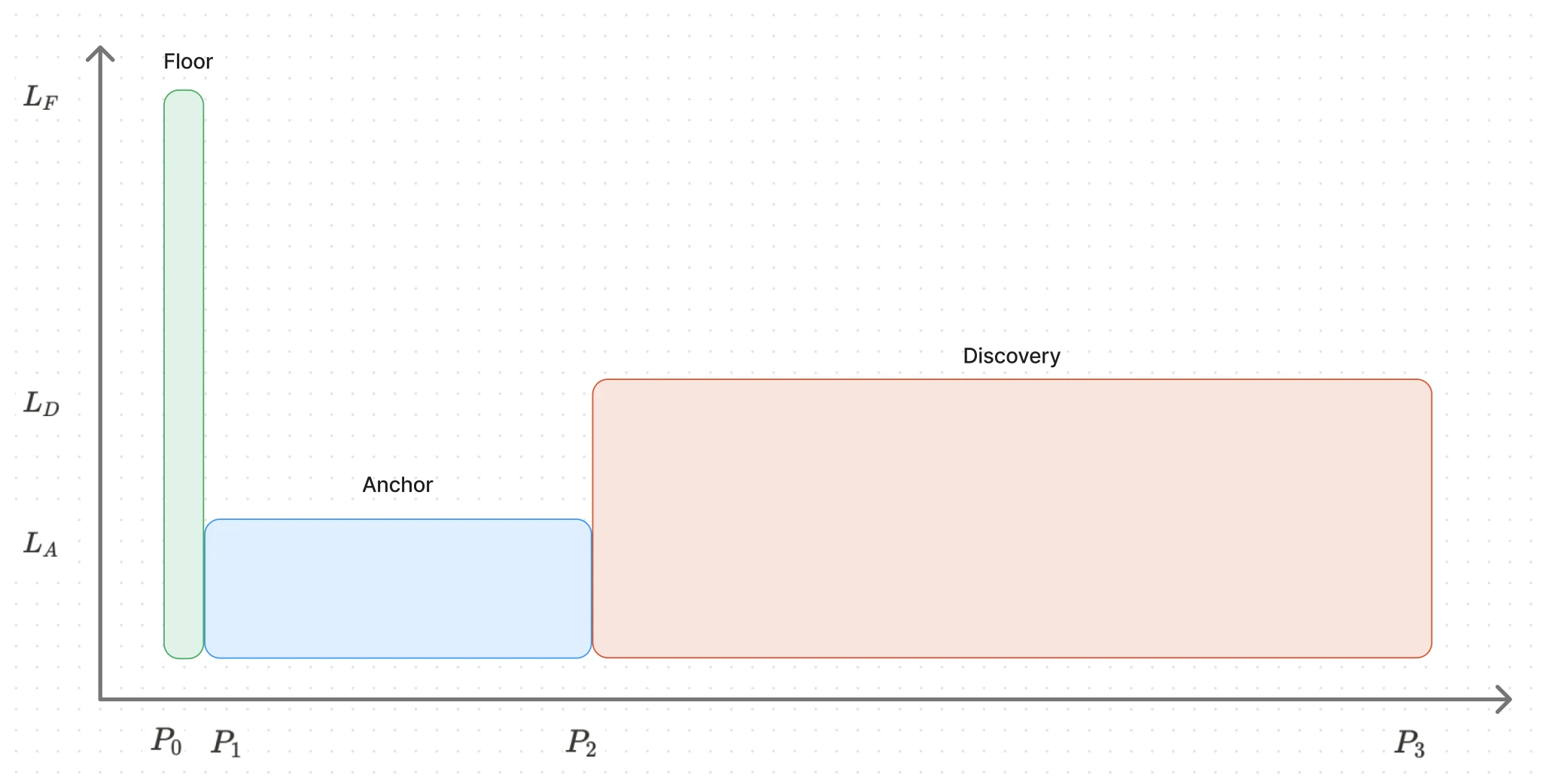
在 Baseline 的设计中,当基于该协议的代币被发行之时,Baseline 的做市策略会在 Uniswap V3 创建三个相互接续的做市范围,价格从低到高依次为“底价范围”(base position)、“锚定范围”(anchor position)以及“价格发现范围”(discovery position)。
解析Baseline(YES):庞氏新王?

  • “底价范围”负责将储备流动性集中在一个较密集的价格范围之内,其存在是为了在大规模抛压来临之际守住代币价格,该范围可防御的最低价位即为相应代币的 BLV。

  • “锚定范围”则负责将储备流动性分布至 BLV 至市价区间内的一个相对较宽的价格范围内,其存在是为了给正常的市场交易行为提供充足流动性。

  • “价格发现范围”则负责将新的代币流动性分布至从市价开始的一个很宽的价格范围内,其存在是为了促进价格的上行发现,并将新的代币供应分配至市场。

简单来说,“底价范围”的意义在于决定 BLV,即协议对代币价值的托底能力;“锚定范围”的意义在于让用户的正常交易更顺畅;“价格发现范围”则是新用户入场时购买新代币的地方。

根据官方文档的描述,Baseline 用于巩固 BLV 的自有流动性来源于协议收入,而该协议的收入合计来源于三个方面:一是通过 Uniswap V3 池子的手续费机制,从用户的买、卖中抽取 1% 作为收入;二是在通过 shift 函数重新调整做市范围时(具体见下一段)扣除一部分储备流动性;三是内置借贷模块的收入(下一 Part 会提到)。

随着协议收入逐渐累积,Baseline 将把这些收入不断投入至“底价范围”和“锚定范围”进行做市,从而不断抬高协议承接抛压的能力。这时,Baseline 会在代币价格上升至特定阈值时通过执行一个名为 shift 的函数来重新调整其三层做市范围 —— “底价范围”会抬升(BLV 上涨),“锚定范围”和“价格发现范围”亦将上调。

解析Baseline(YES):庞氏新王?

对应至上图 YES 的实际走势之中,我们可以看到其 BLV 会呈阶梯式地逐渐上涨,这实际上就是 Baseline 触发了 shift 函数,通过调整 “底价范围”提高了 BLV。

内置借贷:“左脚踩右脚”的魔术

除了做市层面的托底设计之外,Baseline 的另一项关键设计在于内置的借贷模块。

如果说 BLV 的创新决定了 YES 等 Baseline 代币的下限,内置借贷或许会对代币价格的上限有着更直接的影响。

根据 Baseline 的官方文档,该协议允许代币持有者使用 Baseline 代币作为抵押品借入资产。由于 Baseline 可保证每个代币的“基准价值”,因此协议允许持有者以较高的资金利用效率进行借款,且不会设置清算机制。

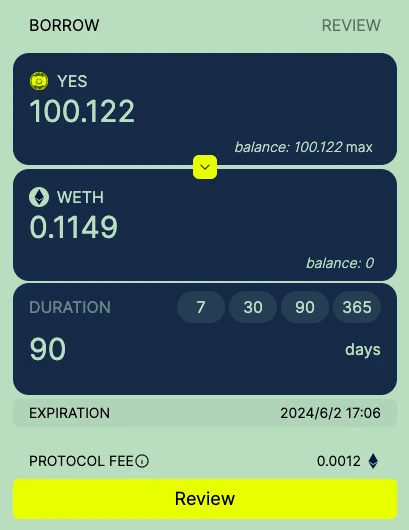
以下图的 YES 借贷为例,Baseline 允许用户以 YES 作为抵押品借出 ETH;贷款期限以天为单位,可以是任意天数;用户除了需要在开设借贷头寸时支付每日 0.01095% 的一次性费用外(前文提到过的协议收入),无需再承担其他利率成本;借贷头寸不会面临清算风险,若违约只会销毁作为抵押资产的 YES。
解析Baseline(YES):庞氏新王?

至于借出 WETH 之后可以做什么,Baseline 甚至直接在文档中的用例一栏中写道提到了可通过借出的 WETH 再次购买代币(YES),以实现杠杆循环,通过提高资金利用效率来扩大自身仓位。

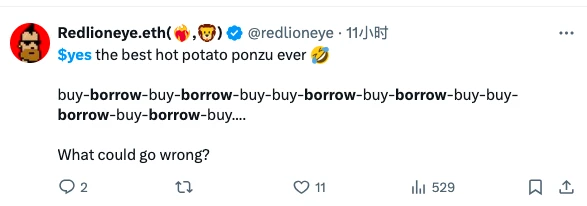
或许由于无需担心仓位本身风险,当前已有大量用户选择了执行上述操作模式,这也为 YES 凭空创建了大量买盘,不断提高了其市价表现,协议也通过累积手续费收入提高了 YES 的 BLV。
解析Baseline(YES):庞氏新王?

至此,“左脚踩右脚”登天之术已初具雏形。

协议曾遭黑客攻击?

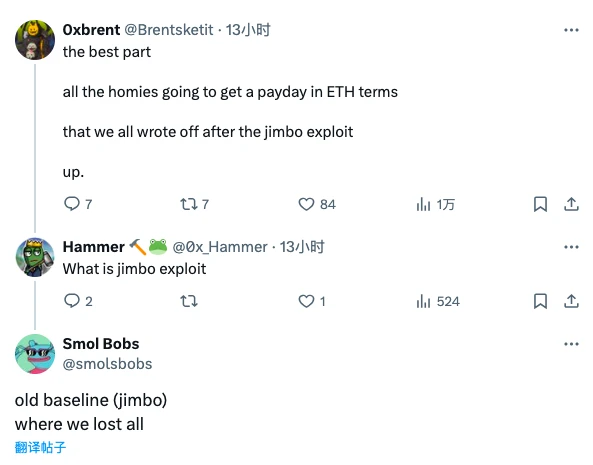
关于 Baseline,社区内的部分质疑来源于该项目的前身 Jimbos Protocol 曾于去年 5 月因黑客攻击损失 4048 ETH,当时价格约为 750 万美元。

事后,虽然 Jimbos Protocol 宣传已与司法机构合作试图逮捕攻击者,且向社区悬赏了约 80 万美元的高额赏金,但最终仍然无果,黑客已于去年 9 月将所有赃款转移到了 Tornado.cash。

也正是如此,虽然 Baseline 已宣布完成了 Trust Security 的第三方安全审计,但仍有许多社区成员对其安全状况持怀疑态度。
解析Baseline(YES):庞氏新王?

YES 还能上车吗?

结合当前情况来看,围绕着 YES 的 FOMO 情绪相当火热。

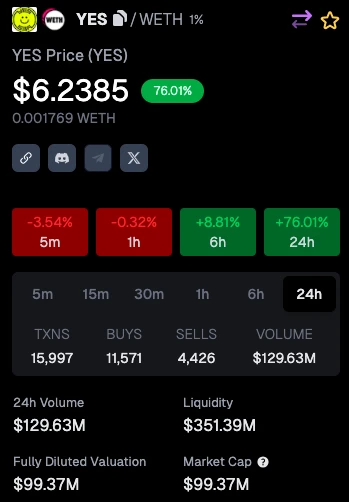
Gecko Terminal 实时数据显示,YES 目前暂报 6.2385 美元, 24 小时涨幅 76.01% ,对应市值为 9937 万美元。
解析Baseline(YES):庞氏新王?

Baseline 官网则显示,YES 目前的 BLV 暂报 0.00116 WETH,约合 4.1 美元,以此计算市价目前较 BLV 溢价约 52% 。

考虑到 Baseline 的分层做市机制,在不发生集中抛售的情况下,“底价范围”和“价格发现范围”会有一定的距离,因此市价较 BLV 存在一定溢价并不奇怪。

至于是否还能入场,我们并不会提供任何投资建议。对于愿意相信 Baseline 新合约质量,且有意尝试其机制的用户而言,请务必注意风险把控,DYOR。
Related Reads

Critical Game Week: BTC Retracement Confirmation vs. HYPE Support Battle | Guest Analysis

This weekly analysis outlines a critical juncture for BTC and HYPE markets, focusing on key price level confirmations. **BTC Analysis:** BTC is at a pivotal point after a five-wave rally from the June 5th low of $59,100. The price has broken below a short-term rising channel's lower boundary, with the current move seen as a pullback to test this breakdown. Failure to reclaim this level could lead to a retest of the $59,000-$60,000 support zone. The core scenario hinges on this channel retest outcome. * **Key Levels:** Resistance at $64,500-$65,000 (channel boundary) and $69,500-$70,500. Support at $59,000-$60,000 and $55,000. * **Strategy:** A core bearish stance is maintained (20% short from last week), with short-term plans for tactical trades. Three detailed contingency plans (A/B/C) are provided for short positions on resistance tests or breakdowns, emphasizing strict stop-loss discipline. **HYPE Analysis:** HYPE shows strong momentum but is currently in a corrective phase after hitting a new high of $76.94. The price is retesting the crucial $64-$66 support area. * **Key Levels:** Resistance near $77 and $80-$82. Support at $64-$66 and $52-$54. * **Strategy:** The short-term approach is "buy on dips, avoid chasing rallies." A long position is considered only if clear stabilization signals appear at the $64-$66 or deeper $52-$54 support zones, with tight risk controls. **General Risk Management:** A standardized trailing stop-loss protocol is emphasized: set initial stop, breakeven at +1% profit, then trail stops upward to lock in gains. *Disclaimer: All analysis is presented as a personal trading framework, not investment advice. Market conditions are complex and require dynamic adjustment.*

marsbit15m ago

Critical Game Week: BTC Retracement Confirmation vs. HYPE Support Battle | Guest Analysis

marsbit15m ago

Research Report Interpretation: Citi Attends AWS Summit, Bullish on Cloud Business Acceleration but Data Governance Remains Key Variable

Citi analyst Tyler Radke's team attended the AWS New York Summit (June 17-18), engaging with over 10 clients and partners. In a June 19 report, they highlighted the summit's focus on scaling agent AI for enterprise deployment. Citi maintains a "Buy" rating on Amazon, forecasting AWS revenue growth to accelerate to 37% in FY27 from 30% in FY26, noting this estimate may be conservative. Key takeaways: 1. **AWS Strategy Shift:** AWS is moving from proof-of-concepts to scalable deployment. New offerings like AWS Context (building enterprise knowledge graphs), Amazon Quick (cross-application AI assistant), and security tool Continuum address core enterprise pain points for AI adoption. 2. **Data Infrastructure Beneficiaries:** Data infrastructure companies like Snowflake, Elastic, Oracle, and ClickHouse are seen as direct beneficiaries of scaling AI workloads, as evidenced by strong growth and use cases presented. 3. **Critical Role of Data Governance:** As AI agents scale from hundreds to thousands, effective data governance becomes the key variable for deploying AI in core business processes. AWS Context represents AWS's strategic extension from providing compute/models to offering a data governance infrastructure layer. The report emphasizes that without solving data governance, AI will remain confined to pilot projects. The investment thesis focuses on AWS revenue acceleration and data infrastructure vendors' growth, while monitoring signals like AWS's quarterly revenue growth, Bedrock AgentCore task volume, and pricing impacts on companies like Elastic.

marsbit21m ago

Research Report Interpretation: Citi Attends AWS Summit, Bullish on Cloud Business Acceleration but Data Governance Remains Key Variable

marsbit21m ago

Crucial Week of Contention: BTC Tests Support and HYPE's Key Level Battle | Special Analysis

**Market Enters Critical Week: Bitcoin Pullback Test and HYPE Support Battle** The market enters a crucial phase of contention this week. The marginal shifts in Federal Reserve policy expectations continue to dictate the pricing rhythm for risk assets. Meanwhile, in the crypto market, following a period of sideways consolidation, the divergence between bulls and bears is becoming concentrated at key price levels. **Bitcoin (BTC) Analysis & Strategy** * **Technical View:** The 4-hour chart suggests BTC is in a five-wave structure since the June 5th low near $59,100. Price action shows a short-term rising channel. The recent drop below this channel's lower boundary is now being followed by a pullback attempt (wave 40-41). The outcome of this retest is critical. * **This Week's Outlook:** The core focus is whether BTC can reclaim and hold above the channel's lower boundary. * **Bullish Scenario:** A successful hold could lead to a continued rebound, potentially challenging the $69,500 - $70,500 resistance zone. * **Bearish Scenario:** Failure to hold may trigger a renewed test of the $59,000 - $60,000 core support area, with $55,000 as a deeper support level. * **Operational Strategy:** The author maintains a 20% mid-term short position initiated last week near $64,500, based on a model signaling a shift to a bearish structure. Short-term tactics involve using 30% capital for potential "spread" trades, with three contingency plans (A, B, C) outlined for reacting to resistance tests, breakouts, or support breakdowns. **HYPE Analysis & Strategy** * **Technical View:** On the 4-hour chart, HYPE shows strong momentum, having recently broken to a new high since January. The current pullback presents a clear three-wave correction structure, bringing the price back to the critical $64 - $66 support zone. * **This Week's Outlook:** The focus is on the battle for the $64 - $66 support area. * **Bullish Scenario:** Holding this support could signal a continuation of the uptrend from the June 10th low, leading to new highs. * **Bearish Scenario:** A breakdown could extend the correction, potentially testing the deeper $52 - $54 support band. * **Operational Strategy:** The recommended short-term approach is "buy on dips, avoid chasing rallies." A light long position (under 30% capital) could be considered if HYPE shows stabilization signals at the $64-$66 or $52-$54 support zones, confirmed by model signals. Strict stop-loss discipline is emphasized. **General Risk Management:** A strict trailing stop-loss protocol is advised: set an initial stop; move to breakeven at +1% profit; lock in profits progressively thereafter. *Disclaimer: All analysis is presented as the author's personal technical perspective and trading log, not as investment advice. Markets are complex and dynamic; risk control is paramount.*

Odaily星球日报21m ago

Crucial Week of Contention: BTC Tests Support and HYPE's Key Level Battle | Special Analysis

Odaily星球日报21m ago

AI Agents Also Need 'Credit Checks': ERC-8126 is Filling the Gap in On-chain Trust

The article discusses ERC-8126, a proposed standard designed to address the lack of trust and verification for AI Agents operating on-chain. While ERC-8004 provides AI Agents with a basic on-chain identity (answering "Who are you?"), it does not guarantee trustworthiness. ERC-8126 aims to fill this gap by establishing a verification layer (answering "Are you reliable?"). It standardizes how independent verification providers can assess an agent's associated risks across five key areas: Token/Contract Verification (ETV), Media Content Verification (MCV), Solidity Code Verification (SCV), Web Application Verification (WAV), and Wallet Verification (WV). These providers generate a standardized risk score (0-100) and proofs based on their checks, without acting as a single authoritative certifier. This allows wallets, marketplaces, dApps, and other agents to consume these risk signals—for example, to display warnings, filter listings, or make interaction decisions. The standard also incorporates concepts like Private Data Verification (PDV) and Zero-Knowledge Proofs (ZKP) to allow verification without exposing sensitive underlying data. Positioned alongside ERC-8004 (Identity) and ERC-8183 (Commerce for agents), ERC-8126 represents a step toward building a verifiable and accountable infrastructure for the emerging on-chain AI Agent economy, shifting trust assessment from purely user-based judgment to standardized, consumable signals.

marsbit39m ago

AI Agents Also Need 'Credit Checks': ERC-8126 is Filling the Gap in On-chain Trust

marsbit39m ago

Rented Conviction: How Much Real Money Is Behind the Bitcoin ETF Flows

Borrowed Belief: How much of Bitcoin ETF flows are real money? Weekly Bitcoin ETF flows, often interpreted as a measure of institutional conviction, are heavily influenced by a hidden arbitrage trade rather than genuine directional buying. A cash-and-carry arbitrage, where traders buy the ETF while simultaneously shorting Bitcoin futures on the CME to lock in a basis spread (the price difference between futures and spot), drives roughly half of the week-to-week flow volatility. This delta-neutral activity appears as ETF inflows but is unrelated to price views. Data shows a strong correlation (0.70) between weekly ETF inflows and increases in hedge fund short positions on CME futures, while Bitcoin’s weekly price returns have almost no explanatory power. However, this arbitrage activity dominates short-term *fluctuations*, not the cumulative *stock* of investments. Of the total ~$55 billion in net ETF inflows since launch, only about $1 billion currently represents net arbitrage exposure. The vast majority consists of steady, directional buying averaging around $400 million per week. The arbitrage trade has been unwinding for two years, with hedge fund short positions peaking near $14 billion in late 2024 and declining to ~$4.5 billion. Recent ETF outflows partly reflect this ongoing unwind as the basis compresses, not a loss of faith in Bitcoin. Thus, ETF flows overstate the *volatility* of belief, not its *level*. The headline number is more a gauge of arbitrage desk activity than conviction. For accurate interpretation, monitor the CME basis relative to Treasury yields and hedge fund net shorts—these reveal how much of the reported “demand” is truly directional.

marsbit42m ago

Rented Conviction: How Much Real Money Is Behind the Bitcoin ETF Flows

marsbit42m ago

Trading

Spot
Futures
活动图片