数据解读Farcaster:「DEGEN」成为应用内最高频词语

Odaily星球日报Published on 2024-02-28Last updated on 2024-02-28

Abstract

Farcaster是如何保持人们参与的?

原文作者:Sid Shekhar

原文编译:深潮 TechFlow

数据解读Farcaster:「DEGEN」成为应用内最高频词语

在 Farcaster 上一周的反应

加密货币一直是一项社区运动。社区定义了这个行业中的意义——无论是比特币被视为硬资产的模因,还是 NFT 项目被誉为继宝可梦和芭比娃娃之后下一个全球性大 IP。

围绕这些资产形成的社区围绕着共享的焦点兴趣点聚集在一起,创造出充满活力的,尽管是短暂的,生态系统。这些形成尽管引人入胜,但经常面临不可避免的难题,兴趣转移、参与度下降以及关注度的丧失。

这些群体内注意力的短暂性凸显了一个重大挑战:如何维持长期参与度。

Farcaster 是如何保持人们参与的?

Farcaster 现在拥有超过 20 万的用户,有趣的是,即使本月在 Frame 狂潮的影响下出现了曲棍球式的增长,每天的发布数量和参与度没有大幅下降。加密货币应用程序通常都以盈利为目的(用户努力追求下一个 10 倍或空投)而 Farcaster 却有着不同的 "氛围"。

我深入了解开源发布数据,量化是什么和谁驱动了这种氛围。以下是我最喜欢的一些 farcaster“人物画像”(附带一些有趣的统计数据):

提问者

将近 38% 的参与过投票的人都曾在网络上提出过问题。这些问题并不是普通的问题,而是往往具有深意的问题。从根本上说,用户对他人的意见感兴趣,并邀请他们进行对话。就数量而言:有近 40 万次发布中包含问题,约占所有发布的 6% !

数据解读Farcaster:「DEGEN」成为应用内最高频词语

来自/哲学频道的精选问题

上图是来自philosophy频道的精选问题。

回复者

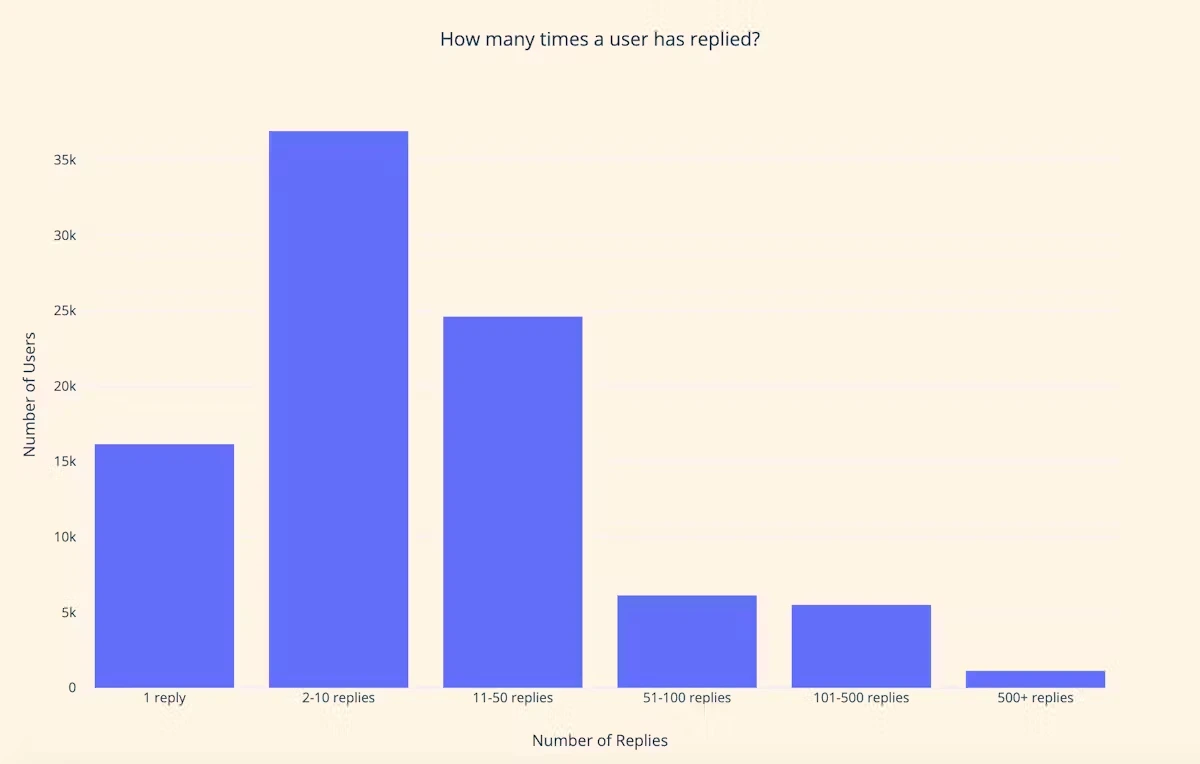
秉承 replyguys 的精神,Farcaster 上高达 64% 的发布都是回复。根据用户的回复次数进行分组时,大多数用户似乎都属于多次回复用户(如下图所示),一些极端回复用户的回复次数高达数千次(仅在几周的活动之后)。
数据解读Farcaster:「DEGEN」成为应用内最高频词语

长篇内容受到喜欢

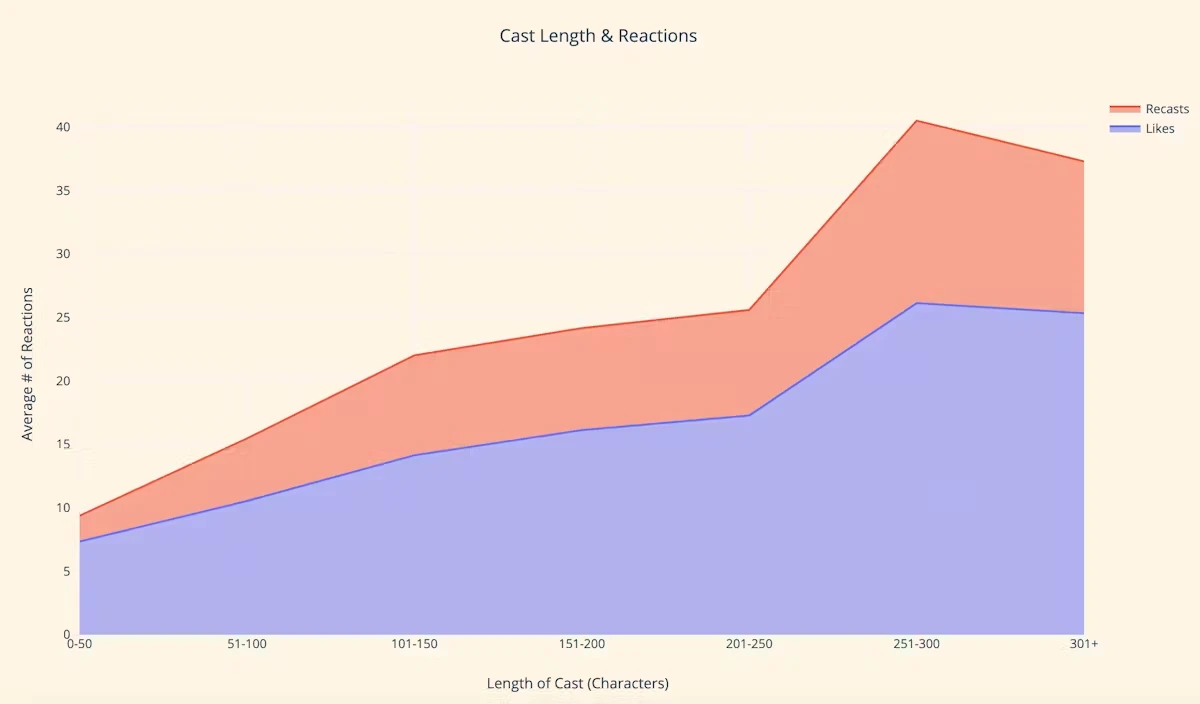
我们知道,发布者是狂热的书籍读者。原来,整个网络也喜欢发布中的长篇写作。数据显示,发布长度与用户参与度显著相关:更长的发布通常会收到更多的点赞和转发。尽管一般每次发布的字符限制约为 320 个字符,但数据告诉我们,深度和细节更能引起 Farcaster 观众的共鸣。
数据解读Farcaster:「DEGEN」成为应用内最高频词语

打赏者

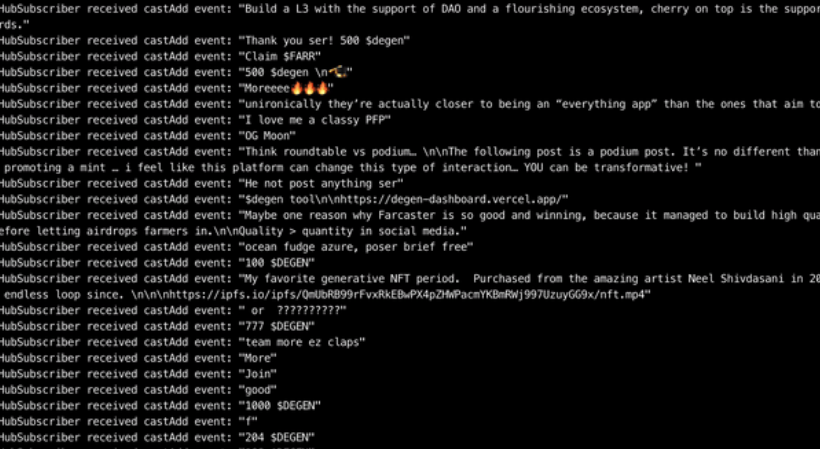
上周,我和一个朋友决定连接到 Farcaster Hub 的实时发布流。我们运行一会就意识到,我们屏幕的大部分都被$DEGEN 填满了。
数据解读Farcaster:「DEGEN」成为应用内最高频词语

从 Farcaster Hub 到 GRPC 订阅的实时源

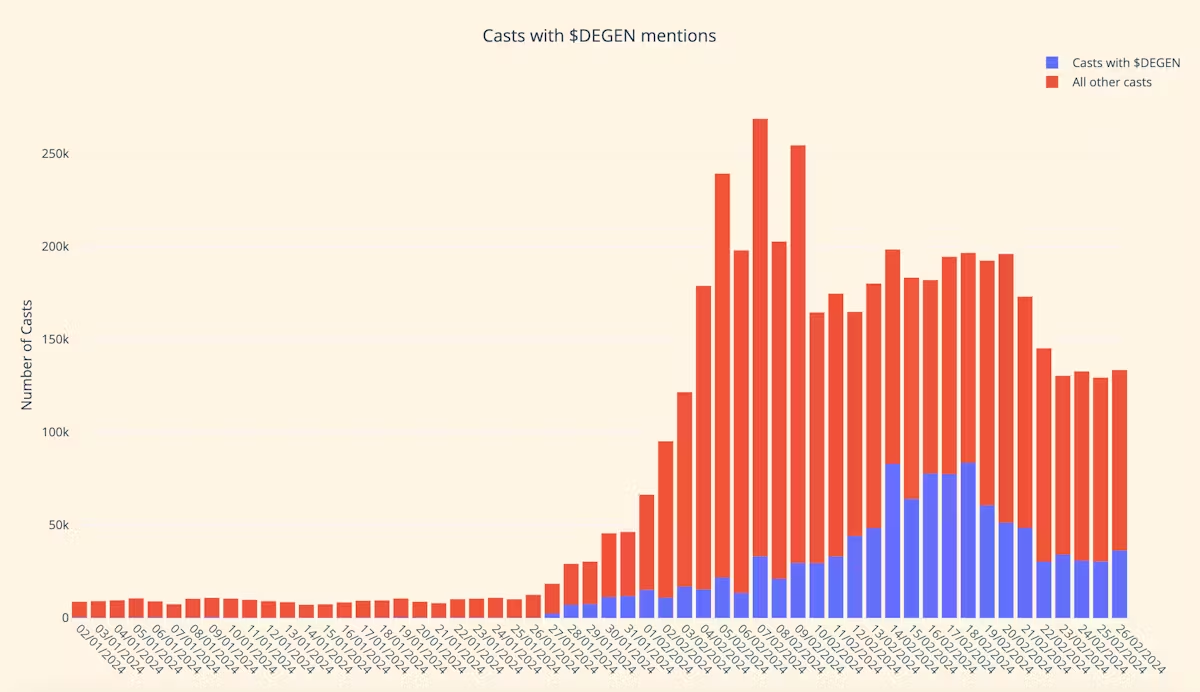
到目前为止,Farcaster 上使用最多的词是$DEGEN,其作为打赏货币的主要用途(人们可以回复一个发布,附上一个数字和$DEGEN 来打赏发布者)。虽然像 Steemit 这样的项目确实有支付帖子象征性金额的功能,但在社交媒体内容上打赏尚未在大规模上探索并取得成功。

关于这一现象的一些高层次统计数据:

超过 3.7 万名用户在某个时间点为 $DEGEN 投过票,近 16% 的投票中包含"$DEGEN"。
数据解读Farcaster:「DEGEN」成为应用内最高频词语

Builder

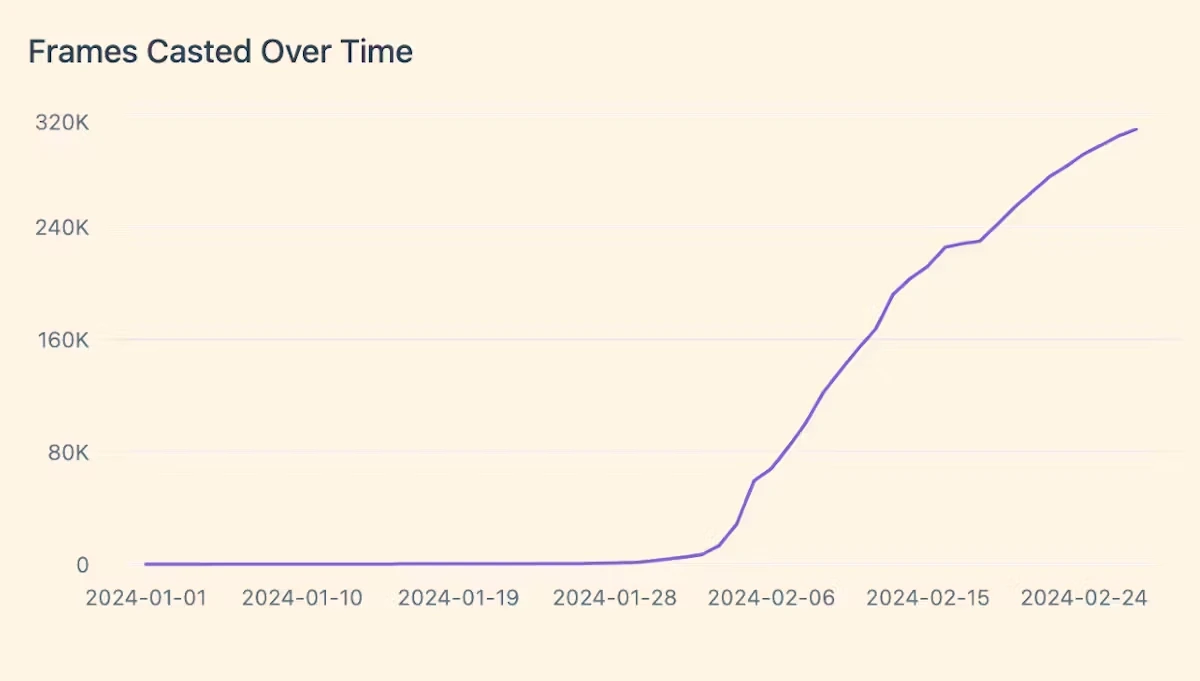
最后,让我们来谈谈房间里的大猩猩。Frames 的推出和 NFT 铸造、应用、游戏等的 frame-ification 为用户和开发者在 Feed 上解锁了大量创意和有趣的体验。不仅今年带有 Frames 的发布数量激增(见下文),而且 2024 年, Frame 的发布获得的点赞数占 Farcaster 上点赞总数的近 22% 。
数据解读Farcaster:「DEGEN」成为应用内最高频词语

来源:https://frames.spindl.xyz/

一些要点

a) 在增长的这个阶段,保持 Farcaster 参与度的是一种核心文化,即人们慷慨地分享他们的问题、回答、点赞、打赏和想法。深度参与 > 浅层参与。

b) 底层协议及其社交图谱是开放且可分析的,这非常棒。

我可能会深入研究更多此类数据,包括不断变化的渠道格局以及利基社区如何开始合并和发展。
Related Reads

Beyond the Model Lies the Harness: Deepseek Enters the Arena, Why Has the Main Battlefield of China's AI Competition Shifted?

In mid-to-late May 2026, Deepseek internally established a new Harness team focused on code agent products, internally benchmarked against Anthropic's Claude Code. This move, marked by the formula "Model + Harness = Agent" in their job postings, signals a major shift in China's AI competition: the main battlefield is transitioning from developing large models to building toolchains and achieving workplace integration. Deepseek's direct involvement in Harness development aims to secure control over interface design and training data feedback loops, moving beyond open-sourcing powerful models. Harness, the runtime infrastructure for AI agents, handles everything beyond model reasoning—task orchestration, tool calling, context management, safety checks, and error recovery. It is crucial because agent products are not just outputs of model capability but also training grounds for it. Real-world task failures recorded by Harness can feed back into model training, creating a flywheel effect. Engineering Harness is more critical than optimizing prompts, as poor context management or error handling can drastically reduce agent success rates in multi-step, real-world scenarios. This shift is not isolated. Other major Chinese tech companies are also pursuing differentiated toolchain strategies. Tencent leverages its enterprise ecosystem (WeChat Work, Tencent Cloud) to build connectors for organizational-level AI collaboration and complex task delivery. Alibaba focuses on lowering automation barriers on the web with a front-end, browser-based GUI Agent framework, PageAgent. This diversification shows the industry recognizes that success lies not in a perfect general agent, but in vertically focused solutions built with robust engineering. The trend is validated by overseas success, such as Poland's Viktor, an AI coworker on Slack achieving $20M ARR by autonomously executing complex, multi-step tasks. This proves a shift in enterprise willingness to pay—from "AI-assisted generation" to "AI-autonomous execution." As Harness matures to provide safety guards and reliability, AI transitions from a human-supervised intern to an independent outsourcer. The competition now faces key engineering challenges: preventing "token explosion" through intelligent context compression, and building "thick frameworks" with features like sandbox isolation and checkpoint recovery for enterprise-grade stability. Geopolitical restrictions on tools like Claude Code further create a significant market vacuum for domestic solutions like Deepseek's Harness. For enterprises and developers, the focus must shift from comparing model benchmarks to evaluating a vendor's engineering capabilities, error recovery mechanisms, context management, and ecosystem compatibility when choosing AI products and platforms.

marsbit4m ago

Beyond the Model Lies the Harness: Deepseek Enters the Arena, Why Has the Main Battlefield of China's AI Competition Shifted?

marsbit4m ago

Soaring Export Data for Memory Chips, Market Is Redefining the Valuation Anchor for Memory Stocks

Korean storage export data for the first 20 days of June shows substantial year-on-year increases in both value and price-per-kilogram for categories like DRAM, NAND, and SSDs. This signals a potential shift beyond simple demand recovery, indicating rising prices and a product mix shift towards higher-value items, possibly influenced by AI infrastructure needs. A key point is that the surge in price-per-kilogram is not simply a uniform chip price hike. It reflects a combination of actual price increases and, more importantly, an export structure increasingly dominated by high-value-density products like HBM (High-Bandwidth Memory) and advanced DRAM, which are critical for AI servers. This suggests AI-driven demand may be spilling over from just HBM into broader memory markets. SK Hynix stands to benefit directly due to its leading HBM position. For Samsung and Micron, the implication is potential for greater margin elasticity if the tightness in high-end memory spreads to enterprise SSD and NAND prices. However, the storage sector remains cyclical. Risks include supply expansion, inventory changes, and potential slowdowns in broader AI capital expenditure. Ultimately, while the strong export data supports upward revisions for storage company earnings and fuels discussion of an "AI infrastructure bottleneck premium," a definitive valuation shift from a cyclical to a structural story depends on upcoming quarterly reports. Investors need confirmation from SK Hynix, Samsung, and Micron that improvements in average selling prices, product mix, and, crucially,毛利率 are sustained over multiple quarters.

marsbit1h ago

Soaring Export Data for Memory Chips, Market Is Redefining the Valuation Anchor for Memory Stocks

marsbit1h ago

Why Does SpaceX Have Such a High Valuation Ceiling? The Answer Lies in Musk's Business Blueprint

SpaceX achieved a record-breaking IPO on June 12, 2026, with its market cap surging past $2.1 trillion. This valuation reflects its central role within Elon Musk's expansive, interconnected technological ecosystem. The article details how four core components form a synergistic closed-loop system: 1) **The "Brain" (xAI & Orbital Compute):** xAI provides AI models and massive ground/space-based supercomputing for simulation and decision-making across the system. 2) **The "Neural Logistics Core" (Starlink & Starship):** Starlink's low-latency satellite network enables global data transmission, while Starship's low-cost, reusable launch capacity aims to make large-scale space deployment economically viable. 3) **The "Physical Body" (Tesla & Optimus):** Tesla's manufacturing prowess and energy products support hardware production and power, pivoting toward mass-producing the Optimus humanoid robot for terrestrial and potential space-based labor. 4) **The "Human Interface" (Neuralink & X):** Neuralink seeks direct brain-computer communication, and the X platform provides real-time societal data. Together, these elements create three reinforcing "flywheels": manufacturing/logistics, data-driven iteration, and energy/compute/network synergy. This integrated approach promises lower costs, faster innovation cycles, and potential infrastructure-as-a-service offerings. However, it also concentrates technical, regulatory, and corporate governance risks. Ultimately, SpaceX's high valuation stems from its position as the indispensable infrastructural backbone—handling space transport, global communications, and future orbital computing—tying together Musk's entire vision for a self-reinforcing technological empire.

marsbit1h ago

Why Does SpaceX Have Such a High Valuation Ceiling? The Answer Lies in Musk's Business Blueprint

marsbit1h ago

Trading

Spot
Futures
活动图片