This Week in Coins: Bitcoin and Ethereum Hold Stable Amid Frantic News Cycle

DecryptPublished on 2023-10-08Last updated on 2023-10-08

Abstract

Ethereum and XRP both saw depreciation despite many positive developments.

It was a week full of headlines in crypto, but they weren't being made by market stalwarts Bitcoin and Ethereum. Their stable values suggest cryptocurrencies are less reactive to the current news cycle than they were during its heady 2021 bull run and subsequent 2022 crash.

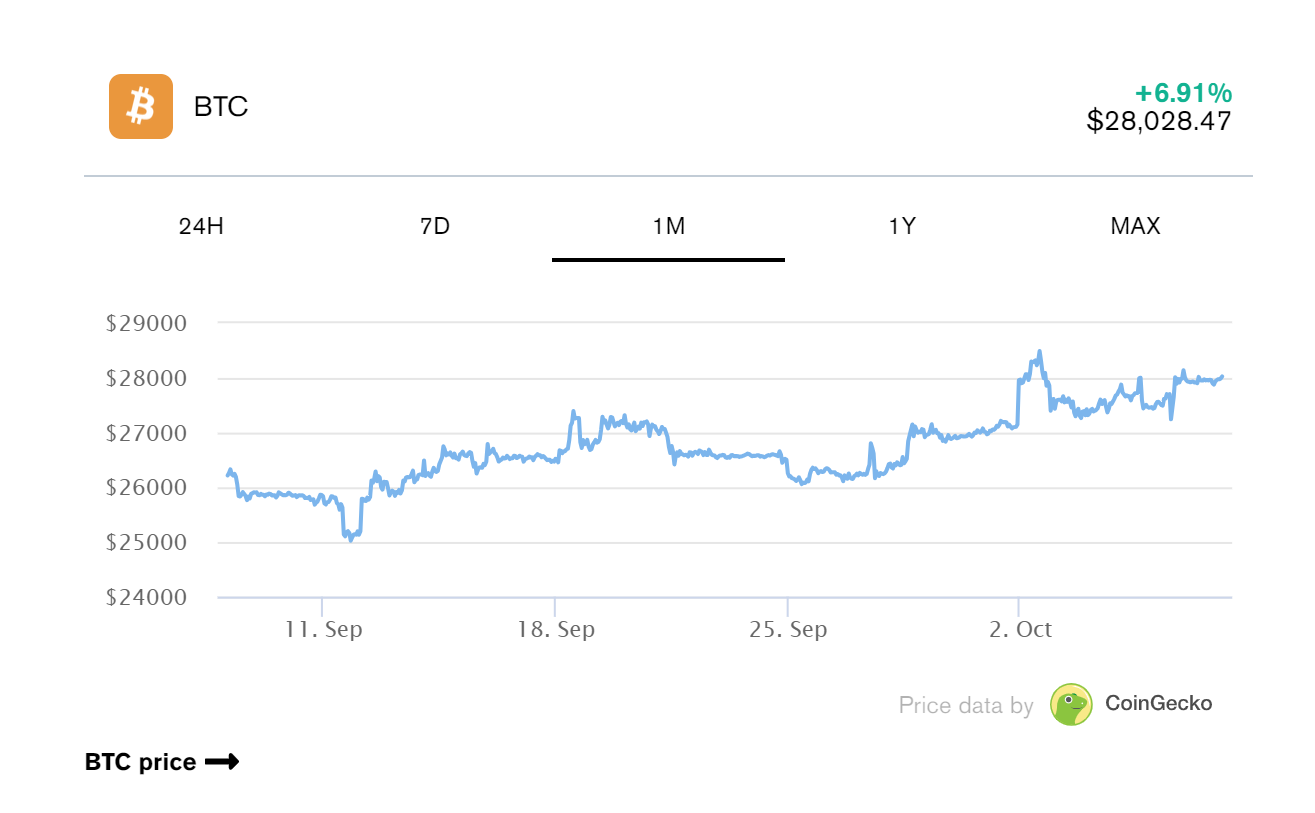
Market leader Bitcoin (BTC) grew a modest 2.7% over the seven days and now changes hands at $27,952. It briefly hit a two-month high on Sunday night when it crossed the $28,000 threshold.

The closest contender Ethereum (ETH) had a comparably harder week and lost 2.1% to trade at $1,636 at the time of writing. Its weak performance comes despite several positive announcements, including a UBS asset tokenization trial supported by the Monetary Authority of Singapore (MAS) and the launch of nine Ethereum Futures ETFs in the U.S. on Monday.

Grayscale announced on Monday that it hopes to convert its Ethereum trust into a spot ETF. The crypto asset manager’s application stems from its courtroom victory back in August when it won an appeal against the Securities and Exchange Commission after the latter rejected its application to convert its Bitcoin trust into a spot ETF.

The SEC also lost an appeal in its lawsuit against XRP progenitor Ripple this week. The SEC had hoped in vain that Judge Torres would reconsider her ruling that selling XRP to retail consumers doesn’t constitute a breach of American securities laws.

Ripple also secured a Major Payments Institution license from the MAS this week. However, the good news gains were reversed by the weekend. XRP fell 1.6% over the last seven days to hit $0.5224 by the weekend.

Only two cryptocurrencies posted any notable price movements, rallying around 15% this week: Avalanche (AVAX), which currently trades for $10.39, and Solana (SOL), which is currently worth $23.31.

On Monday, the Solana network's total value locked (TVL) hit a new 2023 high of $338.82 million.

The week began with Coinbase secured a Major Payment Institution (MPI) license from MAS. This development follows the In-Principle Approval (IPA) Coinbase received last year, part of a drive by the exchange to expand globally due to the uncertain regulatory climate on the company’s U.S. home turf.

On Tuesday, Helen Boyd, Head of Capital Markets at the independent regulatory watchdog the Financial Conduct Authority (FCA), announced that the British Treasury hopes to launch a Digital Securities Sandbox (DSS) by the end of the first quarter of next year.

A sandbox is a controlled test environment for those looking to bring innovative products to the market. The FCA already has a similar engagement via its Regulatory Sandbox where companies with viable products can begin pitching them to a closed circle of early customers, but the DSS has “a new rule set that would allow it to do new things with digital securities.”

On Thursday, Hong Kong’s police force and Securities and Futures Commission (SFC) launched a joint task force to monitor illegal activities on crypto exchanges following the suspension of trading on the JPEX exchange. The JPEX incident is one of the largest cases of financial fraud in Hong Kong history. involving at least 2,305 victims of the incident, who collectively have been defrauded of HK$1.43 billion ($182.9 million).

A report published this week by blockchain data platform Chainalysis shows that recent inflows to Hong Kong have rivaled that of mainland China over the past year, despite hosting only 0.5% of the latter’s population.

Finally this week, both Starbucks and the Museum of Modern Art launched NFTs.
Related Reads

Behind the Coinbase Acquisition of USDH: Hyperliquid’s Interest-Driven Choice

The article discusses the transition of the Hyperliquid ecosystem's native stablecoin, USDH, following its acquisition by Coinbase. Last September, USDH, issued by Native Markets, was a focal point in the ecosystem. Recently, Coinbase announced it will become the official USDC treasury deployer on Hyperliquid. Native Markets granted Coinbase the rights to purchase the USDH brand assets, leading to the gradual phase-out of USDH. Users can convert USDH to USDC or fiat without fees during this period. USDC is now Hyperliquid's official stablecoin. The move is framed as a three-way win: * **Coinbase & Circle:** Deepen ties with Hyperliquid's on-chain economy. Both companies are staking HYPE tokens. Circle had already invested in HYPE previously. * **Hyperliquid:** Becomes the primary beneficiary, set to receive the vast majority (estimated ~90%) of the reserve yield income from the ~$5.16 billion in USDC on its platform. This could translate to significant daily HYPE buybacks. The alliance with Coinbase may also offer regulatory advantages in the US. * **Native Markets:** While exiting the stablecoin business, the team reportedly received economic compensation from Coinbase for the USDH brand assets, framing it as a successful conclusion to USDH's role. However, the article notes criticism from some Hyperliquid community members. They view the shift as a step back for decentralization and argue that the original USDH issuer vote was driven by internal interests rather than user benefit, leaving regular users with nothing. The conclusion reflects that the eventual partnership between Hyperliquid and the giants (Coinbase/Circle) underscores a reality of利益分配 (interest distribution) over initial ideals of community and ecosystem advocacy.

Odaily星球日报50m ago

Behind the Coinbase Acquisition of USDH: Hyperliquid’s Interest-Driven Choice

Odaily星球日报50m ago

Google and Microsoft Battle in the AI PC Arena: Is Local Computing Power an IQ Tax? Is the Cloud PC the Ultimate Form?

Google and Microsoft are competing in the AI PC arena, with the article questioning whether powerful local AI hardware is necessary. It argues that current "AI PCs" often rely heavily on cloud AI for complex tasks, making premium local AI silicon potentially less critical. Google recently unveiled "Android PCs," a new high-end productivity-focused product line. Unlike traditional AI PCs that add AI features to existing Windows systems, Android PCs position cloud-based AI, specifically Google's Gemini, as their core. The system deeply integrates AI, allowing context-aware assistance directly where the user is working, regardless of the underlying device hardware (x86 or ARM). The piece suggests that cloud computing might be the future for AI PCs. Unlike cloud gaming, which demands ultra-low latency, AI tasks are more tolerant of network delays, as users already expect some processing time. This makes the cloud-computing model well-suited for AI. Examples like Alibaba's "Wuying AI Cloud Computer" show how cloud services can offer robust AI capabilities without requiring powerful local hardware. This shift challenges the traditional PC model. With rising memory costs and limitations in consumer-grade local AI performance, the "light local, heavy cloud" approach offers an alternative. It could lead to devices that primarily need a good display and network connection, with heavy AI lifting done remotely. However, the transition is just beginning. Traditional players like Microsoft are pushing both local AI standards (e.g., 40+ TOPS NPU requirements) and deeply integrating cloud AI (Copilot with GPT) into Windows. Apple leverages its tight ecosystem and has found success with more affordable MacBooks, potentially positioning it well for AI integration later. Chipmakers like Intel and AMD, while promoting local AI, also benefit massively from supplying data centers for the cloud AI infrastructure. The conclusion is that AI is redefining the PC. The future battle will involve cloud integration, OS-level AI, and cross-device ecosystems. While questions about network reliability, data privacy, and user adaptation remain, the era of the AI cloud computer seems to be on the horizon.

marsbit1h ago

Google and Microsoft Battle in the AI PC Arena: Is Local Computing Power an IQ Tax? Is the Cloud PC the Ultimate Form?

marsbit1h ago

World Cup Approaches, Prediction Markets Face a Major Test

The 2026 FIFA World Cup represents a major public test for sports prediction markets like Polymarket and Kalshi, which have grown significantly by offering tradable markets on event outcomes. This global event, hosted by the US, Canada, and Mexico, concentrates risks related to sports integrity, cross-border operations, and gambling ecosystems. A key concern is the potential for insider trading on non-public information (e.g., injuries, lineups), which could be exploited in granular prediction markets. FIFA's choice of its official prediction market partner, ADI Predictstreet, has raised significant doubts. The platform, relatively unknown, has faced scrutiny over the integrity of its executives—including past insider trading allegations and associations with a major EU corruption scandal—its rapid licensing in Gibraltar, and the fact its product was not yet live at the time of the announcement. This partnership begins with a "trust deficit." FIFA itself carries historical corruption baggage, and its deepening ties with betting and data industries fuel concerns about maintaining sporting integrity. While FIFA has established monitoring systems, their effectiveness against potential insider trading across decentralized global prediction markets remains unproven. Major US-based prediction platforms have updated rules to prohibit trading based on confidential information. However, the World Cup's complex ecosystem of federations, teams, and officials makes enforcement far more challenging than in domestic leagues. The event will not determine the fate of prediction markets but will critically test whether they can be integrated as a regulated event-trading infrastructure or remain a high-risk gambling-adjacent activity within global sports.

marsbit2h ago

World Cup Approaches, Prediction Markets Face a Major Test

marsbit2h ago

Trading

Spot
Futures

Hot Articles

What is $BITCOIN

DIGITAL GOLD ($BITCOIN): A Comprehensive Analysis Introduction to DIGITAL GOLD ($BITCOIN) DIGITAL GOLD ($BITCOIN) is a blockchain-based project operating on the Solana network, which aims to combine the characteristics of traditional precious metals with the innovation of decentralized technologies. While it shares a name with Bitcoin, often referred to as “digital gold” due to its perception as a store of value, DIGITAL GOLD is a separate token designed to create a unique ecosystem within the Web3 landscape. Its goal is to position itself as a viable alternative digital asset, although specifics regarding its applications and functionalities are still developing. What is DIGITAL GOLD ($BITCOIN)? DIGITAL GOLD ($BITCOIN) is a cryptocurrency token explicitly designed for use on the Solana blockchain. In contrast to Bitcoin, which provides a widely recognized value storage role, this token appears to focus on broader applications and characteristics. Notable aspects include: Blockchain Infrastructure: The token is built on the Solana blockchain, known for its capacity to handle high-speed and low-cost transactions. Supply Dynamics: DIGITAL GOLD has a maximum supply capped at 100 quadrillion tokens (100P $BITCOIN), although details regarding its circulating supply are currently undisclosed. Utility: While precise functionalities are not explicitly outlined, there are indications that the token could be utilized for various applications, potentially involving decentralized applications (dApps) or asset tokenization strategies. Who is the Creator of DIGITAL GOLD ($BITCOIN)? At present, the identity of the creators and development team behind DIGITAL GOLD ($BITCOIN) remains unknown. This situation is typical among many innovative projects within the blockchain space, particularly those aligning with decentralized finance and meme coin phenomena. While such anonymity may foster a community-driven culture, it intensifies concerns about governance and accountability. Who are the Investors of DIGITAL GOLD ($BITCOIN)? The available information indicates that DIGITAL GOLD ($BITCOIN) does not have any known institutional backers or prominent venture capital investments. The project seems to operate on a peer-to-peer model focused on community support and adoption rather than traditional funding routes. Its activity and liquidity are primarily situated on decentralized exchanges (DEXs), such as PumpSwap, rather than established centralized trading platforms, further highlighting its grassroots approach. How DIGITAL GOLD ($BITCOIN) Works The operational mechanics of DIGITAL GOLD ($BITCOIN) can be elaborated on based on its blockchain design and network attributes: Consensus Mechanism: By leveraging Solana’s unique proof-of-history (PoH) combined with a proof-of-stake (PoS) model, the project ensures efficient transaction validation contributing to the network's high performance. Tokenomics: While specific deflationary mechanisms have not been extensively detailed, the vast maximum token supply implies that it may cater to microtransactions or niche use cases that are still to be defined. Interoperability: There exists the potential for integration with Solana’s broader ecosystem, including various decentralized finance (DeFi) platforms. However, the details regarding specific integrations remain unspecified. Timeline of Key Events Here is a timeline that highlights significant milestones concerning DIGITAL GOLD ($BITCOIN): 2023: The initial deployment of the token occurs on the Solana blockchain, marked by its contract address. 2024: DIGITAL GOLD gains visibility as it becomes available for trading on decentralized exchanges like PumpSwap, allowing users to trade it against SOL. 2025: The project witnesses sporadic trading activity and potential interest in community-led engagements, although no noteworthy partnerships or technical advancements have been documented as of yet. Critical Analysis Strengths Scalability: The underlying Solana infrastructure supports high transaction volumes, which could enhance the utility of $BITCOIN in various transaction scenarios. Accessibility: The potential low trading price per token could attract retail investors, facilitating wider participation due to fractional ownership opportunities. Risks Lack of Transparency: The absence of publicly known backers, developers, or an audit process may yield skepticism regarding the project's sustainability and trustworthiness. Market Volatility: The trading activity is heavily reliant on speculative behavior, which can result in significant price volatility and uncertainty for investors. Conclusion DIGITAL GOLD ($BITCOIN) emerges as an intriguing yet ambiguous project within the rapidly evolving Solana ecosystem. While it attempts to leverage the “digital gold” narrative, its departure from Bitcoin's established role as a store of value underscores the need for a clearer differentiation of its intended utility and governance structure. Future acceptance and adoption will likely depend on addressing the current opacity and defining its operational and economic strategies more explicitly. Note: This report encompasses synthesised information available as of October 2023, and developments may have transpired beyond the research period.

363 Total ViewsPublished 2025.05.13Updated 2025.05.13

What is $BITCOIN

Discussions

Welcome to the HTX Community. Here, you can stay informed about the latest platform developments and gain access to professional market insights. Users' opinions on the price of BTC (BTC) are presented below.

活动图片