[dragon and tiger list] BTC's short-term volatility will increase, ETH's capital rate will remain low

Huobi ResearchPubblicato 2022-04-21Pubblicato ultima volta 2022-04-21

Introduzione

The volatility of BTC decreased and the demand for short-term change was strong.

1. Market trend: BTC is lower than the main moving average, and there is great rebound pressure

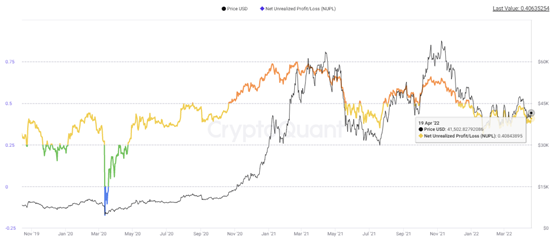
From the change of the ratio of unrealized gain to loss of BTC, this value reached 0.408 on April 19 and the lowest point of the year reached 0.314 on January 22. Historically, the ratio of realized gains to unrealized losses can be as low as less than 0.25. At present, the nupl index of BTC has been running in the low range within 2 years. If in a bull market, this value has increased to a low buying point. The expectation of BTC shrinkage adjustment remains unchanged. The long-term adjustment means that the nupl index is likely to continue to retreat, and the price decline is also expected.
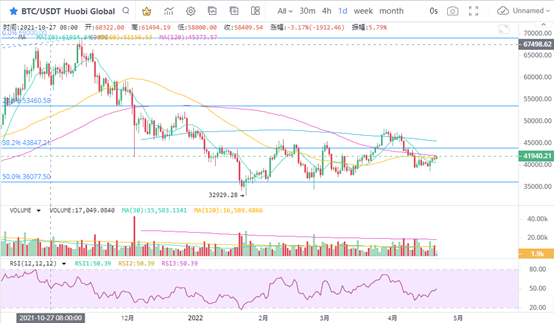
In terms of price, BTC in the daily K-line chart is already below the bonding areas of different moving averages, and the demand for further changes is very strong. In short, if BTC cannot maintain the upward breakthrough trend, it will choose to break down in the short term. Recently, the US dollar index has continued to strengthen, and the point has reached more than 100, which also puts great pressure on the rebound of BTC. In addition, the Fed's expectation of raising interest rates is very strong, and BTC is more likely to remain weak.
2. Interpretation of eth average capital rate:

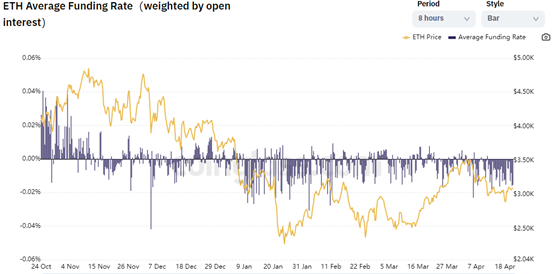
The average daily operating rate of eth is below - 0.02%, indicating that investors frequently buy eth funds. The decrease of financing cost means that the selling pressure of eth is large. Considering that the ETH point operates around us $3100, there are many opportunities for further downward change.

In terms of daily K-line, the bonding effect of eth moving average is more obvious, and the risk of short-term change is greater. In particular, the strong earthquake expectation is very strong, so we should pay attention to the high change expectation.
3. Dragon and tiger list:

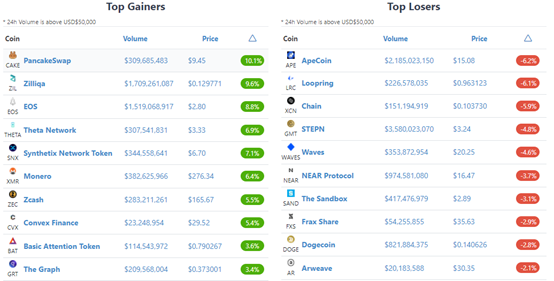
During the short-term rise of mainstream currencies, the overall market began to differentiate continuously. Among the currencies with the highest growth, the platform currency cake has a large short-term increase, while the old public chain ZIL, EOS and theta have the highest growth. At the same time, XmR and Zec rank relatively high, the market hot spots are relatively scattered, and it is more likely to grasp short-term opportunities.
CAKE

Pancakeswap (also known as pancake) is the top five decentralized exchange and the largest exchange on BSC (coin security intelligent chain), with the highest number of users. Pancakeswap has the following characteristics: the transaction cost is much lower than that on ERC chain (the cost of each transaction of BSC is about US $0.01 ~ 0.3), and the transaction cost of ERC chain is about US $200. Most emerging currencies on the currency security chain can be traded in pancakeswap.

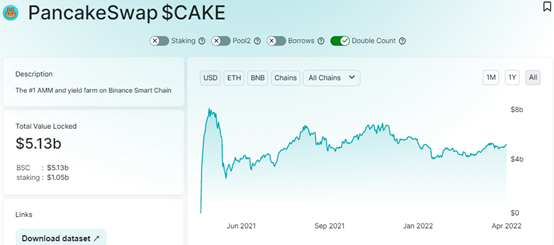
In terms of position locking, the amount of cake position locking remained stable, reaching US $5.13 billion on April 21. Although it is lower than the highest peak of $7.79 billion on March 3, 2021, the TVL value of cake is very stable during the year, which supports the expectation of cake rebound.

In terms of 24-hour increase, cake rose to 10.1%, continuing the recovery trend since mid March. The daily trading volume is not high, and the rhythm of price recovery is relatively mild.
EOS

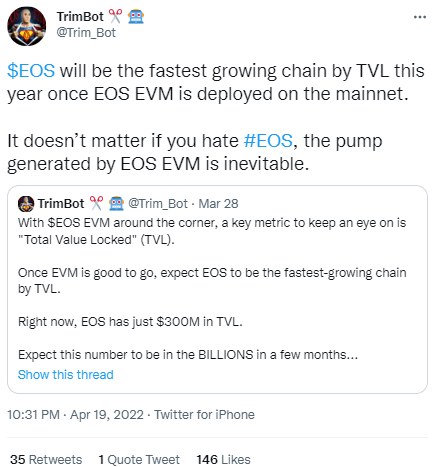
As an old public chain, EOS's TVL ranks 27th in the public chain. On April 21, 2022, the value showed that it was $280 million. Although the lock up volume is not high, the recent action of EOS foundation is expected to change this situation.

On April 19, 2022, EOS network foundation held eosevm press conference and AMA activity in twitterspaces. Yves LaRose, founder and CEO of EOS network foundation, Matias Romeo, technical director of EVM working group and Dr. yarkin, core member of EVM product team, attended the event and delivered a keynote speech around this major event.

At the press conference, Yves LaRose described in detail the original intention of EOS network foundation, its main t contribution after taking over EOS and the changes brought to eosio by Mandel upgrade, and announced the official brand of eosevm - trust. According to its description, trust will operate as an independent project, and then the developer preview version of trust will be officially opened. At the same time, a token named EVM will be issued in the future as part of EVM value products. The release of trust (token: EVM) will help EOS further complete the ecological diversification, make EVM's defi project benefit from yield, and further stimulate the TVL improvement of EOS.

Therefore, although the recent price trend of EOS is relatively mild, it is expected to continue to rise, which is worthy of attention.
XMR and ZEC

Private currency XmR and Zec led the short-term increase, indicating that the hot plates are relatively scattered under the current market. The short-term performance of private currency is good. In contrast, the short-term increase of BTC is limited. We can continue to pay attention to the adjustment expectation in the near future.

Decline list

Among the currencies with the highest decline, ape, GMT, waves and near led the decline, indicating that the performance of hot currencies is poor and the market is on the eve of change. The overall market sectors rose and fell with each other. While paying attention to BTC's changing direction, we need to pay more attention to the risk of currency holding.

Letture associate

DeFi Has Reached Its Most Dangerous Moment: The Real Vulnerabilities Are Not in the Code

DeFi in Peril: The Real Vulnerability Isn't in the Code April 2026 marked a paradigm shift in DeFi security, with over $625 million lost across 30 incidents—the worst month in crypto history by event count. Crucially, none of the major exploits (Drift Protocol: $285M, KelpDAO: $292M, Wasabi Protocol: $4.5M) resulted from smart contract vulnerabilities. Instead, failures occurred in the operational "plumbing": social engineering to compromise multi-signature councils, a single-point-of-failure 1-of-1 bridge validator, and stolen admin private keys. These events expose a fundamental misalignment: the industry's security model has long focused on code audits, while the actual attack surface has shifted to privileged access points and off-chain infrastructure. The article introduces the term "OpenFi" to describe this reality: permissionless, on-chain, yet operationally dependent on trusted third parties (admins, validators, oracles) at key junctures. The KelpDAO exploit vividly demonstrated asymmetric "contagion risk." A configuration error in a smaller protocol triggered a panic, causing approximately $13.2 billion in outflows from larger, unaffected protocols like Aave within 48 hours, as users fled uncertain collateral. The core dilemma is the double-edged sword of centralization. Operational levers like emergency councils (e.g., Arbitrum freezing stolen funds post-KelpDAO) enable crisis response but also create catastrophic attack surfaces if compromised (e.g., Drift). The path forward demands radical honesty: protocols must clearly disclose their trust assumptions, operational levers, and failure modes. The industry must treat operational security (key management, configurations, incident response) with the same rigor as code security. Survival depends on building systems whose risks can be understood, priced, and insured, moving beyond the outdated "code is law" mantra to a mature model of disclosed and managed trust.

链捕手7 h fa

DeFi Has Reached Its Most Dangerous Moment: The Real Vulnerabilities Are Not in the Code

链捕手7 h fa

Vitalik's Article Emphasizes Ethereum Must Be 'Amazing', But Foundation Is Not the Center

Vitalik Buterin has published a lengthy response to recent community criticism directed at the Ethereum Foundation (EF). Acknowledging a sense of "unease," he addresses concerns about the EF's strategic direction, its perceived disconnect from ETH's price performance, and calls for its reduced central role. Vitalik rejects the notion that the EF should be the central governing body of Ethereum, framing it instead as one "node with a clear mandate" among many within the ecosystem. He highlights the EF's limited ETH holdings (≈0.16% of supply) compared to other blockchain foundations and states it will no longer sell significant amounts of ETH. Its future focus will be on long-term, critical projects that align with Ethereum's core values of censorship-resistance and decentralization, which might not otherwise happen. A core argument is that Ethereum must be "amazing," but not by merely chasing higher transaction speeds at the cost of decentralization. He proposes focusing on the "CROPS" dimensions: creating a Cryptographically provable, Reliable, Open, Private, and Secure network. This includes pursuing goals like a formally verifiable, bug-free Ethereum client and minimizing protocol-level reliance on intermediaries. The article concludes by noting that while Vitalik clarifies the EF's refocused role, he does not directly address community suggestions for creating a new organization explicitly aligned with ETH's economic interests. This "alignment gap" is presented as a key challenge for Ethereum's future.

链捕手7 h fa

Vitalik's Article Emphasizes Ethereum Must Be 'Amazing', But Foundation Is Not the Center

链捕手7 h fa

Galxe: How a Quest Platform Evolved into Web3's Growth Infrastructure

Galxe, once perceived as a simple Web3 quest platform, has evolved into a core growth infrastructure within the Web3 ecosystem. It addresses a fundamental Web3 growth dilemma: the lack of a mature, systematic user acquisition and retention system akin to Web2's advertising and analytics platforms. While users complete quests (social tasks, on-chain interactions) for rewards, Galxe's true innovation lies in transforming these fragmented, one-off actions into lasting, verifiable identity credentials. This process of *behavioral assetization* creates a persistent record of a user's activities across projects and chains. For users, their wallet accumulates a valuable history that can unlock future access and rewards, fostering a "profile-building" mentality. For projects, Galxe provides a pre-screened user pool with rich behavioral data, enabling targeted outreach to users based on their specific on-chain history and community engagement. Galxe employs a gamefied growth path, guiding users from low-friction social tasks into deeper, valuable on-chain interactions through a structured progression of quests. This solves the incentive-behavior mismatch common in Web3, filtering users by their willingness to engage. Beyond quests, products like Passport (identity verification) and Starboard (community analytics) position Galxe as a comprehensive growth operating system. The platform's defensible advantage is its self-reinforcing data and network flywheel: more projects attract more users, enriching behavioral data; richer data enables better user targeting, attracting more projects. Ultimately, Galxe is shifting Web3's growth logic from short-term "reward-driven" traffic towards a long-term "identity-driven" relationship model, where a user's accumulated on-chain履历 becomes a core asset.

marsbit7 h fa

Galxe: How a Quest Platform Evolved into Web3's Growth Infrastructure

marsbit7 h fa

Trading

Spot
Futures

Articoli Popolari

Cosa è BITCOIN

Comprendere HarryPotterObamaSonic10Inu (ERC-20) e la sua posizione nel mondo delle criptovalute Negli ultimi anni, il mercato delle criptovalute ha assistito a un aumento della popolarità delle meme coin, catturando l'interesse non solo dei trader, ma anche di coloro che cercano coinvolgimento comunitario e valore di intrattenimento. Tra questi token unici c'è HarryPotterObamaSonic10Inu (ERC-20), un progetto intrigante che mescola riferimenti culturali nel tessuto delle criptovalute. Questo articolo esplora gli aspetti chiave di HarryPotterObamaSonic10Inu, analizzando i suoi meccanismi, l'etica guidata dalla comunità e il suo coinvolgimento con il panorama crittografico più ampio. Che cos'è HarryPotterObamaSonic10Inu (ERC-20)? Come suggerisce il suo nome, HarryPotterObamaSonic10Inu è una meme coin costruita sulla blockchain di Ethereum, classificata secondo lo standard ERC-20. A differenza delle criptovalute tradizionali che possono enfatizzare l'utilità pratica o il potenziale investimento, questo token prospera grazie al valore di intrattenimento e alla forza della sua comunità. Il progetto mira a creare un ambiente in cui gli utenti coinvolti possono riunirsi, condividere idee e partecipare ad attività ispirate a diversi fenomeni culturali. Una caratteristica notevole di HarryPotterObamaSonic10Inu è la zero tassa sulle transazioni. Questo elemento allettante tende a incoraggiare il trading e il coinvolgimento della comunità, privo di costi aggiuntivi che possono scoraggiare i trader di piccole dimensioni. L'offerta totale della moneta è fissata a un miliardo di token, un numero che segna la sua intenzione di mantenere una circolazione sostanziale all'interno della comunità. Creatore di HarryPotterObamaSonic10Inu (ERC-20) Le origini di HarryPotterObamaSonic10Inu sono avvolte in un certo mistero; i dettagli sul creatore rimangono sconosciuti. Lo sviluppo di questo token non presenta un team identificabile o un piano esplicito, cosa non rara nel settore delle meme coin. Invece, il progetto è emerso organicamente, con il suo progresso fortemente dipendente dall'entusiasmo e dalla partecipazione della sua comunità. Investitori di HarryPotterObamaSonic10Inu (ERC-20) Per quanto riguarda investimenti esterni e finanziamenti, HarryPotterObamaSonic10Inu rimane ambiguo. Il token non elenca alcuna fondazione di investimento conosciuta o un sostegno organizzativo significativo. Invece, la linfa vitale del progetto è la sua comunità di base, che informa la sua crescita e sostenibilità attraverso azioni collettive e coinvolgimento nello spazio crittografico. Come funziona HarryPotterObamaSonic10Inu (ERC-20)? In quanto meme coin, HarryPotterObamaSonic10Inu opera principalmente al di fuori delle strutture tradizionali che governano spesso il valore degli asset. Ci sono diversi aspetti distintivi che definiscono il funzionamento del progetto: Transazioni senza tasse: Senza costi fiscali sulle transazioni, gli utenti possono comprare e vendere liberamente il token senza preoccuparsi di costi nascosti. Coinvolgimento della comunità: Il progetto prospera sull'interazione della comunità, sfruttando le piattaforme social per creare entusiasmo e facilitare il coinvolgimento. Discussioni, condivisione di contenuti e coinvolgimento sono elementi cruciali che aiutano ad espandere la sua portata e a favorire la lealtà tra i sostenitori. Nessuna utilità pratica: Va notato che HarryPotterObamaSonic10Inu non offre un'utilità concreta all'interno dell'ecosistema finanziario. Piuttosto, è classificato come un token principalmente per attività di intrattenimento e comunitarie. Riferimento culturale: Il token incorpora astutamente elementi della cultura pop per attirare interesse, collegandosi a appassionati di meme e seguaci delle criptovalute. HarryPotterObamaSonic10Inu esemplifica come le meme coin operino in modo diverso rispetto ai progetti di criptovalute più tradizionali, entrando nel mercato come costrutti sociali innovativi piuttosto che come asset utilitari. Cronologia di HarryPotterObamaSonic10Inu (ERC-20) La storia di HarryPotterObamaSonic10Inu è segnata da diversi traguardi notevoli: Creazione: Il token è emerso da un meme virale, catturando l'immaginazione di molti appassionati di criptovalute. Le date di creazione specifiche non sono disponibili, sottolineando la sua crescita organica. Inserimento negli scambi: HarryPotterObamaSonic10Inu ha fatto il suo ingresso in vari scambi, consentendo un accesso e un trading più facili da parte della comunità. Iniziative di coinvolgimento della comunità: Attività in corso volte a migliorare l'interazione della comunità, comprese gare, campagne sui social media e generazione di contenuti da parte di fan e sostenitori. Piani di espansione futura: La tabella di marcia del progetto include il lancio di una collezione NFT, merchandising e un sito di eCommerce relativo ai suoi temi culturali, coinvolgendo ulteriormente la comunità e cercando di aggiungere più dimensioni al suo ecosistema. Punti chiave su HarryPotterObamaSonic10Inu (ERC-20) Natura guidata dalla comunità: Il progetto dà priorità al contributo collettivo e alla creatività, garantendo che il coinvolgimento degli utenti sia al centro del suo sviluppo. Classificazione come meme coin: Rappresenta l'epitome delle criptovalute basate sull'intrattenimento, distinguendosi dai veicoli d'investimento tradizionali. Nessuna affiliazione diretta con Bitcoin: Nonostante la somiglianza nel nome del ticker, HarryPotterObamaSonic10Inu è distintivo e non ha alcuna relazione con Bitcoin o altre criptovalute consolidate. Focus sulla collaborazione: HarryPotterObamaSonic10Inu è progettato per creare uno spazio per la collaborazione e la condivisione di storie tra i suoi detentori, fornendo un canale per la creatività e il legame comunitario. Prospettive future: L'ambizione di espandersi oltre il suo presupposto iniziale verso NFT e merchandising delinea un percorso per il progetto per potenzialmente entrare in strade più mainstream all'interno della cultura digitale. Poiché le meme coin continuano a catturare l'immaginazione della comunità crittografica, HarryPotterObamaSonic10Inu (ERC-20) si distingue per i suoi legami culturali e il suo approccio centrato sulla comunità. Anche se potrebbe non adattarsi al modello tipico di un token orientato all'utilità, la sua essenza risiede nella gioia e nella camaraderia coltivate tra i suoi sostenitori, evidenziando la natura in evoluzione delle criptovalute in un'epoca sempre più digitale. Con la continuazione dello sviluppo del progetto, sarà importante osservare come le dinamiche della comunità influenzano la sua traiettoria nel panorama in continuo cambiamento della tecnologia blockchain.

1.5k Totale visualizzazioniPubblicato il 2024.04.01Aggiornato il 2024.12.03

Cosa è BITCOIN

Come comprare BTC

Benvenuto in HTX.com! Abbiamo reso l'acquisto di Bitcoin (BTC) semplice e conveniente. Segui la nostra guida passo passo per intraprendere il tuo viaggio nel mondo delle criptovalute.Step 1: Crea il tuo Account HTXUsa la tua email o numero di telefono per registrarti il tuo account gratuito su HTX. Vivi un'esperienza facile e sblocca tutte le funzionalità,Crea il mio accountStep 2: Vai in Acquista crypto e seleziona il tuo metodo di pagamentoCarta di credito/debito: utilizza la tua Visa o Mastercard per acquistare immediatamente BitcoinBTC.Bilancio: Usa i fondi dal bilancio del tuo account HTX per fare trading senza problemi.Terze parti: abbiamo aggiunto metodi di pagamento molto utilizzati come Google Pay e Apple Pay per maggiore comodità.P2P: Fai trading direttamente con altri utenti HTX.Over-the-Counter (OTC): Offriamo servizi su misura e tassi di cambio competitivi per i trader.Step 3: Conserva Bitcoin (BTC)Dopo aver acquistato Bitcoin (BTC), conserva nel tuo account HTX. In alternativa, puoi inviare tramite trasferimento blockchain o scambiare per altre criptovalute.Step 4: Scambia Bitcoin (BTC)Scambia facilmente Bitcoin (BTC) nel mercato spot di HTX. Accedi al tuo account, seleziona la tua coppia di trading, esegui le tue operazioni e monitora in tempo reale. Offriamo un'esperienza user-friendly sia per chi ha appena iniziato che per i trader più esperti.

3.8k Totale visualizzazioniPubblicato il 2024.12.12Aggiornato il 2025.03.21

Come comprare BTC

Cosa è $BITCOIN

ORO DIGITALE ($BITCOIN): Un'Analisi Completa Introduzione all'ORO DIGITALE ($BITCOIN) L'ORO DIGITALE ($BITCOIN) è un progetto basato su blockchain che opera sulla rete Solana, con l'obiettivo di combinare le caratteristiche dei metalli preziosi tradizionali con l'innovazione delle tecnologie decentralizzate. Sebbene condivida un nome con Bitcoin, spesso definito “oro digitale” a causa della sua percezione come riserva di valore, l'ORO DIGITALE è un token separato progettato per creare un ecosistema unico all'interno del panorama Web3. Il suo obiettivo è posizionarsi come un asset digitale alternativo valido, anche se i dettagli riguardanti le sue applicazioni e funzionalità sono ancora in fase di sviluppo. Cos'è l'ORO DIGITALE ($BITCOIN)? L'ORO DIGITALE ($BITCOIN) è un token di criptovaluta esplicitamente progettato per l'uso sulla blockchain di Solana. A differenza di Bitcoin, che fornisce un ruolo di stoccaggio di valore ampiamente riconosciuto, questo token sembra concentrarsi su applicazioni e caratteristiche più ampie. Aspetti notevoli includono: Infrastruttura Blockchain: Il token è costruito sulla blockchain di Solana, nota per la sua capacità di gestire transazioni ad alta velocità e a basso costo. Dinamiche di Offerta: L'ORO DIGITALE ha un'offerta massima fissata a 100 quadrilioni di token (100P $BITCOIN), sebbene i dettagli riguardanti la sua offerta circolante siano attualmente non divulgati. Utilità: Sebbene le funzionalità precise non siano esplicitamente delineate, ci sono indicazioni che il token potrebbe essere utilizzato per varie applicazioni, potenzialmente coinvolgendo applicazioni decentralizzate (dApp) o strategie di tokenizzazione degli asset. Chi è il Creatore dell'ORO DIGITALE ($BITCOIN)? Attualmente, l'identità dei creatori e del team di sviluppo dietro l'ORO DIGITALE ($BITCOIN) rimane sconosciuta. Questa situazione è tipica tra molti progetti innovativi nel settore blockchain, in particolare quelli allineati con la finanza decentralizzata e i fenomeni delle meme coin. Sebbene tale anonimato possa favorire una cultura guidata dalla comunità, intensifica le preoccupazioni riguardo alla governance e alla responsabilità. Chi sono gli Investitori dell'ORO DIGITALE ($BITCOIN)? Le informazioni disponibili indicano che l'ORO DIGITALE ($BITCOIN) non ha alcun sostenitore istituzionale noto o investimenti di venture capital prominenti. Il progetto sembra operare su un modello peer-to-peer incentrato sul supporto e sull'adozione della comunità piuttosto che su percorsi di finanziamento tradizionali. La sua attività e liquidità si trovano principalmente su exchange decentralizzati (DEX), come PumpSwap, piuttosto che su piattaforme di trading centralizzate consolidate, evidenziando ulteriormente il suo approccio di base. Come Funziona l'ORO DIGITALE ($BITCOIN) Le meccaniche operative dell'ORO DIGITALE ($BITCOIN) possono essere elaborate in base al suo design blockchain e alle caratteristiche della rete: Meccanismo di Consenso: Sfruttando il proof-of-history (PoH) unico di Solana combinato con un modello di proof-of-stake (PoS), il progetto garantisce una validazione efficiente delle transazioni contribuendo all'alta performance della rete. Tokenomics: Sebbene meccanismi deflazionistici specifici non siano stati dettagliati ampiamente, l'ampia offerta massima di token implica che potrebbe soddisfare microtransazioni o casi d'uso di nicchia che devono ancora essere definiti. Interoperabilità: Esiste il potenziale per l'integrazione con l'ecosistema più ampio di Solana, inclusi vari piattaforme di finanza decentralizzata (DeFi). Tuttavia, i dettagli riguardanti integrazioni specifiche rimangono non specificati. Cronologia degli Eventi Chiave Ecco una cronologia che evidenzia traguardi significativi riguardanti l'ORO DIGITALE ($BITCOIN): 2023: Il dispiegamento iniziale del token avviene sulla blockchain di Solana, contrassegnato dal suo indirizzo di contratto. 2024: L'ORO DIGITALE guadagna visibilità poiché diventa disponibile per il trading su exchange decentralizzati come PumpSwap, consentendo agli utenti di scambiarlo contro SOL. 2025: Il progetto assiste a un'attività di trading sporadica e a un potenziale interesse per impegni guidati dalla comunità, sebbene non siano state documentate partnership significative o avanzamenti tecnici fino ad ora. Analisi Critica Punti di Forza Scalabilità: L'infrastruttura sottostante di Solana supporta alti volumi di transazioni, il che potrebbe migliorare l'utilità di $BITCOIN in vari scenari di transazione. Accessibilità: Il potenziale basso prezzo di trading per token potrebbe attrarre investitori al dettaglio, facilitando una partecipazione più ampia grazie a opportunità di proprietà frazionata. Rischi Mancanza di Trasparenza: L'assenza di sostenitori, sviluppatori o di un processo di audit pubblicamente noti potrebbe generare scetticismo riguardo alla sostenibilità e all'affidabilità del progetto. Volatilità del Mercato: L'attività di trading è fortemente dipendente dal comportamento speculativo, il che può comportare una significativa volatilità dei prezzi e incertezze per gli investitori. Conclusione L'ORO DIGITALE ($BITCOIN) emerge come un progetto intrigante ma ambiguo all'interno dell'evolvente ecosistema di Solana. Sebbene tenti di sfruttare la narrativa dell'“oro digitale”, la sua partenza dal ruolo consolidato di Bitcoin come riserva di valore sottolinea la necessità di una chiara differenziazione della sua utilità e struttura di governance. L'accettazione e l'adozione future dipenderanno probabilmente dall'affrontare l'attuale opacità e dalla definizione più esplicita delle sue strategie operative ed economiche. Nota: Questo rapporto comprende informazioni sintetizzate disponibili a ottobre 2023, e potrebbero essersi verificati sviluppi oltre il periodo di ricerca.

99 Totale visualizzazioniPubblicato il 2025.05.13Aggiornato il 2025.05.13

Cosa è $BITCOIN

Discussioni

Benvenuto nella Community HTX. Qui puoi rimanere informato sugli ultimi sviluppi della piattaforma e accedere ad approfondimenti esperti sul mercato. Le opinioni degli utenti sul prezzo di BTC BTC sono presentate come di seguito.

活动图片