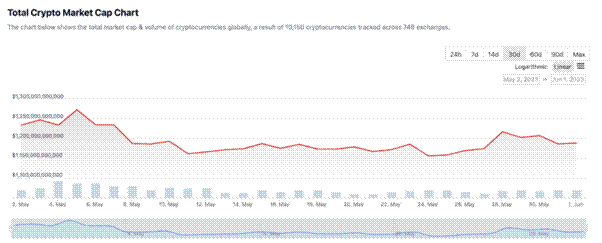
This week the crypto market took a hit, with investment sentiment dwindling.
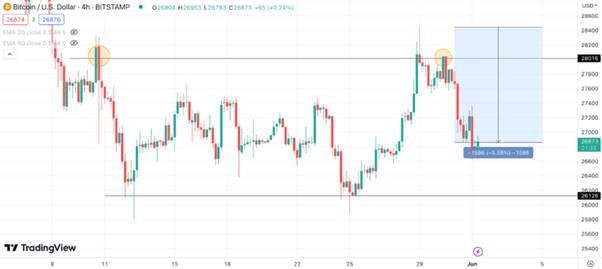
There are countless factors that contribute to the above negative influence. In the past 4 days alone, the price of Bitcoin has dropped by more than 5% and the price of Ethereum has also dropped by 3%.
In this article, we'll take a closer look at these factors before highlighting Altcoin that are still holding out against the bear wave and raking in millions of dollars in their early sale.
Volatility continues to spread across the crypto coin market, only last week's uptrend has been superseded by a dramatic price reversal.
A key component of this change has been the financial uncertainties surrounding the US Government debt ceiling.
In the past two weeks, American politicians have engaged in intense negotiations to find a solution to reach an agreement to raise the public debt ceiling, thereby preventing the risk of default.
The risk of default on the US debt has made countless investors restless because the country has never had a history of public debt default.
However, in the event that this scenario actually occurs, it will most likely cause a chain of domino effects on financial markets – and the crypto market will not escape that fate.
According to CNBC, the US House of Representatives passed a bill to raise the debt ceiling yesterday, but the bill still needs to be XEM and approved by the Senate before it can take effect.
Another factor causing the market to falter is the recent downtrend in the price of Bitcoin ($ BTC).
Based on CoinGecko's analysis, Bitcoin's market cap is currently at $521 billion, which equates to the coin dominating 44% of the entire market.
As such, the Bitcoin price and related trends will often affect the entire cryptocurrency market. When Bitcoin encounters any kind of uncertainty, other cryptocurrencies will often suffer – this is a scenario that is almost certain to happen in today's context.
Finally, the crypto market is also being influenced by personal consumption expenditure (PCE) data , and it is important that this data shows that inflation is still at its high point in April.
It's pouring cold water on investors who are still hoping the Fed will stop raising rates — or even cut rates.
When interest rates are high, "high-risk" assets like cryptocurrencies only make investors more nervous, choosing instead to focus on safer assets, such as bonds. .
Therefore, when the PCE index has no new movement, investors' sentiment in the market may continue to be negatively affected.
Insecurity about the recent price volatility of Bitcoin and Ethereum, many crypto investors are looking for other ways to hedge their risk.
One option that has gained a lot of attention in this area is yPredict ($YPRED) – a cryptocurrency analysis platform built on the Polygon network.
The platform is designed to be the world's first "all-in-one" analytics ecosystem using AI technology, aimed at developers, traders and market analysts.
In order to fulfill that mission, the yPredict team has developed a range of valuable tools and services into a convenient and amateur-friendly platform.

According to the project guidance report, some of the key features included in the platform are real-time trading signal monitoring, crypto market trend analysis, technical analysis using AI technology. , and automatic chart pattern recognition.
Furthermore, yPredict will also have a specialized trading marketplace where traders can access a premium prediction model developed by the world's top 1% of artificial intelligence and machine learning experts. .
This market has immediately received a lot of attention since it allows traders to access models that are only available to institutional investors, while at the same time creating passive profit opportunities for AI/ML developers.
Traders must use $YPRED, yPredict's native trading token, to have exposure to these models – of course token holders in hand will also have free access to the tools other analysis of the ecosystem.
With its advanced features, yPredict has attracted great interest from the community – recent reports show that more than 20,000 people are already on the project's waiting list.
Currently, yPredict is still in the early sale stage and has raised nearly 2 million USD from investors.
This early sale is in Phase 6 of a total of 8 phases, the token $YPRED is priced at $0.09 – 33% less than the planned exchange listing price.
XEM yPredict's Early Sale Now
Another project that is also going against the trend of other crypto markets is Launchpad XYZ ($LPX) .
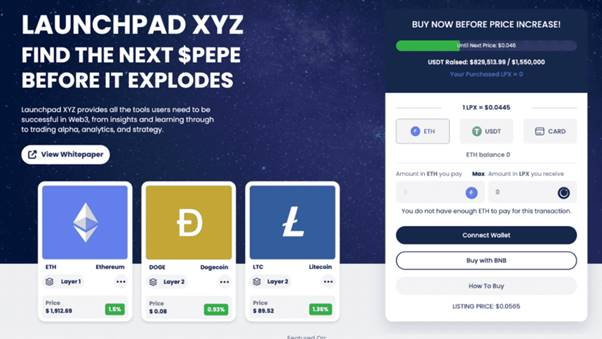
Like the Wall Street Meme, Launchpad XYZ is currently in the early sale phase and has just broken through the $800k milestone.
This Ethereum-based project is opening a new path in the crypto space thanks to its fully centralized Web3 platform, which aims to streamline the digital asset investment process.
The Launchpad XYZ ecosystem includes many features, such as the NFT DEX or the early sale of cryptocurrencies, to help new players easily integrate into the ever-changing Web3 environment. .
In addition, Launchpad XYZ also focuses on the education sector. The platform offers the “Inside Edge” newsletter and a Telegram channel dedicated to trading signals to all of its users.
That's not all, those looking for a more immersive and in-depth experience can check out Launchpad XYZ's metaverse library – ensuring that whatever you want, the platform can satisfy it.
Launchpad XYZ's utility token, $LPX, is vital in supporting all of the platform's features. This token is not only used to pay for transaction fees, but holders can also stake their tokens for exclusive perks – like access to the NFT whitelist.
Investors can now buy $LPX through Launchpad XYZ's early sale for just $0.0445 - 26% below the expected list price.
Attend Launchpad XYZ Early Sale
Finally, the sustainable development-focused project Ecoterra ($ECOTERRA) is also making great strides in the crypto market, having brought in more than $4.6 million even before its official launch.
Investors have been eagerly looking forward to owning the ticker $ECOTERRA during the ongoing early sale, especially as these tokens are being offered for sale at relatively low prices.
Like the two projects listed above, Ecoterra is in the spotlight, even as the cryptocurrency market plunges continuously. The project's Twitter account has more than 16,000 followers.
The craze around Ecoterra stems from its eco-friendly mission: to encourage individuals and businesses to move towards sustainability through the Recycle2Earn app, in which users will be rewarded with the code -20232023202320232023-3 - each recycling of common materials.
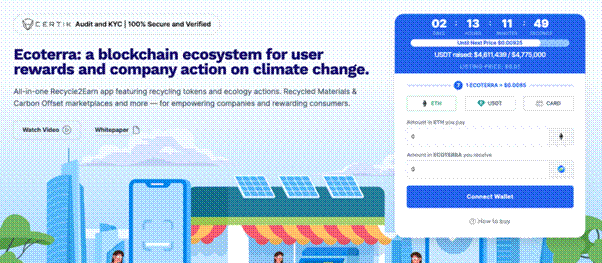
The Ecoterra ecosystem also opens up a Carbon Offset Market, a Recycled Materials Exchange, and even a public “Influence Profile” for each user – thereby maintaining its status as a global solution. represent crypto players who care about the environment.
Players can now own $ECOTERRA by participating in Phase 7 of the early sale, at a discounted price of only $0.0085 per token.
However, the number of tokens distributed for this period is rapidly decreasing – and once the early sale ends, the token will be listed for $0.00925.