Bitcoin price returns to $28,000 level after choppy month

THE BLOCKPublished on 2023-05-30Last updated on 2023-05-30

Abstract

As a result of largely bitcoin's efforts, the wider crypto market cap has grown from $1.19 trillion to $1.22 trillion — up 2.6% in the last 24 hours.

QUICK TAKE

•Bitcoin’s price has returned to the $28,000 mark after a few weeks trading at the bottom of its recent range.

•This comes as the U.S. President says a deal has been made regarding the debt ceiling.

The price of bitcoin has risen to $28,000 after trading below this mark for the majority of May.

Since March, bitcoin has been trading in a range between $27,500 and just above $30,000. Since May 10, the coin has been in the lower half of this range, dropping as low as $26,000, according to CoinGecko. Yet a rally in the evening on May 28 has counteracted this.
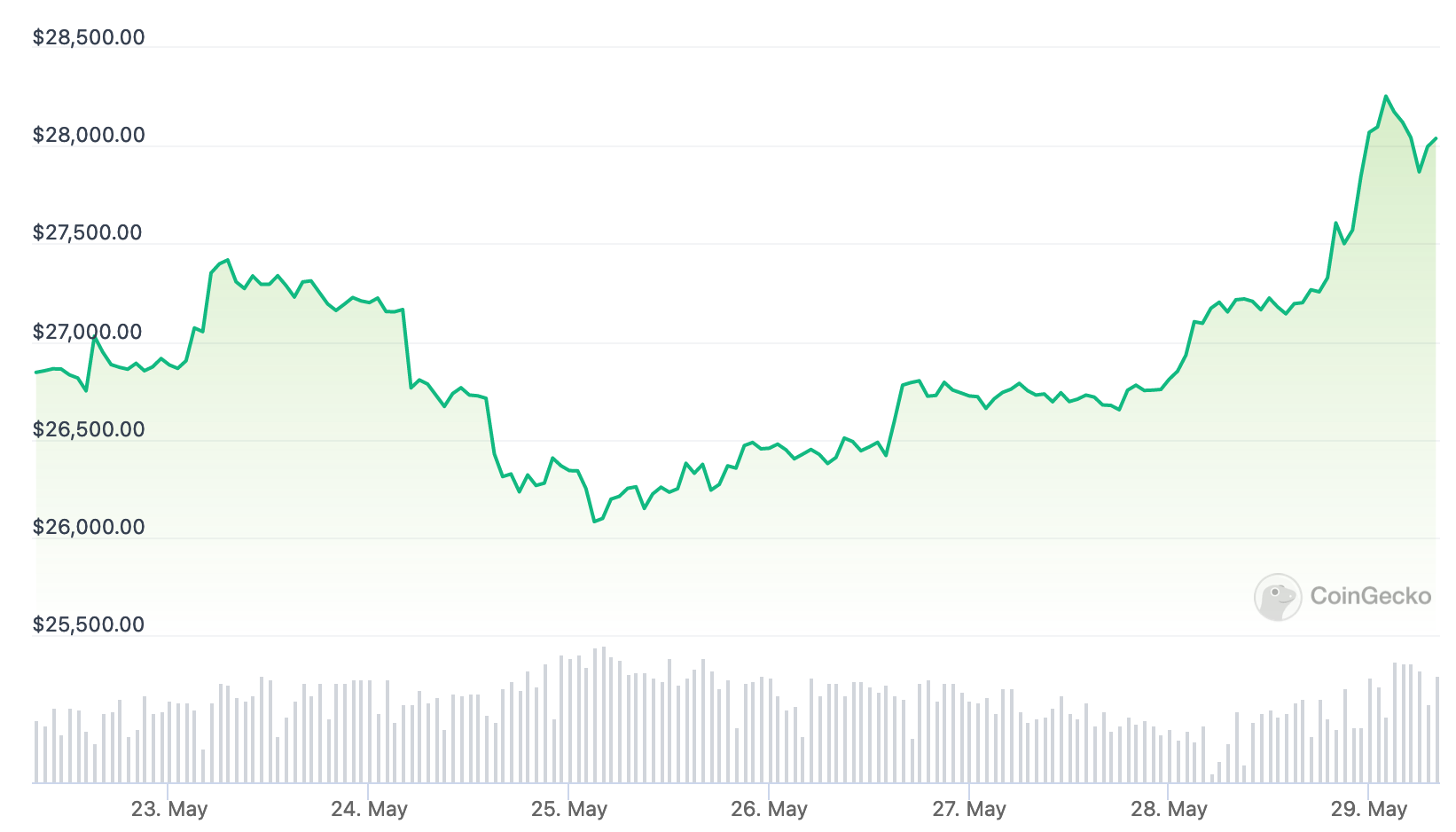
Bitcoin price has steadily built up over the last few days. Image: CoinGecko.

As a result of largely bitcoin's efforts, the wider crypto market cap has grown from $1.19 trillion to $1.22 trillion — up 2.6% in the last 24 hours.

A few coins have followed in bitcoin's progress, with ether and cardano each up 5% and polygon up 9%. Recently hyped memecoin pepe remains flat at around the $0.0000014 mark.

The rising prices follow news that a deal has been made to solve the U.S. debt ceiling problem. The deal will push back the debt ceiling to Jan 1, 2025, according to Reuters. U.S. President Joe Biden said the deal takes the "threat of catastrophic default off the table."

The deal may come as no surprise to Tether CTO Paolo Ardoino, who said on The Block's The Scoop podcast last week that a debt default would be unlikely because of the extreme consequences that it would have.

It may, however, affect former Bitmex CEO Arthur Hayes' planning for the year. He said that the timing would be interesting if this deal was reached in the fall — something that would create a powder keg of a situation. But with a deal already in the works, perhaps this year will be a little less volatile.

Related Reads

When Hyperliquid Steals Solana's 'Internet Capital Market' Script

The article "When Hyperliquid Steals Solana's 'Internet Capital Markets' Playbook" discusses Solana's struggles to maintain its "internet capital markets" narrative by 2026. Despite its initial success as a high-performance "Ethereum killer," SOL's price has underperformed, dropping significantly compared to other major cryptocurrencies. Solana's vision of a global, on-chain trading network for all assets is being challenged not primarily by Ethereum, but by Hyperliquid. Hyperliquid, evolving from a perpetual contracts platform into a dedicated financial infrastructure Layer 1, has become a major beneficiary of the shift of derivatives trading from centralized exchanges to on-chain. The article argues that for high-frequency financial trading, a specialized, performance-focused chain like Hyperliquid may be more suitable than a general-purpose ecosystem like Solana. Further compounding Solana's issues was a major $200+ million exploit on its key perpetual protocol, Drift, in April, which damaged market confidence. In response, Solana founder Anatoly Yakovenko heavily promoted the protocol Phoenix as a replacement, boosting its visibility but not its trading volume, which remains far behind leading platforms. Solana supporters have launched a public critique of Hyperliquid's decentralization, pointing to its limited validators and closed-source code. Critics, however, note Solana's own declining validator count and centralization metrics. This strategy has also caused internal friction, with developers of other Solana protocols expressing discontent over the foundation's perceived favoritism towards Phoenix. The conclusion is that Hyperliquid's rise represents a challenge to the "general-purpose blockchain" narrative, proving that the core of a capital market might be a specialized trading engine rather than a broad ecosystem. If Solana cannot regain dominance in derivatives, it risks remaining a "meme coin paradise" while its grand "internet capital markets" ambition slips away.

marsbit1h ago

When Hyperliquid Steals Solana's 'Internet Capital Market' Script

marsbit1h ago

When Hyperliquid Steals Solana's 'Internet Capital Markets' Playbook

The article discusses how Solana's grand vision of becoming an "Internet Capital Markets" platform is facing significant challenges in 2026, primarily from the unexpected rise of Hyperliquid. Solana's performance has weakened, with its token SOL experiencing the largest price decline among major cryptocurrencies. Its core narrative of building a global, chain-based marketplace for all assets is under pressure both internally and externally. Hyperliquid, originally a perpetual futures exchange, has evolved into a dedicated Layer 1 financial infrastructure network. Its focused, trading-centric approach is attracting capital and challenging the assumption that a "general-purpose" ecosystem like Solana is necessary for a capital market. Hyperliquid's success suggests that for high-frequency trading, superior performance, liquidity, and user experience may be more critical than a broad application ecosystem. Internally, Solana's strategy suffered a blow from a major hack on the Drift Protocol in April, resulting in over $200 million in losses. In response, Solana founder Anatoly Yakovenko has heavily promoted Phoenix as a new decentralized perpetual futures platform on Solana. While this boosted Phoenix's visibility, its trading volume remains far behind leading platforms. Solana's community has launched a rhetorical attack against Hyperliquid, questioning its decentralization due to its limited validator set and closed-source code. Critics, however, point out Solana's own decreasing validator count and increasing centralization of stake. This focus on "decentralization metrics" has also caused internal friction, with other Solana ecosystem developers expressing discontent over the foundation's perceived favoritism towards Phoenix. The article concludes that the rise of Hyperliquid represents a challenge to the "general-purpose blockchain" narrative, proving that an efficient trading engine might be more central to a capital market than a vast ecosystem. If Solana cannot regain dominance in the derivatives space, it risks remaining a "meme coin paradise" rather than achieving its ambition of hosting global assets.

链捕手1h ago

When Hyperliquid Steals Solana's 'Internet Capital Markets' Playbook

链捕手1h ago

Trading

Spot
Futures
活动图片