Why an Interest Rate Hike Is Still on the Table for June

WSJPubblicato 2023-05-22Pubblicato ultima volta 2023-05-24

Introduzione

The fire hose of commentary from the Federal Reserve this past week made one thing clear: Central-bank officials are fiercely split on how to navigate the policy path forward and whether to raise interest rates or hold them steady when the Fed’s policy-making committee next meets in June.

The fire hose of commentary from the Federal Reserve this past week made one thing clear: Central-bank officials are fiercely split on how to navigate the policy path forward and whether to raise interest rates or hold them steady when the Fed’s policy-making committee next meets in June.

Officials laid the groundwork at their May meeting for the Fed to pause next month, although they stopped short of committing to specific next steps. But since then, a series of economic surveys and data releases have appeared to show an economy that looks increasingly stable.

That has emboldened the central bank’s hawks to publicly endorse the idea of at least one more rate boost in June, given that the pace of inflation remains more than double the Fed’s target. Dallas Fed President Lorie Logan, a voting member of the Federal Open Market Committee, was perhaps the most explicit, saying Thursday that while the data “could yet show” it is appropriate to skip a rate hike, the current environment suggests that “we aren’t there yet.”

The economic case for further policy tightening centers on fresh optimism that the U.S. will be able to stave off a recession, at least until sometime next year. A new working paper from economists at the San Francisco Fed shows that, despite years of strong demand and high inflation, U.S. households across the income spectrum still hold an estimated half-trillion dollars in excess savings—enough to fuel consumer spending at least into the fourth quarter of 2023.

At the same time, some of the more interest-rate-sensitive sectors of the economy that had been impacted by monetary-policy tightening—namely, housing and manufacturing—could be reaccelerating.

Skanda Amarnath, executive director at Employ America and a former research analyst with the New York Fed, notes that growth in multifamily residential units under construction and resilience in mortgage demand both are helping to paint an “encouraging picture” for the housing market. Manufacturing data out this past week from the Philadelphia Fed, he added, suggest that the most contractionary months for that sector could be behind us.

Buoyancy in housing and manufacturing isn’t “a typical thing you see right before a recession,” Amarnath said.

There is also the question of whether the regional-banking turmoil of the past few months caused financial conditions to tighten beyond what the Federal Reserve had intended.

Fed Chairman Jerome Powell noted on Friday that rates might not need to rise as high as the central bank had anticipated because of bank stress. But so far, the impact has been less dramatic than anticipated.

The central bank’s own survey of senior loan officers showed bank lending practices tightening only mildly between the fourth quarter of 2022 and the first quarter of 2023. “Honestly, I expected that the turbulence...was going to cause a lot more panic,” Atlanta Fed President Raphael Bostic said at an economic conference in Florida this past week.

Chicago Fed President Austan Goolsbee, also on stage for the keynote discussion, agreed.

Fed officials still have nearly a month before they must make a decision, and Powell on Friday signaled the need for the central bank to tread carefully.

Even so, the recent signs of economic strength suggest that monetary policy could have more room to run. If any outstanding data come in hotter than expected, brace for the possibility of at least one more increase in the federal-funds rate.

Letture associate

Solana Proposals Could Lead to Reduction in Staking Yields to 2.25% and Cut Emissions by $1.5 Billion

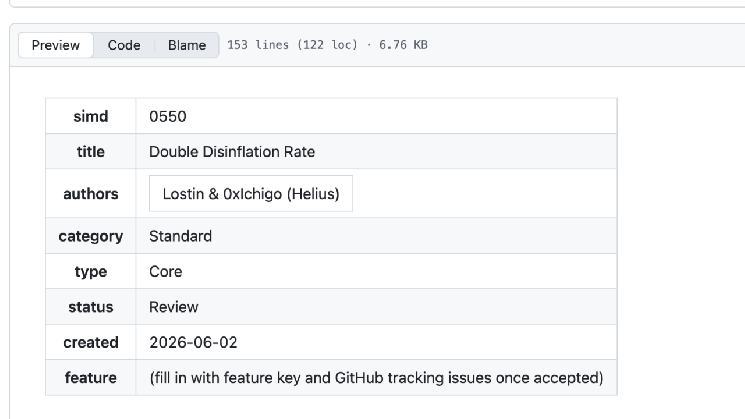
Solana is moving towards a stricter monetary model that could lead to a SOL deficit and significantly reduce staking rewards for holders. Two governance proposals drive these changes. SIMD-550, currently under vote, would double Solana's annual disinflation rate from 15% to 30%, accelerating the timeline to reach a final inflation rate of ~1.5% to the first half of 2029. The second, SIMD-553 (already approved), introduces additional token burning tied to computational units used on the network. Together, these measures could reduce SOL emission by an estimated $1.4-$1.5 billion over six years. The immediate impact would be lower staking yields, potentially falling from the current ~5.25% to approximately 4.34% in year one, 3% in year two, and 2.25% by year three. Analyst Matt Mena from 21Shares suggests inflation should be tied to economic metrics to help offset this decline. The changes also raise concerns for validator economics, with some potentially becoming unprofitable as inflation rewards decrease and voting costs may rise. However, the lower passive yield might push a significant portion of the 67.9% staked SOL into Solana's DeFi ecosystem for activities like lending and trading. This shift could boost network fee revenue to compensate for lower inflation rewards. The proposals aim to trade lower yield today for less dilution tomorrow, betting that network growth and usage will make this a worthwhile trade-off for SOL holders.

cryptonews.ru27 min fa

Solana Proposals Could Lead to Reduction in Staking Yields to 2.25% and Cut Emissions by $1.5 Billion

cryptonews.ru27 min fa

Bitcoin 'Basically Hopped' to $80K. What Will Happen to the Price in Autumn?

Bitcoin surged close to $80,000 in August, marking its fastest growth since 2024. Experts anticipate continued volatility for the autumn season, with price forecasts heavily dependent on macroeconomic conditions and regulatory developments in the US. Key drivers for the recent rise include a weakening US dollar, renewed capital inflows into spot Bitcoin ETFs, and liquidations of trading positions. The US Treasury's decision to increase long-term bond purchases has helped stabilize debt markets but pressured the dollar, leading investors to seek assets like Bitcoin as a hedge. Looking ahead, experts outline two primary scenarios for Bitcoin's price. A positive outcome, supported by favorable macroeconomics and the potential passage of the CLARITY Act regulating crypto in the US, could push Bitcoin toward $85,000-$100,000. Conversely, a negative scenario involving hawkish signals from the US Federal Reserve or regulatory setbacks could trigger a correction, potentially driving the price back down to the $62,000-$75,000 range. Institutional demand, reflected in consistent ETF inflows, is seen as a crucial stabilizing factor, gradually outweighing the influence of Bitcoin's traditional four-year cycles. Meanwhile, a broad rally in altcoins is not widely expected, as capital is likely to flow selectively into the most liquid projects. The central question for autumn is whether institutional buying can transform August's rapid surge into a sustainable upward trend.

cryptonews.ru31 min fa

Bitcoin 'Basically Hopped' to $80K. What Will Happen to the Price in Autumn?

cryptonews.ru31 min fa

Trading

Spot
活动图片