What’s Next For Ethereum Price As It Drops Below $2,000?

newsbtc2023-04-24 tarihinde yayınlandı2023-04-24 tarihinde güncellendi

Özet

The price of Ethereum has fallen below $1,900, dropping from the $2,000 mark that was previously held by bulls. This has led to another sell-off and the bearish influence remains...

The price of Ethereum has fallen below $1,900, dropping from the $2,000 mark that was previously held by bulls. This has led to another sell-off and the bearish influence remains strong despite attempts at recovery.
In the last 24 hours, Ethereum has risen by only 1.2%, but on the weekly chart, the altcoin has seen a significant drop of over 10%. The technical outlook for Ethereum is also in favor of the bears, as demand and accumulation for the altcoin have decreased. In order for Ethereum to make a recovery, it is crucial for it to breach the immediate resistance strength from buyers.
Despite this, most altcoins, including Ethereum, have remained bullish on the higher time-frame structure. However, bulls must defend the following support line or supply zone for Ethereum to start its recovery.

With Bitcoin struggling under the $30,000 price mark, many altcoins are also experiencing difficulty in breaking through their immediate price ceilings. On the one-day chart, the decline in the market capitalization of Ethereum indicates a decrease in buyers.
Ethereum Price Analysis: One-Day Chart
Ethereum

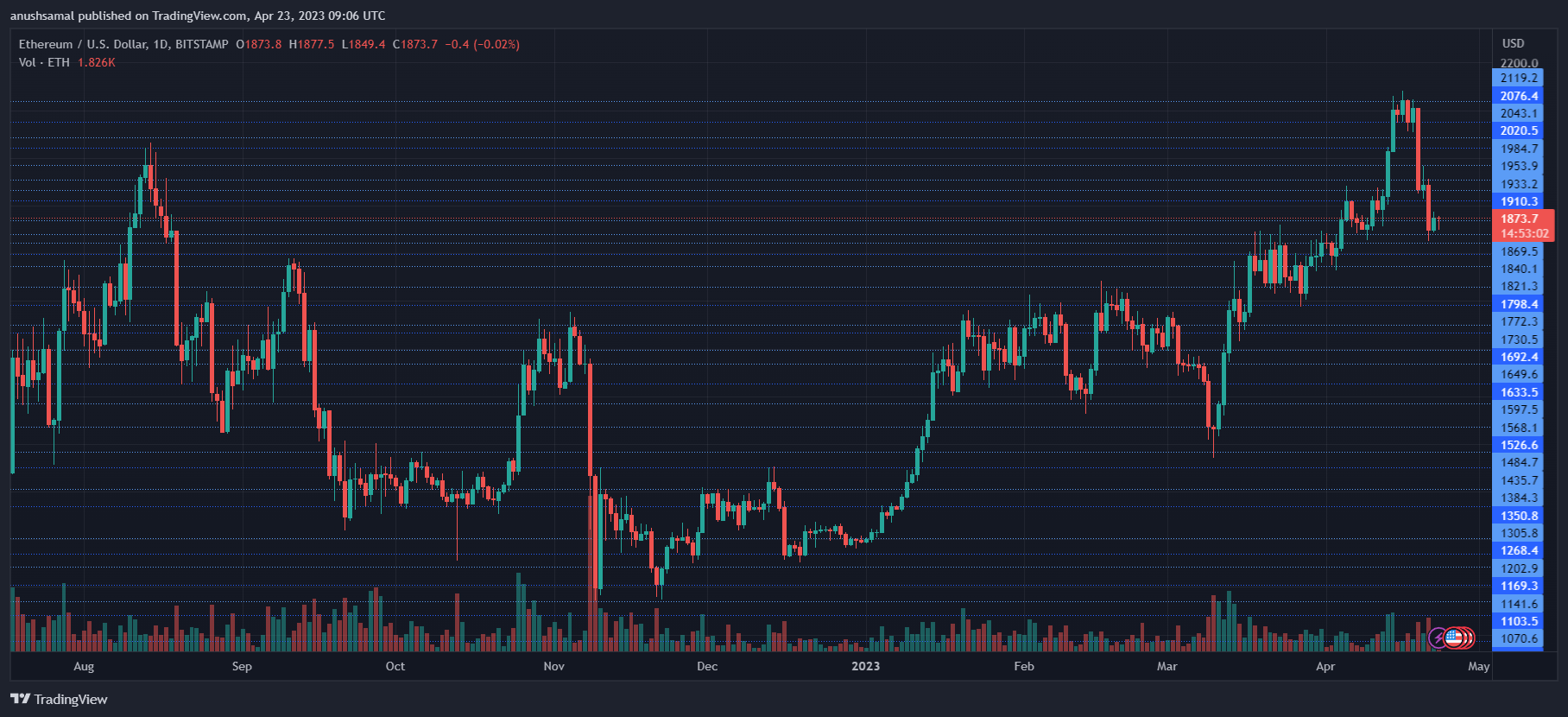
Ethereum was priced at $1,880 on the one-day chart | Source: ETHUSD on TradingView At the time of writing, ETH was valued at $1,880, having fallen below its bearish block ranging from $1,900 to $2,000. This drop in price is likely due to a routine price pullback, as Ethereum had traded above the $2,025 price mark after approximately eight months. However, as selling pressure increased, the bears have taken control.
The immediate overhead resistance for the altcoin is $1,910. A move above this level could potentially push ETH to touch $1,950, which may help to facilitate a price recovery. Conversely, the support levels for ETH are currently at $1,840 and $1,820.

During the previous session, the amount of ETH traded was in the red, indicating an increase in selling pressure.
Technical Analysis
Ethereum

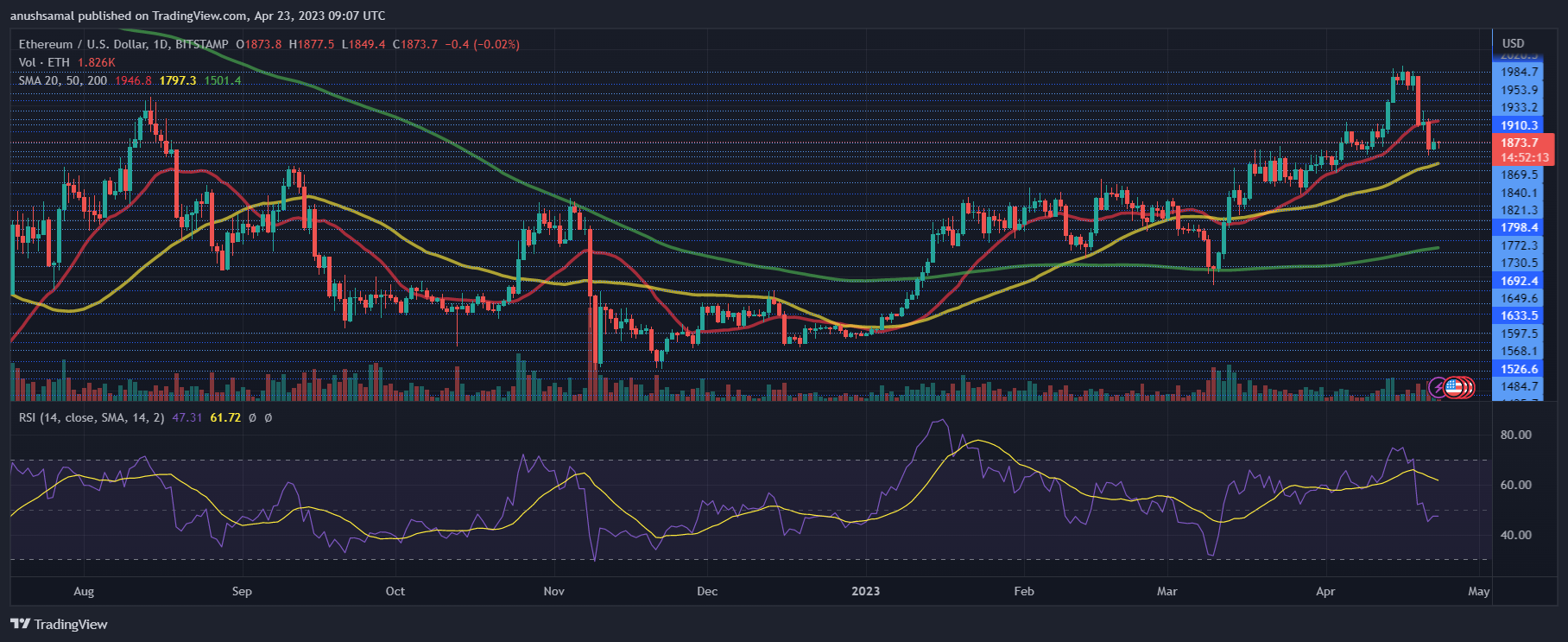
Ethereum registered a fall in buying strength on the one-day chart | Source: ETHUSD on TradingView As demand for ETH decreased, buyers also began to lose confidence in the asset. The Relative Strength Index showed that sellers outnumbered buyers on the one-day chart, as it was positioned just below the 50-mark.
Additionally, ETH dropped below the 20-Simple Moving Average line, indicating that sellers were in control and driving the price momentum in the market. However, with a slight increase in demand, ETH has the potential to trade above the 20-SMA line once again.


Ethereum

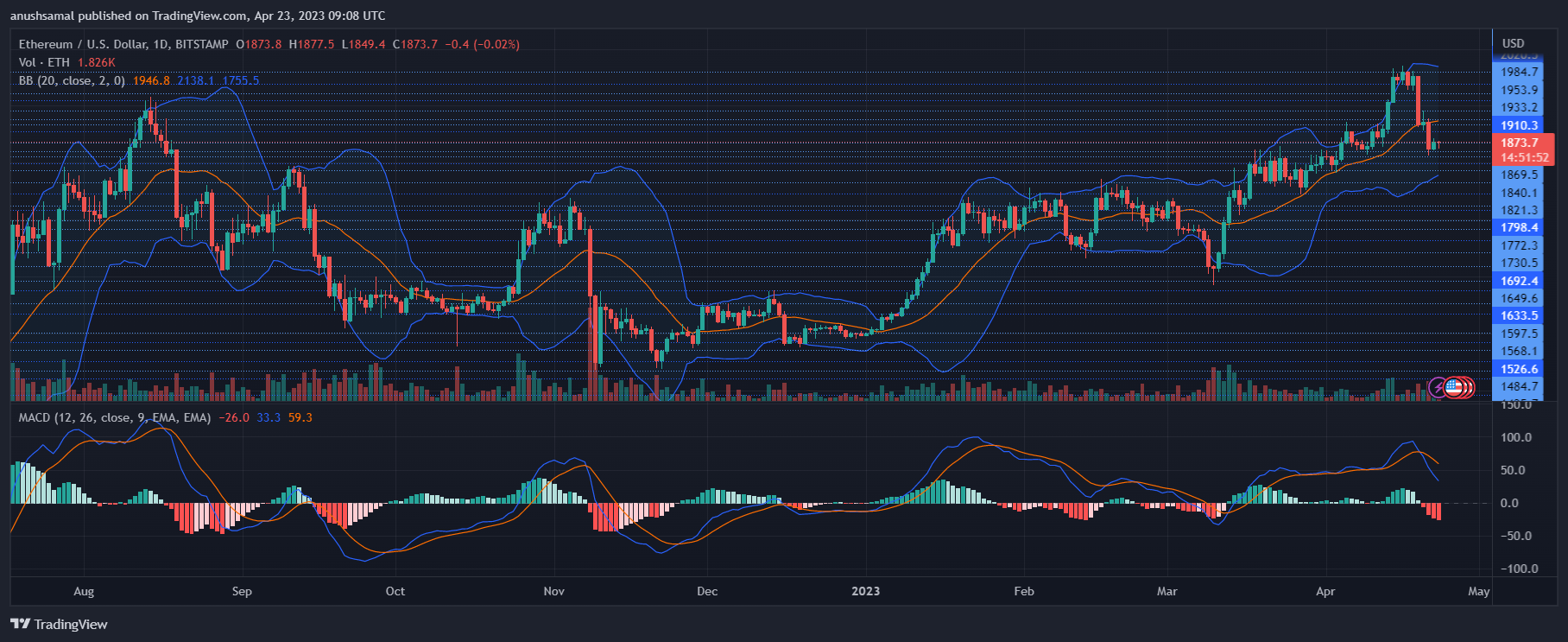
Ethereum started to display sell signals on the one-day chart | Source: ETHUSD on TradingView In line with other technical indicators, ETH began to exhibit sell signals on the one-day chart. The Moving Average Convergence Divergence, which measures price momentum and reversals, formed red histograms. This reading corresponds to sell signals for the altcoin.
Additionally, the Bollinger Bands, which gauge price volatility, were relatively far apart, but they have started to slightly converge. It suggested that ETH may trade within a specific price range over the coming trading sessions.


İlgili Okumalar

Why Ethereum Staking Will Change in 2026

The article discusses the evolving role of Ethereum (ETH) staking, shifting from a niche crypto enthusiast topic to a mainstream portfolio management tool for financial advisors and institutional investors. It explains how staking works in Ethereum's Proof-of-Stake network, detailing validator requirements and methods like solo staking, pools, exchanges, and liquid staking protocols, each with its own risk-reward profile (e.g., liquidity, control, technical requirements). A key point is staking's growing importance for corporate treasuries, where staking rewards represent a significant income stream, unlike non-yielding Bitcoin holdings. Looking ahead, the article highlights the anticipated 'Glamsterdam' upgrade in late 2026 as a pivotal development expected to enhance scalability, decentralization, and post-quantum resistance, further solidifying Ethereum's institutional appeal. It also emphasizes that while staking offers passive income and network participation, risks include technical failures, slashing penalties, platform/custodial risks, and regulatory uncertainty. For advisors, the conclusion stresses the need to evaluate staking providers beyond just promised yields, focusing on reliability, fees, withdrawal terms, security, and the specifics of reward structures (protocol vs. MEV-based). The regulatory landscape and infrastructure maturity around digital asset custody are noted as critical adjacent topics to monitor.

cryptonews.ru56 dk önce

Why Ethereum Staking Will Change in 2026

cryptonews.ru56 dk önce

Scott Bessent's Risky Bond Buyback Operation Could Fuel Bitcoin Price Surge

Bitcoin returned to the $80,000 level on Thursday, breaking past a key $79,000 resistance point, on news of an upcoming $92 billion U.S. Treasury bill auction scheduled for August 31st. The price recovery saw Bitcoin reach a daily high of $80,808, though it faced brief selling pressure. The cryptocurrency was trading around $80,400 by late morning EST, marking a roughly 3% daily increase and pushing its market cap back to $1.61 trillion. This surge positions Bitcoin for a monthly gain of over 20%, a sharp reversal from July's flat performance. The volatility led to $105 million in leveraged Bitcoin positions being liquidated in 24 hours, with short positions accounting for the majority of losses. Analysts note the large-scale Treasury auction could drain short-term market liquidity, potentially pushing yields higher and pressuring risk assets like stocks and crypto. Furthermore, a recent article in The Economist warns that U.S. Treasury Secretary Scott Bessent's policies risk undermining confidence in the American financial system. The report criticizes measures to artificially cap long-term bond yields and a shift towards issuing more short-term T-bills, which shortens the overall debt duration and increases vulnerability to future rate hikes. This approach, along with distorting market pricing mechanisms, could jeopardize long-term investor trust in U.S. sovereign debt. Prominent figures like Ray Dalio suggest such policies are reducing the inflation-adjusted yield of traditional fixed-income assets, potentially driving capital seeking a store of value towards alternatives like gold and Bitcoin, whose prices have risen since the Treasury's announcements.

cryptonews.ru57 dk önce

Scott Bessent's Risky Bond Buyback Operation Could Fuel Bitcoin Price Surge

cryptonews.ru57 dk önce

İşlemler

Spot
活动图片