Bitcoin Price Holds Key Support But 100 SMA Is The Key To Recovery

newsbtcPublished on 2023-02-13Last updated on 2023-02-13

Abstract

Bitcoin price is consolidating above the $21,500 support. BTC could start a decent recovery if it clears the $22,000 resistance and the 100 hourly SMA.

Bitcoin price is consolidating above the $21,500 support. BTC could start a decent recovery if it clears the $22,000 resistance and the 100 hourly SMA.

Bitcoin is struggling to start a recovery wave above the $22,000 resistance.

The price is trading below $22,200 and the 100 hourly simple moving average.

There was a break above a key bearish trend line with resistance near $21,900 on the hourly chart of the BTC/USD pair.

The pair could continue to move down if it stays below the $22,000 resistance zone.

Bitcoin Price Continues to Struggle

Bitcoin price extended its decline below the $22,200 support zone. BTC even broke the $22,000 support zone and settled below the 100 hourly simple moving average.

The price traded towards the $21,500 support zone. A low is formed near $21,475 and the price is now consolidating losses. There was a minor recovery wave above the $21,800 resistance zone. Besides, there was a break above a key bearish trend line with resistance near $21,900 on the hourly chart of the BTC/USD pair.

Bitcoin price spiked above the 23.6% Fib retracement level of the downward move from the $23,450 swing high to $21,475 low. It is now trading below $22,200 and the 100 hourly simple moving average.

An immediate resistance is near the $22,000 level and the 100 hourly simple moving average. The next major resistance is near the $22,200 zone. The main resistance is now near the $22,500 zone or the 50% Fib retracement level of the downward move from the $23,450 swing high to $21,475 low.
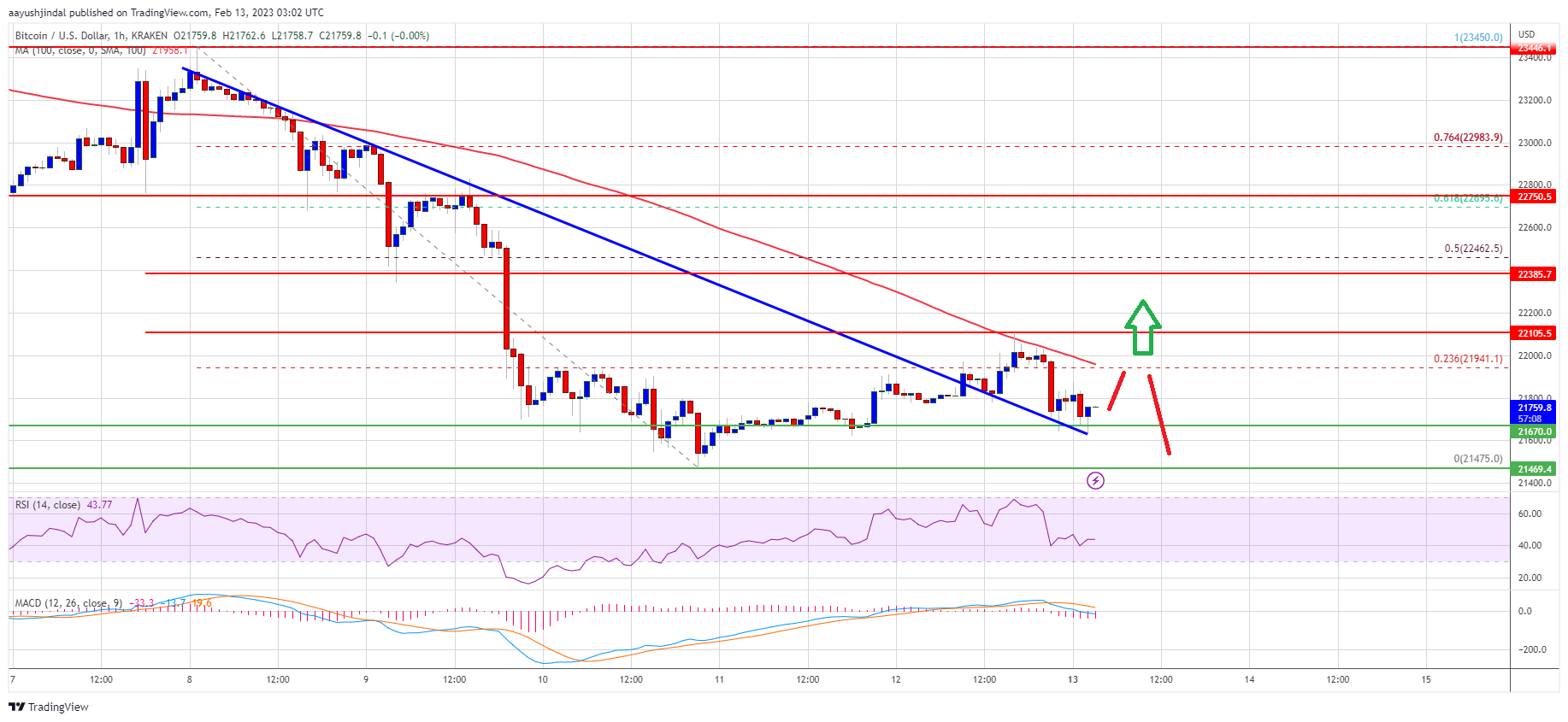
A clear move above the $22,500 resistance might start a steady increase. In the stated case, the price may perhaps rise towards the $22,850 level. The next resistance could be near the $23,000 level, above which btc price might rise towards the $23,450 resistance zone.

More Losses in BTC?

If bitcoin price fails to clear the $22,000 resistance, it could continue to move down. An immediate support on the downside is near the $21,650 zone.

The next major support is near the $21,500 level, below which the price might start major decline. In the stated case, the price could decline towards the $20,500 zone.

Technical indicators:

Hourly MACD – The MACD is now losing pace in the bearish zone.

Hourly RSI (Relative Strength Index) – The RSI for BTC/USD is now below the 50 level.

Major Support Levels – $21,500, followed by $21,200.

Major Resistance Levels – $22,000, $22,200 and $22,500.

Related Reads

The Semiconductor Century: Investment Roadmap Amidst the 2026 AI Surge

The Semiconductor Century: Investment Roadmap in the 2026 AI Surge This analysis outlines the pivotal role of semiconductors in the 2026 AI-driven landscape. With the global semiconductor market projected to reach ~$9.75 trillion in 2026, AI infrastructure spending by hyperscalers is a primary growth driver, fundamentally shifting demand from consumer electronics to strategic technology assets. The report breaks down the industry into four key segments: 1) Designers (e.g., Nvidia, AMD) who own high-margin IP; 2) Foundries, led by TSMC which manufactures ~90% of the world's most advanced chips; 3) Equipment makers like ASML, the sole producer of critical EUV lithography machines; and 4) Memory specialists such as SK Hynix, crucial for supplying high-bandwidth memory (HBM) for AI servers. It highlights significant companies: Nvidia (dominant in AI GPUs and CUDA software), TSMC (critical but geopolitically concentrated foundry), ASML (monopoly in advanced lithography), AMD (key alternative to Nvidia), Broadcom (leader in custom AI chips), and SK Hynix (leading HBM supplier). For diversified exposure, semiconductor ETFs like SMH, SOXX, and SOXQ are presented. Key investment risks are emphasized: over-reliance on AI demand, acute geopolitical and supply chain concentration in Taiwan, policy uncertainty around export controls, the cyclical nature of memory markets, and high valuations for leaders like Nvidia and Broadcom. Critical 2026 catalysts include the industry's push toward a $1 trillion annual sales milestone, the ramp-up of TSMC's Arizona factory, the deployment of Nvidia's next-generation Vera Rubin platform, AMD's market share progress, and HBM4 supply dynamics. The conclusion advises investors to balance the sector's extraordinary growth against its very real risks—geopolitical concentration, AI dependency, memory cyclicality, and valuation—to make informed decisions.

marsbit25m ago

The Semiconductor Century: Investment Roadmap Amidst the 2026 AI Surge

marsbit25m ago

What Will End the AI Bull Market: Positioning or Narrative?

Who Will End the AI Bull Market: Overcrowded Positions or the Narrative Itself? The US stock market's relentless rally, led by AI-themed stocks, faces a growing contradiction. Technically, positioning appears dangerously stretched: the S&P 500's six-week winning streak is historically extreme, and Goldman Sachs's Risk Appetite Indicator signals potential for a pullback. Many hot sectors are in extreme overbought territory, with mechanical fund flows suggesting the market is at or near maximum long positioning, limiting upside and creating pressure for a reset. However, shorting is difficult due to volatile exit timing and the risk of a sharp short squeeze. Fundamentally, the AI narrative remains robust, propping up sentiment. Strong corporate earnings, contained inflation concerns, and absorbed geopolitical risks provide no clear catalyst for a bear market. Yet, market performance has become excessively concentrated. Without AI contributions, broader market returns would be mediocre; semiconductors alone accounted for nearly 40% of gains since March. The market has shifted into a "greed mode," overlooking previous concerns about AI costs, energy bottlenecks, pricing wars, and security issues. The core risk is the interplay between these two factors. Nomura strategist Charlie McElligott warns that a sudden, DeepSeek-style negative catalyst could trigger a Nasdaq limit-down event, with semiconductor ETFs potentially plunging 15% in a day. The same mechanical flows that fueled the rally could violently reverse and amplify a downturn. Thus, the bull market's fragility lies in the tension between immediate technical vulnerability from crowded trades and a deeper, narrative-driven collapse should the AI story falter.

marsbit31m ago

What Will End the AI Bull Market: Positioning or Narrative?

marsbit31m ago

Bear Market Financial Report Comparison: Pure Crypto Exchanges vs. Multi-Asset Platforms, Robinhood More Resilient Than Coinbase

Bear Market Earnings Showcase the Resilience of Multi-Asset Platforms vs. Crypto-Only Exchanges Coinbase and Robinhood's recent earnings reports, both missing expectations and erasing $12 billion in market value, highlight a core vulnerability of exchange models in a crypto downturn: heavy reliance on transaction fees. Coinbase's Q1 revenue fell 31% to $1.41 billion, with a net loss of $394 million, driven by a 40% drop in transaction revenue as spot trading volumes plummeted. While its subscription and services segment (44% of revenue) offers some buffer, key components like stablecoin revenue remain tied to trading activity. In contrast, Robinhood reported a 15% revenue increase to $1.07 billion, with net income of $350 million. Although its crypto trading revenue fell 47%, this was offset by strong growth in other areas: prediction market revenue surged 320%, stock revenue grew 46%, and options revenue rose 8%. This diversification, with transaction revenue still at 58% of the total, made Robinhood more resilient. The analysis extends to platforms like Revolut, where payments and banking are central. In 2025, Revolut's revenue grew 45% to $6.1 billion, evenly spread across segments. Its wealth segment (including crypto, stocks, and CFDs) constituted just 15% of revenue, making it far less exposed to crypto market cycles than Coinbase or even Robinhood. The key takeaway is that platforms with diversified, non-correlated revenue streams—particularly through derivatives, prediction markets, or core banking services—are better insulated during crypto bear markets. Robinhood's asset variety acts as a hedge, while Coinbase's heavier exposure to spot crypto trading leaves it more vulnerable to prolonged downturns.

marsbit31m ago

Bear Market Financial Report Comparison: Pure Crypto Exchanges vs. Multi-Asset Platforms, Robinhood More Resilient Than Coinbase

marsbit31m ago

Trading

Spot
Futures

Hot Articles

What is $BITCOIN

DIGITAL GOLD ($BITCOIN): A Comprehensive Analysis Introduction to DIGITAL GOLD ($BITCOIN) DIGITAL GOLD ($BITCOIN) is a blockchain-based project operating on the Solana network, which aims to combine the characteristics of traditional precious metals with the innovation of decentralized technologies. While it shares a name with Bitcoin, often referred to as “digital gold” due to its perception as a store of value, DIGITAL GOLD is a separate token designed to create a unique ecosystem within the Web3 landscape. Its goal is to position itself as a viable alternative digital asset, although specifics regarding its applications and functionalities are still developing. What is DIGITAL GOLD ($BITCOIN)? DIGITAL GOLD ($BITCOIN) is a cryptocurrency token explicitly designed for use on the Solana blockchain. In contrast to Bitcoin, which provides a widely recognized value storage role, this token appears to focus on broader applications and characteristics. Notable aspects include: Blockchain Infrastructure: The token is built on the Solana blockchain, known for its capacity to handle high-speed and low-cost transactions. Supply Dynamics: DIGITAL GOLD has a maximum supply capped at 100 quadrillion tokens (100P $BITCOIN), although details regarding its circulating supply are currently undisclosed. Utility: While precise functionalities are not explicitly outlined, there are indications that the token could be utilized for various applications, potentially involving decentralized applications (dApps) or asset tokenization strategies. Who is the Creator of DIGITAL GOLD ($BITCOIN)? At present, the identity of the creators and development team behind DIGITAL GOLD ($BITCOIN) remains unknown. This situation is typical among many innovative projects within the blockchain space, particularly those aligning with decentralized finance and meme coin phenomena. While such anonymity may foster a community-driven culture, it intensifies concerns about governance and accountability. Who are the Investors of DIGITAL GOLD ($BITCOIN)? The available information indicates that DIGITAL GOLD ($BITCOIN) does not have any known institutional backers or prominent venture capital investments. The project seems to operate on a peer-to-peer model focused on community support and adoption rather than traditional funding routes. Its activity and liquidity are primarily situated on decentralized exchanges (DEXs), such as PumpSwap, rather than established centralized trading platforms, further highlighting its grassroots approach. How DIGITAL GOLD ($BITCOIN) Works The operational mechanics of DIGITAL GOLD ($BITCOIN) can be elaborated on based on its blockchain design and network attributes: Consensus Mechanism: By leveraging Solana’s unique proof-of-history (PoH) combined with a proof-of-stake (PoS) model, the project ensures efficient transaction validation contributing to the network's high performance. Tokenomics: While specific deflationary mechanisms have not been extensively detailed, the vast maximum token supply implies that it may cater to microtransactions or niche use cases that are still to be defined. Interoperability: There exists the potential for integration with Solana’s broader ecosystem, including various decentralized finance (DeFi) platforms. However, the details regarding specific integrations remain unspecified. Timeline of Key Events Here is a timeline that highlights significant milestones concerning DIGITAL GOLD ($BITCOIN): 2023: The initial deployment of the token occurs on the Solana blockchain, marked by its contract address. 2024: DIGITAL GOLD gains visibility as it becomes available for trading on decentralized exchanges like PumpSwap, allowing users to trade it against SOL. 2025: The project witnesses sporadic trading activity and potential interest in community-led engagements, although no noteworthy partnerships or technical advancements have been documented as of yet. Critical Analysis Strengths Scalability: The underlying Solana infrastructure supports high transaction volumes, which could enhance the utility of $BITCOIN in various transaction scenarios. Accessibility: The potential low trading price per token could attract retail investors, facilitating wider participation due to fractional ownership opportunities. Risks Lack of Transparency: The absence of publicly known backers, developers, or an audit process may yield skepticism regarding the project's sustainability and trustworthiness. Market Volatility: The trading activity is heavily reliant on speculative behavior, which can result in significant price volatility and uncertainty for investors. Conclusion DIGITAL GOLD ($BITCOIN) emerges as an intriguing yet ambiguous project within the rapidly evolving Solana ecosystem. While it attempts to leverage the “digital gold” narrative, its departure from Bitcoin's established role as a store of value underscores the need for a clearer differentiation of its intended utility and governance structure. Future acceptance and adoption will likely depend on addressing the current opacity and defining its operational and economic strategies more explicitly. Note: This report encompasses synthesised information available as of October 2023, and developments may have transpired beyond the research period.

363 Total ViewsPublished 2025.05.13Updated 2025.05.13

What is $BITCOIN

Discussions

Welcome to the HTX Community. Here, you can stay informed about the latest platform developments and gain access to professional market insights. Users' opinions on the price of BTC (BTC) are presented below.

活动图片