AI炒作见顶,大涨的LSD板块能否承接市场热点?

区块律动Published on 2023-02-09Last updated on 2023-02-09

Abstract

资金已闻风而动

AI 的炒作已经醉生梦死,在情绪的持续持续推进下,获利盘巨大,筹码断层严重,高位滞胀。AGIX 昨日大幅回落,A 股汉王科技今日低开,宣告 AI 行情告一段落。然而在此轮行情的获利资金眼中,市场仍然干柴烈火。

题材很重要,但有时候题材出现的时机更重要。
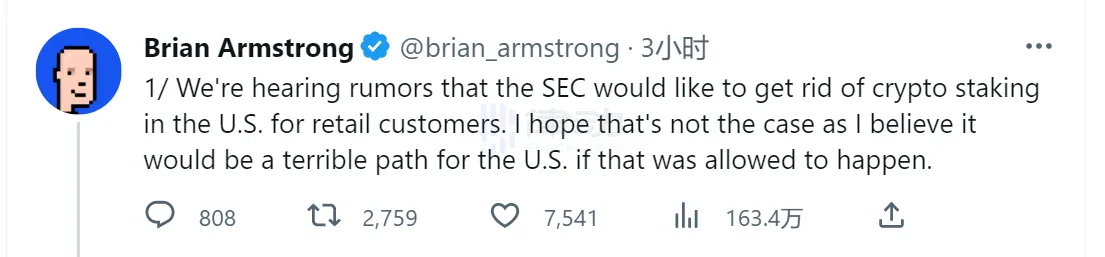
数小时前,Coinbase CEO Brian Armstrong 推特称,传闻美国 SEC 希望在美国取消散户的加密货币质押,一时间市场传言美国监管层面将对加密市场重拳出击,这种政策的前因与逻辑暂且不表。市场层面,有危就有机,CEX 质押利空,则 LSD(流动性质押衍生品)利好。下面让我们梳理一下 LSD 板块的相关币种。

LSD 四兄弟

LDO(Lido)

以太坊流动性质押龙头,以当前近 500 万枚的 ETH 质押量占据市场 90 以上份额,其协议设计简洁明了,存入 ETH 即可 1:1 得到 stETH,作为权益衍生资产,后者在 Curve 上拥有不错的流动性。

如果我们认为 LSD 是目前加密市场基本面最「硬」的逻辑,LDO 则为中军。在 2022 年下半年的熊市的数次回暖中,LDO 常常是资金率先选择的对象,当前市值 23 亿美元。

RPL(Rocket Pool)

相比于 Lido 全链扩张的打法,Rocket Pool 专注于以太坊。LDO 只具备治理功能,但在 Rocket 网络,需质押一定数目的 RPL 以保证节点正常运行,该设计赋予 RPL 一定的 Utility。RPL 当前市值 8.5 亿美元,今日已突破近一年高点,近三个月趋势持续向上,涨幅已达到 300%。

SSV(ssv.network)

SSV 本身是一个服务于验证人的基础设施,但 SSV 并不做资产管理的工作,也就是 SSV 并不吸收用户的 ETH 再进行组合。不像 Lido 一类真正的质押服务商。SSV 主要服务于两类用户,一类是长期持仓的,需要保证资金安全(不托管资产给第三方),但不想自己动手的大户;一类是以 Lido、Rocketpool、Binance 为首的一众 ETH 质押服务商 SSV 的价值捕获。SSV 帮助质押运营商减少运维压力、减少设备服务器的支出及其管理成本、减少安全风险,方便省心。

SSV 当前市值 2.3 亿美元,截至目前日内上涨 20%。

FXS(Frax)

Frax 以算法稳定币而闻名,其由一连串的 DeFi 产品组成,包括稳定币、借贷市场、去中心化交易平台等。Frax 介入 LSD 的时间并不长,目前市场份额排名第五,市值 1 亿美元左右,与 LSD 概念贴合度一般,是否能得到市场的认可,还需要时间检验。

LSD 的基本面定位

严格意义上说,AI 在加密行业中缺少合理靠谱的炒作逻辑,此轮行情更像是对全球整体科技行情的共振响应。进一步,如果我们认为 AI 属于 meme 类题材炒作,那 LSD 毫无疑问属于加密行业的基本面赛道——质押是有实际落地的应用,而近期每轮回暖中 LDO 等标的的率先表现也印证了这一点。由此可见,切换不仅仅是资金的溢出,也是一种市场审美的回归。


Related Reads

Should You Buy SpaceX Stock at $1.7 Trillion? Here's What the Market Is Worried About

SpaceX is preparing for a massive IPO aiming to raise around $75 billion at a valuation of approximately $1.75 trillion. While its achievements in reusable rockets and the profitable Starlink satellite internet service are clear, the market is concerned about the aggressive valuation. Key issues include: the current $1.75 trillion valuation, which is about 94 times 2025 revenue, seems to price in not just existing businesses but also unproven future ventures like AI infrastructure and orbital data centers. Financially, while Starlink is profitable, the AI division, bolstered by the acquisition of xAI, is incurring massive losses and consuming the majority of capital expenditures. This acquisition also introduced complex related-party financing arrangements and debt onto SpaceX's balance sheet. Furthermore, corporate governance poses a challenge. SpaceX's dual-class share structure ensures founder Elon Musk retains absolute control, limiting ordinary shareholders' influence over high-risk, long-term strategic decisions. The future success of ambitious projects like the Starship rocket—critical for lowering costs and enabling new services—remains a significant variable for the valuation. In summary, the market's apprehension (FUD) centers not on doubting SpaceX's past technological triumphs but on questioning how much premium public investors should pay for a future that combines proven profits with highly speculative and capital-intensive new ventures, all under a governance structure that offers limited shareholder oversight.

marsbitHá 38m

Should You Buy SpaceX Stock at $1.7 Trillion? Here's What the Market Is Worried About

marsbitHá 38m

Breaking the DeFi Cascading Liquidation Curse: Vitalik Proposes a New Solution

Vitalik Buterin has proposed a new DeFi design to eliminate the automatic liquidation mechanism that causes market instability during sharp downturns. The current system, used by protocols like Aave, triggers forced sales when collateral value falls below a threshold, often exacerbating price drops and creating systemic selling pressure. Buterin's alternative model is based on splitting an asset like ETH into two synthetic option-like tokens, P and N, pegged to a price index. Their combined value always equals one ETH. Instead of sudden liquidation, a position's value gradually drifts from its target peg if the market moves. Users must proactively rebalance their holdings to maintain their desired exposure, transferring the management burden from the protocol to the user or automated tools. A key advantage is the reduced reliance on real-time oracles. Pricing decisions are deferred until contract expiry, allowing for more robust, fault-tolerant oracle designs. This removes a clear liquidation threshold that speculators can target for manipulation or MEV extraction. However, significant challenges remain. Frequent rebalancing could incur high slippage and transaction costs, necessitating new liquidity provider models. The design is better suited for hedging instruments than for stablecoins requiring a rigid 1:1 peg. While not an immediate replacement for existing systems, the proposal challenges the foundational assumption that instantaneous forced liquidation is an unavoidable necessity in DeFi, opening the door for fundamentally different risk management architectures.

marsbitHá 42m

Breaking the DeFi Cascading Liquidation Curse: Vitalik Proposes a New Solution

marsbitHá 42m

The End of Single-Factor Cryptography

The article "The End of Single-Factor Crypto" posits a fundamental shift in the cryptocurrency ecosystem. It argues the era where crypto asset valuations were predominantly driven by, and correlated with, Bitcoin's price is ending. The space is bifurcating into two distinct economies: endogenous and exogenous. The endogenous economy represents traditional crypto, where token and project values are directly tied to crypto market prices. The emerging exogenous economy comprises projects and businesses that may utilize blockchain technology or tokens but derive their fundamental value from external, non-crypto factors like consumer demand, subscription revenue, or real-world utility. Examples include AI inference platforms like Venice, fintech lenders using blockchain for efficiency, and stablecoin/payment infrastructure companies acquired by giants like Mastercard and Stripe. This shift means investment analysis must change. For exogenous assets, evaluating traditional business fundamentals—such as revenue streams, unit economics, and competitive moats—becomes more critical than tracking Bitcoin charts. While endogenous assets like Bitcoin remain relevant, the growth of the exogenous category is driven by measurable demand independent of crypto price cycles, paving the way for a new, more diversified market phase. Consequently, crypto is evolving from a single-factor, reflexive asset class into a multifaceted ecosystem with varied drivers and investment theses.

marsbitHá 43m

The End of Single-Factor Cryptography

marsbitHá 43m

Morning Post | Bitmine Plans to Raise $300 Million Through Preferred Stock Issuance; Polymarket Accuses Kalshi of Commercial Espionage

ChainCatcher's Daily Crypto Brief: Key developments from the past 24 hours include significant funding moves, regulatory actions, and market predictions. Bitmine announced a $300 million preferred stock fundraising. Polymarket accused rival prediction platform Kalshi of corporate espionage, citing numerous suspicious coincidences in product launches, a claim Kalshi strongly denied. The U.S. Department of Justice, in a joint "Disruption Week" anti-fraud operation with companies like Coinbase and Meta, froze over $3.8 million in cryptocurrency linked to scams. In infrastructure news, Macau completed its integration with the multi-central bank digital currency bridge, mBridge, aiming to build efficient cross-border payment channels. Cosmos Labs acquired the block explorer Mintscan. Market-wise, Geoffrey Kendrick, Standard Chartered's Head of Digital Assets Research, stated Bitcoin is nearing a bottom around $63,000, maintaining a year-end target of $100,000. He noted stability in U.S. spot Bitcoin ETF holdings. Ahead of SpaceX's anticipated IPO, internal insiders at Rocket Lab (RKLB) sold over $18.41 million in stock. In tokenization, Goldman Sachs partnered with Apex and Archax to launch a tokenized real estate fund. The meme token tracker GMGN reported the top trending tokens: on Ethereum, HEX, SHIB, LINK, PEPE, mUSD; on Solana, TROLL, swarms, WORLDCUP, neet, Buttcoin; and on Base, PEPE, toby, ODDS, ELSA, SKI.

链捕手Há 57m

Morning Post | Bitmine Plans to Raise $300 Million Through Preferred Stock Issuance; Polymarket Accuses Kalshi of Commercial Espionage

链捕手Há 57m

Trading

Spot
Futures

Hot Articles

How to Buy LDO

Welcome to HTX.com! We've made purchasing Lido (LDO) simple and convenient. Follow our step-by-step guide to embark on your crypto journey.Step 1: Create Your HTX AccountUse your email or phone number to sign up for a free account on HTX. Experience a hassle-free registration journey and unlock all features.Get My AccountStep 2: Go to Buy Crypto and Choose Your Payment MethodCredit/Debit Card: Use your Visa or Mastercard to buy Lido (LDO) instantly.Balance: Use funds from your HTX account balance to trade seamlessly.Third Parties: We've added popular payment methods such as Google Pay and Apple Pay to enhance convenience.P2P: Trade directly with other users on HTX.Over-the-Counter (OTC): We offer tailor-made services and competitive exchange rates for traders.Step 3: Store Your Lido (LDO)After purchasing your Lido (LDO), store it in your HTX account. Alternatively, you can send it elsewhere via blockchain transfer or use it to trade other cryptocurrencies.Step 4: Trade Lido (LDO)Easily trade Lido (LDO) on HTX's spot market. Simply access your account, select your trading pair, execute your trades, and monitor in real-time. We offer a user-friendly experience for both beginners and seasoned traders.

4.4k Total ViewsPublished 2024.03.29Updated 2026.06.02

How to Buy LDO

Discussions

Welcome to the HTX Community. Here, you can stay informed about the latest platform developments and gain access to professional market insights. Users' opinions on the price of LDO (LDO) are presented below.

活动图片












