Aave Whale "Midnight Pump" Drains Borrowers of $6 Million Every Night, Who's Behind This?

marsbitPublished on 2026-07-29Last updated on 2026-07-29

Abstract

A "whale" is repeatedly causing interest rate spikes on Aave's USDC pool by temporarily withdrawing nearly $190 million in liquidity every night around 23:30 UTC and returning it within an hour. This action, tracked to a specific Ethereum address, spikes the pool's utilization above its 92% target, sharply increasing variable borrowing rates for all users in the pool during that window. Analysis suggests this is likely a fund performing a daily compliance ritual—withdrawing funds to prove ownership for a snapshot before redepositing them. While the time window for these withdrawals has tightened from June to July, the practice imposes a significant cost. Calculations show this activity costs borrowers in the pool an extra $1.7 million per year. For context, a single $1 million loan incurs about $3,280 in extra annual interest. The transparency of DeFi exposes how traditional financial compliance processes can create a hidden tax for decentralized finance users, highlighting a need for adapted regulatory frameworks.

Author: Cooper Duschang

Compiled by: Deep Tide TechFlow

Deep Tide Guide: Someone is draining $190 million in liquidity from Aave's USDC pool every night and returning it half an hour later—this operation is forcing all borrowers to pay an extra $6 million in interest annually. Deep Tide tracked the on-chain flow of funds and found this is most likely a mandatory daily process for a certain fund to prove to its investors that "we indeed hold this money." The transparency of DeFi has exposed the invisible tax that traditional financial compliance processes impose on on-chain users.

Core Discovery

Since May, the utilization rate of Aave's USDC pool has been spiking daily during the midnight UTC period. The reason is that someone withdraws $190 million USDC around 23:30 and deposits it back within an hour. This affects the interest rates for all lenders and borrowers in the pool.

By tracing the fund flow from this wallet, we found the behavior most consistent with the explanation: a certain institution needs to withdraw funds from the DeFi pool daily to take a snapshot proving asset ownership, and then deposit them back.

This "pump-and-dump" time window has become increasingly tight in July, consistently centered around midnight UTC. Compared to a scenario with no liquidity withdrawal, this operation is causing all USDC borrowers to pay an extra $6 million per year.

How Does Aave's Utilization Mechanism Work?

Aave's dual-interest rate model incentivizes borrowing and lending based on a target utilization rate. When utilization is below the target, the interest rate increases slowly; when it exceeds the target, the rate spikes sharply. The utilization formula is (Total Borrowed / Total Deposited). For example, the more assets borrowed, the closer the utilization gets to 100%.
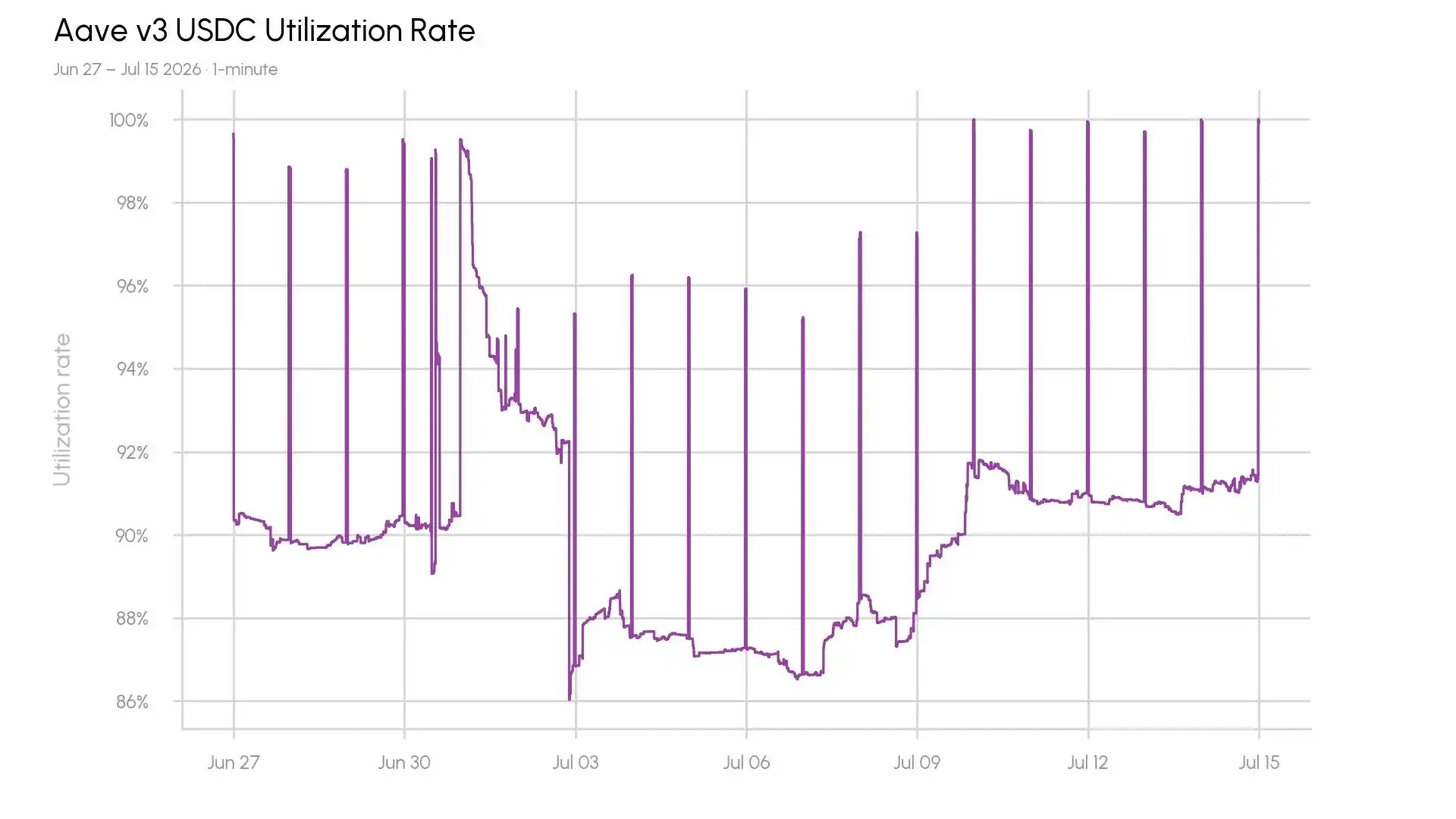
Figure: Aave's dual-interest rate model—the borrowing rate curve steepens sharply after exceeding the target utilization rate (e.g., 92%). Source: Coin Metrics / Talos

The target utilization rate for the USDC market on Aave's Ethereum main instance is 92%. After exceeding the target, the interest rate curve becomes very steep—from 92% to 100% utilization, the borrowing rate skyrockets from 4% to 14%. This discourages borrowing demand or encourages more people to deposit USDC to meet the demand.

The utilization rate in Aave's USDC market typically fluctuates around 90%. However, since May, minute-level data shows repeated sharp spikes in utilization.
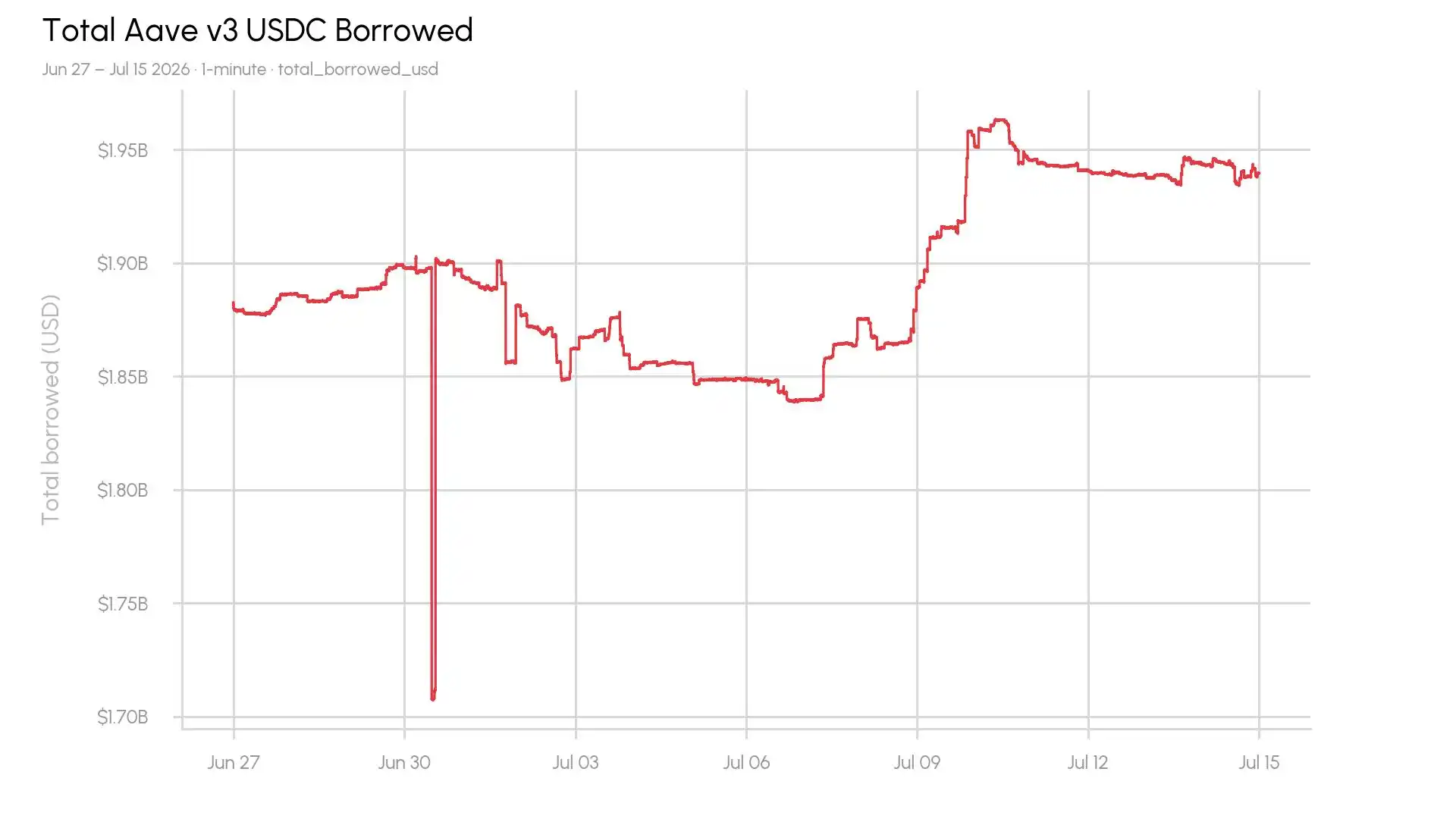
Figure: Minute-level data of Aave USDC market utilization, showing regular midnight spikes since May. Source: Coin Metrics / Talos

Why Do These Spikes Occur?

Excluding governance adjustments or oracle manipulation, only two variables affect the utilization rate: the amount of USDC deposited and the amount borrowed.

Apart from a brief dip in borrowing, the total borrowed amount has averaged $1.89 billion since June 27th. If borrowing hasn't consistently surged—which would push utilization higher—then the amount of USDC deposited must be plummeting.

Between 23:30 UTC and latest 00:30 UTC, over $150 million in USDC deposits are withdrawn and redeposited. The available borrowing liquidity plummets from about $210 million to as low as $33,000.
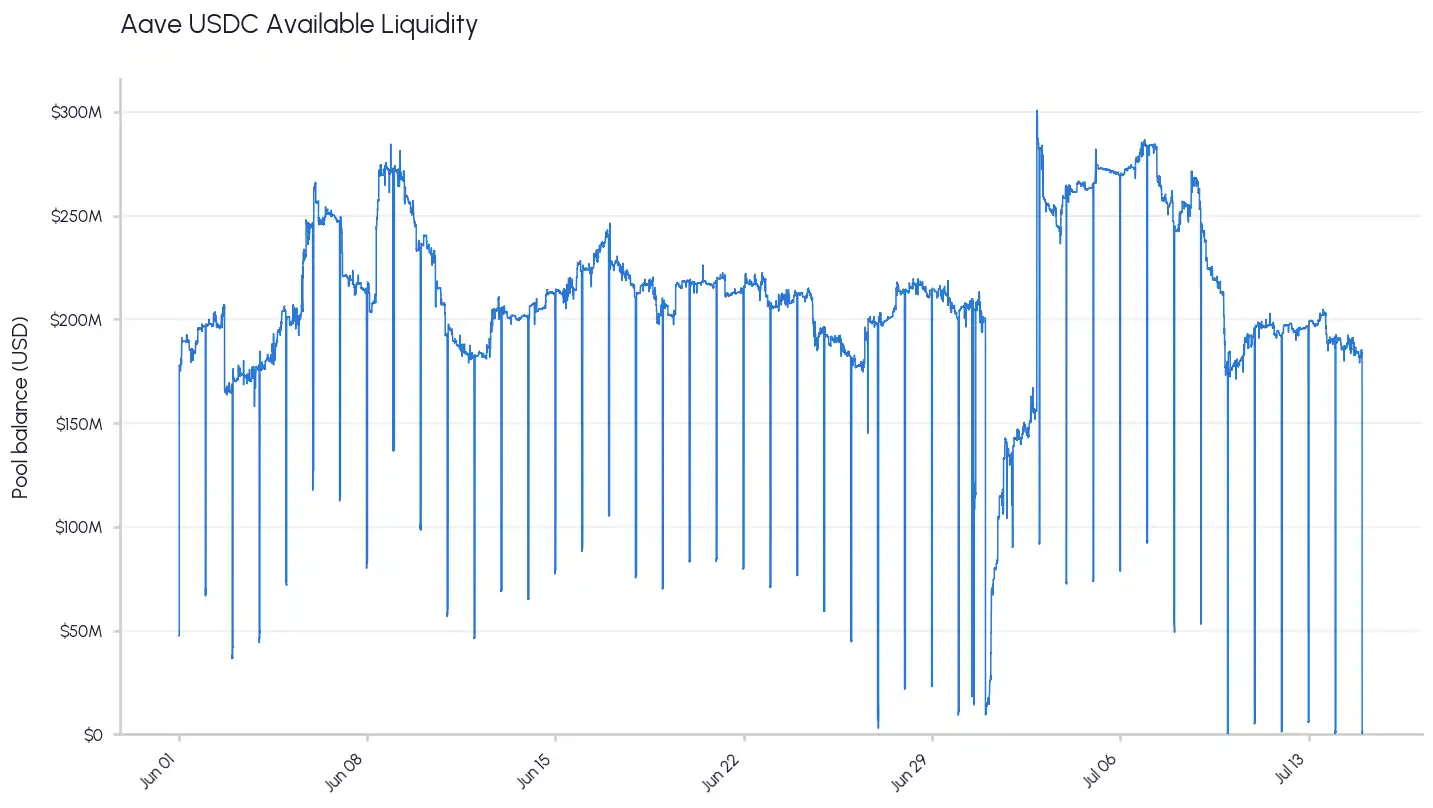
Figure: Over $150 million USDC withdrawn and redeposited daily between 23:30–00:30 UTC, available liquidity crashes from ~$210 million to a low of $33k. Source: Coin Metrics / Talos

Who Is Creating These Spikes?

Ethereum's pseudonymity allows us to publicly track addresses and transactions without exposing the user or intent. We found the address moving $190 million every night: 0x56957E411Ea83a0B4A0689C1fB0D1e5eA0d20149.
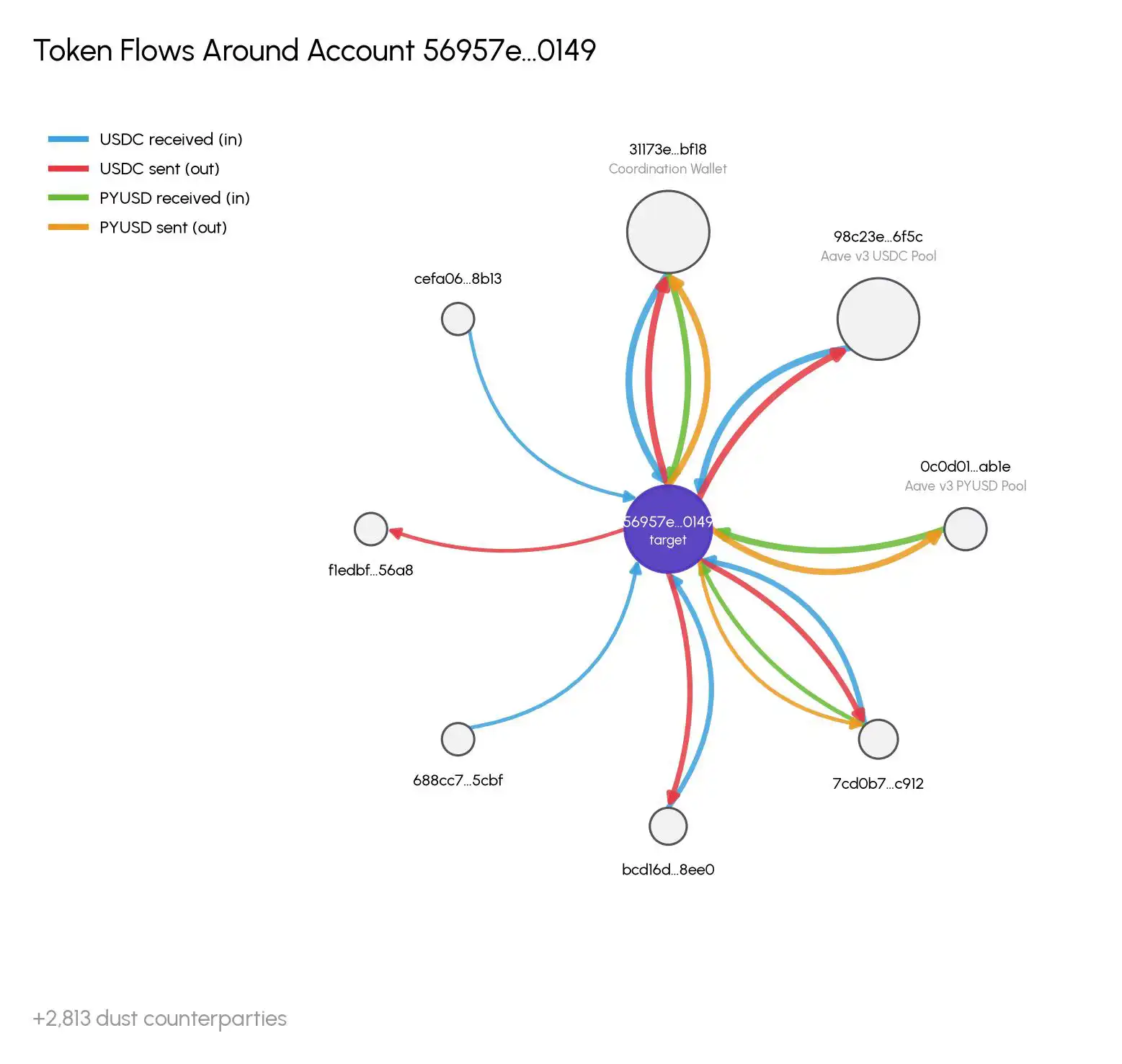
Figure: Fund flow path of the involved address 0x5695...0149, withdrawing liquidity from Aave for a snapshot each night before returning it. Source: Coin Metrics / Talos

This account received funds on December 5th, 2025. Examining balance changes and fund flows, we traced that the target address performed similar operations on Aave's PYUSD pool in December and January. The target address receives USDC, deposits it into the Aave pool, withdraws around 23:30 UTC, and sends it to 0x31173Ed183e5a9450C3671018ec4d770c8A8bF18 a few minutes later. The USDC is then returned shortly after 00:00 UTC and redeposited into the Aave pool.

This "coordinating wallet" 31173e...bf18 receives funds from the target address and another address holding sUSDS by depositing USDC to earn yield. This combined capital is sent nightly to a third, upper-level wallet: 0xf1edbf98dda764ec51de3776371f0f7d6f6156a8.

This is likely a process where an investor is required to prove their holdings daily by withdrawing liquidity from DeFi pools for snapshot purposes.

From June to July, the average time window for pumping and dumping has tightened. The withdrawal time shifted from 23:20 to 23:34, and the return time shortened from 00:34 to 00:09. The average interval between withdrawal and return was 259 blocks in June, shrinking to 177 blocks in July.
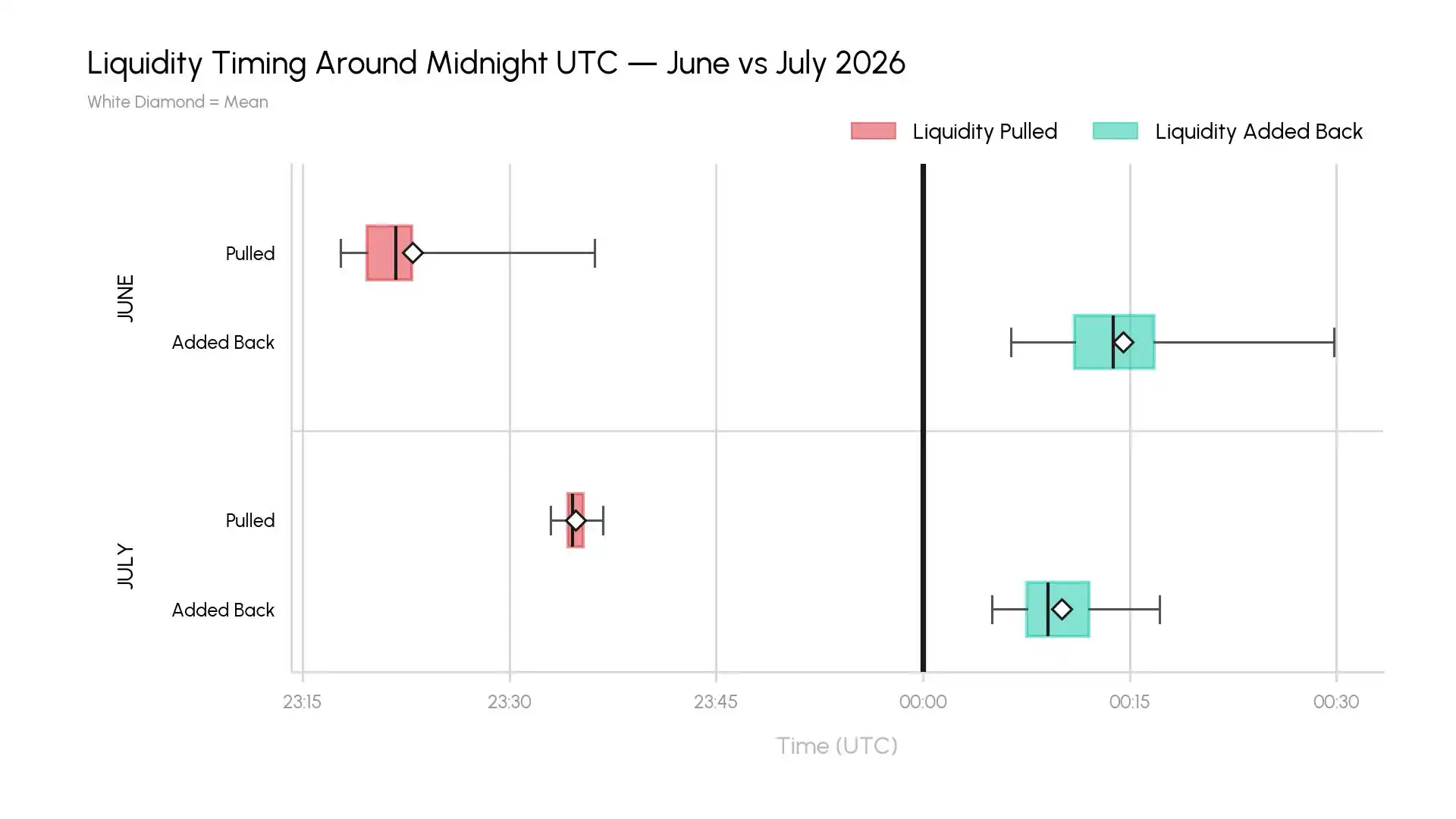
Figure: The withdrawal and return time window tightened from June to July, with the interval shortening from an average of 259 blocks to 177 blocks. Source: Coin Metrics / Talos

What Is the Impact on Borrowers?

The utilization spikes caused by liquidity withdrawal benefit depositors but harm borrowers. When utilization spikes, the floating borrowing rate also spikes, leading to temporarily higher repayments calculated per block.

Yield or interest on Aave is streamed per block. With an average Ethereum block time of 12 seconds, about 5 blocks are produced per minute. We decomposed the floating borrowing APR to simulate how a $1 million borrowing position is affected by minute-by-minute changes in the borrowing rate.
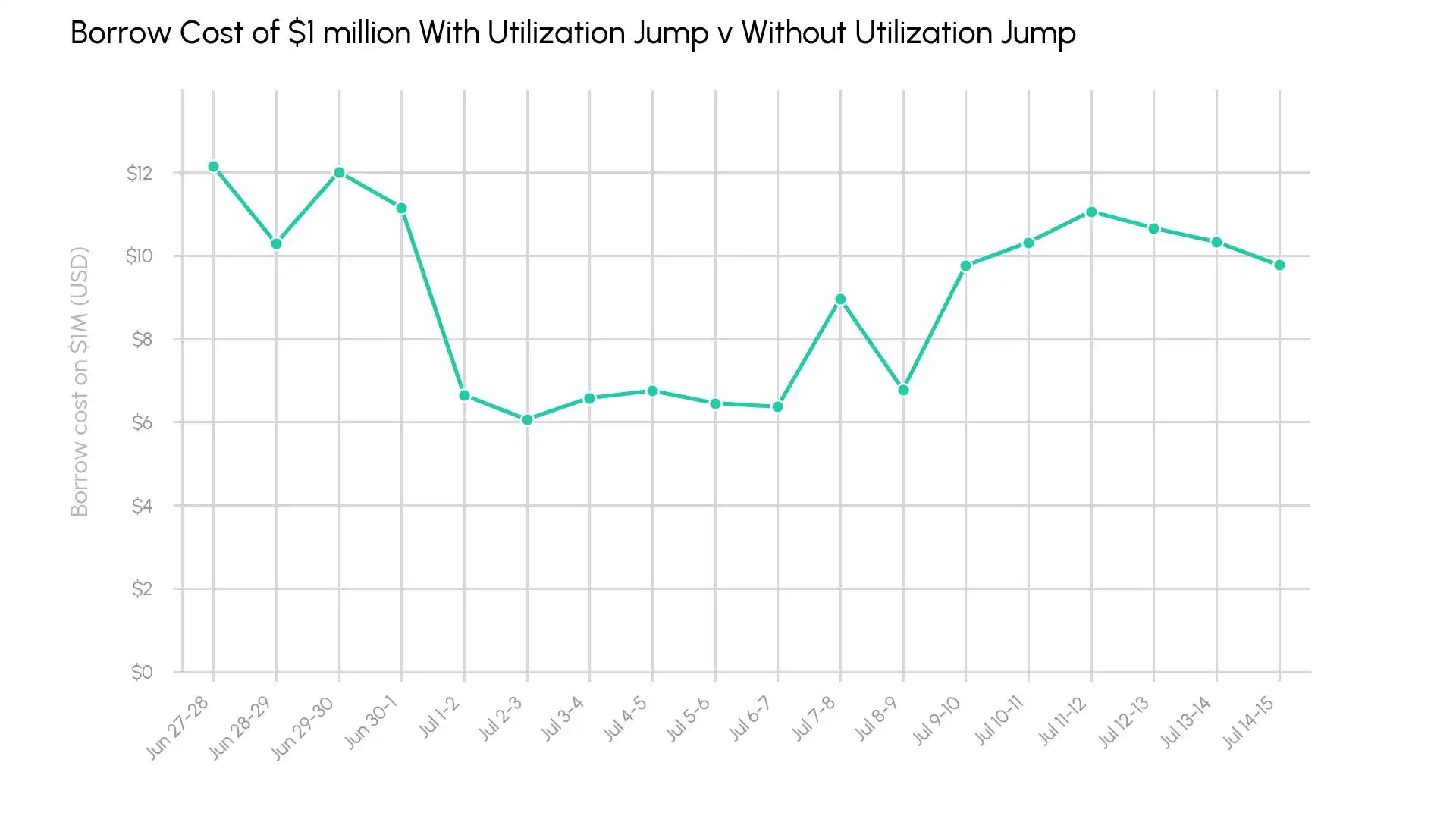
Figure: Minute-by-minute borrowing rate changes for a $1 million borrowing position during liquidity withdrawal, costing an extra ~$9 per night over 18 days. Source: Coin Metrics / Talos

Over 18 days, when liquidity was withdrawn, a borrower with a $1 million position paid an average of $9 more per day compared to a simulated scenario where liquidity was not temporarily altered. This would amount to a loss of about $3,280 annually. For the total $1.89 billion borrowed in the USDC pool, this costs all borrowers an extra $17,000 per night, or $6 million per year. Borrowers are paying more for activities unrelated to their own loans.

Why Does This Matter?

We believe these consistent utilization spikes most closely align with an explanation of a fund proving its holdings. Establishing regulations and improving workflows around DeFi investments could help reduce these negative impacts on lending pools. The transparency of blockchain can aid in tracking fund flows within blockchain protocols without needing to send funds to a designated address to prove they exist and are under the control of approved parties.

Today, lenders and borrowers must monitor not only the health of their own positions but also those in the entire pool. Tracking funds and deciphering their intent can help assess new risks and predict liquidity and interest rate changes.


Trending Cryptos

Related Questions

QWhat is the primary impact of the 'midnight liquidity draining' phenomenon described in the article?

AThe primary impact is that it costs all USDC borrowers on Aave an estimated $6 million extra in interest payments annually. This occurs because withdrawing $190 million in liquidity from the USDC pool temporarily spikes the utilization rate, triggering Aave's steep interest rate curve and increasing borrowing costs for everyone until the funds are redeposited.

QAccording to the article, what is the most likely explanation for the consistent nightly withdrawals and redeposits of funds on Aave?

AThe most likely explanation is that a fund or institutional investor is required to prove its asset holdings daily for compliance or reporting purposes. The process involves withdrawing funds from the DeFi pool (like Aave) to take a 'snapshot' proving ownership and control, before quickly returning the funds.

QHow does Aave's interest rate model respond when the utilization rate of a pool exceeds its target (e.g., 92% for USDC)?

AAave uses a dual interest rate model. When the utilization rate exceeds the target (like 92%), the borrowing interest rate curve becomes very steep. For the USDC pool, this means rates can jump sharply from around 4% at 92% utilization to as high as 14% at 100% utilization, designed to discourage further borrowing or incentivize more deposits.

QWhat specific wallet address was identified as being responsible for the nightly liquidity movements, and what pattern did its activity show over time?

AThe wallet address identified is 0x56957E411Ea83a0B4A0689C1fB0D1e5eA0d20149. Analysis showed that from June to July, the time window for its 'withdraw-and-redeposit' operation became more compact. The average interval between withdrawal and redeposit shortened from 259 blocks in June to 177 blocks in July, indicating a faster process.

QWhy does the article suggest that DeFi's transparency is a double-edged sword in this context?

ADeFi's transparency allows for the public tracking of these fund flows and the identification of the systemic issue, exposing how traditional financial compliance processes can impose a hidden cost (the 'invisible tax' of extra interest) on other protocol users. However, it also means lenders and borrowers must now monitor not just their own positions but also the health and activity of the entire pool to anticipate such risks.

Related Reads

Citi Research Report Analysis: U.S. Proposed Ban on Chinese Optical Modules Has No Substantial Progress, Short-term Enforcement Faces Supply Constraints

Citi Report Analysis: U.S. Proposed Ban on Chinese Optical Modules Lacks Substantive Progress, Faces Supply Bottlenecks in Short Term. Reuters reported on August 4th that the U.S. government and FCC are considering a ban on Chinese optical modules. Citi's August 9th report clarifies that optical modules are not listed on any effective FCC ban. The FCC's Order 26-50 established two restricted list mechanisms (based on manufacturer and production location), but optical modules were only mentioned once, as an example in a disclosure requirement, not as a restricted product. The reported ban remains at a proposal stage. Citi estimates Chinese suppliers provide 60-70% of high-speed optical modules for U.S. hyperscalers. Non-Chinese suppliers cannot fill this gap in the short term, making the immediate implementation of a genuine ban unlikely. Future regulatory paths could be manufacturer-based (least likely), location-based covering all offshore production (strictest), or location-based covering only China (more feasible but with unresolved definitions). A ban would pressure U.S. AI infrastructure, conflicting with stated policy goals. Citi sees low near-term implementation probability, with the issue potentially becoming a negotiation chip in bilateral talks. U.S. domestic capacity build-out is a key long-term variable. Among Chinese companies, XSENS and Dongshan Precision have the highest U.S. exposure, while Tianfu Communication, as a passive component supplier, is relatively insulated. Citi maintains Buy ratings on all three with respective price targets. The conclusion is that Chinese modules are currently irreplaceable in the U.S. AI supply chain, creating a longer timeline for potential restrictions than the market may expect.

marsbit16m ago

Citi Research Report Analysis: U.S. Proposed Ban on Chinese Optical Modules Has No Substantial Progress, Short-term Enforcement Faces Supply Constraints

marsbit16m ago

Lead Analyst Claims Bitcoin is at a Critical Stage: 'We are at the Bear Market Bottom, What Happens Next…'

Renowned cryptocurrency analyst Benjamin Cowen, in his latest analysis video, examined recent events and historical cycles in the Bitcoin market. Noting Bitcoin's trading range of $64,000 to $65,000, Cowen stated that market dynamics and investor interest show similarities to past cycles, suggesting the upcoming period marks a critical turning point. Cowen observed a significant decline in public interest and investor enthusiasm for the crypto market, with social risk metrics falling to 0.2, far below levels seen four years ago. He added that market volatility has notably decreased, and a sense of distrust prevails among investors, drawing parallels to the ends of bear markets in 2018 and 2022. Historical data indicates Bitcoin markets typically bottom in summer months, followed by a period of stagnation with low volatility, implying a major move could occur in the year's final quarter. However, Cowen noted on-chain indicators like the MVRV Z-Score have not yet signaled a definitive bottom. Cowen believes an event in the coming weeks could shake the market, potentially triggering a final sell-off wave. Such an event, he argues, would bring investors back and pave the way for a new bull cycle. He predicts October as the most likely bottoming period, while acknowledging September or November are also possible, advising crypto users to remain cautious and prepared for a decisive market moment.

cryptonews.ru25m ago

Lead Analyst Claims Bitcoin is at a Critical Stage: 'We are at the Bear Market Bottom, What Happens Next…'

cryptonews.ru25m ago

Bitcoin Community in Uproar: Deciphering the New Scaling War Sparked by BIP-110

On August 10, Luke Dashjr, a long-time Bitcoin Improvement Proposal (BIP) editor and co-founder of Ocean mining pool, was removed from the BIP editing team for bypassing discussion protocols and preemptively assigning a number to BIP-110, a controversial soft fork proposal he helped draft. The conflict stems from Bitcoin Core's version 30 release in October 2025, which removed the default 83-byte limit on OP_RETURN, a field used for embedding non-transaction data. In response, BIP-110 aimed to enforce this limit as a consensus rule. It controversially lowered the activation threshold for miners to 55% and included a mandatory activation clause, causing significant community backlash. Major mining pools like Foundry USA and AntPool did not support it, with public criticism from figures like F2Pool's Wang Chun and Michael Saylor, who argued it compromised Bitcoin's neutrality. On August 8, at block height 961,632, nodes running the BIP-110 patch rejected the main chain block, causing a chain split. The minority chain, supported by only about 2.53% of the network's hash rate, produced just one additional block before stalling. The main chain quickly outpaced it by over 240 blocks. No major exchanges have supported the minority chain. The event highlighted Bitcoin's governance reality: while rules can be proposed by a few, ultimate authority lies with the economic majority—miners willing to expend hash power and users/exchanges recognizing a chain's validity. Following the failed split, BIP-110 proponents, including Luke Dashjr, have begun discussing a change to the proof-of-work algorithm to create a separate coin, though this remains in early discussion stages.

marsbit46m ago

Bitcoin Community in Uproar: Deciphering the New Scaling War Sparked by BIP-110

marsbit46m ago

Trading

Spot

Hot Articles

Discussions

Welcome to the HTX Community. Here, you can stay informed about the latest platform developments and gain access to professional market insights. Users' opinions on the price of PUMP (PUMP) are presented below.

活动图片