Send a Message to Transfer Coins? Telegram to 'Stuff' a Crypto Wallet into 1 Billion Users This Summer

marsbitPublished on 2026-07-22Last updated on 2026-07-22

Abstract

Telegram founder Pavel Durov has announced that a native, non-custodial wallet called Gram wallet will be built into every Telegram app this summer. This move aims to provide instant, fee-free cryptocurrency transfers for the platform's over 1 billion monthly active users. Durov described it as the largest deployment of a non-custodial crypto wallet in history. The new wallet, developed by Telegram itself, differs fundamentally from the existing third-party @wallet bot. It will be non-custodial from the start, meaning users will control their private keys. Following the announcement, the GRAM token (formerly Toncoin) saw a price increase of approximately 8%. This initiative is part of Telegram's renewed control over the TON blockchain and its "Make TON Great Again" roadmap, marking a return to the project after a 2018 SEC lawsuit. The launch comes as other super-apps like X Money and Meta are also expanding into digital payments, with Telegram opting for a crypto-native approach. However, key details remain unclear, including the exact launch date beyond "this summer," how the promised zero fees will be implemented technically, and how asset support and private key management will work for mainstream users.

Author: Claude, Deep Tide TechFlow

Deep Tide's Guide: Telegram founder Pavel Durov announced that this summer, a native non-custodial Gram wallet will be built into all Telegram apps, offering zero-fee instant transfers to over 1 billion users. GRAM subsequently rose about 8% to $1.53. This wallet differs from the existing third-party-operated @wallet bot; it is developed by Telegram itself, with users directly controlling their private keys. Amid a competitive window where super apps like X Money and Meta's stablecoin payments are entering the fray, Durov is betting on a crypto-native route. However, the promise of the "largest deployment in human history" still lacks technical details and a definitive timeline.
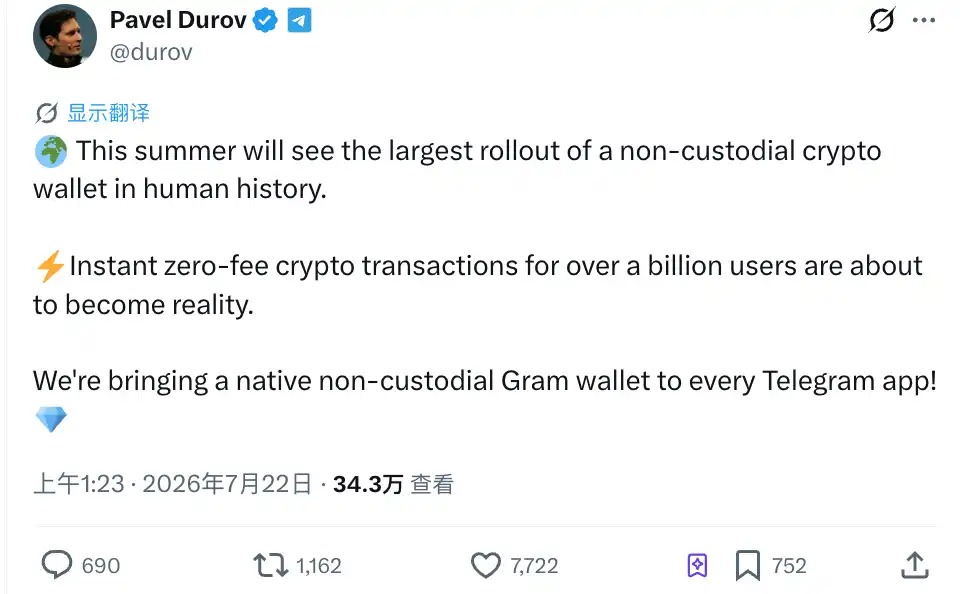
Telegram founder Pavel Durov announced in his Telegram channel on July 21 that this summer, a native non-custodial Gram wallet will be built into every Telegram application, providing instant, zero-fee cryptocurrency transfer services to over 1 billion monthly active users.

Durov characterized this launch as "the largest non-custodial crypto wallet deployment in human history." For comparison, the most widely used self-custody wallet in the crypto space, MetaMask, has tens of millions of users; no crypto wallet has ever started with a base of 1 billion users.

Completely Different from the Existing @wallet, Telegram Steps In Directly

This new wallet is fundamentally different from the existing @wallet bot within Telegram.

According to Decrypt, the existing @wallet is a mini-app developed and operated by the independent third-party company The Open Platform (TOP), and is not an official Telegram product. The service already boasts over 150 million registered users, with a default custodial model (meaning a third party holds user private keys), requiring users to actively switch to use its self-custody layer.

The new wallet announced by Durov is a feature natively embedded into the Telegram app, designed from the ground up as non-custodial, with users controlling their own private keys and assets. Non-custodial means there is no intermediary that can freeze, seize, or block transactions.

According to BeInCrypto, TOP founder Andrew Rogozov confirmed that the existing custodial @wallet service will continue to operate independently. However, key questions remain unanswered: whether the old and new wallets will ultimately coexist, which assets besides GRAM the new wallet will support, and how private key management will be handled for ordinary users who have never interacted with cryptocurrency.

GRAM Rises About 8%, But Still 88% Away from Previous High

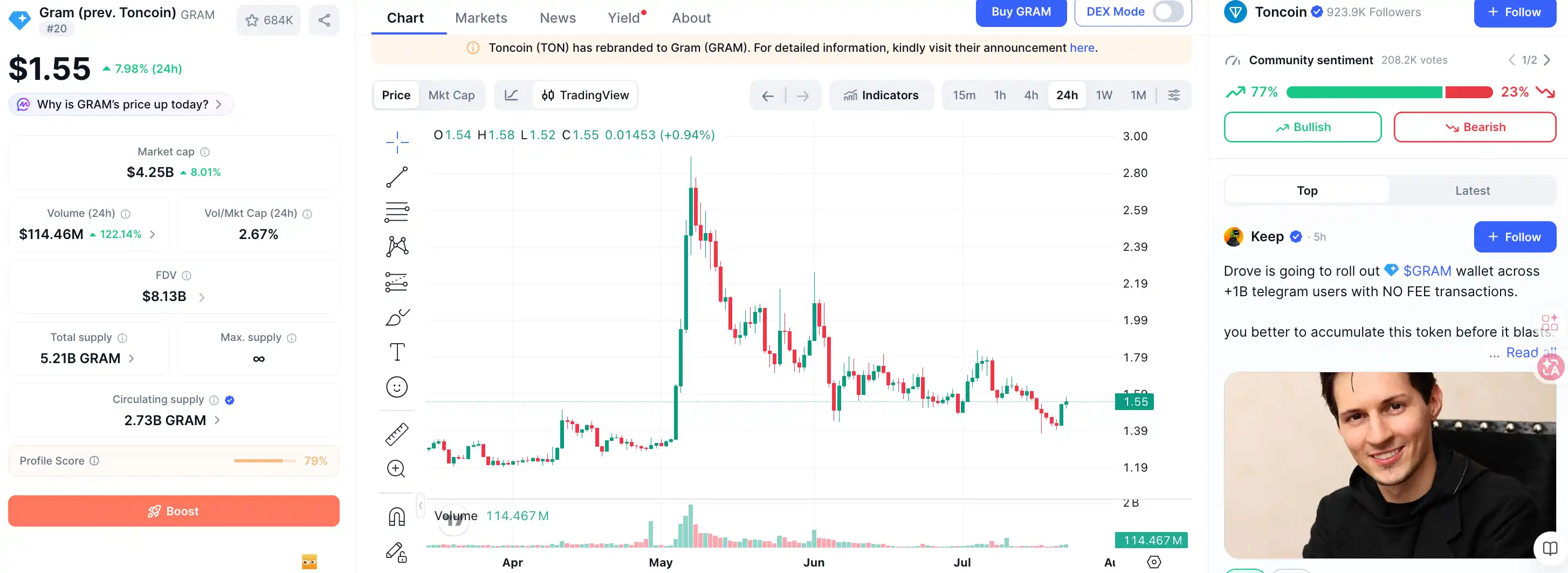
Following the announcement, GRAM (originally Toncoin, the native token of the TON blockchain) rose approximately 8.5% in 24 hours to around $1.53, with a market cap of about $4.18 billion. According to CoinMarketCap data, this partially offset a cumulative decline of about 25% since July, but significant reversal remains distant.

GRAM's 200-day exponential moving average is far above its current price, indicating a still bearish long-term trend. The token's all-time high was $8.25 (during the Telegram 'Tap-to-Earn' gaming frenzy in June 2024). It reached its yearly high of $2.89 in May 2026 when Telegram announced it was taking over the TON network. A return from the current price to the May high would require an increase of approximately 88%.
From SEC Lawsuit to 'Make TON Great Again', Durov's Seven-Year Comeback Battle

This wallet deployment is the latest chapter in a narrative that began in 2018.

In 2018, Telegram raised $1.7 billion for the TON blockchain project, planning to issue a token called Gram. The SEC subsequently sued, determining the token was an unregistered security. In 2020, Telegram settled with the SEC, refunding investors $1.2 billion and paying an $18.5 million fine, completely withdrawing from the project. Community developers took over, independently operating the token renamed as Toncoin for several years.

In 2026, Durov regained control of the TON network and launched a seven-step roadmap named "Make TON Great Again" (MTONGA). Publicly completed steps so far include: the Catchain 2.0 upgrade achieving a 10x speed increase and sub-second transaction confirmation; a 6x reduction in base transaction fees; Telegram becoming the network's largest validator; and the token name change (from Toncoin back to Gram) passed by 81% community vote on June 15. The built-in wallet is likely step five, with three remaining steps yet to be disclosed.

Super App Payments War Heats Up, Telegram Chooses Crypto-Native Route

Durov's wallet announcement comes during a dense window where multiple super apps are simultaneously deploying payment functions.

According to Glitchwire, Musk's X Money launched on June 26 for US Premium subscribers, offering 6% APY, Visa Direct peer-to-peer transfers, and 3% cashback, but currently only supports fiat currency. Crypto and stock trading features are on the roadmap but not yet live. Meta is also re-strategizing digital payments, reportedly sending partnership invitations to third-party stablecoin providers, planning to integrate stablecoin payments into WhatsApp, Instagram, and Facebook in the second half of 2026.

The route choices of the three super apps present a stark contrast: X Money takes a compliant fiat route (holding money transmitter licenses in over 40 states), Meta explores a stablecoin middle path, while Telegram directly bets on a crypto-native non-custodial wallet. Telegram's advantages lie in its user base (over 1 billion monthly active users) and natural affinity for the crypto community. The risks involve the user education costs associated with non-custodial models and regulatory uncertainty.

Zero-Fee Promise Still Lacks Key Details

Durov's promised "zero fees" is another issue requiring attention. Most crypto wallets still charge network fees, even if minimal. Telegram might bypass gas fees through internal subsidies or by using methods like off-chain settlement, but the specific technical solution has not been announced.

According to CryptoBriefing, in July 2025, Telegram launched a non-custodial TON Wallet to 87 million US users as a proof-of-concept. That deployment demonstrated that a messaging app could distribute wallet infrastructure at scale without the traditional friction of crypto onboarding, but a significant gap remained between the number of on-chain active wallets and the user base.

Beyond "this summer," Durov has not provided a more specific launch date.

Related Questions

QWhat are the key differences between the new native Gram wallet announced by Telegram and the existing @wallet bot?

AThe new native Gram wallet is a core feature built directly into the Telegram app by Telegram itself, designed from the ground up as a self-custodial wallet where users control their private keys. In contrast, the existing @wallet bot is a third-party mini-app developed and operated by The Open Platform (TOP). It currently operates primarily as a custodial service (where TOP holds the keys), with a self-custodial layer available as an optional switch.

QWhat are some of the unanswered questions and uncertainties surrounding Telegram's planned Gram wallet deployment?

AKey unanswered questions include: a precise launch date beyond 'this summer'; technical details on how the promised 'zero-fee' transactions will be implemented; whether the new wallet will support assets beyond GRAM; how the wallet will manage the user experience and security for crypto-naive users among Telegram's billion-plus user base; and how the new official wallet will coexist with the existing third-party @wallet bot.

QHow has the announcement of the native Gram wallet affected the GRAM (TON) token's price and market position?

AFollowing the announcement, the GRAM token price rose approximately 8.5% to around $1.53. However, its overall market position remains challenging. The price is still about 88% below its year-to-date high of $2.89 from May 2026, and its 200-day exponential moving average is well above the current price, indicating a long-term bearish trend. It is also far from its all-time high of $8.25 set in June 2024.

QHow does Telegram's approach to payments compare with strategies from other 'super apps' like X (formerly Twitter) and Meta?

ATelegram, X, and Meta are taking distinct paths. X Money (on platform X) is pursuing a licensed, fiat-first approach in the US, offering features like yields and cashback, with crypto trading as a future roadmap item. Meta is reportedly exploring a partnership model with third-party stablecoin providers for integration into its apps. Telegram is taking a crypto-native route by directly building and integrating a self-custodial crypto wallet, leveraging its large user base and inherent appeal to the crypto community.

QWhat is the historical context of Telegram's involvement with the TON blockchain and the GRAM token?

ATelegram's history with TON and GRAM dates back to 2018 when it raised $1.7 billion for the TON blockchain project and planned to issue the Gram token. The SEC sued, alleging the token was an unregistered security. In 2020, Telegram settled, refunding investors and paying a fine, completely abandoning the project. Independent developers continued it as Toncoin. In 2026, under the 'Make TON Great Again' (MTONGA) roadmap, Durov and Telegram regained control, with key steps including network upgrades, fee reductions, Telegram becoming the top validator, and the community voting to rename Toncoin back to Gram.

Related Reads

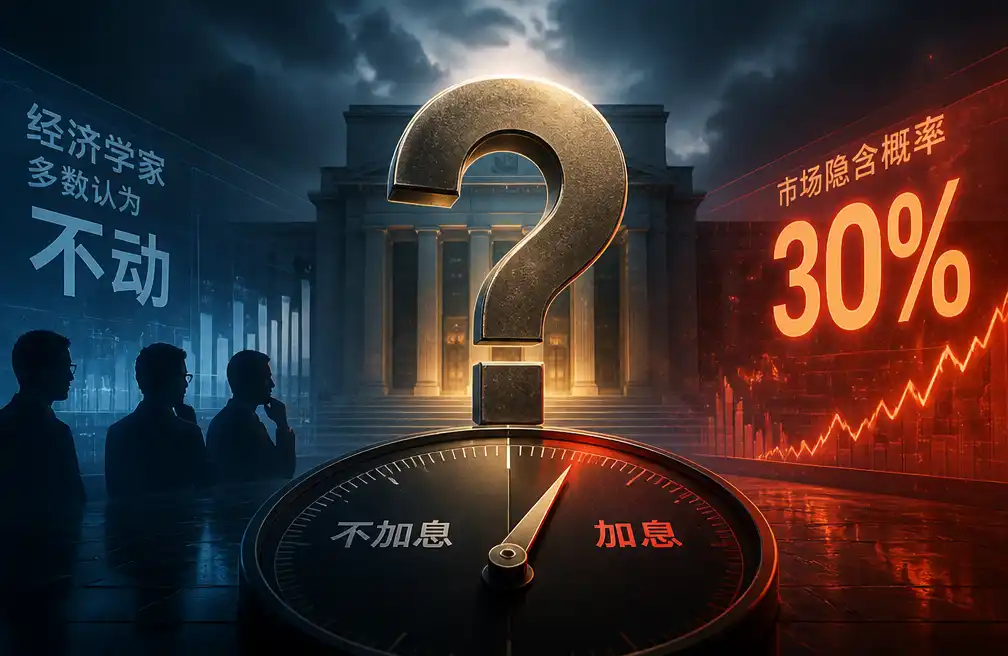
To Hike or Not Tonight: Economists Unanimous on 'No', Markets Price in a 30% Chance

Federal funds futures are repricing ahead of the July FOMC decision, as traders pay a higher premium for the risk of a surprise rate hike or more hawkish signals. This contrasts with economists, where a Reuters survey of 104 analysts unanimously expects rates to remain unchanged at 3.50%-3.75%, with 78 foreseeing no change through year-end. Yet, futures markets have priced in about a 30% probability of a 25-basis-point hike. The core debate, especially under new Fed Chair Kevin Warsh, centers on how the Fed will respond to the oil price shock from Middle East tensions. The market is not necessarily predicting a hike tonight but is hedging against two tail risks: an immediate rate increase, or a hold combined with communication that seriously opens the door for a September hike. This hedging activity has driven up open interest in Fed funds futures. Analysts are divided on how to weight the oil price surge in the Fed's reaction function. Hawkish voices (e.g., BofA) worry that completely dismissing the price pressure could challenge the Fed's inflation credibility in Warsh's first major test. Dovish views (e.g., Citi) argue the shock is primarily supply-driven and that overreacting with rate hikes could unnecessarily hurt growth, unless clear signs of secondary inflation emerge. Warsh's new tenure amplifies policy path uncertainty, as markets lack a stable baseline for his communication style. This environment forces traders to price in a wider range of outcomes, explaining the divergence between unanimous economist forecasts and market hedging. The key focus will be on Warsh's post-meeting commentary. If he downplays the oil shock and stresses anchored long-term expectations, hawkish pricing may recede. If he emphasizes the risk of broader price spillovers and prioritizes returning to 2% inflation, the market will interpret this as reopening the door for a September hike. This would sustain support for the USD, keep pressure on JPY (testing intervention thresholds), and challenge risk assets like stocks and crypto through higher discount rates and weaker sentiment. The baseline remains no action in July, but the communication will determine how far this repricing extends.

marsbit33m ago

To Hike or Not Tonight: Economists Unanimous on 'No', Markets Price in a 30% Chance

marsbit33m ago

The Semiconductor Industry's Most Obscure Chokepoint Material: It Has Multiplied in Price Unnoticed, and China Just Banned Its Export

"Helium: The Silent Choke Point in Semiconductors" Helium, despite being the universe's second most abundant element, is critically scarce on Earth. It cannot be synthesized artificially and escapes Earth's gravity once released, making it a non-renewable resource. Yet, it is indispensable for advanced semiconductor manufacturing, requiring ultra-high purity (99.9999%) for processes like wafer etching, leak detection, and thermal management in lithography tools, with no viable substitutes. This low-profile resource, whose price has doubled unnoticed, suddenly gained attention when China imposed an export ban on July 10th. The ban is a response to a severe global shortage triggered months earlier. In March, missile attacks damaged the world's largest helium production hub in Qatar's Ras Laffan, halting a third of global supply with repairs expected to take 3-5 years. Concurrently, Russia tightened export controls, and the US sold off its federal helium reserve. Approximately 200 specialized transport containers, each worth ~$1 million, were stranded with perishable cargo. Global spot prices skyrocketed, and chipmakers like TSMC warned of potential impacts. China, which imports over 84% of its helium (primarily from Qatar and Russia), faces a severe squeeze. Despite being helium-poor, China has developed domestic extraction technology over five years, processing byproduct gases from LNG plants to produce ultra-pure helium. Domestic output, while still only covering less than 20% of demand, enabled the recent export ban aimed at securing domestic supply for its own expanding chip industry. The industry now faces "Helium Shortage 5.0." With key global sources constrained for years, this invisible gas—once wasted on party balloons—has become a critical, geopolitically charged bottleneck for chips, healthcare (MRI machines), and beyond, forcing the world to finally treat it as the finite strategic resource it is.

marsbit1h ago

The Semiconductor Industry's Most Obscure Chokepoint Material: It Has Multiplied in Price Unnoticed, and China Just Banned Its Export

marsbit1h ago

Early Investor of Unitree Bets on a Brain-Computer Interface Company

"Wabo Technologies, a brain-computer interface (BCI) startup, has secured new funding from Vertex Ventures (under Temasek), Hongtai Fund, Chengdu Future Industry Fund, and Huifengda Capital. Vertex Ventures is known for its early bet on Unitree Robotics. Inspired by the sci-fi film "Avatar," founder Zhang Xingzhi has pursued human-machine interaction for over a decade. He established Wabo in late 2025, coinciding with China's push for BCI as a future industry. Unlike companies focused solely on medical hardware, Wabo positions itself as a model company. Its core mission is to develop a "Human Neural Intent Model" that decodes EEG, EMG, and behavioral signals to understand a user's goals, confirmations, corrections, and stop intentions before physical action, translating them into standardized control signals for machines, robots, or smart devices. The young, full-stack team, backed by academic collaborators from Tianjin University and Fudan University, quickly attracted investors. The company had previously raised a seed round from Ceyuan Capital. Investors were impressed by Wabo's systematic capabilities in data collection, signal processing, and engineering, seeing potential beyond a single hardware product toward a reusable layer of human intent interpretation. Applications span medical rehabilitation, smart homes, embodied AI, and even space exploration, with Wabo partnering with Tianjin University on pioneering "space BCI" research. Wabo plans a dual-headquarters strategy, with Shanghai focusing on high-end R&D and model development, and Chengdu handling hardware, product development, and supply chain. The BCI sector in China is heating up, with over 30 financing deals in early 2026. Zhang believes future competition will center on who can build a sustainable data-model-scenario loop. He predicts industry consolidation within three years, with only companies that master this闭环 surviving. The vision from "Avatar" is inching closer to reality."

marsbit1h ago

Early Investor of Unitree Bets on a Brain-Computer Interface Company

marsbit1h ago

Trading

Spot
活动图片